For decades, surveillance systems in industrial facilities served a singular, reactive purpose: record what happened and review the footage after something went wrong. Cameras watched. Hard drives are stored. Security teams reviewed. And the broader operational machinery of the facility, the production lines, the logistics flows, the safety protocols, remained entirely disconnected from the surveillance infrastructure.
That model no longer holds.
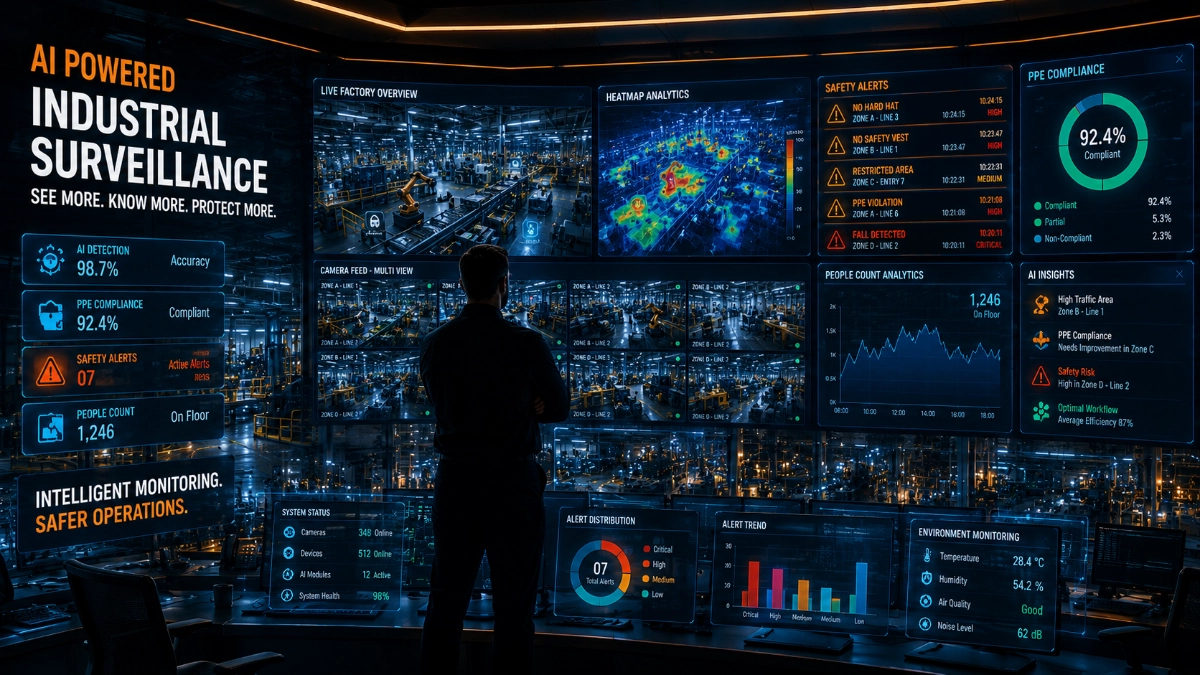
AI Surveillance → Operational Intelligence
Across manufacturing plants, oil and gas facilities, warehouses, power generation sites, pharmaceutical campuses, and logistics hubs, a fundamental transformation is underway. Industrial surveillance systems are evolving from passive video recorders into active, AI-powered operational intelligence platforms. They are no longer just watching operations; they are analysing, measuring, alerting, predicting, and informing decisions in real time.
The modern surveillance system does not merely capture an image of a worker entering a restricted zone. It identifies whether that worker is wearing the correct PPE, flags a compliance violation, triggers an automated alert, logs the event to a safety dashboard, and simultaneously escalates the incident to a site supervisor all within seconds.
This is not a future concept. It is happening right now at industrial sites around the world. And for organisations that have not yet made this transition, the operational and safety gap between where they are and where they need to be is widening every day.
This article explains exactly why industrial surveillance is becoming an operational intelligence layer, what that means technically, how it is deployed practically, and why the facilities that embrace this shift are gaining a significant competitive and safety advantage over those that do not.
What Is Operational Intelligence in Industrial Surveillance?
Operational intelligence refers to the real-time collection, analysis, and application of data to improve decision-making, efficiency, and outcomes in an operational environment. When applied to surveillance, it means transforming video feeds from passive recordings into structured, actionable data streams that drive operational responses.
In an industrial context, operational intelligence surveillance functions as a continuous monitoring layer that simultaneously handles:
- Worker safety and behaviour analysis.
- Equipment and machinery activity tracking.
- Process and workflow monitoring.
- Logistics and material movement visibility.
- Environmental and thermal condition monitoring.
- Compliance verification and audit trail generation.
- Anomaly detection and incident prediction.
- Perimeter and access control intelligence.
Where traditional CCTV answered the question “What happened?”, operational intelligence surveillance answers “What is happening right now and what should we do about it?”
How Traditional Industrial CCTV Systems Operate
To understand how dramatically the landscape has shifted, it helps to understand what conventional industrial surveillance looked like and why it consistently fell short of true operational value.
Traditional CCTV systems in industrial environments were designed around a straightforward architecture: cameras positioned at fixed points recorded continuous video footage, which was transmitted to a local recording server (DVR or NVR) and stored for review. A security team or control room operator monitored selected feeds, typically in a reactive mode, reviewing footage only when an incident was reported.
The limitations of this model were significant:
- Cameras generated enormous volumes of footage with no automated analysis capability.
- The burden of monitoring fell entirely on human operators, creating fatigue and attention gaps.
- Incidents were typically identified after the fact, not in real time.
- There was no integration with operational systems; production, safety, or maintenance teams had no access to surveillance insights.
- Scaling required linear hardware investment: more cameras, more storage, more operators.
- Analytics were absent; pattern recognition, anomaly detection, and predictive alerts did not exist.
- Value was confined to security incident documentation rather than operational improvement.
In short, traditional CCTV systems were eyes without intelligence, able to see, but unable to understand, interpret, or act.
Why Traditional CCTV Strategies Fail in Modern Industrial Environments
Modern industrial operations are highly complex, fast-moving, and densely interconnected. A petrochemical plant managing hundreds of process variables, a pharmaceutical cleanroom maintaining strict environmental conditions, or a large logistics hub coordinating thousands of vehicle movements per day, none of these environments can be effectively governed by passive surveillance alone.
The Scale Problem
Large industrial facilities can deploy hundreds or thousands of camera points. No team of human operators can meaningfully monitor this volume of feeds in real time. Traditional systems created vast surveillance coverage on paper while delivering minimal actual operational awareness.
The Speed Problem
Industrial incidents, safety violations, equipment failures, and process deviations develop in seconds. A system that relies on post-event review or slow human response cannot prevent incidents; it can only document them.
The Integration Problem
Traditional CCTV systems operated in complete isolation from other plant systems. SCADA systems, building management systems (BMS), production management software, and maintenance platforms had no connection to surveillance data. Operational teams made decisions without the visual context that surveillance could have provided.
The Intelligence Problem
Raw video footage carries an enormous amount of operational information: worker movements, equipment states, traffic patterns, process conditions, but traditional systems had no mechanism to extract, interpret, or act on this information automatically.
The Compliance Problem
Regulatory requirements for safety documentation, incident reporting, and audit trails have grown substantially more demanding. Manual surveillance approaches cannot reliably meet the continuous, consistent documentation standards that modern industrial compliance requires.
How Surveillance Systems Now Support Operational Intelligence Functions
The transformation from traditional CCTV to operational intelligence surveillance is not simply a hardware upgrade. It represents a fundamental rethinking of what surveillance infrastructure is for and what it can deliver. The following are the core operational intelligence functions now embedded in modern industrial surveillance platforms.
1. Process Monitoring and Workflow Visibility
AI-powered cameras positioned along production lines can continuously monitor process status, identify deviations from standard operating procedures, and flag workflow bottlenecks automatically. Plant operators receive real-time visibility into production flow without having to be physically present on the floor.
2. Equipment Activity Tracking
Video analytics can monitor whether machinery is operating, idle, or exhibiting unusual behaviour patterns. By correlating equipment visual states with operational data, facilities can detect early signs of mechanical degradation, unplanned idle time, or unauthorised equipment use.
3. Worker Safety Analytics
Advanced computer vision algorithms analyse worker movements, posture, proximity to hazards, and behaviour patterns. Falls, slips, unauthorised zone entries, ergonomic risks, and fatigue indicators can all be detected and flagged in real time, enabling intervention before an injury occurs.
4. PPE Compliance Monitoring
One of the most widely deployed operational intelligence applications in industrial surveillance is automated PPE detection. AI systems can verify in real time whether workers are wearing required hard hats, safety vests, gloves, eye protection, and steel-toed boots at every entry point and across the operational floor. Violations trigger instant alerts, and compliance data feeds directly into safety dashboards and audit reports.
5. AI-Based Anomaly Detection
Machine learning models trained on normal operational patterns can identify deviations that human operators would miss, such as unusual smoke or vapour accumulation, abnormal equipment vibration signatures visible on camera, unauthorised personnel behaviour, or process states that fall outside acceptable parameters. Anomaly detection functions as an early warning system across the entire facility.
6. Thermal Monitoring
Thermal cameras integrated into the surveillance infrastructure provide continuous monitoring of equipment temperature signatures, electrical panel conditions, and process heat distribution. Thermal anomalies that indicate bearing failures, electrical faults, or process overheating can be detected well before they escalate into costly failures or safety incidents.
7. Logistics and Vehicle Movement Analysis
In warehouses, distribution centres, and industrial campuses, AI surveillance monitors vehicle routes, dwell times, congestion points, loading dock utilisation, and compliance with speed and routing rules. This data directly informs logistics optimisation, reducing throughput delays and improving vehicle safety.
8. Perimeter Intelligence
Intelligent perimeter surveillance goes far beyond detecting unauthorised entry. Modern systems classify threats by type and severity, differentiate between human and non-human intrusions, track movement trajectories, integrate with access control systems, and initiate graduated response protocols automatically.
9. Incident Prediction and Prevention
By analysing behavioural patterns, environmental conditions, and historical incident data, AI surveillance platforms can identify pre-incident indicators, the combination of conditions that historically precede accidents, equipment failures, or security breaches. This predictive capability moves industrial safety from reactive to proactive.
10. Production Bottleneck Analysis
Surveillance data combined with operational analytics identifies where workflow slowdowns occur, how frequently they happen, and what conditions trigger them. Operations managers gain granular visibility into production inefficiencies that would otherwise require extensive manual observation to detect.
11. Occupancy Analytics and Space Utilisation
Industrial facilities benefit from knowing how different zones are occupied and utilised throughout the operational cycle. Occupancy analytics inform staffing decisions, emergency evacuation planning, facility layout optimisation, and energy management by tracking actual usage patterns rather than relying on scheduled assumptions.
12. Operational Heat Mapping
Aggregate movement and activity data from surveillance systems generate operational heat maps, visual representations of where activity is concentrated, where it is absent, and how patterns shift over time. Heat maps are powerful tools for facility layout planning, maintenance scheduling, and safety risk assessment.
13. Integrated Command Centre Workflows
Modern operational intelligence surveillance feeds directly into integrated command centres where security, safety, operations, and maintenance functions converge. Operators see unified situational awareness dashboards combining video feeds, analytics outputs, alert streams, and operational data, enabling coordinated, rapid response to any event.
14. Real-Time Alert Orchestration
Intelligent alert systems prioritise, route, and escalate notifications based on predefined rules and AI-assessed risk levels. A PPE violation in a low-risk zone triggers a different workflow than a thermal anomaly near a critical process component. Alert orchestration ensures the right information reaches the right people in the right timeframe.
How Operational Intelligence Changes Industrial Surveillance Design
When surveillance is designed as an operational intelligence layer rather than a security afterthought, the design principles change significantly.
Camera Positioning Driven by Operational Value
Camera placement decisions are no longer solely determined by security perimeter requirements. Operational intelligence design positions cameras to maximise visibility into process-critical areas, high-risk safety zones, logistics bottlenecks, and equipment condition monitoring points.
Edge AI Processing Architecture
Processing video analytics at the edge directly on or near the camera dramatically reduces bandwidth requirements, eliminates cloud-dependency latency, and enables real-time response even in facilities with limited connectivity. Edge AI cameras process intelligence locally and transmit only actionable data and structured alerts to central systems.
Layered Integration Architecture
Operational intelligence surveillance is designed from the outset to integrate with existing plant systems: SCADA, DCS, BMS, ERP, CMMS, and industrial IoT platforms. Data flows bidirectionally: surveillance feeds operational context into plant systems, and operational parameters inform surveillance alert thresholds.
Scalable, Modular Infrastructure
Intelligent surveillance systems are designed for scalability. Organisations can begin with high-priority operational zones and expand coverage incrementally, adding AI analytics capabilities as operational needs evolve without requiring wholesale infrastructure replacement.
Cybersecurity by Design
Industrial surveillance systems that connect to OT networks introduce cybersecurity considerations that passive CCTV systems never faced. Operational intelligence surveillance platforms must be designed with network segmentation, encrypted data transmission, role-based access controls, and regular security audit capabilities built into the architecture from the start.
Traditional Industrial CCTV vs. AI-Driven Operational Intelligence Surveillance
The following comparison illustrates the fundamental differences between conventional CCTV approaches and modern operational intelligence surveillance systems:
| Feature / Capability | Traditional Industrial CCTV | AI-Driven Operational Intelligence Surveillance |
| Primary Purpose | Passive security monitoring and incident recording | Real-time operational intelligence, safety, and process optimisation |
| Camera Intelligence | Fixed-view, dumb sensors with manual review | AI-enabled smart sensors with automated event detection and analytics |
| Data Utilization | Footage stored; reviewed only after incidents | Continuous analysis; insights fed into operations systems in real time |
| Alert Mechanism | Manual observation; no automated alerts | Automated, rule-based, and AI-driven alerts with escalation workflows |
| Integration Level | Standalone system with no OT/IT integration | Fully integrated with SCADA, BMS, ERP, and industrial IoT platforms |
| Analytics Capability | None or very basic motion detection | Advanced: PPE detection, crowd analytics, thermal, anomaly detection |
| Response Time | Delayed; depends on human review | Millisecond-level detection with instant alert dispatch |
| Operational Value | Security only | Security + safety + efficiency + compliance + maintenance + logistics |
| Scalability | Hardware-intensive, difficult to scale | Edge AI + cloud hybrid; scalable across multiple sites |
| Business Intelligence | Not applicable | Feeds operational dashboards, KPIs, and executive reporting |
| Maintenance Role | None | Predictive maintenance through equipment and activity monitoring |
| Cost Over Time | High reactive cost from incidents and downtime | Lower lifecycle cost through prevention and operational optimisation |
How AI Video Analytics Improve Industrial Operations
Operational Efficiency
AI surveillance identifies inefficiencies that would otherwise require dedicated time-and-motion studies to uncover. Bottlenecks, idle time, suboptimal workflows, and underutilised resources all become visible through continuous video analytics, enabling operations managers to make data-driven improvements rather than relying on anecdotal observations.
Safety Compliance
Automated, always-on compliance monitoring eliminates the gaps inherent in periodic manual inspections. PPE compliance rates, zone access adherence, safety protocol compliance, and emergency procedure execution are all measurable, trackable, and reportable with AI surveillance, creating a defensible compliance record for regulatory purposes.
Downtime Reduction
By enabling predictive maintenance through equipment condition monitoring and thermal analysis, AI surveillance helps facilities move from reactive repair cycles to condition-based maintenance programs. Catching developing equipment issues visually before they escalate into failures reduces unplanned downtime significantly.
Resource Allocation
Occupancy analytics, workflow data, and activity pattern analysis from surveillance systems provide operations and HR teams with objective data to inform staffing levels, shift planning, and resource deployment decisions, replacing assumption-based scheduling with evidence-based planning.
Emergency Response Coordination
In emergency scenarios, integrated command centres with live operational surveillance dramatically accelerate response coordination. Emergency teams gain instant situational awareness, knowing exactly where personnel are, what conditions exist in each facility zone, and how the situation is evolving, enabling faster, more effective response and evacuation management.
Maintenance Planning
Surveillance systems monitoring equipment visual states, thermal signatures, and activity cycles generate a continuous dataset that maintenance planning teams can use to schedule interventions at optimal times, balancing maintenance cost against operational impact.
Situational Awareness
Operational intelligence surveillance gives plant managers, safety officers, and executive leadership a level of real-time operational awareness that was previously impossible without physically walking the floor. Live dashboards combining video, analytics, and operational data create a comprehensive, accessible picture of facility status at all times.
Practical Deployment Examples Across Industrial Sectors
Manufacturing Facilities
In automotive and heavy manufacturing plants, AI surveillance monitors assembly line throughput, worker ergonomics, machine activity cycles, and safety zone compliance simultaneously. Production managers receive real-time alerts on bottlenecks, and safety teams track PPE compliance across hundreds of workers without manual auditing.
Oil and Gas Plants
Upstream and downstream oil and gas facilities deploy thermal and visual AI surveillance for early leak detection, hot-work permit area monitoring, confined space entry compliance, vehicle access control, and perimeter security. The combination of thermal imaging and AI analytics provides continuous process safety monitoring in environments where human inspection frequency is necessarily limited.
Warehouses and Distribution Centres
Logistics-intensive facilities use AI surveillance to optimise vehicle routing, monitor dock activity, track inventory movement, verify loading accuracy, and enforce pedestrian safety zones. Real-time logistics analytics from surveillance data directly reduce throughput times and vehicle incident rates.
Smart Industrial Campuses
Large multi-building industrial campuses benefit from unified surveillance intelligence that spans buildings, outdoor areas, and infrastructure, creating a single operational picture across a complex facility environment. Integrated access control, visitor management, and operational monitoring support both security and efficiency objectives.
Power Plants
Power generation facilities use thermal surveillance for transformer and switchgear condition monitoring, turbine hall activity oversight, and control room security. AI analytics support both safety compliance and asset protection in environments where equipment failures carry catastrophic consequences.
Pharmaceutical Facilities
In pharmaceutical manufacturing and research environments, surveillance intelligence monitors cleanroom access compliance, personnel behaviour in sterile zones, environmental condition anomalies, and batch process integrity. The documentation capability of AI surveillance also supports GMP compliance and regulatory audit requirements.
Airports and Critical Infrastructure
Airports deploy perimeter intelligence, crowd analytics, baggage handling monitoring, and access control surveillance across complex multi-zone environments. AI surveillance enables security teams to manage vast spatial coverage with automated anomaly detection and coordinated response workflows.
Data Centers
Data centre operators use AI surveillance for physical access control, equipment room environmental monitoring, personnel behaviour analytics, and perimeter security. Thermal cameras monitor server room conditions and provide early warning of cooling system anomalies that could threaten equipment integrity.
Integration with Industrial Automation and Control Systems
The operational intelligence value of surveillance multiplies substantially when surveillance data is integrated with other plant systems. Modern platforms are designed for deep integration across the industrial technology stack:
SCADA Integration: Surveillance analytics provide visual context for process data. A SCADA alarm for an abnormal pressure reading can be instantly correlated with camera feeds of the relevant equipment area, giving operators visual confirmation of the process state alongside the sensor data.
BMS Integration: Building management systems coordinating HVAC, lighting, access, and fire systems gain an additional data layer when integrated with surveillance analytics. Occupancy data from surveillance improves HVAC efficiency; access event correlation improves security response.
CMMS Integration: Maintenance management systems benefit from surveillance-generated equipment condition data. Visual anomalies, thermal alerts, and equipment activity patterns feed directly into maintenance work order generation and scheduling systems.
ERP Integration: Production tracking and resource planning systems gain real-time production floor visibility data from surveillance analytics, improving the accuracy of production reporting and supply chain coordination.
Emergency Response Systems: Integration with emergency response platforms ensures that surveillance data informs evacuation coordination, emergency services communication, and incident management from the moment an event is detected.
Enterprise-Grade Operational Intelligence: The Role of Advanced Surveillance Platforms
The transition from traditional CCTV to operational intelligence surveillance requires a platform engineered specifically for the demands of industrial environments, not a consumer-grade security system repurposed for industrial use.
Enterprise platforms such as Impact by Honeywell represent the kind of purpose-built, AI-enabled surveillance infrastructure that modern industrial environments require. Designed for scalability, deep integration, and operational intelligence delivery, enterprise surveillance ecosystems like these provide the robust, secure, and analytics-rich foundation that manufacturing, energy, logistics, and critical infrastructure operators need.
For organisations in India and across South Asia evaluating enterprise surveillance infrastructure, Impact by Honeywell distributors in India provides access to globally proven operational intelligence surveillance solutions with local deployment expertise, support infrastructure, and integration capability, enabling facilities to transition from passive monitoring to active operational intelligence without the complexity of navigating unfamiliar global supply chains.
The selection of an enterprise surveillance platform should prioritise: AI analytics capability, integration openness with existing OT and IT systems, edge processing architecture, cybersecurity design, scalability roadmap, and the vendor’s demonstrated understanding of industrial operational environments.
The Future of Industrial Surveillance: Predictive, Autonomous, and Integrated
Predictive Industrial Analytics
The next evolution of operational intelligence surveillance moves beyond real-time detection toward predictive analytics using historical surveillance data combined with machine learning to forecast where incidents, failures, or compliance gaps are most likely to occur. Facilities will move from monitoring current conditions to anticipating future states.
Autonomous Industrial Monitoring
As AI capabilities advance, surveillance systems will increasingly operate with greater autonomy, automatically adjusting camera positions, modifying alert thresholds based on operational context, coordinating with other automated systems, and executing pre-authorised response actions without human intervention for defined event types.
Digital Twins Integration
Surveillance data will feed directly into digital twin models, real-time virtual representations of physical facility states. AI surveillance becomes the sensory layer of the digital twin, continuously updating the virtual model with visual operational data that enhances simulation accuracy and operational decision support.
Edge AI Surveillance
Edge AI processing will continue to advance, enabling cameras to perform increasingly sophisticated analytics locally, reducing bandwidth requirements, improving response latency, and enabling intelligent surveillance in remote or bandwidth-constrained industrial locations such as offshore platforms, pipeline monitoring stations, and rural infrastructure sites.
Industrial IoT Integration
Surveillance intelligence will merge more deeply with Industrial IoT sensor networks. Camera-based observations will be automatically correlated with environmental sensors, vibration monitors, flow meters, and process instrumentation, creating a multi-dimensional operational awareness layer that is more powerful than any individual data source alone.
Unified OT and Security Intelligence Ecosystems
The traditional boundary between operational technology (OT) and physical security technology will continue to dissolve. Future industrial intelligence platforms will present a unified OT + security data layer where process data, safety analytics, security intelligence, and maintenance insights are all accessible through a single, integrated operational visibility platform.
Cybersecurity in the Intelligent Surveillance Era
As surveillance systems become more deeply connected to OT and IT networks, cybersecurity considerations grow proportionally more critical. Industrial surveillance platforms of the future will incorporate zero-trust network architectures, AI-powered intrusion detection, encrypted data transmission throughout the system, and continuous security posture monitoring, protecting the operational intelligence layer itself from becoming a vulnerability in the industrial network.
Practical Deployment and Optimisation Recommendations
For organisations planning to transition to operational intelligence surveillance, the following deployment principles maximise the probability of a successful outcome:
- Begin with a comprehensive operational audit. Identify the highest-priority operational visibility gaps where the lack of real-time data is costing the most in safety incidents, inefficiency, or compliance risk. Design the initial deployment to address these gaps first.
- Design for integration from day one. Select surveillance platforms with open APIs and demonstrated integration capability with your existing SCADA, BMS, and ERP systems. Integration added as an afterthought is far more costly and less effective than integration designed in from the start.
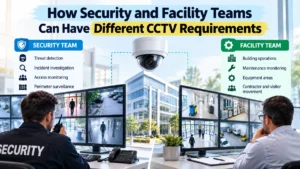
- Involve operations teams in surveillance design. Surveillance systems designed purely by security teams frequently miss the operational intelligence opportunities most valuable to plant managers and operations leads. Cross-functional design ensures the system delivers maximum value.
- Plan for scalability. Deploy a platform architecture capable of expanding coverage and analytics capability without requiring infrastructure replacement. Modular edge AI platforms are generally more scalable than centralised analytics architectures.
- Address cybersecurity in the design phase. Work with your OT security team to ensure surveillance network segmentation, encrypted communications, and role-based access controls are built into the architecture. Treat surveillance infrastructure as part of the OT attack surface.
- Measure operational outcomes, not just security metrics. Track KPIs such as PPE compliance rates, incident response times, equipment downtime, throughput efficiency, and safety audit scores, not just camera uptime and alert volume. Operational outcomes justify and guide investment.
Read Also: Surveillance Design for Multi-Tenant Commercial Facilities
Read Also: CCTV Workflow Engineering for Emergency Operations Teams