Every year, thousands of buildings across the globe get equipped with fire alarm systems chosen primarily because they were the most affordable option in the budget. On paper, this seems like sensible financial management. The system meets the minimum code requirements, gets installed, passes inspection, and the project moves on.
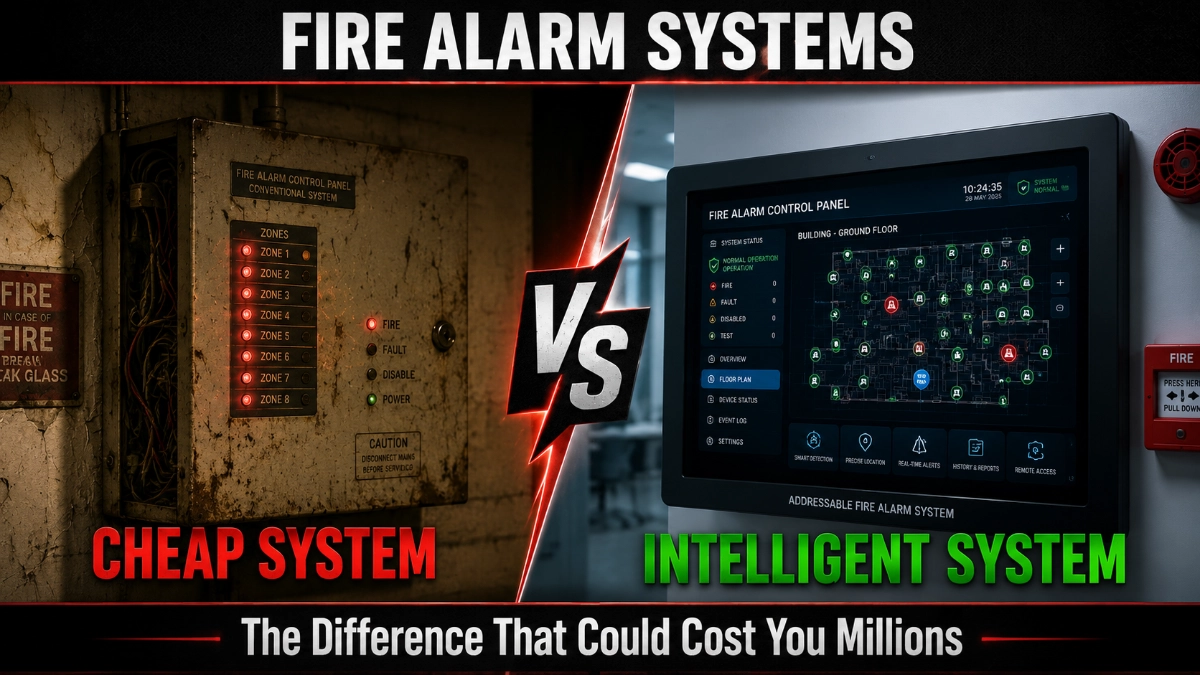
But fire alarm infrastructure is not like buying office furniture. A cheap desk stays cheap. A cheap fire alarm system can quietly become one of the most expensive decisions a facility makes in fines, downtime, regulatory non-compliance, reactive maintenance calls, false alarms that disrupt operations, and, in the worst cases, inadequate emergency response when it matters most.
This article explains exactly what separates cheap, basic fire alarm systems from intelligent, addressable fire alarm infrastructure. It explores why the gap matters more than ever as buildings become smarter, more complex, and more integrated and why professionals responsible for fire safety infrastructure need to rethink what “good enough” actually means.
What Defines a Cheap or Basic Fire Alarm System?
A basic or low-cost fire alarm system, often referred to as a conventional fire alarm system, operates on a zone-based detection method. In this architecture, multiple detectors are wired together on a single circuit, and the conventional fire alarm panel only knows that something triggered somewhere within that zone. It cannot tell you which device was activated.
These systems have been used reliably in simpler buildings for decades. For a small single-zone retail shop or a modest warehouse with one occupancy type, a conventional fire alarm panel may be entirely appropriate. The challenge arises when organisations deploy these systems in buildings they were never designed for.
Characteristics of conventional or basic fire alarm systems:
- Zone-only detection, no device-level identification.
- Limited or no integration capability with BMS or security systems.
- Fixed zone capacity is difficult to expand without major rewiring.
- No real-time diagnostics or automated health monitoring.
- Manual maintenance and fault isolation are required.
- Limited cause-and-effect programming capability.
- Higher susceptibility to false alarms from environmental factors.
- No remote monitoring or cloud connectivity.
In short, a conventional fire alarm panel gives you a signal. An intelligent system gives you a complete, actionable picture of what is happening, where, and why.
What Defines an Intelligent Fire Alarm System?
An intelligent fire alarm system built around an addressable fire alarm panel communicates individually with every detector, call point, sounder, and module on its network. Each device has a unique digital address. The panel continuously polls every device, monitors its health, tracks its sensitivity drift, and logs all events with timestamps.
The GST fire alarm system range, for example, represents the category of modern intelligent addressable platforms designed for complex commercial, industrial, and infrastructure environments. These systems are engineered not just to detect fire, but to manage fire safety as an ongoing operational discipline.
Characteristics of intelligent addressable fire alarm systems:
- Device-level identification of the precise location of every alarm or fault.
- Continuous automated diagnostics and detector health monitoring.
- Full cause-and-effect programming for scenario-based response.
- Deep integration with BMS, access control, elevators, and HVAC.
- Scalable loop architecture expands without full rewiring.
- Multi-site network management from a single interface.
- Predictive maintenance through drift and sensitivity monitoring.
- Cloud connectivity and remote monitoring capability.
- Encrypted communications and cybersecurity-ready design.
- Automated compliance reporting and event audit trails.
Why Modern Facilities Have More Complex Fire Safety Requirements
Buildings today are fundamentally different from the buildings that conventional fire alarm systems were designed to protect. A modern commercial tower integrates HVAC, access control, elevators, energy management, security cameras, occupancy sensors, and public address systems, often all talking to a central building management system (BMS).
Industrial campuses span multiple structures across large areas. Data centres run 24/7 with zero tolerance for unnecessary evacuation or water-based suppression activation. Hospitals must manage fire events without causing patient harm or operational shutdown. Airports cannot afford evacuation false alarms that disrupt hundreds of thousands of travellers.
In these environments, a fire alarm system is not just a detection device. It is a critical node in the building’s operational intelligence network. It must communicate, coordinate, and respond with precision, and a cheap, zone-based system simply cannot do this.
The Major Differences: Intelligent vs Basic Fire Alarm Systems
1. Detection Accuracy
Addressable detectors use multi-criteria detection algorithms analysing smoke particle size, heat rise rate, and carbon monoxide levels simultaneously. This allows the system to distinguish a genuine fire signature from steam, dust, or cooking fumes. Cheap systems rely on single-threshold sensors that trigger on any particle above a set level, regardless of whether it is smoke or condensation from a cold store.
2. Addressable vs Non-Addressable Architecture
The fundamental architectural difference defines everything else. In a conventional fire alarm panel setup, a triggered zone only tells you which corridor or floor is affected, not which of the 20 detectors in that zone has activated. Engineers must walk the zone, check each device, and manually isolate the cause. In an addressable system, the panel screen immediately identifies the specific device: Detector 47, Dispatch Warehouse, Bay 3, Row 7.
3. False Alarm Reduction
False alarms are not a minor inconvenience. In industrial and commercial settings, every false alarm costs money in production halts, emergency service responses, evacuation downtime, and regulatory scrutiny. Intelligent fire alarm systems dramatically reduce false alarm rates through multi-criteria detection, alarm verification sequences, cross-zoning logic, and cause-and-effect programming that requires confirmation before activating full evacuation protocols.
4. Real-Time Diagnostics and Detector Health Monitoring
Every addressable detector continuously reports its sensitivity status to the panel. If a detector’s sensitivity begins to drift from dust accumulation, environmental degradation, or component ageing, the system flags it for attention before it either fails to detect or generates false alarms. This is a capability that conventional detectors fundamentally cannot replicate.
5. Cause-and-Effect Programming
Modern fire safety management requires more than “detect and alarm.” It requires orchestrated, scenario-specific responses. A GST fire alarm system or similar intelligent platform allows engineers to program: if Detector Group A activates in Zone 3, then release magnetic door holders on Floor 4, shut down HVAC on that floor, activate stairwell pressurisation, trigger the PA system with a floor-specific voice message, and notify the BMS all automatically, within milliseconds. A basic system sends a relay signal and rings a bell.
6. Scalability
Conventional fire alarm systems are difficult and expensive to expand. Adding more zones often means new cables, new panels, and significant rewiring. Addressable systems use loop architecture; a single cable loop can carry hundreds of addressable devices. Expanding the system means adding devices to the loop, not rewiring the building. For facilities planning phased growth or campus expansion, this flexibility is operationally critical.
7. Multi-Building and Multi-Site Coordination
Large infrastructure operators’ industrial campuses, university estates, airport terminals, and retail complexes need a single operational view across all their buildings. Intelligent fire alarm systems support networked panel configurations, allowing a single monitoring station to view and manage fire events across dozens of buildings simultaneously. Conventional systems are fundamentally isolated by nature.
8. BMS and Security System Integration
Building management systems today control energy, HVAC, access, lighting, elevators, and fire safety as an integrated platform. Intelligent fire alarm systems integrate via open protocols BACnet, Modbus, and OPC-UA — enabling the BMS to respond to fire events automatically: locking certain access points, recalling elevators, switching to emergency lighting, and modifying HVAC pressurisation. This coordination is impossible with a conventional fire alarm panel that outputs a simple dry-contact relay.
9. Predictive Maintenance
Conventional systems are maintained reactively; a failure is discovered during a test or, worse, during an actual event. Intelligent systems monitor every device continuously and flag drift, degradation, or communication faults proactively. Maintenance teams receive alerts before devices fail. This predictive approach reduces emergency call-outs, extends equipment lifespan, and ensures the system is always inspection-ready.
10. Cybersecurity Readiness
As fire alarm systems gain network connectivity for remote monitoring, cloud integration, and BMS communication, cybersecurity becomes a legitimate concern. Intelligent fire alarm platforms designed for modern deployment include encrypted communications, role-based access controls, secure firmware update mechanisms, and audit logging. Cheap systems with bolted-on connectivity often have none of these protections.
11. Cloud and Remote Monitoring Capabilities
Modern intelligent fire alarm infrastructure supports cloud-native monitoring dashboards. Facility managers and fire safety consultants can view system status, device health, recent events, and test compliance from any location. For multi-site operators, this remote visibility eliminates the need for on-site checks for routine monitoring a significant operational efficiency.
The Hidden Costs of Cheap Fire Alarm Systems
The upfront savings of a basic fire alarm system often disappear rapidly once facilities begin operating at scale. Consider the following lifecycle cost factors that rarely appear in initial procurement budgets:
- False alarm response costs: Emergency service callouts, production halts, evacuation management, and staff time. In many jurisdictions, repeated false alarms attract regulatory fines.
- Manual fault isolation: Engineering teams spend hours walking zones looking for a fault that an addressable system would pinpoint in seconds.
- Reactive maintenance premiums: Emergency maintenance callouts cost significantly more than planned, predictive maintenance visits.
- Compliance remediation: As regulations evolve and audits identify gaps, conventional systems often require expensive retrofits or partial replacements.
- Integration failures: When buildings upgrade their BMS or security platforms, a conventional fire alarm panel cannot integrate. The system must be replaced entirely.
- Downtime costs: Unplanned shutdowns triggered by false alarms in a manufacturing plant or data centre can exceed the cost of an intelligent fire alarm system within a single incident.
- Insurance premiums: Insurers increasingly consider fire detection quality when setting premiums for commercial and industrial properties.
- Reputational risk: For hospitals, airports, and public buildings, fire alarm false alarms or response failures carry significant reputational consequences.
Why Intelligent Fire Infrastructure Is Becoming the Industry Standard
The shift from conventional to intelligent addressable fire alarm systems is not driven by technology enthusiasm; it is driven by operational reality. Facilities have become too complex, too integrated, and too high-stakes for zone-only detection.
Regulatory frameworks across major markets are progressively incorporating requirements for addressable systems in buildings above certain size, occupancy, or risk thresholds. Insurance underwriters are increasing scrutiny on fire detection quality. Building certifications LEED, BREEAM, WELL increasingly consider fire safety intelligence as part of their assessment criteria.
Beyond compliance, the business case is straightforward. Intelligent fire alarm systems cost more upfront. Over a 15–20 year lifecycle, they consistently deliver lower total cost of ownership through predictive maintenance, fewer false alarms, easier expansion, and deeper integration with building operations.
Comparison Table: Basic vs Intelligent Fire Alarm Systems
| Feature / Capability | Cheap / Basic System | Intelligent Addressable System |
| Detection Architecture | Zone-based, non-addressable | Fully addressable, device-level precision |
| False Alarm Rate | Higher — limited discrimination | Significantly lower — multi-criteria analysis |
| Event Visibility | Zone only — no device ID | Exact device location, real-time data |
| Cause-and-Effect Logic | Basic or absent | Fully programmable, scenario-based |
| System Diagnostics | Manual inspection required | Continuous automated health monitoring |
| Scalability | Limited — fixed zone capacity | Highly scalable — loop expansion ready |
| BMS Integration | Minimal or none | Deep integration via open protocols |
| Multi-Site Management | Not supported | Centralized remote network management |
| Predictive Maintenance | Reactive only | Drift monitoring, proactive alerts |
| Cybersecurity | Minimal | Encrypted comms, secure access control |
| Cloud Monitoring | Not available | Full cloud-native remote visibility |
| Compliance Reporting | Manual documentation | Automated audit trails, event logs |
| Emergency Coordination | Single building, basic relay | Multi-system, BMS and PA integrated |
| Upfront Cost | Lower | Higher initial investment |
| Long-Term TCO | Higher (reactive maintenance) | Lower (predictive, efficient lifecycle) |
Practical Deployment Examples Across Industry Sectors
Manufacturing Plants
A large automotive parts manufacturing plant with multiple production zones, paint booths, chemical storage, and logistics areas requires a fire detection system that can differentiate between welding fume, a constant operational presence, and an actual fire event. Intelligent addressable systems with multi-criteria detectors handle this discrimination reliably. Cause-and-effect programming can shut down specific ventilation zones, activate local suppression, and alert safety teams without halting the entire production line.
Hospitals and Healthcare Facilities
Hospital fire safety management is uniquely challenging. Full evacuation is rarely the correct response; patients on life support cannot be moved without risk. Intelligent fire alarm systems support progressive horizontal evacuation protocols, where only the affected zone is evacuated while adjacent areas are alerted and prepared. This requires device-level precision, cause-and-effect programming, and BMS integration that conventional systems cannot provide.
Data Centres
Data centres have zero tolerance for unnecessary suppression system activation. A false alarm triggering a gas suppression system can destroy millions of dollars of equipment and cause days of downtime. Intelligent fire alarm systems with cross-zoning logic, alarm verification sequences, and multi-criteria detection dramatically reduce the risk of false suppression activation while ensuring genuine events are detected faster and with greater accuracy.
Airports and Transportation Hubs
Airports span enormous areas across multiple terminals, concourses, and support buildings. Intelligent networked fire alarm systems allow a central operations team to monitor all areas simultaneously, respond precisely to any event, and coordinate with gate management, PA systems, and emergency services without triggering unnecessary terminal-wide evacuations.
Commercial Towers
High-rise commercial towers present vertical evacuation challenges that require intelligent, floor-specific response coordination. Modern intelligent fire alarm platforms manage phased evacuation, stairwell pressurisation, elevator recall, and floor-specific PA announcements, all integrated with the building’s BMS and security systems.
Smart Buildings and Industrial Campuses
Smart buildings integrate fire safety with energy management, occupancy analytics, and predictive maintenance platforms. Intelligent fire alarm systems communicate with these platforms via open protocols, enabling truly unified building intelligence. On industrial campuses spanning multiple structures, networked addressable panels provide a single operational view across the entire estate.
How Intelligent Fire Alarm Systems Improve Operational Outcomes
Compliance Readiness
Intelligent systems generate automated event logs, inspection records, and device health reports. When regulatory audits occur, compliance documentation is already organised and accessible. For conventional systems, compliance evidence is assembled through a time-consuming, error-prone process.
Infrastructure Resilience
Redundant loop architecture, fail-safe communication paths, and supervised wiring ensure that intelligent fire alarm systems maintain operational integrity even when individual cables or devices fail. Conventional systems can go entirely dark if a single zone cable is compromised.
Maintenance Efficiency
Predictive maintenance alerts allow facilities teams to schedule device replacements during planned downtime windows rather than emergency callouts. Over a typical 15-year system lifecycle, this approach delivers measurable savings in maintenance costs and engineering labour.
Emergency Management Coordination
When a genuine fire event occurs, intelligent systems dramatically accelerate response effectiveness. Emergency services receive precise location data, building layout information, and system status reports. Cause-and-effect sequences have already initiated appropriate building responses before any human action is required.
Long-Term Return on Investment
The ROI calculation for intelligent fire alarm systems must account for: reduced false alarm incidents, lower maintenance costs over the lifecycle, avoided regulatory fines, integration savings from BMS compatibility, insurance premium considerations, and the operational continuity value of preventing unnecessary downtime. Across these dimensions, intelligent systems consistently outperform their cheaper counterparts over any realistic planning horizon.
The Future of Fire Safety: Intelligence, Analytics, and Autonomy
AI-Assisted Fire Detection
Next-generation intelligent fire alarm systems are beginning to incorporate machine learning models trained on large environmental datasets. These models can identify fire signatures with even greater discrimination than current multi-criteria algorithms, adapting to the specific environmental profile of each facility over time. The result is a further reduction in false alarms and earlier detection of genuine events.
Predictive Fire Analytics
Beyond predictive maintenance of devices, AI-powered analytics platforms are beginning to model fire risk probability based on environmental conditions, equipment operating states, maintenance history, and seasonal factors. Facilities can receive risk alerts before any detector triggers, enabling proactive management of fire hazard conditions.
Cloud-Native Fire Monitoring
Cloud platforms are transforming fire alarm monitoring from a local panel display into a real-time, globally accessible operational dashboard. Multi-site operators can monitor hundreds of buildings from a unified interface, with intelligent alerting, automated reporting, and integration with their broader facilities management platforms.
Smart Evacuation Systems
Intelligent fire alarm systems are increasingly integrating with dynamic wayfinding platforms, digital signage, smart lighting paths, mobile evacuation guidance, and PA systems to guide occupants to the safest available exit routes based on real-time fire event location data. This is particularly valuable in complex facilities like hospitals, airports, and high-rise towers.
Digital Twins for Fire Safety
Building digital twin platforms which create virtual models of physical buildings for simulation and analysis are beginning to incorporate fire safety as a core data stream. Intelligent fire alarm systems feed real-time data into these models, enabling scenario planning, evacuation simulation, and infrastructure resilience analysis without physical testing.
Autonomous Diagnostics and Maintenance
The next evolution of predictive maintenance is autonomous diagnosis systems that not only flag device degradation but also initiate maintenance workflows, order replacement parts, and schedule engineer visits without human intervention. Early implementations of this capability are already appearing in the most advanced fire safety management platforms.
Practical Buying and Deployment Recommendations
For facility managers, fire safety consultants, and infrastructure planners evaluating fire alarm systems, the following framework provides a practical starting point:
- Assess facility complexity first: Single-zone simple buildings may suit conventional systems; anything multi-zone, multi-story, or multi-building warrants a serious evaluation of addressable architecture.
- Evaluate integration requirements: If your facility has a BMS, access control, or HVAC automation, confirm that your fire alarm platform supports open protocol integration before procurement.
- Calculate lifecycle cost, not purchase cost: Request 15-year total cost of ownership projections that include maintenance, expansion, compliance, and integration costs.
- Demand scalability documentation: Ensure the system supports loop expansion without full replacement as your facility grows or changes.
- Require cybersecurity specifications: For any networked fire alarm system, request encryption standards, access control mechanisms, and firmware security documentation.
- Verify cause-and-effect capability: For mission-critical facilities, confirm that the system supports full custom cause-and-effect programming for scenario-based response.
- Check remote monitoring options: Cloud monitoring capability is increasingly standard in quality intelligent platforms; it reduces on-site monitoring requirements and improves response times.
Conclusion: Fire Safety Is Infrastructure, Not a Checkbox
The difference between cheap and intelligent fire alarm systems is not simply a matter of features. It is a difference in operational philosophy. A cheap system treats fire detection as a compliance checkbox: install it, pass inspection, move on. An intelligent system treats fire safety as a continuous operational discipline, monitoring, integrating, adapting, and improving.
Modern facilities, such as smart buildings, data centres, hospitals, industrial campuses, airports, and commercial towers, are too complex and too high-stakes for checkbox thinking. The organisations that get this right are those that evaluate fire alarm infrastructure the same way they evaluate any other mission-critical system: by asking not what it costs today, but what it will cost over its lifetime, and what it will protect.
Intelligent addressable fire alarm systems are not a luxury. For any facility where people, data, or operations matter, they are the engineering standard that the environment demands.
Read Also: Remote Diagnostics for PAN India Fire Alarm Infrastructure
Read Also: Why Industrial Fire Detection Is Shifting Toward Intelligent Infrastructure