Managing a surveillance operation across a single facility is already demanding. Now imagine coordinating real-time video streams, AI-driven alerts, access control events, and emergency response workflows across dozens of cities simultaneously, with each site running on different hardware, networks, and time zones.
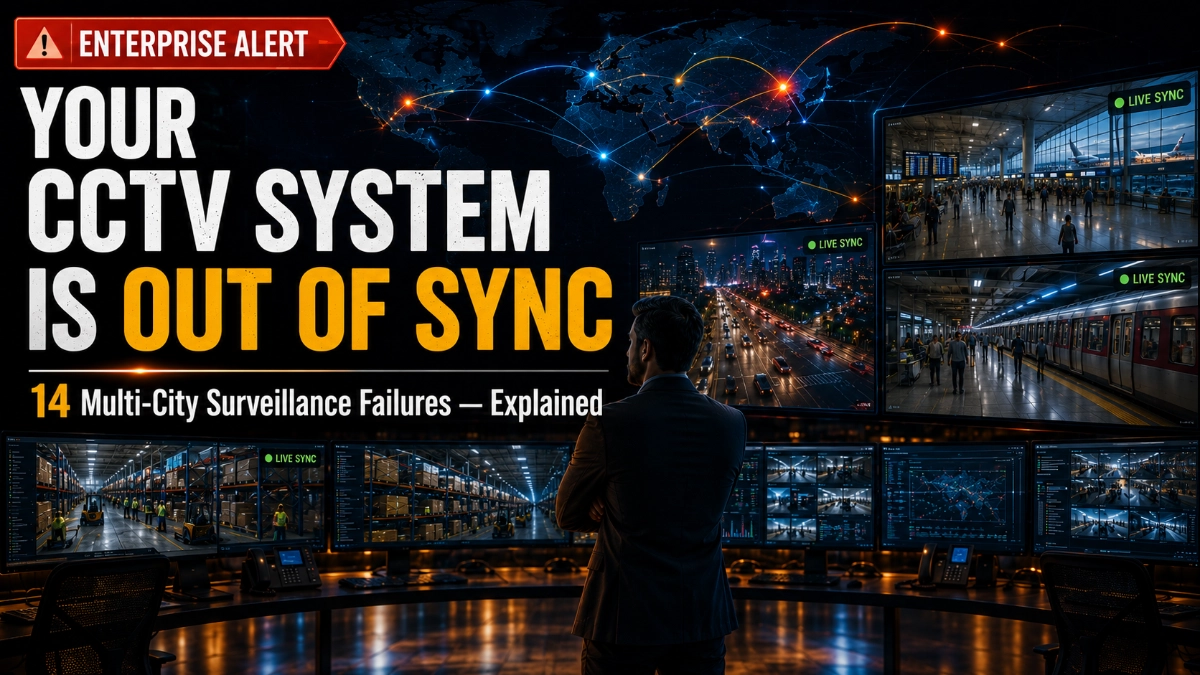
This is the daily operational reality for enterprise security teams, smart city administrators, airport authorities, logistics network operators, and commercial infrastructure managers. The complexity is not just technical. It is organisational, operational, and strategic.
Yet most multi-city surveillance deployments were never designed with synchronisation as a core requirement. They evolved from standalone CCTV installations that were later connected, often loosely and inadequately, into something resembling a unified system.
The result is predictable: fragmented situational awareness, delayed emergency escalation, inconsistent AI analytics, and command centres that struggle to maintain a coherent operational picture across distributed locations.
This article examines why synchronisation has become the defining challenge in large-scale surveillance operations, what specific technical and operational failures arise when it is absent, and how modern intelligent surveillance ecosystems are solving these problems at enterprise scale.
What Does Surveillance Synchronisation Actually Mean?
Surveillance synchronisation refers to the ability of distributed security systems, cameras, sensors, access control panels, AI analytics engines, storage systems, and command interfaces to operate in coordinated, real-time alignment across geographically separated locations.
In practical terms, synchronisation means:
- Video feeds from all sites are timestamped to a unified time reference.
- Alerts generated at one location are immediately visible and actionable at the central command centre.
- AI analytics engines at every site apply consistent detection models and thresholds.
- Incident data, video evidence, and event logs are replicated accurately across cloud and on-premise storage.
- Bandwidth allocation, network routing, and failover paths are managed intelligently to prevent data loss.
- Access control systems, video management platforms, and emergency notification systems communicate seamlessly.
Without synchronisation across all these layers, a multi-city surveillance deployment operates as a collection of isolated systems rather than a unified security infrastructure.
How Traditional Multi-Site Surveillance Operated
In the early phases of enterprise CCTV deployment, security systems were designed site by site. Each location had its own digital video recorder (DVR) or network video recorder (NVR), its own local storage, and its own security team. Communication between sites was minimal, typically limited to phone calls or email when a serious incident required coordination.
As enterprise operations expanded across cities and regions, organisations attempted to connect these isolated systems through VPNs, central VMS servers, and remote viewing software. This worked reasonably well when the number of sites was small and the volume of video data was modest.
However, as camera counts grew into the hundreds or thousands, as AI analytics were layered onto existing infrastructure, and as regulatory requirements demanded longer video retention periods, the limitations of this patchwork approach became impossible to ignore.
14 Major Synchronisation Challenges in Multi-City Surveillance Operations
The following challenges represent the most operationally significant failure points in distributed surveillance environments. Each one degrades the ability of security teams to maintain situational awareness, respond to incidents, and scale operations efficiently.
1. Network Latency Between Cities
Inter-city network latency is one of the most immediate and visible synchronisation problems. Video streams transmitted over long-distance connections experience delays that range from milliseconds to several seconds, depending on network architecture, ISP routing, and geographic distance.
In a live security event, an unauthorised access attempt, a perimeter breach, or a crowd incident, even a two-second delay in video feed delivery to the command centre can compromise the ability to respond in real time. When latency is inconsistent, operators lose confidence in the accuracy of what they are watching.
2. Video Stream Synchronisation Issues
When an incident spans multiple camera angles or multiple locations, investigators and live operators need to view feeds in synchronised playback. Without proper stream synchronisation, footage from two cameras covering the same event may be offset by several seconds, making it extremely difficult to reconstruct an accurate sequence of events.
This becomes critical during post-incident investigations, insurance claims, legal proceedings, and regulatory audits, all of which depend on the integrity of timestamped, synchronised video evidence.
3. Timestamp Inconsistencies
Every camera, server, and sensor in a distributed surveillance system generates timestamps. When those devices are not synchronised to a common time source, typically using Network Time Protocol (NTP) or Precision Time Protocol (PTP), timestamps across the system diverge.
Timestamp drift of even a few seconds creates forensic problems. If Camera A shows an event at 14:32:04 and Camera B shows the same event at 14:32:11, investigators cannot determine which record is accurate. Worse, automated AI systems that correlate events across cameras fail when timestamps are unreliable.
4. Multi-Site Command Coordination Delays
In a multi-city operation, security incidents rarely respect site boundaries. A vehicle theft that begins in a logistics warehouse may involve suspects who were previously flagged at a distribution centre 80 kilometres away. Coordinating an effective response requires instant, reliable communication between security teams at both locations and the central command.
Without a unified command platform, coordination happens through phone calls, radio, and email, all of which introduce delays and create information gaps that directly reduce response effectiveness.
5. Cloud Synchronisation Bottlenecks
As surveillance operations move toward cloud-based video storage and analytics, the volume of data that must be synchronised between edge devices and cloud infrastructure grows exponentially. High-definition video from hundreds of cameras creates terabytes of data per day.
When cloud synchronisation pipelines are not engineered specifically for surveillance workloads, bottlenecks develop. Upload queues grow, real-time accessibility degrades, and the cloud becomes a backup archive rather than an active operational layer.
6. AI Analytics Inconsistency Across Locations
Modern surveillance systems increasingly rely on AI-powered analytics for facial recognition, license plate reading, behavioural detection, crowd density estimation, and perimeter intrusion detection. When these AI models are deployed across multiple sites without centralised model management, significant inconsistencies emerge.
One site may be running an AI model trained on a different dataset. Another may have a model that has not been updated in six months. The result is wildly different detection thresholds, false positive rates, and alert volumes across the same enterprise network, making it impossible to establish reliable, system-wide security benchmarks.
7. Centralised VMS Scaling Problems
Video Management Systems (VMS) are the operational core of any surveillance deployment. In a multi-city environment, a centralised VMS must handle live stream aggregation, event management, analytics integration, and user access management for potentially thousands of cameras across dozens of locations.
Many enterprise VMS platforms were not architected to scale horizontally across geographically distributed environments. As camera counts grow, performance degrades, stream buffering increases, search functions slow down, and system-wide alerts begin to queue rather than trigger in real time.
8. Cross-City Event Escalation Delays
When a security event at one location requires escalation to regional management or central security operations, the escalation workflow must traverse multiple communication layers: local security personnel, site supervisors, regional managers, and central SOC teams. Each layer introduces a delay.
In poorly integrated systems, this escalation relies on manual processes, phone trees, ticketing systems, and email notifications that are slow, inconsistent, and prone to failure during high-pressure incidents when clear, rapid escalation matters most.
9. Bandwidth Limitations
Continuous high-definition video streaming is extraordinarily bandwidth-intensive. A single 4K camera stream may consume between 15 and 25 Mbps of sustained bandwidth. Multiply this by hundreds of cameras across a distributed network, and the bandwidth requirements quickly exceed what standard enterprise internet connections can reliably sustain.
Without intelligent bandwidth management, including adaptive bitrate streaming, edge pre-processing, and prioritised transmission for critical feeds, multi-city surveillance networks routinely experience stream degradation, dropout events, and synchronisation failures during peak load periods.
10. Storage Replication Challenges
Enterprise surveillance operations are increasingly required by regulation and internal policy to retain video footage for extended periods of 30, 60, or 90 days in many sectors. Replicating this volume of data reliably across multiple storage locations, while maintaining access performance and data integrity, requires a purpose-built storage architecture.
When storage replication is unreliable, gaps appear in the video archive. These gaps become critical problems during incident investigations, regulatory audits, and legal proceedings, exactly the situations where complete, reliable video records are most essential.
11. Cybersecurity Synchronisation Risks
A distributed surveillance network is, by definition, a distributed attack surface. Cameras, NVRs, edge servers, network switches, and cloud endpoints each represent a potential entry point for cyber threats. When security patches, firmware updates, and access credential changes are not synchronised across all devices simultaneously, the network operates with an inconsistent security posture.
A single unpatched camera in a remote city location can serve as an entry point for a network-wide compromise. In critical infrastructure environments, airports, utilities, and transportation hubs, this is not a theoretical risk. It is an operational reality that requires continuous attention.
12. Multi-Vendor System Compatibility Issues
Most large-scale surveillance deployments incorporate hardware and software from multiple vendors. Camera manufacturers, VMS providers, access control system suppliers, AI analytics vendors, and network infrastructure companies each deliver products built to different standards, using different APIs, different data formats, and different communication protocols.
Integrating these systems reliably is a significant engineering challenge. When integration layers break due to software updates, firmware changes, or API deprecations, synchronisation between subsystems fails, and the operational impact is immediate.
13. Edge-to-Cloud Coordination Failures
Modern surveillance architectures distribute processing intelligence across edge devices, cameras and local servers that perform initial analytics, and cloud platforms that provide centralised management, long-term storage, and advanced AI processing. When edge and cloud layers fall out of synchronisation, the entire operational model breaks down.
Edge devices may continue to generate alerts that are never received by cloud management systems. Cloud-based policies may fail to propagate to edge devices. The result is a surveillance system that appears to be functioning but is, in operational terms, fragmented.
14. Real-Time Alert Orchestration Complexity
In a multi-city surveillance environment, thousands of alerts may be generated simultaneously across all sites. Managing, prioritising, correlating, and routing these alerts to the appropriate personnel in real time requires sophisticated alert orchestration logic.
Without it, command centre operators face alert fatigue, drowning in low-priority notifications while genuinely critical events fail to receive timely attention. Alert orchestration is not simply a convenience feature. It is a core operational requirement in any large-scale distributed surveillance environment.
How These Challenges Impact Enterprise Operations
The synchronisation failures described above do not remain isolated technical problems. They cascade into operational consequences that affect every aspect of enterprise security management:
- Emergency Response Coordination: Delayed, fragmented information during active incidents reduces the effectiveness of first responders and security personnel.
- Situational Awareness: Command centre operators cannot maintain an accurate, real-time picture of security status across all locations.
- Incident Investigations: Inconsistent timestamps, missing footage, and poor cross-site correlation make post-incident analysis unreliable.
- AI Detection Accuracy: Model inconsistencies across locations generate unpredictable detection results that undermine trust in automated analytics.
- Enterprise Security Workflows: Manual coordination steps introduced to compensate for system failures, slow down routine operations and increase operational costs.
- Command Centre Efficiency: Alert fatigue and fragmented interfaces reduce the productivity and situational effectiveness of SOC operators.
- Business Continuity: Surveillance infrastructure that cannot maintain operational coherence during network disruptions or hardware failures creates unacceptable continuity risk.
- Operational Scalability: Systems that work adequately at 50 cameras across 3 sites frequently collapse in performance when scaled to 500 cameras across 30 cities.
Real-World Deployment Examples: Where Synchronisation Failures Hurt Most
Smart City Projects
A smart city surveillance network monitoring traffic intersections, public spaces, and critical infrastructure across a metropolitan area may deploy thousands of cameras managed from a single city operations centre. Any synchronisation failure in this environment directly affects public safety response times and the ability of city administrators to manage large-scale events, emergencies, and daily traffic operations.
Airports
International airports operate surveillance systems across multiple terminals, airside zones, perimeter fencing, cargo handling areas, and access control checkpoints. Synchronisation between these subsystems is not optional; it is a regulatory and operational requirement. A timestamp inconsistency in access control logs, for example, can invalidate an entire security investigation.
Logistics and Warehousing Networks
Large logistics operators may run distribution centres and warehouses across dozens of cities. Coordinating surveillance across this footprint requires real-time visibility into inventory movement, vehicle tracking, perimeter security, and personnel access. Without a synchronised surveillance infrastructure, cargo theft and process compliance violations go undetected until physical audits reveal them, often weeks after the event.
Industrial Campuses
Multi-site industrial operations, manufacturing, energy production, and utilities operate in environments where safety monitoring and security surveillance overlap. Synchronisation failures in these environments carry safety implications that go beyond security operations.
Multi-City Retail Operations
National retail chains depend on synchronised surveillance to monitor shrinkage, manage compliance, and coordinate loss prevention investigations across store networks. AI-powered analytics that perform inconsistently across locations undermine the entire loss prevention programme.
Banking Infrastructure
Banks operate surveillance networks across branch offices, ATM networks, and data centres in multiple cities. Regulatory requirements for video retention, access logging, and incident reporting demand a level of synchronisation precision that ad hoc multi-site systems simply cannot deliver.
Transportation Systems
Rail networks, bus depots, and metro systems require synchronised surveillance across stations, vehicle on-board systems, control rooms, and maintenance facilities. Passenger safety management during incidents depends entirely on the ability of operations teams to access accurate, synchronised video from multiple locations simultaneously.
Why Traditional Surveillance Architectures Fail in Multi-City Operations
Traditional surveillance architectures were designed for a world where security operations were local. The fundamental assumptions embedded in legacy CCTV system design that cameras, storage, and management would all be co-located do not hold in a geographically distributed enterprise environment.
The specific failure modes of traditional multi-site surveillance architectures include:
- Point-to-Point Architecture: Legacy systems connect sites individually rather than through a unified network fabric, creating fragile, non-scalable topologies.
- Proprietary Data Formats: Many legacy VMS platforms store video in proprietary formats that cannot be easily shared, replicated, or accessed by third-party systems.
- Manual Failover Procedures: When a network link or server fails in a traditional multi-site deployment, recovery typically requires manual intervention, introducing operational downtime.
- Static Configuration Management: Traditional systems require on-site technical visits to update camera configurations, AI model deployments, or firmware, creating operational delays and security inconsistencies.
- Absence of Centralised Policy Enforcement: Without a unified management plane, security policies, access control rules, and alert thresholds must be configured individually at each site.
- No Unified Audit Trail: Traditional multi-site deployments rarely produce a coherent, cross-site audit trail that can be used for compliance reporting or post-incident investigation.
As enterprise surveillance environments continue to grow in scale and complexity, these architectural limitations become increasingly costly both in operational terms and in security risk.
How Intelligent Synchronisation Improves Enterprise Surveillance
The shift from traditional multi-site CCTV to intelligent synchronised surveillance ecosystems represents a fundamental architectural transformation. Rather than connecting isolated systems after the fact, modern enterprise surveillance platforms are built around synchronisation as a core design principle.
The key capabilities that define intelligent synchronised surveillance include:
Unified Time Synchronisation
Enterprise-grade surveillance platforms enforce NTP or PTP-based time synchronisation across every device in the network, from edge cameras to cloud storage servers. This ensures that every timestamp in the system is accurate, consistent, and legally defensible.
Centralised AI Model Management
Rather than deploying AI models independently at each site, intelligent surveillance platforms manage model deployment, versioning, and updates centrally. All sites run identical models with identical parameters, ensuring consistent detection performance across the entire enterprise network.
Adaptive Bandwidth Management
Modern surveillance platforms dynamically adjust video stream quality, compression, and transmission priority based on real-time network conditions. Critical feeds receive priority bandwidth. Non-critical streams are compressed or buffered without impacting operational awareness.
Automated Alert Orchestration
Intelligent alert management systems correlate events across multiple sites, suppress duplicate notifications, and route alerts to the appropriate personnel based on predefined escalation rules. This dramatically reduces alert fatigue and ensures that genuinely critical events receive immediate attention.
Cloud-Native Storage Replication
Purpose-built surveillance cloud platforms provide continuous, verified replication of video archives across geographically distributed storage nodes. Retention policies are enforced automatically, and retrieval performance is optimised for both live access and forensic investigation workflows.
Edge-to-Cloud Coordination
Modern architectures distribute processing intelligence between edge devices and cloud platforms in a coordinated, managed way. Edge devices handle real-time analytics and local storage. Cloud platforms provide centralised management, advanced AI processing, and long-term archive access. Both layers remain continuously synchronised.
Unified Command Interface
Enterprise surveillance command platforms aggregate video feeds, analytics alerts, access control events, and communication channels from all sites into a single, unified operator interface. This gives SOC teams complete situational awareness across the entire enterprise from a single screen.
Platforms such as Impact by Honeywell represent this generation of intelligent, enterprise-grade surveillance infrastructure. Designed for large-scale, multi-site deployments, such solutions address the synchronisation challenges described in this article through purpose-built architecture rather than post-hoc integration. Impact by Honeywell distributors in India and across the Asia-Pacific region has been instrumental in deploying these coordinated surveillance ecosystems across airports, industrial campuses, and smart city infrastructure projects.
Traditional vs Intelligent Synchronised Surveillance: A Direct Comparison
| Dimension | Traditional Multi-Site CCTV | Intelligent Synchronised Surveillance |
| Time Synchronisation | Manual or absent; timestamp drift is common | Automated NTP/PTP; sub-millisecond precision |
| Video Access | Site-by-site, local NVR login required | Unified cloud/hybrid access from any location |
| AI Analytics | Inconsistent models per site, manual updates | Centralised model management, uniform deployment |
| Alert Management | Local alerts only; manual escalation | Automated cross-site correlation and routing |
| Bandwidth Management | Fixed streams; no adaptive optimisation | Adaptive bitrate; intelligent QoS prioritisation |
| Storage Replication | Manual backup; inconsistent retention | Automated cloud replication with verified integrity |
| Cybersecurity | Fragmented patching; inconsistent posture | Centralised patch management; unified access policy |
| Command Interface | Multiple VMS logins; fragmented screens | Single pane of glass; unified SOC dashboard |
| Scalability | Degrades as camera count increases | Horizontal scaling; engineered for enterprise growth |
| Failover | Manual recovery; extended downtime | Automated failover; continuous operation |
| Audit & Compliance | Per-site logs; no unified trail | Centralised audit logs; automated compliance reporting |
| Incident Investigation | Manual footage correlation; slow retrieval | AI-assisted search; cross-site timeline reconstruction |
| Integration | Siloed; limited third-party compatibility | Open APIs; native integration with access control and EMS |
Practical Synchronisation Optimisation Recommendations
For organisations currently operating or planning multi-city surveillance deployments, the following recommendations provide a practical framework for addressing synchronisation challenges:
- Conduct a Synchronisation Audit: Assess current timestamp accuracy, AI model consistency, storage replication reliability, and alert escalation workflows across all sites before deploying additional technology.
- Standardise on a Cloud-Native VMS: Select a video management platform architected for distributed enterprise environments, with built-in support for multi-site synchronisation, centralised management, and horizontal scaling.
- Implement Network Time Protocol Universally: Enforce NTP or PTP synchronisation across every device in the surveillance network, including cameras, servers, switches, and access control panels.
- Deploy Centralised AI Model Management: Use a platform that enables you to deploy, update, and monitor AI analytics models centrally across all locations simultaneously.
- Design for Redundancy from Day One: Build network redundancy, storage redundancy, and processing redundancy into the surveillance architecture at the design stage rather than adding it reactively after failures occur.
- Adopt an Open Integration Architecture: Select systems that support open APIs and industry-standard protocols to ensure long-term interoperability as technology evolves and new vendors are added.
- Automate Cybersecurity Synchronisation: Implement centralised firmware update management, automated certificate renewal, and unified access credential management to maintain a consistent security posture across all network devices.
The Future of Multi-City Surveillance: Intelligence, Coordination, and Prediction
The next generation of enterprise surveillance infrastructure is moving beyond reactive monitoring toward proactive, AI-assisted operational intelligence. Several emerging capabilities are shaping the future of synchronised multi-city surveillance:
AI-Assisted Command Centre Orchestration
Future command centres will not simply display video feeds and alert notifications. AI systems will continuously analyse the operational picture across all sites, prioritise the attention of human operators, suggest response actions, and automate routine coordination tasks, freeing SOC teams to focus on complex, high-stakes decisions.
Edge AI Synchronisation
As camera-level AI processing becomes more powerful and more affordable, edge AI will handle an increasing proportion of real-time analytics at the camera itself, reducing the volume of data that needs to be transmitted to central platforms. Synchronising edge AI models across enterprise networks will become a core infrastructure management function.
Cloud-Native Surveillance Operations
The continued migration of surveillance management functions to cloud-native platforms will enable greater operational flexibility, improved scalability, and more consistent synchronisation across geographically distributed enterprise environments. Hybrid architectures that combine edge intelligence with cloud management will become the standard rather than the exception.
Predictive Surveillance Coordination
AI systems trained on historical incident data will begin to predict security events before they occur, generating pre-emptive alerts that allow security teams to position resources and adjust monitoring priorities in advance. This shifts multi-city surveillance from reactive incident management to proactive risk mitigation.
Digital Twins for Surveillance Infrastructure
Digital twin technology, virtual replicas of physical surveillance infrastructure, will enable security planners to model the impact of infrastructure changes, test synchronisation configurations, and simulate incident response scenarios in a risk-free virtual environment before deploying changes to live systems.
Unified Enterprise Security Ecosystems
The ultimate evolution of multi-city surveillance is full integration with broader enterprise security platforms, combining physical security, cybersecurity, access control, emergency management, and business intelligence into a single, unified operational ecosystem. Intelligent surveillance infrastructure will become one layer within this broader enterprise security fabric.
Read Also: Why Industrial Surveillance Is Becoming an Operational Intelligence Layer
Read Also: Surveillance Design for Multi-Tenant Commercial Facilities