India’s infrastructure landscape is expanding at a remarkable pace. Manufacturing corridors stretch from Gujarat to Tamil Nadu. Warehousing networks span hundreds of kilometres across logistics hubs. Hospital chains operate dozens of campuses. Retail enterprises manage thousands of square feet of floor space across multiple cities. For every one of these facilities, a functional, reliable fire alarm system is not optional; it is a fundamental safety and regulatory requirement.
Yet managing fire alarm infrastructure across geographically distributed facilities presents a serious operational challenge. Each site carries its own fire alarm panels, detector loops, battery backups, and network connections. Each site demands periodic inspection, fault response, and compliance documentation. When a facility in Pune develops a ground fault, or a detector in a Chennai warehouse begins showing contamination drift, the traditional model demands boots on the ground, a technician travelling to the site, diagnosing the fault, sourcing parts, and resolving the issue, often days after the problem first appeared.
This reactive model worked reasonably well when facilities were few and geographically concentrated. Today, it simply does not scale. The answer is remote diagnostics for fire alarm infrastructure, a methodology that transforms how fire safety systems are monitored, maintained, and managed across PAN India deployments.
What Is Remote Diagnostics in Fire Alarm Infrastructure?
Remote diagnostics refers to the ability to monitor, analyse, and troubleshoot fire alarm systems from a centralised location without requiring a physical site visit. Using network connectivity, intelligent panel firmware, and cloud-based platforms, facility managers and service teams can observe the health of every connected component in real time.
A modern remote diagnostics framework for fire alarm infrastructure typically includes:
- Live panel health and status monitoring.
- Detector-level fault and contamination reporting.
- Loop communication diagnostics.
- Battery voltage and health tracking.
- Ground fault identification and mapping.
- Network supervision and communication integrity checks.
- Event log access and audit trail management.
- Predictive fault alerts based on trend analysis.
- Remote firmware and configuration management.
- Multi-site command dashboards with consolidated visibility.
This capability is primarily enabled by intelligent addressable fire alarm panels and addressable detectors, which continuously communicate device-level data back to the panel and, through network interfaces, to remote monitoring platforms. Unlike conventional fire alarm panels that only signal zone-level faults, addressable systems pinpoint the exact device, its condition, and often the trend that led to the fault.
How Traditional Fire Alarm Maintenance Operates
For most of the industry’s history, fire alarm maintenance followed a reactive or scheduled preventive model. Field technicians visited each site on a quarterly or bi-annual schedule, performed visual inspections, tested detectors manually, checked battery voltages with a multimeter, reviewed the panel event log on-site, and issued a service report.
This approach has three fundamental limitations:
1. Delayed Fault Detection
A fault that develops between scheduled visits may go undetected for weeks or months. A battery that degrades in October may not be discovered until the February inspection. In the interim, the system operates below its designed reliability threshold.
2. High Service Costs for Multi-Site Operations
Dispatching a technician to a site in Nagpur or Vizag to investigate a single alarm or fault notification is expensive. Travel time, lodging, and labour costs accumulate rapidly across a PAN India infrastructure portfolio.
3. Compliance Exposure
Regulatory frameworks such as NBC (National Building Code), TAC (Tariff Advisory Committee) guidelines, and client-specific SLAs require documented evidence of system operability. Manual service models create documentation gaps that create compliance exposure during audits.
Modern Remote Diagnostic Capabilities for Fire Alarm Systems
Today’s intelligent fire alarm ecosystems provide a comprehensive suite of remote diagnostic tools. Here is a detailed look at each major capability and why it matters for enterprise infrastructure management.
Real-Time Panel Health Monitoring
An intelligent addressable fire alarm panel continuously self-monitors its internal power supply, processor health, communication bus integrity, and output circuits. Remote monitoring platforms receive live status feeds, enabling teams to detect panel degradation before it leads to system failure. For multi-site operators, dashboard views aggregate panel health across all locations, making it easy to spot outliers.
Loop Communication Diagnostics
The communication loop is the nervous system of an addressable fire alarm system. It connects every detector, call point, sounder, and interface module to the panel. Loop diagnostics tools analyse signal quality, communication latency, and device response times. A deteriorating loop connection or a failing device on the loop can be identified remotely, long before it causes a false alarm or failure to detect.
Detector Contamination Analysis
Smoke detectors accumulate dust, debris, and airborne particulates over time. When contamination reaches a threshold, detectors become unreliable, either hypersensitive (generating false alarms) or desensitised (missing genuine smoke events). Advanced addressable detectors report their contamination level as a percentage. Remote platforms use this data to schedule targeted cleaning or replacement, eliminating the need for blanket site-wide inspections.
Battery Health Monitoring
Standby batteries are a critical but often neglected component of fire alarm systems. Remote battery monitoring tracks voltage levels, charge cycles, and discharge performance. Predictive models can forecast battery replacement dates weeks in advance, enabling procurement and scheduling before field replacement becomes urgent.
Ground Fault Identification
Ground faults in wiring are among the most common causes of fire alarm system faults. In large facilities with extensive cable runs, locating a ground fault manually is time-consuming. Intelligent panels with remote diagnostics can isolate the fault to a specific loop segment or zone, dramatically reducing fault-finding time and directing technicians precisely to the problem area.
Network Supervision
Modern fire alarm systems integrate with facility networks through Ethernet, GSM, or dedicated communication channels. Network supervision tools verify that each panel’s communication link to the monitoring platform is active, latency is within acceptable bounds, and backup communication paths are functional. Any communication disruption triggers an immediate alert, preventing silent failures.
Event Log Analysis
Every event that occurs on a fire alarm system, such as alarms, faults, isolations, resets, and tests, is logged with a timestamp. Remote access to event logs enables service teams to review system activity without visiting the site. Unusual patterns, repeated fault-clear cycles, or unexplained alarm clusters can be identified through log analysis and investigated proactively.
Predictive Fault Alerts
By analysing trends in detector sensitivity, battery voltage, loop signal quality, and fault frequency, modern remote monitoring platforms generate predictive fault alerts. These alerts notify service teams that a specific device or component is trending toward failure, enabling a planned intervention rather than an emergency response.
Cloud-Connected Fire Monitoring
Cloud-native monitoring platforms aggregate data from all connected fire alarm panels into a unified interface. These platforms offer role-based access, enabling facility managers, fire safety consultants, service teams, and compliance officers to view relevant data. Alerts, reports, and compliance documentation are generated automatically and stored securely.
Multi-Site Command Dashboards
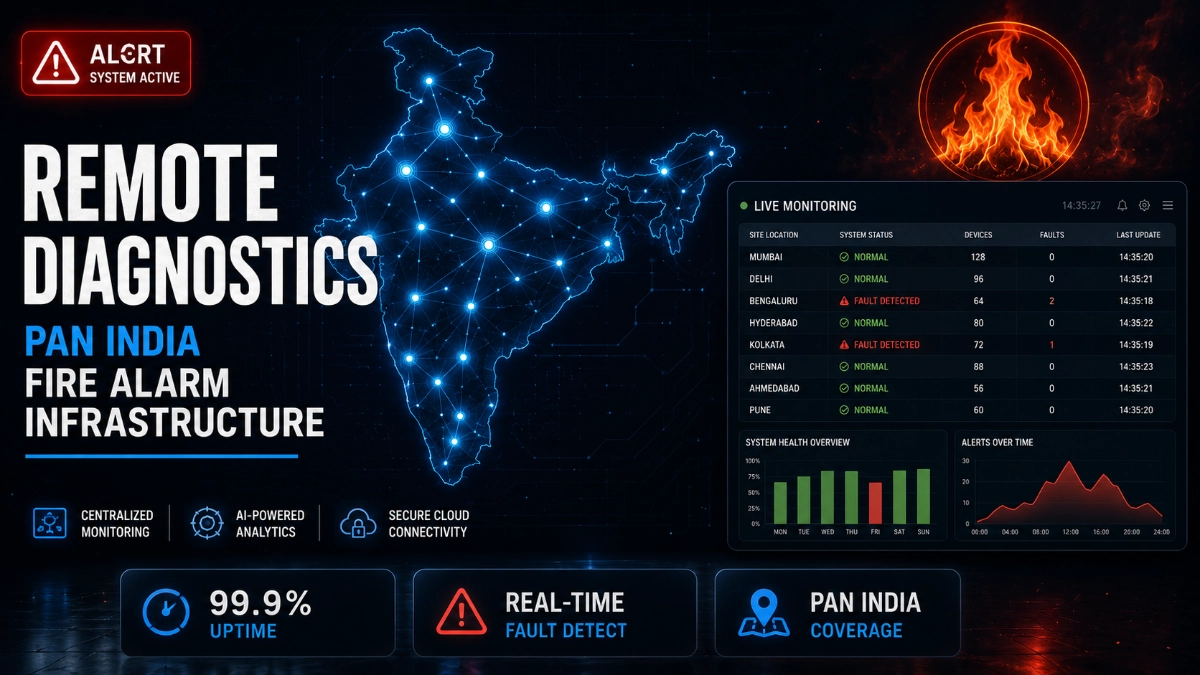
A multi-site command dashboard provides a single-screen view of fire alarm system status across every facility in a portfolio. Red-amber-green health indicators, fault counters, maintenance schedules, and compliance status are all visible from one interface. This is particularly valuable for PAN India infrastructure managers responsible for dozens or hundreds of sites.
Remote Firmware Management
Panel firmware updates, configuration changes, and software patches can be deployed remotely across all connected panels simultaneously. This eliminates the need for technicians to visit each site individually for routine software maintenance, reduces errors, and ensures all systems operate on a consistent, approved configuration baseline.
Intelligent Maintenance Scheduling
Remote diagnostics data feeds directly into maintenance scheduling systems. Instead of fixed quarterly visits, maintenance is scheduled based on actual system condition when a detector approaches its contamination threshold, when a battery reaches its predicted replacement date, or when a loop connection shows degradation. This condition-based maintenance model dramatically improves resource utilisation.
AI-Assisted Fault Detection
Advanced platforms are beginning to apply machine learning to fire alarm diagnostic data. AI models analyse historical fault patterns, environmental factors, and device behaviour to predict failures with greater accuracy and lead time than rule-based alerts. These systems also reduce false alarm rates by distinguishing between genuine fault signatures and transient environmental noise.
Centralised Service Operations
Remote diagnostics enables the creation of centralised service operations centres where a small team of skilled engineers can supervise fire alarm infrastructure across an entire PAN India portfolio. Issues are triaged remotely. Only faults that require physical intervention result in technician dispatch. This model fundamentally changes the economics of fire alarm service delivery.
Why Traditional Fire Alarm Maintenance Models Are No Longer Scalable
The case for moving beyond reactive and scheduled preventive maintenance is compelling. Consider the operational reality of a large Indian enterprise with fire alarm installations across 50 facilities in 20 cities.
- A reactive maintenance model requires dispatching technicians to each of 50 sites whenever a fault occurs. With even a modest fault frequency, this generates hundreds of service visits per year.
- Scheduled preventive maintenance visits provide point-in-time snapshots. They tell you what the system condition was on the day of the visit, not what it is today.
- Manual documentation of system health, test results, and fault histories is error-prone and audit-inefficient.
- Compliance reporting requires assembling data from dozens of separate service records, a labour-intensive process that creates risk of gaps.
- There is no early warning mechanism. Faults are discovered either during scheduled visits or after the system has already failed.
At enterprise scale, these limitations translate directly into increased risk, higher operational cost, and reduced confidence in fire safety infrastructure. The move to intelligent remote diagnostics is not a luxury upgrade; it is an operational necessity for any organisation managing fire alarm infrastructure across multiple locations in India.
How Remote Diagnostics Is Transforming Fire Infrastructure Management in India
Across India’s diverse infrastructure landscape, organisations that have adopted intelligent remote diagnostic fire monitoring report measurable improvements across several operational dimensions.
Improved Fire System Uptime
Predictive alerts and continuous monitoring mean faults are caught and resolved before they cause system downtime. Facilities report significant reductions in unplanned system outages after transitioning to remote diagnostic models.
Faster Fault Resolution
When a fault does occur, remote diagnostics provides the service team with precise information on the exact device, its location, the nature of the fault, and the trending history that preceded it. Technicians arrive on site prepared, with the right parts and a clear understanding of the work required. Mean-time-to-repair drops dramatically.
Strengthened Compliance Readiness
Remote platforms generate automated compliance reports with timestamped data on system health, test records, and maintenance actions. These reports align directly with NBC requirements, insurance auditor expectations, and enterprise safety standards. Compliance documentation that previously required days of manual assembly is available instantly.
Reduced Operational Costs
Condition-based maintenance, remote triage, and targeted technician dispatch reduce total service costs significantly compared to traditional models. Organisations with large PAN India fire alarm portfolios report meaningful cost reductions in annual maintenance expenditure after implementing remote diagnostics.
Enhanced Emergency Response Preparedness
Remote monitoring platforms provide emergency response teams with live system status during a fire event. Panel conditions, active alarms, system isolations, and communication status are visible in real time, enabling faster, better-informed emergency response coordination.
Comparison: Traditional Reactive Maintenance vs. Intelligent Remote Diagnostics
| Parameter | Traditional Reactive Maintenance | Intelligent Remote Diagnostic Model |
| Fault Detection | During scheduled visits or post-failure | Continuous, real-time, predictive |
| Response Time | Days to weeks | Minutes to hours |
| Maintenance Model | Fixed schedule, time-based | Condition-based, data-driven |
| Compliance Reporting | Manual assembly, error-prone | Automated, timestamped, audit-ready |
| Multi-Site Visibility | Site-by-site, fragmented | Unified dashboard, all sites |
| Battery Management | Checked during site visits | Continuous monitoring, predictive replacement |
| Detector Health | Visual inspection or manual test | Contamination level reported continuously |
| Firmware Updates | Manual, per-site technician visit | Remote, simultaneous, centrally managed |
| Service Cost | High — travel, labour, emergency callouts | Reduced — remote triage, targeted dispatch |
| Documentation | Paper-based or spreadsheet | Cloud-stored, automated, role-based access |
| Scalability | Degrades with portfolio growth | Scales efficiently with portfolio |
| False Alarm Management | Reactive investigation | Trend analysis, proactive resolution |
Practical Deployment Examples Across Indian Industries
Manufacturing Plants
Large manufacturing facilities operate across multiple production zones, often with hazardous material storage, electrical switchgear rooms, and complex cable routing. Remote diagnostics allows plant safety managers to monitor every loop and zone from a central safety operations desk. Predictive alerts on detector contamination are especially valuable in dusty or particulate-heavy production environments.
Warehousing Networks
A national logistics company managing 30 warehouses across India cannot afford to dispatch technicians for every panel fault notification. Remote diagnostics enables centralised triage; most faults are resolved remotely through configuration adjustments or documented for the next scheduled visit, while genuine urgent faults trigger rapid targeted dispatch.
Hospitals
Healthcare facilities operate around the clock with zero tolerance for fire system downtime. Remote monitoring provides hospital facility teams and their contracted service providers with 24/7 visibility into system health. Any degradation in a critical zone operating theatres, ICUs, and pharmacy stores triggers immediate alerts, ensuring the highest-risk areas are always under supervision.
Airports
Airport fire alarm infrastructure spans terminals, cargo facilities, fuel storage areas, and maintenance hangars across large, complex sites. Remote diagnostics supports airport facilities teams in managing this complexity, with dashboard views segregated by zone and building, and automatic alerts when any supervised component moves outside its operational parameters.
Retail Chains
A retail chain with 200 outlets across India faces an enormous fire alarm maintenance challenge. Individual outlet fire alarm panels are connected to a central monitoring platform. Faults at any outlet trigger immediate alerts, and compliance reports for all outlets are generated centrally, eliminating the need for outlet-level manual reporting.
Data Centres
Data centres represent mission-critical environments where fire alarm system reliability is paramount. Remote diagnostics integrates with BMS (Building Management Systems) and DCIM platforms, providing data centre operators with holistic visibility across fire safety, power, and environmental systems. Any fire alarm system anomaly is immediately visible alongside other critical facility parameters.
Smart Campuses and Industrial Parks
Large campuses, corporate headquarters, SEZs, and industrial parks combine multiple building types, occupancy profiles, and fire risk categories under one management umbrella. A single remote diagnostic platform consolidates fire alarm monitoring across all buildings, enabling the central facilities team to manage the entire estate without building-by-building monitoring complexity.
Commercial Towers
High-rise commercial towers with multiple tenant floors require precise zoning and fault localisation. Remote diagnostics enables building management teams to identify faults at the exact floor and zone level, coordinate tenant communication, and dispatch maintenance precisely, minimising disruption and response time.
Integration with BMS, Emergency Communication, and Centralised Monitoring Systems
Remote fire alarm diagnostics platforms deliver maximum value when integrated with the broader building and facility management ecosystem.
BMS Integration
Connecting fire alarm diagnostic data with Building Management Systems enables cross-system correlation. A fire alarm event can trigger automatic HVAC shutdown, elevator recall, and access control lockdown, all coordinated through the BMS. Conversely, BMS data on temperature anomalies or airflow disruptions can be used to contextualise fire alarm behaviour.
Emergency Communication Systems
Integration with voice evacuation systems, PA systems, and emergency notification platforms ensures that fire alarm events automatically trigger the appropriate communication response. Remote diagnostic data feeds the status of communication systems back to the monitoring platform, confirming their readiness.
Centralised Monitoring Centres
Many large enterprises and third-party fire safety service providers operate centralised monitoring centres that supervise fire alarm infrastructure across dozens or hundreds of client sites. Remote diagnostic platforms are the enabling technology for these operations, providing the data density and alert management tools required to manage large portfolios effectively.
Cybersecurity Considerations in Remote Fire Monitoring
As fire alarm systems connect to IP networks and cloud platforms, cybersecurity becomes a critical operational consideration. A compromised fire alarm monitoring platform could suppress alarms, generate false alerts, or expose sensitive facility layouts.
Best practices for securing remote fire alarm monitoring infrastructure include:
- End-to-end encryption for all data in transit between panels and monitoring platforms.
- Role-based access control limits dashboard and configuration access to authorised personnel.
- Multi-factor authentication for remote access to fire alarm management systems.
- Regular firmware and software updates to address known vulnerabilities.
- Network segmentation to isolate fire alarm systems from the general IT infrastructure.
- Audit logging of all remote access, configuration changes, and firmware updates.
- Penetration testing and security audits for monitoring platform infrastructure.
Any organisation deploying cloud-connected fire monitoring should ensure its platform provider complies with relevant cybersecurity standards and provides clear contractual commitments around data security and system integrity.
Redundancy and Fail-Safe Communication Strategies
For remote fire alarm monitoring to be reliable, the communication infrastructure itself must be resilient. A monitoring platform that loses connectivity to a site’s panels provides no value.
Recommended redundancy strategies include:
- Primary connectivity via Ethernet or fibre, with 4G/LTE as an automatic failover path.
- Dual SIM configurations for cellular-connected monitoring where primary network coverage is unreliable.
- Local panel event buffering to ensure no event data is lost during communication outages.
- Automatic reconnection protocols that re-establish monitoring sessions immediately after connectivity is restored.
- Heartbeat supervision that triggers alerts when a panel loses contact with the monitoring platform, turning a communication failure into a visible, actionable event rather than a silent blind spot.
For the most critical facilities, dedicated private APN connections provide an additional layer of security and reliability for fire alarm monitoring data.
The Future of Fire Alarm Infrastructure Management: What Comes Next
The evolution of remote diagnostics is accelerating, driven by advances in AI, cloud computing, and IoT connectivity. Here is where fire infrastructure management in India is heading.
AI-Driven Fire Diagnostics
Next-generation platforms apply machine learning to fire alarm data streams, learning normal operating patterns for each device and flagging anomalies that deviate from the expected baseline. These systems reduce false alarm rates and improve fault prediction accuracy well beyond what rule-based systems can achieve.
Predictive Infrastructure Analytics
By combining fire alarm diagnostic data with facility operational data, occupancy patterns, HVAC performance, and production schedules, predictive analytics platforms will model fire risk in real time, providing risk-adjusted maintenance prioritisation across large facility portfolios.
Cloud-Native Fire Monitoring Architectures
Future fire monitoring platforms will be fully cloud-native, eliminating on-premise servers and delivering monitoring-as-a-service with automatic updates, elastic scalability, and consumption-based commercial models. This will make enterprise-grade remote diagnostics accessible to organisations of all sizes.
Digital Twins for Fire Infrastructure
Digital twin technology creates a virtual replica of physical fire alarm infrastructure, updated in real time from sensor data. Facility managers can simulate the impact of changes, test maintenance scenarios, and visualise fault locations within a 3D model of the building before any physical intervention.
Smart Service Automation
AI-powered service management platforms will automatically generate work orders, source spare parts, schedule technicians, and update compliance records, all triggered by remote diagnostic data without human intervention. This will dramatically reduce the administrative overhead of managing large fire alarm maintenance programmes.
IoT-Connected Fire Ecosystem Integration
Fire alarm systems will increasingly integrate with a broader IoT ecosystem, including occupancy sensors, environmental monitors, smart sprinkler systems, and access control platforms, creating a comprehensive fire safety intelligence layer across the facility. Remote diagnostic platforms will provide a unified operational view of this entire ecosystem.
Remote Command Centres for Enterprise Fire Safety
As remote monitoring capability matures, leading enterprises will establish dedicated fire safety remote command centres, staffed by specialised engineers who supervise fire alarm infrastructure across their entire PAN India portfolio in real time. These centres will serve as the nerve centre for fire safety compliance, incident response coordination, and predictive maintenance management.
Practical Deployment and Maintenance Recommendations
For organisations planning to implement or upgrade to remote diagnostic fire alarm infrastructure, the following recommendations apply:
- Select addressable fire alarm panels with built-in network interfaces and remote diagnostic firmware, such as systems designed around the addressable fire alarm panel architecture with TCP/IP connectivity.
- Specify addressable detectors with contamination reporting and individual device addressing across all loops.
- Ensure your monitoring platform supports the panel protocols in use across your existing infrastructure, minimising the need for hardware replacement.
- Implement a phased rollout, prioritise the highest-risk or most complex sites for early deployment, then expand across the portfolio.
- Define clear escalation procedures for different alert types so that remote monitoring data flows efficiently to the right response team.
- Integrate fire alarm diagnostic data with your facility management or CMMS (Computerised Maintenance Management System) platform to close the loop between monitoring and maintenance execution.
- Train your facilities and safety teams to interpret remote diagnostic dashboards and act on predictive alerts. Technology is only effective when the people using it understand what it is telling them.
- Review your GST fire alarm system procurement and conventional fire alarm panel installations for upgrade pathways to addressable infrastructure where remote diagnostics capability is required.
Addressable vs. Conventional Fire Alarm Systems: The Remote Diagnostics Divide
Conventional fire alarm panels operate on a zone-based detection model; they can tell you which zone has activated, but not which specific device. Conventional detectors provide no device-level health data. This makes remote diagnostics fundamentally limited for conventional systems. Intelligent remote diagnostic capability requires addressable fire alarm infrastructure, where every device has a unique address, reports its own health data, and communicates individually with the panel. For any enterprise or multi-site operator considering remote diagnostics, migrating from conventional to addressable fire alarm systems is the foundational technology decision.
Remote Diagnostics Is Not the Future: It Is the Present
India’s fire alarm infrastructure is at an inflexion point. The combination of rapid infrastructure expansion, increasing regulatory scrutiny, and the availability of intelligent connected fire alarm technology has created both the need and the means to fundamentally transform how fire safety systems are managed.
Remote diagnostics for fire alarm infrastructure is not a theoretical benefit waiting to be realised. It is delivering measurable improvements in system uptime, maintenance efficiency, compliance readiness, and operational cost across manufacturing, logistics, healthcare, hospitality, and enterprise facilities across India today.
The organisations that act now specifying intelligent addressable fire alarm panels, deploying connected monitoring platforms, and building remote diagnostic capability into their fire safety operations will be best positioned to manage the safety and regulatory demands of an increasingly complex, distributed infrastructure portfolio.
For fire safety consultants, facility managers, MEP engineers, and enterprise infrastructure operators, the question is no longer whether remote diagnostics is worth implementing. The question is how quickly it can be deployed across your portfolio.
Read Also: Why Industrial Fire Detection Is Shifting Toward Intelligent Infrastructure
Read Also: Fire Alarm Network Segmentation Strategy for Mega Industrial Facilities