In any emergency, a fire on an industrial campus, a security breach at an airport, a medical crisis inside a hospital, the first sixty seconds are critical. Emergency operations teams depend on accurate, real-time visual intelligence to make fast, life-saving decisions. Yet in most facilities today, surveillance systems are still designed for passive monitoring rather than active incident response.
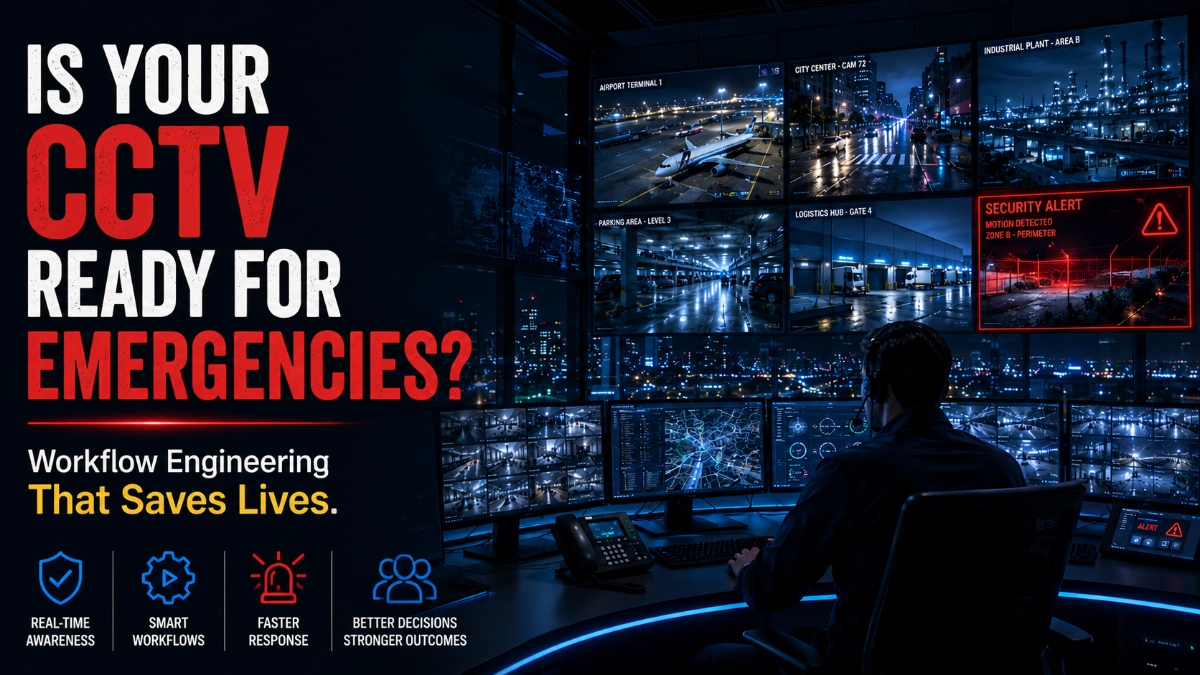
When a CCTV system requires an operator to manually scan dozens of feeds, locate the right camera, and then relay information to responders, precious time is lost. Studies in emergency response consistently show that every additional minute of delayed situational awareness compounds the severity of outcomes, whether that means a fire spreading further, an intruder moving deeper into a facility, or an evacuation becoming chaotic.
CCTV workflow engineering solves this problem. It transforms a surveillance infrastructure from a passive recording system into a dynamic, intelligent emergency coordination tool. This article explains exactly how emergency operations teams can design, deploy, and optimise surveillance workflows that match the speed and complexity of real-world critical incidents.
What Is CCTV Workflow Engineering?
CCTV workflow engineering is the discipline of designing structured, automated, and intelligent processes that govern how surveillance video is captured, analysed, prioritised, distributed, and acted upon, particularly during emergencies.
It goes far beyond installing cameras and recording footage. CCTV workflow engineering defines:
- How are cameras triggered and configured during an incident?
- How are alerts generated, classified, and routed to the right responders?
- How are video feeds displayed, prioritised, and managed across command centres?
- How does surveillance data integrate with fire alarms, access control, and emergency dispatch systems?
- How do operators interact with surveillance tools under high-pressure conditions?
In operational terms, a well-engineered CCTV workflow means that when an incident occurs, the appropriate video automatically appears on the correct screen and the correct alert reaches the appropriate team. The right response action is initiated within seconds.
Why Traditional Surveillance Monitoring Falls Short
Most legacy surveillance systems operate on a reactive model. Cameras record continuously. Operators scan a wall of monitors. Alerts are generated manually or through basic motion detection. Incidents are identified only after an operator notices something unusual.
This approach has critical operational gaps:
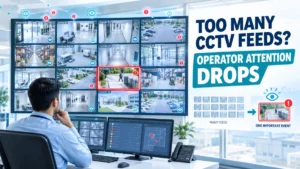
- Operator Overload: A single operator managing 64 or more camera feeds cannot maintain sustained attention on every screen. Human fatigue leads to missed events.
- Slow Detection: Without AI-assisted analytics, unusual events such as perimeter intrusions, crowd surges, or unattended objects take far too long to detect.
- Poor Integration: Traditional systems operate in silos. A CCTV system that cannot communicate with a fire alarm or access control platform creates response coordination failures.
- Manual Escalation: Notifying supervisors, dispatching responders, and pulling relevant footage during an incident all require manual steps that consume critical time.
- Limited Contextual Awareness: Operators see individual feeds but lack the broader situational picture that emergency commanders need.
The shift from reactive surveillance to engineered emergency surveillance workflows addresses every one of these limitations.
Essential Components of Emergency CCTV Workflow Engineering
1. Real-Time Video Prioritisation
During an emergency, not all camera feeds carry equal importance. A workflow-engineered system automatically elevates the priority of cameras closest to the incident zone. Video from those cameras appears immediately on primary display screens, ensuring that operators and commanders focus attention where it matters most. Priority queuing can be based on AI event classification, manual override, or pre-defined incident type.
2. Incident-Triggered Camera Automation
When an incident triggers, whether from a fire alarm, motion sensor, access control alert, or AI detection event, pre-programmed camera automation activates instantly. Cameras in the affected zone pan, tilt, and zoom to cover critical angles. Neighbouring cameras activate in follow-up sequences. This removes the dependency on an operator manually finding and switching to the right feed.
3. AI-Assisted Alert Routing
Modern surveillance platforms use AI-based video analytics to classify events, distinguishing between a person falling, an unauthorised vehicle, a crowd forming, or a fire flash and automatically route alerts to the appropriate response team. A smoke detection event routes to the fire safety team. An access breach routes to security personnel. A perimeter alert routes to guards on patrol. This intelligent routing eliminates the generic alarm fatigue that plagues traditional systems.
4. Video Wall Orchestration
Command centres supporting emergency operations rely on large video walls displaying multiple feeds simultaneously. Video wall orchestration software dynamically controls which feeds appear, in what layout, and at what size, adapting to the evolving nature of an incident in real time. Pre-configured scene templates can be activated instantly for specific emergency types, such as a campus evacuation, a fire response, or a security lockdown.
5. Multi-Location Surveillance Synchronisation
Large organisations, such as airports, hospital networks, industrial campuses, and smart cities, operate surveillance across multiple sites. A workflow-engineered platform synchronises these distributed surveillance environments, allowing a central operations team to manage and respond to incidents across all locations from a single command interface. Synchronised clock systems, unified video management, and centralised alert handling are foundational requirements.
6. Event Escalation Logic
Not every alert requires the same level of response. Event escalation logic defines a structured hierarchy: an initial alert triggers a first-level response. If unresolved within a set timeframe, the system automatically escalates to a supervisor. If still unresolved, the incident escalates to emergency dispatch or external authorities. This automated escalation prevents critical events from being lost in communication queues.
7. Intelligent Operator Workflows
Emergency surveillance platforms engineer the operator experience itself. Guided response protocols appear on screen when an incident triggers, directing operators through the exact steps required for that incident type. Pre-defined checklists, camera views, and communication links reduce cognitive load and prevent procedural errors during high-stress events.
8. Mobile Surveillance Access
Responders on the ground, supervisors in transit, and incident commanders outside the command centre all require real-time visual access during emergencies. Mobile-optimised surveillance platforms allow authorised personnel to view live camera feeds, receive alerts, and communicate with the command centre from smartphones and tablets, ensuring situational awareness is not confined to the control room.
9. Integration with Fire Alarm and Access Control Systems
A fully engineered emergency surveillance ecosystem integrates CCTV with fire detection systems and access control platforms. When a fire alarm activates in Zone 3 of a facility, all cameras covering Zone 3 automatically switch to live monitoring mode, relevant doors unlock for evacuation, and the command centre receives a unified incident view. This cross-system integration eliminates the dangerous information gaps that arise when surveillance, fire, and access systems operate independently.
10. Emergency Dispatch Integration
Surveillance workflow platforms that integrate directly with emergency dispatch systems enable operators to share live video feeds with first responders before they arrive on scene. Police, fire, and medical teams can assess the situation visually while en route, enabling faster and more informed deployment. Some advanced platforms support direct video streaming to responder devices in the field.
11. Edge AI Analytics
Edge AI processes video data directly on the camera or local server, rather than sending all footage to a central system for analysis. This dramatically reduces latency, enabling sub-second detection and alert generation. Edge AI supports object detection, behaviour analysis, crowd density monitoring, and anomaly detection, all critical capabilities for emergency operations where speed of detection directly determines response effectiveness.
12. Situational Awareness Dashboards
Emergency operations teams need a single, unified view of all incident-related data. Situational awareness dashboards combine live camera feeds, alert timelines, personnel locations, access control status, and system health indicators into one interface. These dashboards give incident commanders the contextual picture they need to make rapid, accurate decisions throughout the course of an emergency.
13. Command Centre Workflow Optimisation
The command centre itself must be engineered for emergency performance. This includes ergonomic workstation design, redundant display systems, uninterruptible power supplies, fail-safe network architecture, and clearly defined operator roles and responsibilities. A well-designed command centre ensures that the physical and digital environment supports peak human performance during the most demanding operational moments.
Practical Deployment Examples Across Key Sectors
Industrial Campuses
A refinery or chemical plant deploys incident-triggered camera automation linked to its process control system. When a pressure sensor triggers an alert, cameras in that process zone activate instantly, and the safety operations centre receives a combined process data and video feed for immediate assessment.
Airports
International airports use multi-location surveillance synchronisation to monitor terminals, runways, cargo areas, and perimeter zones from a unified command centre. AI-assisted alert routing detects unattended baggage, unauthorised runway incursions, and passenger distress events with alerts routed automatically to the appropriate airport security or ground operations team.
Hospitals
Hospital emergency operations centres integrate CCTV with access control to manage patient security, infant protection systems, and emergency lockdowns. When a duress alarm activates, cameras in the relevant ward auto-display in the security centre, and access control automatically restricts movement in that zone.
Smart Cities
Urban operations centres running smart city surveillance platforms use edge AI analytics across thousands of street cameras to detect traffic incidents, public safety events, and infrastructure failures in real time. Situational awareness dashboards give city emergency managers a live operational picture across entire metropolitan areas.
Manufacturing Facilities
Factory floors integrate machine safety sensors with CCTV workflows. When a production-line safety system triggers, cameras covering that line automatically switch to the safety team’s displays, and mobile alerts reach floor supervisors within seconds.
Data Centers
Data centres require extremely high physical security. Surveillance workflows integrate with biometric access control and environmental monitoring. Any unauthorised access attempt or cooling system failure triggers immediate video review, automated lockdown procedures, and escalation to facilities management.
Commercial Towers
High-rise commercial buildings deploy video wall orchestration to manage fire evacuation scenarios. When a floor evacuation alarm activates, stairwell and lobby cameras for that floor and adjacent areas auto-populate on the command centre display, giving security personnel clear visibility of evacuation progress.
Transportation Infrastructure
Railway networks and metro systems use emergency dispatch integration to share live tunnel and platform camera feeds with train control rooms and emergency services simultaneously. This enables coordinated responses to passenger incidents, track intrusions, or infrastructure failures with real-time visual coordination.
Operational and Security Benefits of Engineered CCTV Workflows
- Faster Incident Verification: Automated detection and camera routing reduce incident verification time from minutes to seconds.
- Reduced Operator Overload: AI pre-filtering and automated alerts allow operators to focus on confirmed events rather than monitoring all feeds continuously.
- Better Emergency Coordination: Integrated systems ensure that CCTV, fire, access control, and dispatch all operate from a unified information picture.
- Improved Evacuation Visibility: Real-time camera coverage of evacuation routes gives commanders accurate crowd flow data throughout an emergency.
- Reduced Response Time: Automated escalation and dispatch integration get the right resources to the right location faster.
- Enhanced Situational Awareness: Dashboards give all stakeholders, operators, supervisors, and incident commanders a consistent and accurate operational picture.
- Better Forensic Investigation Capability: Event-tagged video archives with metadata make post-incident investigation faster, more accurate, and legally defensible.
- Higher Operational Resilience: Redundant systems, failover architecture, and edge AI ensure surveillance continuity even if central servers face disruption.
Common CCTV Workflow Failures During Emergencies
Understanding where traditional workflows fail helps organisations design more resilient emergency surveillance systems. The most frequent failures include:
- Alert Fatigue: Systems generating too many false alarms cause operators to dismiss genuine events. Without intelligent filtering, operators become desensitised to alerts.
- Single Point of Failure: Centralised recording systems without redundancy can fail during a power outage or network disruption, leaving the operations centre blind.
- Lack of Integration: Surveillance systems that do not communicate with fire, access control, or dispatch systems require manual coordination that introduces dangerous delays.
- Operator Interface Complexity: Poorly designed interfaces slow down response during emergencies, particularly when operators must navigate complex menus to find the right camera.
- Inadequate Bandwidth Planning: High-definition video streams from many cameras simultaneously can saturate network infrastructure during peak incident periods.
- Missing Mobile Capability: Supervisors and responders who cannot access live feeds remotely are effectively operating blind when away from the command centre.
- Absence of Escalation Protocols: Without automated escalation, critical incidents can stagnate at the first-response level without reaching senior decision-makers in time.
- Cybersecurity Vulnerabilities: Poorly secured IP surveillance networks can be compromised, disabling cameras or corrupting footage at the worst possible moment.
How Intelligent Workflow Design Improves Emergency Response
Intelligent workflow design replaces reactive, operator-dependent surveillance with proactive, system-driven emergency coordination. The operational improvements are substantial and measurable.
When a surveillance platform detects a fire event, an intelligently engineered workflow executes the following sequence automatically:
- The edge AI camera detects smoke or flame signatures and triggers an immediate alert.
- The system cross-references the alert with the fire alarm panel to confirm the event location.
- All cameras covering the incident zone and adjacent areas activate in pre-configured emergency mode.
- The command centre video wall switches to the emergency scene template for that zone.
- Operator workstations display the guided response protocol for a fire event.
- Mobile alerts reach the security supervisor, fire safety officer, and facilities manager simultaneously.
- Emergency dispatch receives a live video feed link and the confirmed incident location.
- Access control systems automatically unlock evacuation routes and lock restricted areas.
- The situational awareness dashboard updates with real-time personnel location data from the access control system.
- If the incident is not acknowledged within 90 seconds, the system automatically escalates to the senior emergency coordinator.
This entire sequence executes in under 30 seconds compared to 3 to 10 minutes in a traditional manually operated surveillance environment. The difference in outcome during a real emergency is profound.
Comparison: Traditional vs. Intelligent Emergency Surveillance Workflows
| Aspect | Traditional CCTV Workflow | Intelligent Emergency Workflow |
| Alert Detection | Manual operator observation | Automated AI-triggered alerts |
| Camera Switching | Operator-driven, reactive | Incident-triggered automation |
| Response Time | 2–10 minutes (human lag) | Under 30 seconds (automated) |
| Operator Load | High — monitors all feeds | Reduced — AI pre-filters events |
| Integration | Siloed (standalone system) | Unified (fire, access, dispatch) |
| Situational Awareness | Limited to monitored screens | Full contextual dashboard view |
| Scalability | Linear (more staff needed) | Scalable via AI and automation |
| Forensic Retrieval | Manual timeline search | Tagged, searchable event logs |
| Mobile Access | Rare or not supported | Standard mobile/remote access |
| Evacuation Support | Not coordinated with alerts | Integrated evacuation mapping |
| Incident Escalation | Manual supervisor notification | Automated escalation logic |
| Analytics | Post-incident review only | Real-time predictive analytics |
Enterprise-Grade Platforms for Emergency Surveillance Workflows
Not all video management systems are engineered for emergency operations environments. Mission-critical facilities require platforms that combine video management, AI analytics, integration middleware, and command centre orchestration into a unified ecosystem.
Impact by Honeywell is one such enterprise-grade platform, purpose-built for complex emergency operations and high-security command centre environments. It brings together intelligent video management, multi-system integration, and operator workflow tools designed specifically for organisations that cannot afford surveillance failures during critical incidents. Organisations looking for an Impact by Honeywell distributor in India will find certified integration partners who can deploy and configure these systems for local regulatory compliance and infrastructure requirements.
When evaluating platforms for emergency surveillance workflow deployment, operations teams should assess:
- Native AI analytics capabilities: Both edge and server-based.
- Integration ecosystem: Fire, access control, BMS, and dispatch support.
- Redundancy and failover architecture.
- Operator UX design under high-stress conditions.
- Mobile and remote access capabilities.
- Cybersecurity certifications and encryption standards.
- Scalability for multi-site enterprise deployments.
Cybersecurity in Connected Surveillance Ecosystems
As CCTV systems become more deeply integrated with emergency operations infrastructure, cybersecurity becomes a non-negotiable engineering requirement. An IP-based surveillance system that lacks proper security controls is not just a liability, it is a potential attack vector that could disable an organisation’s emergency response capability at a critical moment.
Key cybersecurity engineering considerations for emergency surveillance systems include:
- End-to-end video stream encryption using TLS and SRTP protocols.
- Role-based access control limits system access to authorised personnel.
- Regular firmware updates and vulnerability patching on all camera endpoints.
- Network segmentation, isolating the surveillance infrastructure from general IT networks.
- Audit logs record all system access, configuration changes, and alert acknowledgements.
- Multi-factor authentication for remote and mobile access.
- Regular penetration testing of the surveillance network infrastructure.
Operational Continuity and Redundancy Planning
Emergency surveillance systems must remain operational precisely when external conditions are most likely to stress infrastructure. Power outages, network disruptions and physical damage to equipment are all foreseeable during major incidents.
Redundancy planning for CCTV workflow engineering includes:
- Uninterruptible power supplies (UPS) and generator backup for all critical recording and display infrastructure.
- Redundant network paths ensure video streaming continues if primary network links fail.
- Edge recording on cameras, ensuring footage is not lost if the central video management server goes offline.
- Geographically redundant command centres enable operations to continue if the primary facility is affected.
- Regular failover testing to verify that backup systems activate correctly under real conditions.
The Future of CCTV Workflow Engineering in Emergency Operations
AI-Assisted Emergency Operations
The next generation of emergency surveillance platforms will use AI not just to detect events but to recommend response actions, predict incident escalation trajectories, and allocate resources dynamically based on real-time conditions.
Predictive Surveillance Analytics
Predictive analytics will allow surveillance systems to identify behavioural patterns and environmental indicators that precede incidents, enabling emergency teams to intervene before an event escalates. Crowd density analysis, anomaly pattern recognition, and historical incident correlation will all contribute to predictive situational intelligence.
Autonomous Threat Detection
Autonomous surveillance systems will handle initial threat detection, classification, and first-response alert generation with minimal human intervention, freeing operators to focus on complex coordination tasks while AI handles high-frequency, routine detection workloads.
Cloud-Based Emergency Monitoring
Cloud-integrated surveillance platforms will enable emergency operations teams to access and manage multi-site video infrastructure from anywhere, with elastic storage, AI processing at scale, and real-time collaboration tools built into cloud-native architectures.
Digital Twins for Emergency Planning
Digital twin technology will allow emergency operations teams to simulate incident scenarios within a virtual replica of their facility, testing surveillance workflows, identifying blind spots, and optimising camera placement and escalation logic before real incidents occur.
Integrated SOC Ecosystems
Security Operations Centres will increasingly function as unified command platforms combining physical security (CCTV, access control), cybersecurity monitoring, IT operations, and emergency management into a single integrated operations environment.
Real-Time Collaborative Command Platforms
Multi-agency emergency response involving police, fire services, medical teams, and facility managers will be supported by shared real-time video and data platforms where all stakeholders can view the same incident picture and coordinate response actions collaboratively.
Read Also: Identifying Hidden Performance Bottlenecks in Surveillance Systems
Read Also: Intelligent Surveillance Layering for Industrial Campuses