Walk through any industrial facility, hospital, or commercial tower, and you will find fire alarm panels glowing green. No faults. Recent inspection passed. Everyone assumes the building is protected. That assumption is dangerous, and it is costing lives and assets every year.
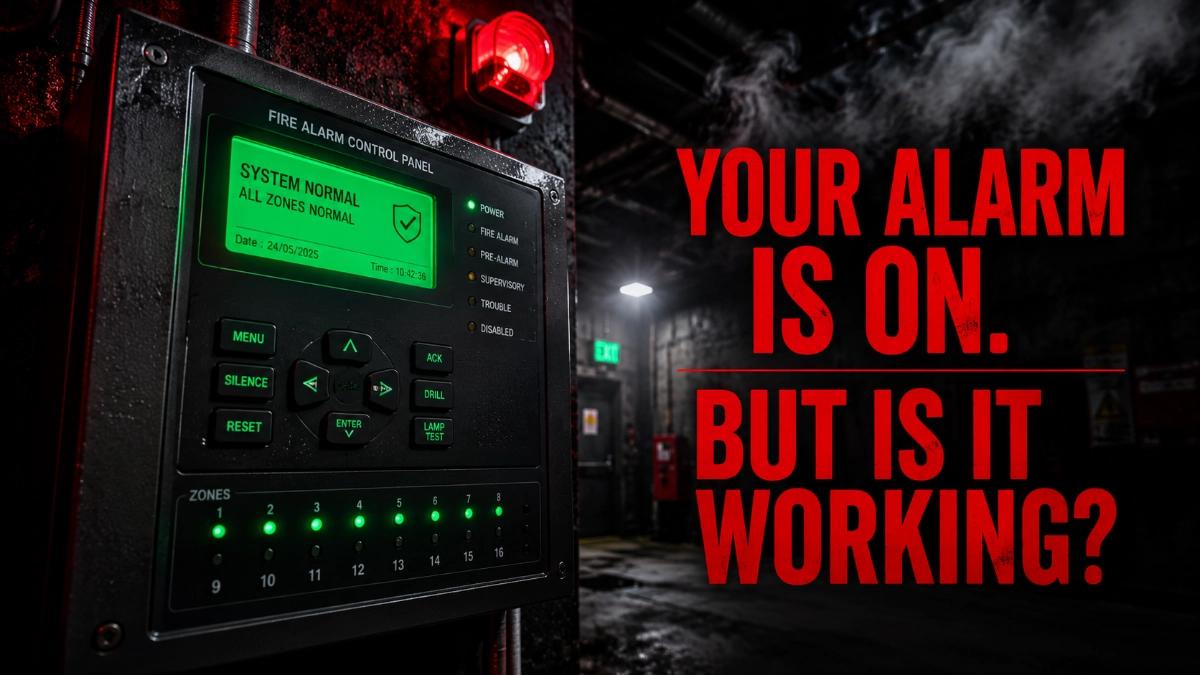
The presence of a fire alarm system is not the same as the reliability of fire detection. A system that passes a compliance audit can still fail to detect a real fire. A panel with no visible faults can house detectors that have silently degraded to a point where they are no longer useful. And a team that dismisses daily fault warnings is one emergency away from disaster.
This article explains why the gap between compliance and reliability is the most underestimated risk in fire safety infrastructure today, and what modern facilities must do to close it.
Compliance Is a Starting Point, Not a Guarantee
Fire safety compliance frameworks establish minimum installation standards. They confirm that a system was correctly installed and operational at the moment of inspection. What they do not confirm is what that system will do twelve months later, after detectors have accumulated dust, loop cables have aged, and cause-and-effect logic has never been updated following building modifications.
A conventional fire alarm panel that passes an annual audit may still have detectors operating at borderline sensitivity, elevated loop resistance in ageing cable runs, or suppression sequences that were never correctly programmed. None of these failures will necessarily trigger an audit finding. All of them meaningfully reduce real-world detection capability.
Compliance sets the floor. Reliability requires you to work continuously above it.
The Hidden Risks That Silently Erode Fire Detection Effectiveness
Most fire detection failures are not sudden. They accumulate gradually through a combination of operational pressures, maintenance shortcuts, and infrastructure age. The risks below are the most common and the most consequential.
Detector Contamination and Sensitivity Drift
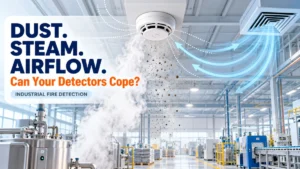
Optical smoke detectors depend on light scattering inside a sealed sensing chamber. Dust, industrial particulates, cooking vapours, and insects gradually contaminate this chamber, causing two serious outcomes: increased false alarm rates and reduced ability to detect genuine smoke. In manufacturing plants, food processing facilities, and warehouses, contamination can occur in weeks. Without regular sensitivity testing, it goes undetected until the system either produces an ignored false alarm or misses a real fire.
Ageing Infrastructure and Ignored Fault Warnings
Fire alarm cable loops degrade over time due to heat cycling, mechanical stress, and moisture ingress. Loop resistance rises and communication reliability drops, particularly in devices at the end of long loop runs. Compounding this, facility operators frequently silence low-priority fault indicators to avoid operational disruption. Over months, silent faults accumulate into genuine structural weaknesses. Post-fire investigations consistently identify ignored fault logs as contributing factors in detection failures.
Poor Zoning Logic and Incomplete Cause-and-Effect Programming
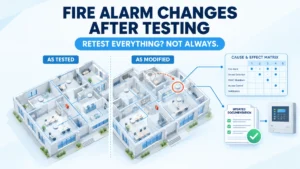
A fire alarm system without correctly programmed cause-and-effect sequences is a detection device only. If a detector in a server room triggers a local sounder but not the suppression system, due to incomplete programming, the system has failed at its most critical function. Similarly, HVAC systems that continue running on alarm can actively distribute smoke through unaffected areas. Poor integration between fire detection and building management systems is one of the most common and least-discussed deficiencies in both conventional and addressable installations.
False Alarm Desensitisation
Repeated false alarms train staff to hesitate before evacuating. In facilities with chronic false alarm problems, workers have been documented returning to workstations after hearing alarm signals, waiting for confirmation. This behavioural pattern is a direct consequence of system unreliability, and it costs critical evacuation time in genuine emergencies. False alarm desensitisation is one of the most psychologically dangerous failure modes in fire safety.
Overdependence on Outdated Conventional Systems
Many facilities built in the 1990s and early 2000s still operate with conventional fire alarm panels that can only identify which zone has activated, not which specific detector. These systems cannot monitor individual device health, cannot provide device-level diagnostic data, and cannot support the granular cause-and-effect logic that modern facility complexity demands. As buildings evolve, conventional systems fall further behind the protection requirements they were designed to serve.
| WARNING SIGNS YOUR FIRE DETECTION STRATEGY MAY BE FAILING |
| • Your team silences fault warnings without completing root cause investigation. |
| • False alarms occur more than twice per year without systematic resolution. |
| • Detector sensitivity has not been formally tested within the past 12 months. |
| • Staff wait to confirm alarms before beginning evacuation. |
| • Building modifications have been made without updating zone logic or detector placement. |
| • Your HVAC system does not switch to fire mode when an alarm activates. |
| • You have no remote monitoring or cloud-connected supervision of your fire system. |
| • Your fire panel cannot identify which individual device has activated. |
Why Modern Facilities Need Intelligent Fire Detection Ecosystems
The solution is not simply replacing old equipment. It is rethinking fire detection as a continuously monitored, analytically supported infrastructure, not a static installation that gets checked once a year.
An intelligent fire detection ecosystem combines addressable detectors with advanced panel diagnostics, cloud-connected supervision, BMS integration, and predictive maintenance programs. Each component serves a specific operational role, and together they eliminate the blind spots that compliance-focused systems leave open.
Addressable fire alarm panels assign a unique identification code to every device on the system. This means every alarm and every fault is attributed to a specific detector, enabling precise emergency response and targeted maintenance intervention. Unlike a conventional fire alarm panel that can only report which zone has been affected, an addressable system tells you exactly which device, on which floor, in which room, and what its current health status is.
Addressable detectors also support continuous self-monitoring. They measure their own sensitivity drift, communication signal quality, and environmental conditions in real time. When a detector begins trending toward failure, the system flags it days or weeks before an observable fault occurs, enabling proactive replacement rather than emergency repair.
A GST fire alarm system architecture built around intelligent addressable technology demonstrates this ecosystem approach in practice. With cloud-connected supervision, facilities managers can monitor system health across single or multiple sites in real time, generate compliance documentation automatically, and receive predictive maintenance alerts before faults become failures.
Basic Compliance vs. Intelligent Reliability: Key Differences
| Aspect | Basic Compliance System | Intelligent Reliable System |
| Primary Goal | Meet minimum code requirements | Ensure continuous, verified protection |
| Detector Type | Conventional zone-based | Addressable with individual device ID |
| Fault Visibility | Zone-level only | Device-level real-time reporting |
| Maintenance | Reactive — fix on failure | Predictive — prevent failure proactively |
| False Alarm Logic | No built-in filtering | Intelligent verification logic |
| Remote Monitoring | Not available | Cloud-connected supervision |
| BMS Integration | Limited or none | Full integration with HVAC and BMS |
| Scalability | Fixed zone architecture | Expandable addressable loop topology |
How to Build a More Reliable Fire Detection Infrastructure
Improving fire detection reliability does not require replacing every system overnight. It requires a structured, prioritised approach to closing the most critical gaps.
- Conduct a system health audit beyond compliance verification. Test individual detector sensitivity, measure loop resistance, and review cause-and-effect programming against the current building layout.
- Upgrade to addressable architecture where feasible. The lifecycle cost savings from reduced false alarms, predictive maintenance capability, and precise emergency response consistently justify the investment in mission-critical facilities.
- Implement continuous remote monitoring. Cloud-connected supervision eliminates the blind spot between inspection visits and provides the audit trail needed for regulatory compliance.
- Integrate fire detection with your building management system. Ensure HVAC systems switch to fire mode on alarm, and that building operators receive contextual emergency information in real time.
- Address false alarm root causes systematically. Every false alarm is a diagnostic event. Investigate root cause, implement corrective action, and track recurrence formally.
- Include cybersecurity in your planning. Network-connected fire systems require encrypted communication, access authentication, and inclusion in your organisation’s broader cybersecurity governance framework.
The Future of Fire Detection: AI, Predictive Diagnostics, and Smart Integration
Artificial intelligence applications in fire detection are moving from pilot programs into operational deployment. Machine learning algorithms trained on large datasets of detector behaviour can distinguish between early fire signatures and environmental conditions that typically produce false alarms. This capability, embedded within modern addressable fire alarm panels, significantly improves detection accuracy without sacrificing sensitivity.
Predictive maintenance analytics aggregate diagnostic data from hundreds of addressable detectors to identify statistical failure probability before devices reach observable fault status. Facilities using this approach report meaningful reductions in both unplanned system downtime and maintenance labour cost.
Cloud-connected fire supervision platforms are also evolving beyond simple remote monitoring into comprehensive operational intelligence tools. They benchmark system performance against industry standards, generate regulatory compliance documentation automatically, and give fire safety consultants the analytical capability to manage fire protection across large portfolios of facilities from a single dashboard.
The direction is clear: fire detection is moving from a static compliance exercise toward a dynamic, continuously validated, data-driven discipline. Facilities that make this transition will carry a materially lower fire risk profile. Those that rely on green panel lights and annual audit passes will remain exposed to risks their systems were never designed to detect.
Note: A green light on your fire panel confirms that your system is powered. It does not confirm that your system will detect the next fire that starts in your facility. The gap between these two conditions is where the most dangerous assumption in fire safety lives.
Closing that gap requires moving beyond compliance as the primary measure of fire protection quality. It requires intelligent, continuously monitored fire detection ecosystems built around addressable detectors, predictive diagnostics, integrated building systems, and verified cause-and-effect logic. It requires treating every fault warning, every false alarm, and every maintenance cycle as an operational intelligence opportunity rather than an administrative inconvenience.
Fire detection reliability is not achieved at commissioning. It is earned and maintained every day. The facilities that understand this are the ones that survive fire events with lives protected and operations intact.
Read Also: What Fire Alarm Engineers Notice That Most Facility Owners Ignore
Read Also: The Most Overlooked Risk in Industrial Fire Safety Infrastructure