Most industrial facilities invest heavily in fire safety hardware. Sprinkler systems get inspected. Fire extinguishers get tagged. Detectors get installed. Emergency exits get marked. On paper, the facility looks compliant, prepared, and protected.
The Hidden Risks Inside Industrial Fire Safety Infrastructure
But fire incidents continue to occur, and when they do, the investigation rarely points to a missing device. It points to something far more subtle: a system that was present but not functioning the way it should have been.
The real risk in modern industrial fire safety infrastructure is not the equipment you can see. It is the hidden operational vulnerabilities that silently accumulate beneath the surface, undetected communication failures, degrading detection infrastructure, poor system integration, and the absence of intelligent diagnostics that would catch problems before they become catastrophes.
This article examines those overlooked risks in depth and explains why industrial facilities, from manufacturing plants to data centres, need to move beyond reactive fire protection toward intelligent, predictive fire safety infrastructure.
Key Takeaways
- Most industrial fire failures trace back to infrastructure vulnerabilities, not missing hardware.
- Hidden risks, such as communication failures, detector contamination, battery degradation, and loop instability, often go undetected during routine operations.
- Traditional fire safety audits frequently miss deeper infrastructure weaknesses.
- Addressable fire alarm systems with predictive diagnostics dramatically improve operational reliability.
- Cybersecurity, BMS integration, and redundancy planning are now essential components of industrial fire safety strategy.
- The future of industrial fire safety lies in AI-assisted diagnostics, cloud-connected monitoring, and autonomous emergency coordination.
What ‘Hidden Fire Safety Risk’ Actually Means in Industrial Environments
Hidden fire safety risk refers to infrastructure vulnerabilities that do not trigger immediate alarms, do not appear on routine inspection checklists, and do not generate obvious symptoms until a real emergency exposes them.
These are not hypothetical risks. They are operational realities that facility managers, fire safety consultants, and industrial engineers encounter regularly, often only after an incident has occurred.
Consider these scenarios:
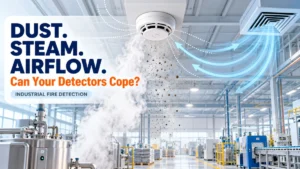
- A detector on a conventional fire alarm panel has been gradually accumulating dust over 18 months. It passes visual inspection because no fault light appears. But its sensitivity has degraded to the point where it would miss an early-stage fire.
- A ground fault in an ageing cable installation intermittently affects loop communication on an addressable system. The fault clears itself before technicians can trace it. The loop appears healthy during the monthly test.
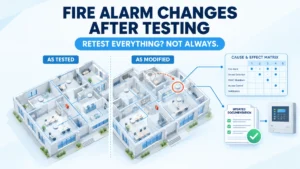
- A fire alarm panel has been programmed with cause-and-effect logic that was correct for the original facility layout, but the facility has been modified three times since installation, and nobody updated the programming.
In each case, the system appears to be working. The risk is invisible. And in a real emergency, the consequences of that invisibility become very real.
Why These Risks Go Unnoticed During Routine Operations
Industrial fire safety management has historically been compliance-driven rather than performance-driven. Facilities focus on passing the inspection, clearing the audit, and maintaining documentation. That approach creates a dangerous gap between apparent compliance and actual operational readiness.
Several structural reasons explain why hidden risks persist:
Inspection Models Are Point-in-Time
Standard fire safety inspections capture the system state at one moment. A detector that tests fine today may be drifting toward failure next month. A battery that shows acceptable voltage during an annual test may fail under the sustained load of a real emergency. Point-in-time testing cannot detect gradual degradation.
Conventional Systems Offer Limited Diagnostics
A conventional fire alarm panel reports zone-level faults, not device-level data. If a detector in Zone 4 begins drifting, the panel may not report any fault at all until the drift crosses a hard threshold. The operational space between ‘functioning normally’ and ‘fault detected’ is invisible.
Maintenance Is Often Reactive
In many industrial facilities, fire system maintenance happens after a problem is reported, not before. Without continuous monitoring and predictive data, maintenance teams work reactively, fixing problems that have already manifested rather than preventing them.
System Integration Is Assumed, Not Verified
Many facilities assume that their fire alarm system communicates correctly with their Building Management System (BMS), emergency lighting, access control, and public address systems. In practice, integration failures are common and often go undetected until a real emergency reveals the gap.
The 15 Most Overlooked Risk Areas in Industrial Fire Safety Infrastructure
1. Undetected Communication Failures
In both addressable and networked fire alarm systems, communication between devices and panels depends on cabling, protocols, and network infrastructure that can degrade over time. Partial communication failures, where data transmits intermittently rather than failing, are among the hardest risks to identify. An addressable fire alarm panel may show devices as ‘online’ while actually receiving intermittent or delayed data.
2. Loop Instability in Addressable Systems
Addressable systems use detection loops that carry both power and data. Loop instability caused by cable damage, excessive device loading, or electromagnetic interference can introduce response delays or cause devices to drop off the loop momentarily. These instabilities often resolve before a technician can respond, leaving no log entry and no obvious fault.
3. Ageing Detection Infrastructure
Detectors have a defined operational lifespan, typically 10 years for most technologies. In practice, many industrial facilities continue operating detectors well beyond this period. As detectors age, their sensing elements drift, calibration degrades, and sensitivity shifts, sometimes toward false alarms, sometimes toward missed events. Neither outcome is acceptable in a mission-critical industrial environment.
4. Ground Fault Issues
Ground faults caused by insulation breakdown in ageing cables, moisture ingress, or physical damage to wiring can interfere with system communication and cause unpredictable behaviour. A sustained ground fault may prevent fault signals from reaching the panel. An intermittent ground fault may produce false alarms that erode operator confidence in the system.
5. Battery Degradation
Every fire alarm system relies on battery backup to maintain operation during a power failure. Battery capacity degrades predictably over time, but this degradation is rarely monitored continuously. A battery that shows acceptable terminal voltage under light load may fail within minutes under the full current draw of a real emergency. Annual battery tests frequently fail to simulate real emergency load conditions.
6. Delayed Event Synchronisation
In large industrial facilities with multiple fire alarm panels networked together, event synchronisation is critical. A fire event detected at one panel must propagate immediately to all connected panels and integrated systems. Communication delays caused by network congestion, protocol mismatches, or configuration errors can create dangerous windows where one part of a facility is responding to an alarm while another part has not yet received it.
7. Detector Contamination
Industrial environments expose detectors to dust, chemical vapours, humidity, and particulate matter at levels far exceeding those in typical commercial environments. Contaminated detectors drift from calibration and may either fail to respond to genuine fire conditions or generate persistent false alarms that lead operators to disable or isolate zones. Both outcomes represent serious safety failures.
8. Poor Fire Alarm Network Segmentation
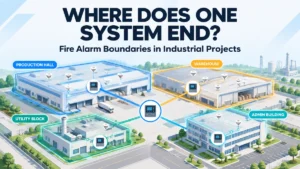
As industrial fire alarm systems become increasingly networked, the risk of a single network event affecting multiple system components grows. Without proper network segmentation, a communication fault, configuration error, or even a cybersecurity incident can propagate across an entire fire alarm network, disabling protection across multiple zones simultaneously.
9. Lack of Predictive Diagnostics
Most fire alarm systems, including many modern ones, are designed to report faults after they occur, not to predict them before they happen. Without predictive analytics that track device performance trends over time, maintenance teams cannot identify detectors drifting toward failure, batteries approaching the end of life, or communication paths degrading before they fail.
10. Improper Cause-and-Effect Programming
Fire alarm cause-and-effect programming defines how the system responds to detection events: which outputs activate, which zones suppress, which notifications are sent, and in what sequence. This programming must accurately reflect the current facility layout, occupancy, and operational requirements. Facilities that have been modified, expanded, or repurposed without corresponding updates to their fire alarm programming carry a hidden risk that only manifests during a real emergency.
11. Cybersecurity Weaknesses in Connected Systems
Modern industrial fire alarm systems increasingly connect to facility networks, cloud platforms, and remote monitoring services. This connectivity introduces cybersecurity risk that the fire safety industry has been slow to address. An unauthorised access event, malware infection, or denial-of-service attack targeting a connected fire alarm system could disable monitoring, generate false alarms, or suppress legitimate alerts at the worst possible moment.
12. Single-Point Failure Architecture
Many industrial fire alarm installations were designed without redundancy. A single panel failure, a single communication path failure, or a single power supply failure can take down protection across large facility sections. Modern industrial fire safety strategy requires redundant architecture backup panels, diverse communication paths, and distributed processing to eliminate single points of failure.
13. Maintenance Visibility Gaps
Without comprehensive maintenance logging and real-time visibility, facility managers cannot know whether required maintenance tasks have actually been completed, whether identified faults have been resolved, or whether device performance is trending in a concerning direction. Maintenance visibility gaps create accountability gaps, and accountability gaps create unmanaged risk.
14. Integration Failures with BMS and Emergency Systems
Fire alarm systems that fail to communicate correctly with Building Management Systems, emergency lighting controllers, HVAC systems, elevator recall systems, and public address infrastructure significantly limit coordinated emergency response. Integration failures are often discovered only during emergency drills or, worse, during real incidents.
15. Human Workflow Dependency
Many industrial fire safety processes depend on human action at critical moments, such as a security officer acknowledging an alarm, a maintenance technician resetting a fault, or a facility manager authorising an evacuation. Each human dependency introduces delay and error risk. Intelligent automation and autonomous coordination reduce the window of human-dependent response in high-stakes situations.
How These Overlooked Risks Affect Industrial Operations
The operational consequences of unmanaged fire safety infrastructure risk extend well beyond the immediate fire event:
Emergency Response Speed
Communication delays, integration failures, and improper cause-and-effect programming all extend the time between fire detection and effective response. In industrial environments where materials can burn rapidly or toxic smoke can accumulate quickly, even a 60-second delay in evacuation initiation or suppression activation can dramatically change outcomes.
Fire Detection Reliability
Ageing detectors, contaminated sensing elements, and degraded detection loops reduce the probability that a real fire event generates a timely alarm. Reduced detection reliability is the most fundamental failure of any fire protection system.
Operational Continuity and Facility Downtime
False alarms caused by contaminated detectors, ground faults, or poor system calibration drive costly operational interruptions. In manufacturing environments, false alarm evacuations halt production, damage in-process materials, and erode worker confidence in the fire safety system. Over time, repeated false alarms lead to alarm fatigue, a condition where occupants and operators begin treating alarms as routine rather than urgent.
Compliance Readiness
Industrial facilities operating under NFPA 72, BS 5839, IS 3218, or equivalent standards face real compliance exposure when hidden infrastructure risks go unaddressed. Regulatory inspectors are increasingly sophisticated in evaluating not just hardware presence but system performance, maintenance records, and integration documentation.
Insurance and Liability Exposure
Insurers are paying closer attention to fire alarm system performance data, maintenance records, and infrastructure age as factors in risk assessment and claims evaluation. A facility that cannot demonstrate continuous system health monitoring and proactive maintenance faces both higher premium exposure and reduced claims support in the event of a loss.
Deployment Perspectives: Risk Profiles Across Industrial Sectors
Manufacturing Plants
High dust concentrations, temperature variations, and vibration create accelerated detector degradation. Chemical fire processes require precisely configured cause-and-effect programming that must be updated whenever process layouts change. Conventional fire alarm panels often lack the per-device diagnostic resolution needed to manage large, complex detection networks.
Warehouses and Logistics Hubs
High rack storage creates complex fire behaviour that demands reliable early detection. Forklift traffic and pallet movements frequently damage detection cables and device housings. Battery backup systems serving large warehouse fire alarm installations are particularly vulnerable to degradation under the extended power-out conditions common in large logistics operations.
Oil and Gas Facilities
Explosive atmosphere classifications, extreme temperature ranges, and the presence of flammable vapours demand detection infrastructure with zero tolerance for drift or contamination. Ground fault management is critical in facilities where cable runs extend across large outdoor areas. Redundant communication paths and network segmentation are essential in distributed production environments.
Airports
Complex, multi-zone fire alarm networks spanning terminals, concourses, and support facilities require sophisticated event synchronisation and cause-and-effect management. Integration with airport operations centres, emergency lighting, and PA systems must function reliably under any failure condition. Single-point failure architecture is unacceptable in safety-critical aviation infrastructure.
Pharmaceutical Plants
Clean room environments impose strict limitations on detector types and maintenance access. Regulatory compliance demands detailed maintenance documentation and verifiable system performance records. Cause-and-effect programming must account for sensitive process areas where suppression activation could contaminate product batches.
Data Centres
Continuous uptime requirements make false alarms as operationally damaging as real fire events. Suppression systems protecting server environments require precise activation logic to avoid unnecessary discharge. Cybersecurity integration between fire alarm systems and IT infrastructure demands careful network design and protocol management.
Power Plants
Extended equipment lifespans in power generation facilities mean that ageing detection infrastructure is endemic. Cable insulation degradation in high-temperature environments accelerates ground fault risk. Remote and unmanned substations require autonomous monitoring and alert systems with reliable long-range communication.
Why Traditional Fire Safety Audits Miss Critical Infrastructure Risks
A traditional fire safety audit follows a structured checklist: verify device installation, test panel response, check battery voltage, and confirm documentation. This approach serves compliance validation well, but it is structurally inadequate for identifying hidden infrastructure risks.
Here is why:
- Audits test systems at a single point in time. They cannot reveal drift, degradation trends, or intermittent faults that resolve before the auditor arrives.
- Audit checklists focus on present-state compliance, not future-state reliability. A battery that passes today’s test may fail next month.
- Traditional audits rarely test integration performance under simulated emergency conditions. They verify that connections exist, not that they function correctly under load.
- Cause-and-effect programming is rarely fully validated during audits. Testing every possible detection-to-output path in a complex industrial facility requires dedicated simulation, not a standard audit process.
- Cybersecurity posture of connected fire alarm systems is rarely evaluated in traditional fire safety audits.
- Detector contamination and sensitivity drift are typically invisible to visual inspection and basic functional testing.
The result is a compliance documentation framework that can confirm a facility meets minimum standards while missing the operational vulnerabilities that determine whether the system will actually protect people and assets in a real emergency.
How Intelligent Fire Infrastructure Reduces Hidden Operational Risk
Intelligent fire safety infrastructure addresses the visibility gap that traditional systems leave open. The core shift is from reactive fault detection to continuous, predictive operational monitoring.
A modern addressable fire alarm panel does more than process alarm signals; it continuously collects performance data from every addressable detector on its loops. This data enables:
- Trend analysis that identifies detectors whose sensitivity is drifting before they reach fault thresholds.
- Early warning of loop instability, communication degradation, and power supply issues.
- Automated maintenance scheduling based on actual device performance data rather than fixed calendar intervals.
- Real-time integration health monitoring that confirms BMS, emergency lighting, and PA system connections are functioning correctly.
- Battery health modelling under simulated load conditions, not just static voltage measurement.
- Comprehensive event logging that supports post-incident analysis, compliance documentation, and insurance reporting.
Addressable detectors in a well-configured system report their own health status continuously. Contamination levels, sensitivity drift, communication quality, and power draw are all visible to facility managers and maintenance teams, not just to technicians with test equipment during scheduled visits.
This is the fundamental operational advantage of intelligent, addressable fire alarm ecosystems over conventional systems: continuous visibility into infrastructure health rather than periodic snapshots of point-in-time compliance.
Comparison: Traditional vs. Intelligent Fire Safety Infrastructure
| Capability Area | Traditional Reactive Infrastructure | Intelligent Predictive Infrastructure |
| Detection Monitoring | Zone-level fault alerts only | Per-device continuous health data |
| Maintenance Model | Scheduled and reactive | Predictive, data-driven scheduling |
| Battery Management | Annual voltage test | Continuous health modeling under load |
| Loop Diagnostics | Fault reported after threshold crossed | Trend data before fault threshold reached |
| Detector Contamination | Visible inspection only | Automatic contamination level reporting |
| Cause-and-Effect Validation | Manual testing only | Automated simulation and verification |
| BMS Integration Health | Assumed, not continuously verified | Real-time integration status monitoring |
| Cybersecurity Posture | Not typically addressed | Network segmentation and access controls |
| Compliance Documentation | Manual audit records | Automated, continuous performance logs |
| Redundancy Architecture | Often single-point failure | Distributed, redundant design |
| Emergency Coordination | Human-dependent workflow | Automated multi-system coordination |
| Remote Monitoring | Limited or absent | Cloud-connected continuous oversight |
| Scalability | Requires major reconfiguration | Software-configurable expansion |
Practical Risk-Reduction Recommendations for Industrial Facilities
Reducing hidden fire safety infrastructure risk requires a systematic approach that addresses both technology and process:
- Conduct a full infrastructure audit that goes beyond compliance checklists, including loop performance data, battery load testing, integration functional testing, and cause-and-effect validation.
- Transition from conventional to addressable fire alarm systems where facility scale and risk profile justify it. The per-device diagnostic visibility of an addressable fire alarm panel delivers operational value that conventional systems cannot match.
- Implement continuous remote monitoring for all mission-critical fire alarm infrastructure. Cloud-connected monitoring platforms allow real-time alerting on performance trends, not just hard faults.
- Establish a documented maintenance program that uses device performance data, not just fixed schedules, to drive maintenance activity.
- Validate BMS integration, emergency lighting coordination, and PA system connectivity under simulated emergency conditions at least annually.
- Review and update cause-and-effect programming whenever facility layout, occupancy, or operational processes change.
- Include cybersecurity assessment in fire system reviews, evaluate network access controls, firmware update processes, and remote access protocols.
- Design for redundancy: eliminate single points of failure in panel architecture, communication paths, and power supply systems.
The Future of Industrial Fire Safety: Intelligence, Prediction, and Autonomy
AI-Assisted Fire Diagnostics
AI-powered diagnostic engines can analyse the continuous data streams from addressable detection networks to identify failure patterns that human analysts would miss. Machine learning models trained on historical device performance data can predict detector failure days or weeks before any fault becomes visible in conventional reporting.
Predictive Fire Safety Analytics
Predictive analytics platforms aggregate data from fire alarm systems, environmental sensors, HVAC systems, and operational data sources to build dynamic risk models. These models can identify periods of elevated fire risk during specific production processes, weather conditions, or operational configurations and trigger preemptive monitoring or operational adjustments.
Cloud-Connected Fire Monitoring
Cloud-connected fire alarm monitoring enables facility managers, fire safety consultants, and emergency coordinators to access real-time system status from any location. Remote diagnostic capability reduces emergency response time and allows expert analysis of system behaviour without requiring on-site presence.
Intelligent Detector Health Monitoring
Next-generation addressable detectors incorporate onboard health monitoring that tracks sensing element performance, contamination accumulation, and environmental exposure over time. This data feeds directly into maintenance management systems, enabling true condition-based maintenance rather than time-based replacement cycles.
IoT-Driven Fire Infrastructure
IoT integration connects fire alarm systems with broader facility operational technology, creating a unified operational picture that allows for smarter emergency response coordination. When a fire event is detected, integrated IoT systems can automatically initiate controlled shutdown of adjacent processes, redirect material handling equipment, and optimise evacuation routing based on real-time occupancy data.
Digital Twins for Industrial Fire Safety
Digital twin technology creates a continuously updated virtual model of a facility’s fire safety infrastructure. This model supports scenario simulation, commissioning validation, cause-and-effect testing, and training exercises, all without affecting live system operation. Digital twins also enable rapid impact assessment when facility modifications are planned.
Autonomous Emergency Coordination
The most advanced industrial fire safety platforms are moving toward autonomous emergency coordination where detection, notification, suppression, evacuation, and emergency service alert happen through automated, verified processes rather than human-dependent workflows. Autonomous coordination eliminates the human response delay that can be the critical factor in a rapidly developing industrial fire event.
Scalability and Long-Term Infrastructure Planning
Industrial facilities evolve continuously, processes change, buildings expand, and occupancies shift. Fire safety infrastructure must be designed to scale with these changes rather than requiring complete replacement with each facility modification.
Modern GST fire alarm systems and other addressable fire alarm ecosystems are designed with scalability as a core principle. Software-configurable cause-and-effect programming, modular panel architecture, and addressable detection loops that support device addition without rewiring all contribute to a fire safety infrastructure that grows with the facility rather than constraining it.
Long-term infrastructure planning should address:
- Migration pathways from conventional to addressable systems that protect existing cabling investments.
- Network architecture that supports future cloud connectivity and remote monitoring integration.
- Panel and loop capacity that accommodates planned facility expansion without panel replacement.
- Redundancy architecture that can be implemented incrementally as operational requirements evolve.
- Documentation and configuration management practices that maintain system accuracy as facility modifications accumulate.
Read Also: Why Detector Placement Can Make or Break Fire Detection Efficiency
Read Also: The Real Difference Between Cheap and Intelligent Fire Alarm Systems