Walk into almost any commercial building, hospital, industrial plant, or data centre today, and you will find a fire alarm system. You will see detectors on ceilings, manual call points on walls, and a fire alarm panel somewhere near the entrance. On paper, the system exists. On paper, the last annual inspection was completed. On paper, the building complies.
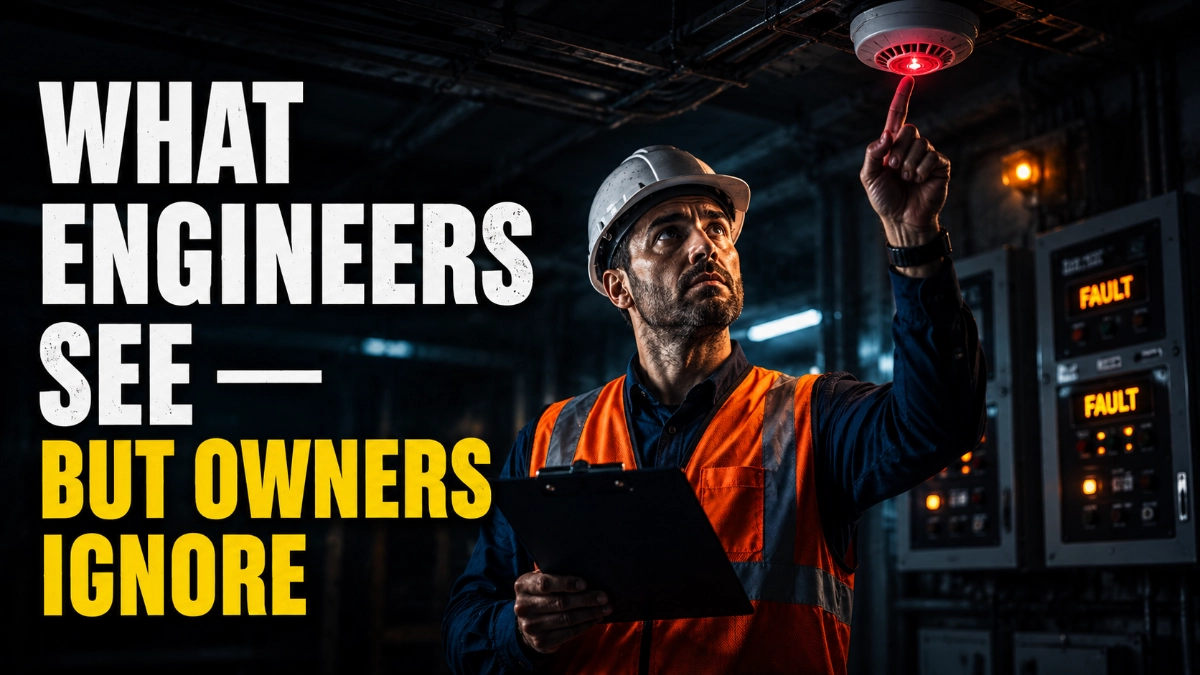
But ask a senior fire alarm engineer what they see, and the answer is often very different.
What engineers observe during maintenance visits and technical audits reveals a persistent and dangerous gap: the gap between a system that is installed and a system that is genuinely reliable. This gap does not always show up on compliance checklists. It does not always trigger panel faults. And it rarely announces itself until the moment a real emergency exposes it.
This article documents exactly what experienced fire alarm engineers notice during inspections, the overlooked details, the silent risks, and the hidden vulnerabilities that facility owners, building managers, and even maintenance contractors often miss. More importantly, it explains why these details matter, how they accumulate over time, and what a proactive engineering strategy looks like in practice.
The Difference Between ‘System Installed’ and ‘System Truly Reliable’
The distinction sounds simple but carries serious operational weight. A system that is installed means detectors are physically present, cables are connected, and the panel powers up. A system that is truly reliable means every component performs correctly under real emergency conditions, every time.
This reliability gap widens gradually. A detector installed five years ago may have drifted in sensitivity. A battery replaced three years ago may no longer hold an adequate charge. A detector sitting directly in the path of an air conditioning vent may dilute smoke concentrations so efficiently that it would never trigger in a real fire scenario.
None of these failures appears as faults on the panel display. None of them triggers an alarm. None of them shows up in a basic pass/fails compliance record. But they fundamentally compromise the system’s ability to detect fire early and reliably.
Experienced engineers understand this distinction instinctively. Their evaluation goes far beyond basic functionality checks. They assess system health holistically, looking at component age, environmental conditions, configuration logic, maintenance history, integration quality, and installation standards. The result is a genuinely different picture of system readiness.
17 Critical Issues Fire Alarm Engineers Notice and Facility Owners Miss
These are the issues that regularly appear during technical audits and engineering reviews. Each one silently reduces system reliability. Taken together, they can make the difference between early detection and catastrophic failure.
1. Dirty or Ageing Smoke Detectors
Smoke detectors accumulate dust, insects, and airborne contaminants over time. In industrial facilities, warehouses, and manufacturing plants, this contamination happens faster. A detector filled with debris does not perform the same as a clean unit.
Some detectors develop nuisance alarms as contamination triggers false positives. Others become desensitised and may fail to detect actual smoke at normal concentrations. Engineers check detector cleanliness and contamination levels as a standard part of any meaningful inspection. In addressable fire alarm systems, panel diagnostics can flag detectors approaching contamination thresholds before they become problematic.
2. Improper Detector Placement
Placement errors are surprisingly common, even in buildings that have been operational for years. Detectors installed too close to air conditioning supply grilles, too far from hazard areas, or in locations where structural beams create dead air pockets will underperform in genuine fire conditions.
In high-bay warehouses, detectors mounted below rack storage may never encounter the smoke rising from a ground-level fire until it has grown significantly. In data centres with raised floor systems and overhead cable trays, detector placement relative to airflow patterns is critical. Engineers evaluate placement logic against real airflow dynamics and fire development patterns, not just grid spacing compliance.
3. Unacknowledged Loop Faults
Many fire alarm panels carry persistent fault conditions that site staff have simply learned to ignore. A common scenario: a short circuit or open circuit fault on a detection loop appears on the panel, is noted, and is never rectified. Maintenance staff press the acknowledge button and continue with their day.
Unacknowledged faults represent real system vulnerabilities. Devices on a faulted loop segment may not communicate correctly. In a genuine emergency, this can mean delayed or absent alarm signals from affected zones. Conventional fire alarm panel installations are especially vulnerable if loop monitoring is not configured correctly. Addressable panels provide more granular fault reporting, but only deliver value if faults are actually investigated and resolved.
4. Ground Fault Instability
Ground faults develop when cable insulation deteriorates, moisture enters conduit systems, or mechanical damage exposes wiring. In many facilities, low-level ground faults appear intermittently, sometimes showing on the panel, sometimes clearing on their own.
Engineers treat intermittent ground faults seriously. A fault that clears itself is often a fault in a worse location or condition than a stable fault. Ground fault instability can interfere with device communication on addressable loops and can, in rare cases, cause spurious activations or system lockouts. Proactive cable condition assessment and insulation resistance testing are essential diagnostic steps.
5. Weak or Degraded Backup Batteries
Every fire alarm panel relies on standby batteries to maintain operation during a mains power failure. Most compliance checks verify that batteries are present and show no fault on the panel display. Engineers go further they conduct load testing to verify actual capacity.
A battery that shows no fault may have degraded significantly from its original rated capacity. In a 24-hour mains failure scenario, an undersized or aged battery may exhaust itself long before emergency services have resolved the situation. Hospitals, data centres, and critical infrastructure facilities face the most serious consequences from inadequate battery backup. Battery replacement on a predictive maintenance schedule rather than waiting for failure is standard engineering practice.
6. Detector Sensitivity Drift
Optical and ionisation smoke detectors drift in sensitivity over their operational lifespan. Without proper calibration verification, a detector can become either too sensitive, generating nuisance alarms, or too insensitive, potentially missing a real fire event in its early stages.
Modern addressable detectors allow engineers to read sensitivity values directly from the panel or via diagnostic software. This capability transforms sensitivity management from a reactive process into a predictive one. Regular sensitivity profiling across all addressable detectors gives engineers a clear picture of which devices need attention before they cause problems.
7. Poor Cable Management
Cable management quality reveals a great deal about the overall standard of an installation. Engineers look for cables running without adequate support, cables sharing conduit with power circuits without appropriate segregation, cables with damaged insulation near sharp edges or through unprotected penetrations, and fire-rated cable runs that have been compromised by subsequent building works.
Poor cable management is not just an aesthetic issue. It creates genuine vulnerability to mechanical damage, electromagnetic interference, and critically, to fire-induced circuit failure before detection and alarm signals can be transmitted.
8. Environmental Interference
Environmental conditions in industrial facilities, food processing plants, and manufacturing environments can severely affect fire detection performance. Steam, aerosols, dust, chemical vapours, and rapid temperature changes all interfere with specific detector technologies.
Engineers evaluate whether the detector technology deployed in each area matches the actual environmental conditions. A standard optical smoke detector in a steam-rich environment will generate persistent false alarms. A heat detector in a large open warehouse may respond far too slowly to provide meaningful early warning. Matching technology to the environment is a fundamental engineering decision that basic compliance inspections do not always verify.
9. HVAC Airflow Affecting Smoke Detection
Heating, ventilation, and air conditioning systems profoundly influence smoke movement within a building. High air change rates in cleanrooms, laboratories, server rooms, and commercial kitchens can dilute smoke concentrations below detection thresholds. Air supply grilles can create turbulence patterns that carry smoke away from nearby detectors.
In large atrium spaces, smoke stratification where hot smoke layers rise but then cool and spread horizontally before reaching detector height, can prevent point detectors from activating until fire growth is already advanced. Engineers assess HVAC operating modes and their interaction with detection coverage as part of a comprehensive system review.
10. Blocked Manual Call Points
Manual call points, the red break-glass units positioned at exit routes, are often blocked by equipment, furniture, stored materials, or signage in the months and years after initial installation. In a real emergency, a blocked call point could prevent an occupant from raising the alarm quickly.
Engineers conduct physical walkthroughs, specifically checking call point accessibility. In large commercial or industrial facilities, call points in loading bays, plant rooms, and storage areas are particularly prone to obstruction. The 300mm clear zone requirement around manual call points is frequently violated without anyone noticing.
11. Device Communication Delays
On large addressable fire alarm systems with many devices on a single loop, communication timing becomes an engineering concern. An overloaded loop with too many devices, excessive cable run lengths, or marginal power supply margins can exhibit communication delays that affect response time.
Engineers test loop communication performance, verify device polling rates, and check power supply loading margins. Devices near the end of long cable runs, or those with marginal signal levels, are particular areas of focus. In mission-critical environments, loop performance testing forms part of regular preventive maintenance.
12. Overloaded Detection Loops
System expansions and building modifications frequently result in additional devices being added to existing detection loops without a proper engineering review. Over time, a loop designed for 100 devices may be carrying 140 or more. Power loading margins, cable resistance, and communication bandwidth all suffer.
Overloaded loops are a common finding in buildings that have undergone multiple fit-out changes, particularly in commercial towers, educational campuses, and healthcare facilities. Engineers check current loop documentation against actual installed device counts and verify that power supply loading remains within manufacturer specifications.
13. Ignored Trouble Warnings
Perhaps the most pervasive issue in facility management is the normalisation of panel trouble warnings. A trouble LED illuminated on the panel becomes part of the furniture. Staff learn the sequence of button presses to silence the indicator without understanding or addressing the underlying cause.
Trouble warnings exist for a reason. Each one represents a condition that reduces system reliability. Engineers document every active trouble condition during an inspection visit and provide a prioritised remediation schedule. Facilities with long-standing unresolved trouble conditions typically have deeper systemic maintenance problems.
14. Poor Maintenance Documentation
Reliable fire alarm system operation depends on accurate and up-to-date documentation. Engineers regularly encounter facilities where as-built drawings do not reflect the current installed configuration, cause-and-effect programming matrices have never been updated after system changes, and maintenance records show test completions without meaningful data.
Without accurate documentation, troubleshooting becomes guesswork, system expansions risk conflicts with existing configuration, and audit trails for compliance purposes are unreliable. Building owners who invest in thorough documentation management, including digital records linked to their building management system, operate at a measurably lower risk level.
15. Incomplete Cause-and-Effect Programming
A fire alarm system is not just a collection of detectors and sounders. In modern buildings, it is a decision-making system that controls door releases, pressurises stairwells, shuts down HVAC systems, releases suppression systems, triggers elevator recalls, and communicates with building management platforms.
Incomplete or incorrect cause-and-effect programming is a serious finding. Engineers verify that all programmed responses are logically correct, physically functional, and consistent with current occupancy and hazard profiles. In hospitals and high-rise commercial buildings, cause-and-effect logic errors can have severe consequences during an actual fire event.
16. Inconsistent Testing Procedures
Annual testing is the minimum standard. But what gets tested, how it gets tested, and whether test results are meaningfully evaluated vary enormously between facilities. Engineers frequently find that only accessible detectors are tested, that testing is conducted in isolation from integrated systems, and that test records record pass/fail without capturing actual response times or sensitivity readings.
A rigorous testing programme includes detector sensitivity measurements, battery load testing, loop integrity testing, integrated system response verification, and periodic full-system evacuation drills. Facilities that conduct only the minimum required testing accumulate hidden reliability deficits over time.
17. Fire Alarm Integration Gaps with BMS Systems
In smart buildings and modern commercial developments, the fire alarm system is expected to integrate seamlessly with the building management system, the access control system, the elevator control system, and increasingly with cloud-based monitoring platforms. Integration gaps where the fire alarm triggers a response but the BMS does not receive or action it correctly, are discovered regularly during engineering audits.
Integration testing requires joint commissioning between fire alarm engineers and BMS specialists. It needs to be repeated whenever either system is upgraded or modified. Facilities that treat fire alarm and BMS commissioning as separate, independent activities regularly discover integration failures at the worst possible moment.
How These Issues Impact Real-World Operations
Understanding what engineers notice is only half the picture. Equally important is understanding how these overlooked issues translate into operational consequences.
| Overlooked Issue | Operational Impact |
| Dirty or drifted detectors | Delayed detection or false alarms; occupant desensitisation |
| Improper placement | Coverage gaps; fire can grow before detection threshold is reached |
| Unacknowledged faults | Devices may not report in emergency; zoning reliability compromised |
| Weak backup batteries | System failure during mains outage; no alarm in a power-cut fire |
| HVAC interference | Smoke diluted below detection threshold; no early warning |
| Blocked call points | Occupants cannot raise manual alarm; delayed evacuation |
| Overloaded loops | Communication delays; possible missed device responses |
| Integration gaps with BMS | Door releases, HVAC shutdowns, elevator recalls may not operate |
| Incomplete cause-and-effect | Suppression may not activate; HVAC may continue feeding fire |
| Poor documentation | Troubleshooting delays; compliance audit failures; undetected changes |
Warning Signs Facility Owners Should Never Ignore
Based on field experience across industrial facilities, commercial towers, hospitals, and data centres, these are the warning signs that should prompt an immediate engineering review:
| Critical Warning Signs: Act Immediately. If you observe any of the following, do not wait for the next scheduled inspection. |
- A panel trouble indicator that has been illuminated for more than 48 hours without investigation.
- Smoke detectors that are visibly discoloured, dusty, or show signs of insect infestation.
- Manual call points that are obstructed, damaged, or positioned where they cannot be easily reached.
- A fire alarm that has triggered multiple false alarms in recent months without a root cause being identified.
- Battery replacement records showing batteries are more than three years old.
- An inability to locate current as-built drawings or cause-and-effect matrices for the installed system.
- System expansions or building modifications completed without a fire alarm engineering review.
- Integration functions, door releases, and HVAC shutdowns that have not been tested in over 12 months.
- Panel log entries showing repeated device faults on the same zone or loop.
- Site staff who cannot clearly explain how to interpret panel fault conditions.
How Fire Alarm Engineers Evaluate System Health Beyond Compliance
A compliance inspection answers a simple question: Does the system meet the minimum standard required by current regulations? A proper engineering evaluation answers a different and more important question: Is this system reliably capable of performing its intended function under real emergency conditions?
Experienced fire alarm engineers use a layered evaluation approach that covers the following domains:
Physical Condition Assessment
Engineers conduct a physical walkthrough evaluating detector condition, mounting integrity, cable runs, call point accessibility, sounder and beacon locations, and control panel condition. They look for evidence of physical damage, environmental exposure, and installation quality issues.
Functional Performance Testing
Beyond basic activation testing, engineers verify detector sensitivity values on addressable systems, conduct battery load testing, verify sounder coverage levels against evacuation alarm standards, and test integrated system responses, including door releases, HVAC shutdowns, and suppression system triggers.
Loop and Network Integrity
For addressable fire alarm panels, engineers verify loop loading margins, communication timing performance, cable insulation resistance, and device polling reliability. Network-connected systems also undergo communication pathway verification.
Programming and Logic Review
Cause-and-effect programming is reviewed against current occupancy and hazard conditions. Zone configurations are verified against current floor plans. System software versions are noted and compared against the manufacturer’s current releases.
Documentation and Records Audit
Engineers compare installed configuration against as-built drawings, review maintenance records for completeness and accuracy, check detector replacement and battery replacement history, and verify that previous fault conditions have been appropriately resolved.
Integration Verification
All interfaced systems, BMS, access control, elevator control, suppression systems, and monitoring stations are tested jointly to verify that integration pathways are functional and that programmed responses operate correctly.
Basic Compliant System vs. Well-Engineered and Proactively Maintained System
| Aspect | Basic Compliant System | Well-Engineered Proactive System |
| Inspection frequency | Annual minimum | Quarterly or continuous monitoring |
| Detector management | Replace on failure | Predictive replacement based on sensitivity data |
| Battery management | Replace on panel fault | Scheduled replacement + load testing |
| Documentation | Paper-based, often outdated | Digital, real-time, linked to BMS |
| Fault management | React when noticed | Proactive resolution within defined SLAs |
| Loop monitoring | Basic continuity | Full communication performance logging |
| Integration testing | At commissioning only | Regular joint testing with all interfaced systems |
| Cause-and-effect review | At commissioning only | Reviewed at every occupancy or system change |
| Environmental assessment | Not typically included | Included in engineering audit programme |
| Diagnostic capability | Limited panel fault display | Full addressable diagnostics, cloud reporting |
| False alarm management | Reactive investigation | Proactive sensitivity management programme |
| Lifecycle planning | Reactive replacement | Planned lifecycle management schedule |
Real-World Scenarios: What Engineers Find Across Different Environments
Industrial Facilities and Manufacturing Plants
In manufacturing environments, engineers regularly encounter detectors heavily contaminated with airborne particles from production processes. Conventional fire alarm panel installations in large plant areas often have outdated zone configurations that no longer reflect current equipment layouts. Heat detector technologies in areas with high ambient temperatures are frequently operating near their threshold, reducing detection margin significantly.
Commercial Towers and Office Buildings
Multi-tenancy buildings undergo continuous internal modifications. Tenant fit-outs routinely result in new partitions being built without smoke detector repositioning, detection zones that no longer align with physical compartmentation, and cause-and-effect programming that references spaces which no longer exist in their original form.
Hospitals and Healthcare Facilities
In hospitals, the consequences of fire alarm failure are uniquely severe. Engineers in healthcare environments particularly focus on cause-and-effect logic for fire door releases, smoke exhaust system activation, and zonal alarm management that supports staged evacuation. GST fire alarm system installations in healthcare are common in certain markets and require specific programming expertise to be maintained correctly.
Data Centres
Data centres combine high airflow rates, dense equipment loading, and extremely low tolerance for false alarms. Engineers evaluate aspirating smoke detection systems for filter condition and sampling hole blockage, verify suppression system trigger logic, and assess the impact of hot-aisle/cold-aisle containment on smoke movement patterns. Integration between fire alarm and facility management platforms is critical.
Educational Campuses
Large campuses with multiple buildings and complex networked fire alarm systems frequently suffer from incremental expansion problems. Buildings added to an existing networked system without a full engineering review can create loop loading problems, communication delays, and cause-and-effect programming gaps. Battery systems in older campus buildings often have not been load-tested for years.
Hotels
Hotels present unique challenges around guest room detector management, kitchen and laundry false alarm suppression, and integrated systems covering multiple occupancy types within a single building. Addressable detectors in hotel environments require regular sensitivity management to balance false alarm suppression with genuine detection reliability.
Smart Buildings
Modern smart buildings with integrated BMS platforms and cloud-connected building systems present new challenges around fire alarm integration reliability. Engineers in smart building environments verify communication pathway resilience, assess cybersecurity controls on networked fire alarm infrastructure, and ensure that software updates to BMS or fire alarm panel firmware do not inadvertently disrupt integration functions.
The Future of Fire Alarm Engineering: Intelligence, Analytics, and Connectivity
The fire alarm industry is undergoing a significant transformation driven by advances in sensor technology, network connectivity, data analytics, and artificial intelligence. Facilities that understand this shift can use it to achieve genuinely higher safety and reliability standards, not just better compliance records.
Intelligent Self-Diagnostic Systems
Modern addressable fire alarm panels and addressable detectors increasingly incorporate self-diagnostic capabilities. Detectors report their own contamination levels, sensitivity drift, and communication quality back to the panel continuously. Engineers can extract this data and use it to manage device lifecycles predictively rather than reactively.
AI-Assisted Fire System Monitoring
AI-powered monitoring platforms are beginning to analyse fire alarm event data, fault patterns, and environmental sensor readings to identify developing problems before they cause failures. Machine learning models trained on large event datasets can detect anomalies that human reviewers would miss, distinguishing, for example, between a detector sensitivity trend that indicates natural ageing and one that indicates an environmental change requiring immediate investigation.
Predictive Maintenance
Cloud-connected fire alarm infrastructure enables remote monitoring of system health parameters across multiple sites simultaneously. Facility owners with large property portfolios can move from a schedule-based maintenance model to a condition-based one, prioritising engineering attention on the sites and systems that genuinely need it, rather than applying equal resources regardless of actual condition.
Smart Detector Analytics
Next-generation detector analytics go beyond simple smoke detection. Multi-sensor detectors analyse temperature profiles, carbon monoxide concentrations, optical particle characteristics, and humidity simultaneously. This multi-parameter analysis significantly reduces false alarm rates while improving genuine detection performance, a critical advance for facilities like food processing plants, laundries, and industrial kitchens where single-parameter detectors struggle.
Cloud-Connected Fire Infrastructure
Cloud connectivity enables continuous remote monitoring, automated fault reporting, maintenance scheduling integration, and real-time emergency services notification. For facility owners managing multiple sites, cloud-connected platforms provide a consolidated view of fire system health across the entire estate, transforming fire safety management from a site-by-site paper exercise into a data-driven strategic function.
Cybersecurity in Connected Fire Alarm Networks
As fire alarm systems become network-connected, cybersecurity becomes an engineering concern. A compromised fire alarm network could theoretically be used to trigger false evacuations, suppress genuine alarms, or disable integrated systems. Engineers assessing connected fire alarm infrastructure now routinely evaluate network segmentation, access controls, firmware update management, and logging of remote access events. Facility owners should ensure that cybersecurity considerations form part of their fire alarm system procurement and maintenance specifications.
Integrated Building Safety Ecosystems
The long-term direction of building safety technology is toward fully integrated ecosystems where fire alarm, access control, CCTV, BMS, occupancy management, and emergency communications operate as a coordinated platform. Fire alarm engineers working in this environment need to understand not just detection and alarm technology, but the broader system architecture within which fire safety functions are embedded.
Practical Inspection and Maintenance Recommendations
Based on engineering best practice across a range of facility types, the following actions represent the minimum proactive programme that facility owners should maintain:
- Conduct engineering audits, not just compliance inspections, at least every two years for standard occupancies and annually for critical facilities.
- Implement a detector sensitivity monitoring programme using addressable panel diagnostic data.
- Conduct battery load testing at intervals consistent with battery age and manufacturer guidance, not just visual panel checks.
- Maintain current as-built documentation and update it immediately following any building modification or system change.
- Verify integrated system responses, door releases, HVAC shutdowns, and suppression triggers at least annually and following any system modification.
- Establish a loop loading register and review it before any additional devices are connected.
- Implement a formal fault management process with defined response times for different fault severity levels.
- Review cause-and-effect programming whenever occupancy patterns, hazard profiles, or building configurations change.
- Engage a qualified fire alarm engineer, not just a maintenance technician, to conduct periodic system health reviews.
- For facilities with cloud-connected or networked fire alarm systems, include a cybersecurity review in the engineering audit scope.
Read Also: The Most Overlooked Risk in Industrial Fire Safety Infrastructure
Read Also: Why Detector Placement Can Make or Break Fire Detection Efficiency