Walk through any modern manufacturing plant, warehouse, or industrial campus, and you will find surveillance cameras everywhere. Yet despite round-the-clock recording, incidents still occur, and many go undetected until significant damage is already done.
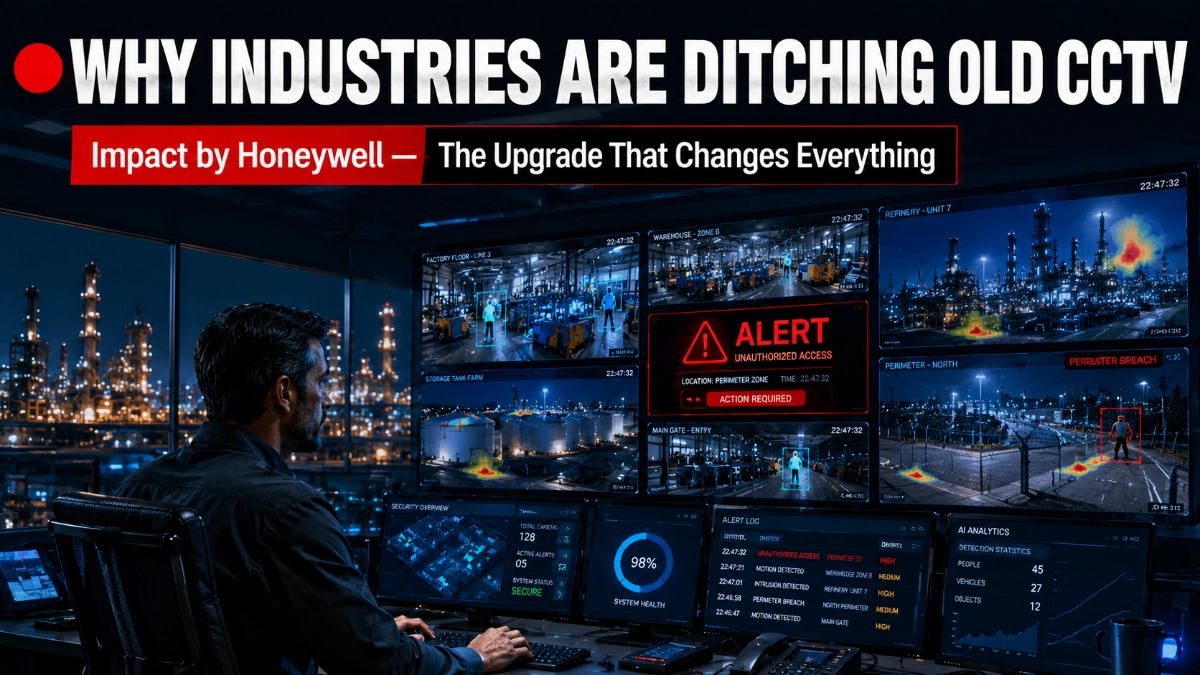
The problem is not a lack of cameras. The problem is a lack of intelligence.
Traditional CCTV systems were designed to record. Today’s industrial environments demand something far more capable: proactive surveillance that detects threats, monitors operations, and responds to incidents in real time across multiple locations simultaneously. This is why industries across manufacturing, logistics, energy and critical infrastructure are switching to Impact by Honeywell CCTV.
What Is Impact by Honeywell CCTV?
Impact by Honeywell is an enterprise-grade, AI-powered video surveillance and management platform built for complex industrial and commercial environments. It combines high-performance hardware with intelligent software to deliver unified, scalable, and cyber-resilient surveillance.
Unlike conventional CCTV that treats cameras as passive recorders, Impact by Honeywell transforms every device into an intelligent data point within a networked ecosystem that monitors, analyses, and reports in real time. Core capabilities include:
- Centralised Video Management System (VMS) with multi-site support.
- AI-powered video analytics at the edge and server level.
- Hybrid cloud and on-premises storage flexibility.
- Open API architecture for third-party integration.
- Cybersecurity-hardened communication and data protection.
Problems with Traditional Industrial CCTV Systems
Understanding why industries are switching starts with recognising what traditional systems get wrong.
Reactive, Not Proactive
Legacy CCTV records events but does not act on them. Security teams review footage after an incident, losing critical response time. Basic motion detection floods operators with false alarms, causing alert fatigue and allowing real threats to go unnoticed.
No Centralised Management
Managing multiple sites through disconnected DVR or NVR systems creates operational chaos. There is no unified dashboard, no consistent policy enforcement, and no real-time awareness across locations.
Poor Integration and Cybersecurity Gaps
Traditional CCTV operates in silos. It does not communicate with access control, alarm, or industrial automation systems. Many legacy systems also run outdated firmware with unencrypted communication, a serious vulnerability in an era of growing cyber-physical threats.
Key Reasons Industries Are Switching
1. Centralised Multi-Site Monitoring
Impact by Honeywell enables security teams to monitor all facilities from a single unified dashboard. Whether an organisation runs three warehouses or thirty factories, every camera feed, alert, and event log is visible in one place. This eliminates blind spots, reduces staffing redundancy, and enables faster decisions across the enterprise.
2. AI-Powered Video Analytics
This is the core differentiator. The platform’s AI engine transforms raw video into actionable intelligence, detecting not just movement but meaning. Capabilities include:
- Behavioural analysis: loitering, crowding, restricted zone entry.
- PPE compliance monitoring: helmets, vests, goggles.
- Licence plate recognition for vehicle access management.
- Slip, trip, and fall detection in safety-critical zones.
- Intrusion detection with intelligent boundary enforcement.
The system distinguishes between a person walking near a perimeter and an actual intrusion, dramatically reducing false alerts and giving security teams fewer, more meaningful notifications to act on.
3. Scalability Without Compromise
Industrial operations grow. Impact by Honeywell scales seamlessly, adding cameras, sites, and analytics without disrupting existing infrastructure. The platform supports thousands of cameras across geographically distributed environments, making it suitable for a single large campus and a global enterprise alike.
4. Cybersecurity-Focused Architecture
Built with cyber-physical security as a foundational principle, the platform incorporates end-to-end encrypted video transmission, role-based access control (RBAC), automated firmware patch management, and compliance reporting aligned with IEC 62443 and NIST CSF frameworks.
5. Seamless Industrial Integration
The open API architecture connects Impact by Honeywell with access control systems, building management systems (BMS), SCADA/industrial control platforms, fire detection systems, and ERP tools, transforming surveillance from a standalone function into core operational infrastructure.
6. Storage Optimisation and Intelligent Search
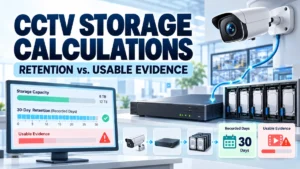
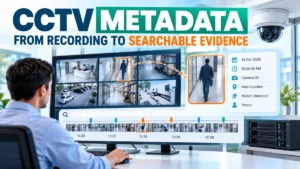
AI-driven storage management retains only relevant footage at full quality, reducing storage costs by up to 50% compared to continuous recording. Intelligent video search allows operators to locate specific footage by object type, behaviour, time, or location, cutting investigation time from hours to minutes.
7. Edge Analytics and Hybrid Cloud Support
Edge AI processing runs analytics directly on the camera or edge device, reducing bandwidth consumption and enabling real-time intelligence even in remote locations. Hybrid cloud compatibility lets organisations choose where data is stored on-premises, in the cloud, or both, supporting data sovereignty and disaster recovery requirements.
Traditional CCTV vs. Impact by Honeywell
| Feature | Traditional CCTV | Impact by Honeywell |
| Monitoring Mode | Reactive (post-incident) | Proactive (real-time AI) |
| Analytics | Basic motion detection | AI: behaviour, PPE, LPR, intrusion |
| False Alerts | High | Low — context-aware classification |
| Multi-Site Management | Fragmented | Unified centralised dashboard |
| Cybersecurity | Minimal, often unencrypted | Encrypted, RBAC, audit logs |
| Integration | Standalone | Open API: OT, IT, BMS, access control |
| Storage | Continuous, high cost | AI-optimised, event-based retention |
| Incident Response | Manual, slow | Automated alerts, second-level detection |
| Cloud Support | None or basic | Full hybrid cloud compatibility |
Real-World Use Cases
Manufacturing Plants
An automotive components manufacturer deployed Impact by Honeywell across three production facilities. The system monitors PPE compliance, tracks forklift movement near pedestrian zones, and detects unsafe behaviour in real time. Incident reports dropped by 40% within six months.
Warehouses and Logistics
A national e-commerce distributor integrated the platform across twelve warehouse locations. Centralised monitoring reduced security headcount, while intelligent video search cut investigation time from four hours to under fifteen minutes per incident.
Oil and Gas Facilities
An energy operator monitoring remote hazardous environments deployed ruggedised, ATEX-compliant hardware with encrypted feeds to a central control room. Intrusion detection at unmanned sites reduced security patrol costs by 60%.
Critical Infrastructure
Power utilities and water treatment facilities use Impact by Honeywell to meet Critical Infrastructure Protection (CIP) compliance requirements, while AI analytics continuously monitor sensitive equipment zones for anomalous activity.
How Intelligent Surveillance Is Transforming Industrial Operations
The shift from passive recording to active intelligence is reshaping how organisations think about surveillance. It is no longer purely a security function; it has become an operational tool.
- Safety: AI detects unsafe behaviours before they cause injury, PPE violations, proximity alerts near machinery, and slip and fall risks.
- Operations: Camera feeds generate structured data on occupancy, equipment utilisation, and movement patterns for management decisions.
- Predictive: Emerging analytics identify patterns that precede incidents, enabling proactive maintenance and risk mitigation.
- Unified Command: Enterprises are consolidating security and operations monitoring into single command centres powered by intelligent video platforms.
The Future of Industrial Surveillance
The trajectory is clear: AI capabilities will deepen, edge processing will expand, and cloud management will become standard. The boundary between physical security and operational intelligence will continue to dissolve.
Next-generation developments include predictive analytics that anticipate incidents before they occur, autonomous response capabilities that trigger lockdowns and emergency protocols without human authorisation, and tighter cyber-physical integration across connected industrial environments.
Organisations that invest in intelligent surveillance infrastructure today are not just solving a security problem; they are building an operational intelligence asset that will increase in value as AI capabilities continue to advance.
Read Also: How Video Analytics Is Reshaping Industrial Surveillance
Read Also: Why Enterprises Are Rebuilding Surveillance Infrastructure from Scratch