Walk into any large industrial facility built more than a decade ago, and you will find a security control room filled with monitors, each streaming live footage from dozens of cameras. Somewhere in that room, a guard sits watching. Or rather, appearing to watch. Research consistently shows that after just 20 minutes of continuous video monitoring, a human observer misses more than 95% of all on-screen activity. For industrial environments where seconds matter and threats come in many forms, that statistic is not just a performance concern. It is a liability.
Traditional CCTV systems were designed to record. They captured events so that security teams could review footage after an incident. They were, by design, reactive. The camera watched. The hard drive is stored. The human reviewed. And by the time anyone acted, the window for prevention had usually closed.
This model is no longer sufficient for the complexity of modern industrial operations. Today’s manufacturing plants, warehouses, oil refineries, data centres, and logistics hubs operate around the clock, across vast perimeters, with thousands of daily personnel movements, vehicle flows, and equipment interactions. Security teams cannot scale fast enough to monitor all of it manually. And the consequences of a missed intrusion, a safety violation, or an undetected hazard can be catastrophic.
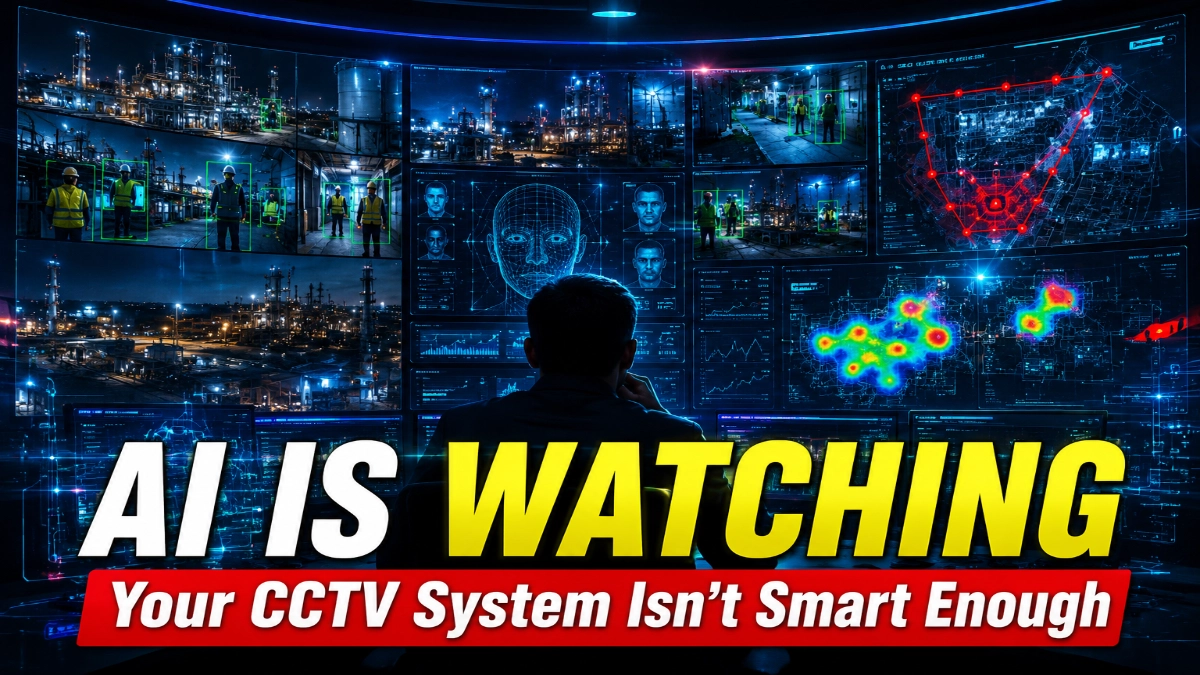
Video analytics changes this equation entirely. By embedding artificial intelligence directly into the surveillance pipeline, industrial facilities can now extract actionable intelligence from every camera feed, every second of every day, without relying on human attentiveness. The camera no longer just watches. It understands.
What Is Video Analytics? A Clear Definition
Video analytics, also called intelligent video surveillance (IVS) or video intelligence, refers to the automated analysis of video content using computer vision, machine learning, and artificial intelligence algorithms. Rather than simply recording visual data, a video analytics system interprets what it sees and generates structured, actionable outputs.
At its core, video analytics works by analysing pixel data in real time or near-real time. The system identifies objects, classifies them, tracks their movement, and compares observed behaviour against predefined rules or learned patterns. When something falls outside expected parameters, the system generates an alert, logs an event, or triggers an automated response.
The difference between a standard CCTV system and an AI-powered video analytics platform is the difference between a security camera and a security analyst. One record. The other reasons.
Standard CCTV vs. Intelligent Video Analytics
Standard CCTV systems operate on a simple input-output model: the camera captures video, the signal is transmitted, and the footage is stored. Any intelligence applied to that footage depends entirely on a human reviewing it.
Intelligent video analytics adds a processing layer between capture and storage. Every frame is analysed algorithmically. Objects are detected and labelled. Movement patterns are mapped. Anomalies are flagged. The system generates metadata alongside the video stream, turning raw footage into searchable, structured security data.
This shift fundamentally changes how industrial security operates, moving teams from surveillance to supervision, from watching to directing.
How AI and Machine Learning Enhance Industrial Surveillance
Modern video analytics platforms are powered by deep learning models, particularly convolutional neural networks (CNNs), trained on vast datasets of human, vehicle, and object behaviour. These models learn to recognise patterns with high accuracy and adapt over time through continuous training.
The practical result is a system that can distinguish between a person walking normally and a person behaving suspiciously, tell the difference between an authorised vehicle and an unknown one, detect a worker missing their hard hat among a crowd of hundreds, and identify early visual signs of fire or smoke before sensors trigger.
Unlike rule-based systems that rely on fixed parameters, AI-powered analytics platforms improve with exposure. The more data they process in a specific environment, the more accurately they model normal behaviour and the more precisely they detect deviations from it.
Key Video Analytics Technologies in Industrial Surveillance
1. Object Detection and Classification
Object detection is the foundational capability of any video analytics system. Using deep learning models, the system identifies and classifies objects within the camera frame: people, vehicles, machinery, packages, and more. In industrial settings, object detection allows teams to track asset movements, monitor restricted area access, and count personnel in zones for safety compliance.
2. Intrusion Detection
Intrusion detection analytics automatically alert security teams when an unauthorised person or vehicle enters a defined zone. The system does not wait for a guard to notice or a sensor to trigger. The moment a boundary is crossed, the analytics engine raises an alert. This is particularly valuable for securing server rooms in data centres, chemical storage areas in refineries, and high-value inventory zones in warehouses.
3. Perimeter Analytics
Perimeter analytics extends intrusion detection across the entire facility boundaries. The system monitors fence lines, access roads, and open perimeters continuously, flagging any approach or breach. For oil and gas facilities, power plants, and large industrial parks, perimeter analytics provides a first layer of defence that scales without adding patrol staff. Virtual trip wires can be configured across any area of the camera field, generating immediate alerts when crossed.
4. Facial Recognition
Facial recognition technology matches detected faces against databases of authorised or flagged individuals. In high-security industrial environments, this capability strengthens access control by verifying that personnel entering restricted zones are who they claim to be. Integrated with access control systems, facial recognition can automatically deny or grant access, log identity events, and flag individuals on watchlists without human intervention.
5. License Plate Recognition (LPR)
License plate recognition (LPR) analytics automatically reads and logs vehicle license plates as they enter or exit a facility. Industrial logistics hubs, warehouses, and manufacturing campuses use LPR to automate vehicle access control, verify authorised vendor fleets, track dwell times, and generate audit trails for every vehicle movement on site. LPR systems can operate in low-light conditions and at vehicle speeds up to highway rates, making them practical for active facility gates.
6. Behaviour Analysis
Behaviour analysis goes beyond detecting what is in the frame to analysing how subjects are behaving. The analytics engine models normal movement patterns for a given location and flags deviations. A person walking slowly near a perimeter fence, someone repeatedly passing a restricted door, or an employee working in an area outside their normal zone can all be flagged for supervisor review. In manufacturing environments, behaviour analysis can also detect signs of fatigue or distress among workers.
7. Crowd Density Monitoring
For industrial facilities with large workforces, crowd density monitoring provides real-time visibility into personnel concentration across different zones. The system maps headcounts in assembly areas, break rooms, evacuation routes, and loading docks. During emergencies, crowd density analytics supports evacuation management by directing personnel away from congested exits. During normal operations, it helps facility managers optimise staffing layouts and identify bottlenecks.
8. PPE (Personal Protective Equipment) Detection
PPE detection is one of the most operationally impactful video analytics applications in industrial settings. The system visually confirms that all personnel in designated safety zones are wearing required protective equipment, including helmets, high-visibility vests, safety goggles, gloves, and steel-toed footwear. When a violation is detected, the system issues an immediate alert to floor supervisors. This replaces manual safety audits with continuous automated compliance monitoring, reducing injury risk and supporting regulatory compliance documentation.
9. Smoke and Fire Detection Analytics
Traditional fire detection systems rely on heat sensors or smoke detectors, which require the presence of sufficient smoke or heat before triggering. Visual smoke and fire detection analytics identify early signs of combustion, including subtle smoke wisps and flame glows, directly from camera footage. This provides significantly faster detection than sensor-based systems alone and adds a redundant safety layer, particularly valuable in environments where sensor coverage may be limited or where fires can spread rapidly.
10. Loitering Detection
Loitering detection identifies individuals who remain in a specific location beyond a defined time threshold without a legitimate purpose. For industrial facilities, this is particularly relevant around entry points, vehicle loading docks, server room corridors, and perimeter boundaries. Loitering alerts allow security teams to investigate potential reconnaissance activity, unauthorised access attempts, or welfare concerns before an incident escalates.
11. Vehicle Tracking and Flow Analysis
Vehicle tracking analytics follow vehicles across multiple camera zones, generating movement histories and analysing traffic patterns across the facility. Logistics managers use vehicle flow analysis to optimise routing, reduce congestion at loading bays, track fleet utilisation, and identify unauthorised vehicle movements. For large industrial campuses, this capability significantly improves operational efficiency alongside security performance.
12. Heat Mapping
Heat mapping generates visual representations of activity intensity across a facility over time. By aggregating movement data from multiple cameras, the system reveals which zones experience the highest traffic, when peak activity periods occur, and where operational inefficiencies exist. Facility managers use heat maps to redesign workflows, adjust access point capacity, and position security resources more effectively.
13. Motion Pattern Analysis
Motion pattern analysis builds behavioural baselines for normal activity in each camera zone and continuously compares live data against these baselines. Unusual patterns, such as movement in an area that is normally inactive at night, or movement that does not follow expected pathways, trigger alerts for investigation. Over time, the system becomes more accurate as it refines its model of what normal looks like in that specific environment.
Industrial Use Cases: Where Video Analytics Delivers Real Value
Manufacturing Plants
In manufacturing environments, video analytics monitors production floors for safety compliance, equipment proximity violations, unauthorised zone access, and worker behaviour patterns. PPE detection systems run continuously across assembly lines and hazardous material handling areas. Motion pattern analysis detects workflow disruptions before they cause production delays.
Warehouses and Distribution Centres
Warehouses face constant challenges around inventory security, forklift safety, and controlled access to high-value storage areas. Video analytics provides automated monitoring of loading dock access, forklift speed compliance, zone authorisation verification, and after-hours intrusion detection. LPR systems streamline vehicle processing at facility gates, reducing wait times while maintaining complete audit trails.
Oil and Gas Facilities
Oil and gas installations operate across large, often remote perimeters with high-consequence hazard zones. Perimeter analytics and intrusion detection protect exclusion zones around processing equipment. Smoke and fire detection analytics provide early warning of combustion events. PPE compliance monitoring ensures workers near flammable material areas maintain required protective standards at all times.
Logistics Hubs and Transport Terminals
Large logistics hubs process thousands of vehicle movements and personnel entries daily. Video analytics automates the monitoring of all these interactions, using LPR to manage vehicle flow, behaviour analysis to flag anomalies, and crowd density monitoring to manage peak-hour congestion. Operational heat maps help terminal managers optimise dock assignments and reduce turnaround times.
Data Centres
Data centres demand the highest levels of physical security. Facial recognition and access control integration ensure only authorised personnel enter server halls. Intrusion detection monitors cooling corridors, equipment rooms, and roof access points. Behavioural analysis flags any unusual activity near server racks or cabling infrastructure, providing a security layer beyond badge-based access control alone.
Power Plants and Utilities
Power generation and utility facilities are classified as critical infrastructure, making perimeter security and internal access control essential. Video analytics monitors control room access, outdoor equipment yards, and transmission infrastructure around the clock. Loitering detection and behaviour analysis help identify potential insider threats or reconnaissance activity before incidents occur.
Smart Industrial Parks
Modern industrial parks and smart campuses integrate video analytics at the infrastructure level. Centralised command centres receive real-time intelligence from hundreds of cameras across multiple facilities, using AI-powered dashboards to prioritise alerts and coordinate response. Vehicle tracking, crowd density monitoring, and perimeter analytics operate as a unified system rather than isolated installations.
Operational Benefits of Intelligent Video Analytics
Deploying AI-powered video analytics delivers measurable improvements across security, safety, and operational efficiency dimensions:
- Faster Threat Detection: Automated alerts trigger within seconds of an anomaly, compared to minutes or hours in manual monitoring scenarios.
- Reduced Manual Monitoring Workload: Analytics platforms filter and prioritise events, allowing security teams to focus on verified incidents rather than watching passive footage.
- Improved Incident Response: Real-time alerts with visual verification enable security teams to assess and respond to incidents immediately, rather than discovering them during post-event review.
- Better Compliance Monitoring: Continuous automated monitoring of PPE usage, zone access, and behavioural standards generates compliance documentation without manual audits.
- Operational Intelligence Insights: Heat maps, vehicle flow analysis, and crowd density data provide operations managers with actionable insights that improve facility efficiency beyond security functions.
- Reduced False Alarms: AI classification significantly reduces false positives from wind, shadows, and small animals that regularly trigger traditional motion sensors.
- Enhanced Perimeter Security: Virtual perimeters monitored continuously by AI outperform physical patrols in coverage, consistency, and speed of detection.
Why Traditional CCTV Monitoring Is No Longer Enough
Traditional CCTV systems were built for a different era of industrial operations. They assumed manageable perimeters, limited camera networks, and sufficient human resources to review footage effectively. None of those assumptions holds for modern industrial facilities.
Today’s industrial campuses span dozens of hectares. They operate 24 hours a day, seven days a week, with complex personnel and vehicle flows across hundreds of monitored zones. A single facility may have 500 cameras or more. No human team can meaningfully monitor that volume of footage in real time.
The limitations of passive CCTV are compounding. False alarms from conventional motion sensors waste security team attention and breed complacency. Recording-only systems allow incidents to develop without warning. Manual PPE checks and safety audits are intermittent and easy to game. Perimeter patrols cover ground slowly and inconsistently. Post-event forensic review recovers footage after damage has already been done.
AI-powered video analytics addresses every one of these limitations. It scales without adding headcount. It monitors every camera simultaneously without fatigue. It detects anomalies with greater accuracy than human observers. It generates compliance documentation automatically. It turns the surveillance infrastructure that facilities have already invested in into an active operational asset rather than a passive storage system.
This is not an incremental upgrade. It is a fundamental transformation of how industrial security operates.
Comparison: Traditional Surveillance vs. AI-Powered Video Analytics
| Feature / Capability | Traditional CCTV | AI-Powered Video Analytics |
| Monitoring Type | Passive recording only | Active, real-time intelligence |
| Alert Generation | Manual observation required | Automated AI-driven alerts |
| Incident Response | Delayed, post-event review | Immediate, proactive response |
| False Alarm Rate | High (human error-prone) | Low (AI-filtered events) |
| PPE Compliance | Manual walkthroughs needed | Continuous automated detection |
| Perimeter Security | Guard patrols required | 24/7 autonomous monitoring |
| Operational Insights | None | Heat maps, flow analysis, trends |
| Scalability | Linear (more cameras = more staff) | Scales without adding headcount |
| Fire/Smoke Detection | Relies on sensors only | Visual AI detection, early warning |
| Staffing Requirement | High (constant monitoring) | Significantly reduced |
| Data Utilization | Storage only | Active intelligence extraction |
| Threat Prediction | Not possible | Behavioural pattern analysis |
| Integration | Standalone systems | Full ERP, SCADA, BMS integration |
| ROI Timeline | Limited measurable ROI | Quantifiable within 12-18 months |
Challenges and Risks of AI Video Analytics
Video analytics delivers significant value, but responsible deployment requires addressing several operational and technical challenges:
1. Accuracy and False Positives
Even well-trained AI models generate false positives in challenging conditions, including extreme weather, lighting changes, and reflections. Systems require careful calibration for each specific environment. Continuous performance monitoring and model retraining are essential to maintain accuracy over time.
2. Cybersecurity Vulnerabilities
Intelligent surveillance systems are network-connected platforms that process sensitive data. This makes them potential targets for cyberattacks. Compromised cameras or analytics servers could disable security systems at critical moments or expose personal and operational data. Robust cybersecurity architecture, including network segmentation, encrypted data transmission, firmware management, and access controls, must be integrated into every deployment.
3. Privacy and Regulatory Compliance
Facial recognition and behavioural monitoring technologies raise significant privacy considerations. Industrial facilities must ensure that their video analytics deployments comply with applicable data protection regulations, including GDPR in Europe, PDPA in various Asian jurisdictions, and sector-specific requirements in regulated industries. Transparency about surveillance practices, data retention policies, and access controls is an essential component of a legally compliant deployment.
4. Integration Complexity
Connecting video analytics platforms to existing SCADA systems, access control platforms, ERP systems, and command centres requires careful planning and often custom integration work. Facilities with legacy infrastructure may face compatibility challenges that add to deployment timelines and costs.
5. Ongoing Maintenance and Calibration
Video analytics systems require regular maintenance to remain effective. Camera positioning changes, seasonal lighting variations, facility layout modifications, and workforce changes all affect system accuracy. Analytics models should be reviewed and recalibrated quarterly, and performance metrics should be tracked continuously to identify degradation before it affects operational outcomes.
Implementation Best Practices for Industrial Video Analytics
- Conduct a comprehensive site survey to map camera placements, lighting conditions, and network infrastructure before deployment.
- Define clear use cases and success metrics before selecting an analytics platform. Know what problems you are solving.
- Work with vendors who provide environment-specific model training rather than generic off-the-shelf solutions.
- Integrate analytics platforms with existing access control, SCADA, and ERP systems from the outset to maximise operational value.
- Establish cybersecurity protocols, including network segmentation, encrypted communication, and regular security audits for all connected surveillance hardware.
- Train security and operations teams on analytics dashboards and alert management workflows before go-live.
- Schedule quarterly calibration reviews to maintain model accuracy as environmental conditions and operations evolve.
- Document all privacy and data retention policies before deployment and communicate these clearly to all personnel on site.
Scalability and Infrastructure Considerations
Industrial video analytics platforms must be designed to scale with facility growth. On-premises server infrastructure supporting analytics processing should be sized for current camera counts plus projected expansion. Bandwidth planning is critical: high-resolution video streams from hundreds of cameras generate significant network load. Edge computing reduces this burden by processing analytics at or near the camera rather than transmitting raw video to central servers.
Virtualised analytics infrastructure and cloud-hybrid architectures allow facilities to expand analytics capacity without proportional hardware investments. Facilities should work with vendors who support modular licensing models that allow new analytics capabilities to be added without replacing core infrastructure.
The Future of Industrial Surveillance: What Is Coming Next
Edge AI Surveillance
Edge AI surveillance processes video analytics directly on the camera hardware or at local edge servers, eliminating the need to transmit video streams to central processing infrastructure. This dramatically reduces bandwidth consumption, lowers latency, and maintains analytics functionality even during network outages. Edge AI cameras are increasingly standard in new industrial deployments and are being retrofitted into existing camera networks.
Predictive Analytics
The next evolution beyond detecting current anomalies is predicting future incidents before they occur. Predictive analytics systems analyse historical behavioural data, maintenance records, and environmental conditions to model risk profiles for specific zones and time periods. Security teams can position resources proactively rather than reacting to events after they develop.
Autonomous Monitoring Systems
Fully autonomous security monitoring systems combine video analytics with robotic platforms, drone surveillance, and automated response mechanisms to create security operations that require minimal human intervention for routine monitoring tasks. Industrial facilities will increasingly use autonomous drones triggered by perimeter alerts to provide immediate aerial assessment of incidents before human security teams deploy.
Smart City and Infrastructure Integration
Industrial facilities located within smart city ecosystems will increasingly share surveillance intelligence with municipal security platforms. Video analytics data from industrial parks will integrate with traffic management systems, emergency response networks, and public safety platforms to create unified operational pictures across entire urban industrial zones.
AI-Assisted Command Centres
Modern industrial security command centres are already using AI-powered dashboards that prioritise alerts, correlate events across multiple systems, and suggest response actions. Future command centres will use natural language interfaces, predictive incident modelling, and automated incident reporting to further reduce the cognitive load on security operators and improve response quality.
Digital Twin Security Environments
Digital twin technology creates precise virtual replicas of physical industrial facilities. By overlaying video analytics data onto digital twins, security teams gain a real-time, three-dimensional operational picture of their facility. Personnel locations, vehicle positions, environmental conditions, and security alerts are all visualised in the digital model, enabling faster, more informed responses to complex incidents.
Read Also: Why Enterprises Are Rebuilding Surveillance Infrastructure from Scratch
Read Also: What Makes Industrial CCTV Different from Standard Surveillance