Industrial facilities are under more pressure than ever. Tighter production schedules, complex machinery, high-value inventory, and growing workforce expectations have made operational safety non-negotiable. Yet fire remains one of the most underestimated threats in industrial environments.
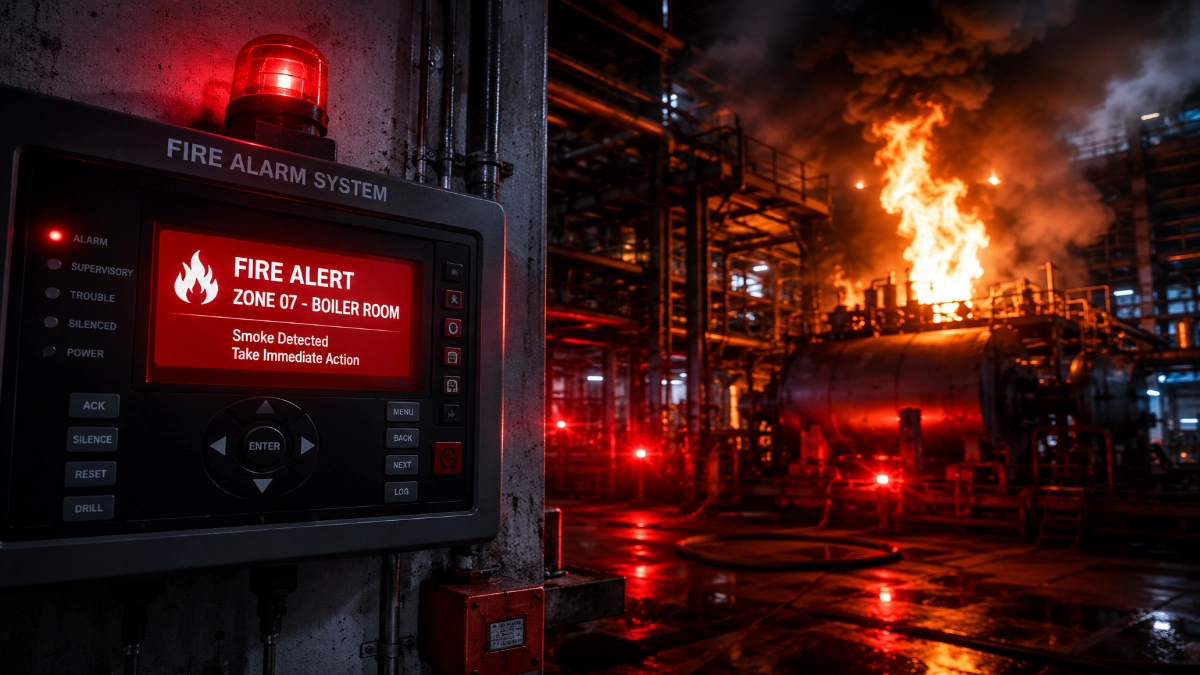
A fire that goes undetected for even a few minutes can destroy equipment, halt production for weeks, and put workers at serious risk. The financial and human cost of delayed detection is staggering and, in many cases, entirely preventable.
This article explains why early fire detection in industrial operations has become a critical priority, how fire detection technology has evolved, and what industrial leaders must do today to protect their facilities.
What Is Early Fire Detection?
Early fire detection is the ability to identify signs of fire, such as heat, smoke, gas, or flame, at the very first stage, before a fire has a chance to grow and spread. It goes beyond traditional approaches where alarms only trigger after visible flames or heavy smoke appear.
Modern early detection systems use multi-criteria sensors, addressable detectors, and smart algorithms to catch subtle changes in the environment. These systems alert facility managers and emergency teams in real time, giving them a critical head start.
Unlike older conventional detectors that simply trigger a zone alarm, addressable detectors pinpoint the exact location of a potential fire event. This precision dramatically improves response speed and reduces false alarms, a major advantage in busy industrial settings.
Why Every Minute Matters During an Industrial Fire
Fire grows exponentially. What begins as a small overheating motor or an electrical fault can double in size every 30 to 60 seconds under the right conditions. In an industrial facility filled with flammable materials, machinery, and stored products, the consequences of late detection are severe.
Fire Growth Stages
- Incipient Stage: Invisible particles and gases form. No visible smoke or flame.
- Growth Stage: Smoke becomes visible. Heat increases rapidly.
- Fully Developed Stage: Flashover may occur. Structural damage begins.
- Decay Stage: Fire consumes available fuel. Significant destruction is complete.
Early detection systems are designed to act during the incipient stage, the only point where damage can still be minimised, and evacuation can occur safely.
The Cost of Delayed Detection
- Asset Damage: Machinery, raw materials, finished goods, and infrastructure can be destroyed in minutes.
- Downtime: Industrial fires can halt operations for days, weeks, or months.
- Worker Safety: Delayed evacuation puts lives at risk and increases employer liability.
- Business Continuity: Supply chains break down, customer contracts are jeopardised, and brand reputation suffers.
Common Fire Hazards Found in Industrial Facilities
Industrial environments are uniquely fire-prone because they combine heat-generating equipment, flammable substances, and high-density storage in the same space. Understanding these hazards is the first step toward effective prevention.
- Electrical Equipment: Faulty wiring, overloaded circuits, and ageing switchboards are common ignition sources.
- Manufacturing Machinery: Friction, overheating motors, and sparks from cutting or welding operations.
- Warehouses: High-rack storage of combustible goods creates rapid fire spread conditions.
- Chemical Storage Areas: Solvents, fuels, and reactive chemicals represent extreme fire and explosion risks.
- Server Rooms & Data Centres: Overheating hardware and cable faults in confined spaces.
- Utility Rooms: Boiler rooms, compressor stations, and electrical panels in low-traffic areas often go unmonitored.
- Production Lines: Continuous operation increases heat build-up and equipment wear.
How Modern Fire Detection Technology Has Evolved
Fire detection has come a long way from standalone smoke detectors with basic on/off alarms. Today’s industrial fire detection systems are intelligent, networked, and designed for complex operational environments.
Key Technology Advances
- Smart Multi-Criteria Sensors: Detect smoke, heat, CO, and flame simultaneously for greater accuracy.
- Addressable Fire Alarm Panels: Identify the exact detector triggered, enabling faster and more precise emergency response.
- Real-Time Monitoring: Continuous data feeds allow facility managers to monitor fire risk 24/7.
- Remote Notifications: Instant alerts sent via SMS, email, or app to safety officers and emergency services.
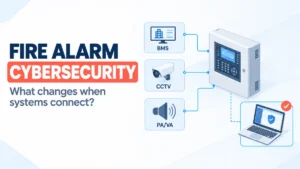
- Building Management System Integration: Fire detection data feeds into centralised facility control systems.
- IoT-Connected Devices: Sensors communicate over wireless networks, enabling flexible installation in large or complex facilities.
The shift from conventional fire alarm panels to addressable systems represents the most significant advancement in industrial fire safety. Addressable systems give facility managers granular, real-time insight into fire events rather than just zone-level alerts.
Benefits of Early Fire Detection in Industrial Operations
1. Faster Emergency Response
When a fire detection system identifies a threat in its earliest stage, emergency teams have more time to act. Evacuation can begin immediately, fire suppression systems can be activated, and local fire services can be notified before conditions deteriorate.
2. Reduced Property Damage
Catching a fire early means smaller fires. A contained incipient-stage incident may cause minimal damage. The same incident, detected ten minutes later, could result in total loss of equipment or an entire production section.
3. Lower Downtime and Business Disruption
Even a partial facility shutdown costs money. Industrial fires that are detected early are more likely to be contained quickly, reducing the footprint of damage and enabling faster return to operations.
4. Improved Employee Safety
Workers are the most valuable asset in any facility. Early warnings ensure timely evacuation and reduce the risk of injury or fatality. This also reduces workers’ compensation claims and regulatory penalties.
5. Regulatory Compliance
Fire safety legislation in India and internationally requires industrial facilities to maintain functioning early warning fire detection systems. Non-compliance can result in fines, shutdowns, or criminal liability in the event of a fire-related incident.
6. Reduced Financial Losses and Insurance Costs
Facilities with documented early fire detection systems often benefit from lower insurance premiums. More importantly, they avoid the catastrophic financial impact of a major fire event, which can include repair costs, lost revenue, legal liability, and reputational damage.
7. Enhanced Operational Resilience
A facility that can detect, respond to, and recover from fire threats quickly is inherently more resilient. Investors, clients, and regulators increasingly view fire safety infrastructure as a measure of operational maturity.
Industries That Benefit Most From Early Fire Detection
| Industry | Primary Fire Risk | Detection Priority |
| Manufacturing | Machine overheating, sparks | High |
| Warehousing & Logistics | Stored combustibles, forklifts | High |
| Automotive | Flammable fluids, welding | High |
| Pharmaceuticals | Chemical reactions, clean rooms | Critical |
| Food Processing | Grease, heat, dust | High |
| Electronics | Static, heat, cable faults | Medium-High |
| Data Centers | Server overheating, UPS failure | Critical |
| Chemical Storage | Reactive substances, vapour | Critical |
Signs That an Existing Fire Detection System May Need Upgrading
Many industrial facilities operate with outdated fire detection infrastructure that may not meet current standards. Use this practical checklist to assess whether your system needs attention:
- The system is more than 10 years old, with no major upgrades
- Frequent false alarms cause alert fatigue among staff
- No real-time remote monitoring or notification capability
- Detectors cover only some areas, leaving blind spots
- The system cannot integrate with modern building management platforms
- No addressable panel, only zone-level alerts available
- Detectors have not been serviced or inspected in the past 12 months
- The facility has expanded, but the fire system has not scaled accordingly
- No data logging or incident reporting from the system
Choosing the Right Industrial Fire Detection Strategy
There is no one-size-fits-all approach to industrial fire detection. The right strategy depends on several facility-specific factors:
- Facility Size: Larger facilities require scalable addressable systems with centralised monitoring.
- Risk Profile: Chemical plants and data centres face higher risks and require more sensitive, multi-criteria detection.
- Occupancy Patterns: 24/7 operations need automated alerts; unmanned areas need remote monitoring.
- Expansion Plans: Choose scalable systems that can grow with your operations.
- Compliance Requirements: Ensure the chosen system meets local fire safety codes and industry standards.
The choice between a conventional fire alarm panel and an addressable fire alarm panel is one of the most important decisions a facility manager will make. Conventional systems are cost-effective for smaller, simpler facilities. Addressable systems are better suited for larger, higher-risk environments where pinpoint detection accuracy and rapid response are essential.
How GST Fire Alarm Systems Support Early Fire Detection
GST fire alarm systems are widely used across industrial and commercial facilities for their reliability, scalability, and compatibility with modern safety infrastructure. A GST fire alarm system typically supports both conventional and addressable configurations, making it suitable for a wide range of industrial applications.
These systems allow facility managers to connect addressable detectors throughout a facility and monitor them from a central panel. When a detector identifies an early-stage fire signature, the panel immediately identifies the precise location and triggers the appropriate response, whether that is an audible alarm, suppression system activation, or an alert to security personnel.
For facilities considering an upgrade or new installation, evaluating a GST fire alarm system as the foundation of their fire safety infrastructure is a practical step toward meeting both compliance requirements and operational resilience goals.
Future Trends in Industrial Fire Detection
The next generation of industrial fire detection technology is already taking shape. Key trends to watch include:
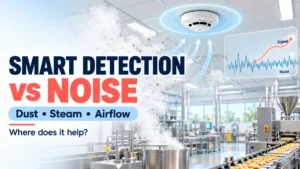
- AI-Assisted Detection: Machine learning algorithms analyse sensor data to distinguish real fire events from environmental noise, dramatically reducing false alarms.
- Predictive Maintenance: Fire detection systems that monitor equipment health and alert managers to conditions that could lead to fire, before an incident occurs.
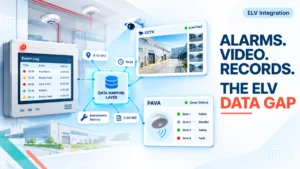
- IoT-Connected Fire Safety Ecosystems: Fully networked facilities where fire sensors, suppression systems, access control, and emergency lighting communicate seamlessly.
- Remote Monitoring Centres: Third-party monitoring services that watch industrial facilities around the clock and coordinate emergency responses.
- Integrated Safety Platforms: Single dashboards that combine fire detection data with air quality, gas leak monitoring, and occupancy tracking for comprehensive safety management.
| Key Takeaways: Early fire detection saves lives, assets, and operational continuity. Fire can double in size every 30–60 seconds. Early warning is the only reliable defence. Addressable systems offer precise, real-time detection far superior to conventional zone alarms. Industrial fire risks include electrical faults, machinery, chemicals, and unmonitored utility spaces. Modern GST fire alarm systems support scalable, addressable detection for all facility sizes. AI, IoT, and predictive maintenance are the future of industrial fire safety. All industrial fire detection systems should be inspected and tested at least annually. |
Conclusion
Early fire detection in industrial operations is not a luxury; it is a fundamental requirement for protecting people, assets, and business continuity. As industrial facilities become more complex and fire risks more varied, relying on outdated detection systems is a liability no organisation can afford.
The move from conventional detection to addressable, AI-integrated, IoT-connected fire safety systems represents the most important upgrade a facility manager can make. The investment in early detection technology pays for itself many times over the first time it prevents a major incident.
For facility managers, plant operators, and EHS professionals: the question is not whether to invest in early fire detection, it is how soon you can make it happen.
Read Also: The New Rules of Fire Detection and Surveillance Planning
Read Also: Fire Alarm System Scalability: Planning for Tomorrow’s Expansion