Most facility managers believe their surveillance setup is adequate until an incident reveals a critical blind spot. Industrial environments present unique security challenges that standard CCTV systems are not designed to handle.
Dust, vibration, extreme temperatures, corrosive chemicals, low-light conditions, and sprawling layouts demand a purpose-built approach. Yet many organisations continue to deploy inadequate systems based on myths, costing them dearly in lost assets, compliance failures, and compromised worker safety.
This article tackles the ten most damaging misconceptions about industrial CCTV systems, replacing them with practical, expert-backed insights that help you make smarter decisions.
Why Getting This Wrong Is Expensive
A poorly chosen surveillance system does not just leave security gaps. It creates operational blind spots, exposes organisations to regulatory penalties, and may invalidate insurance claims after an incident. In an industrial facility, the cost of inadequate surveillance can run into lakhs or even crores of rupees in stolen material, damaged equipment, or liability payouts.
Understanding the realities behind these myths is the first step toward building a surveillance infrastructure that genuinely protects people, assets, and operations.
Myth #1: Industrial CCTV Is the Same as Commercial CCTV
| Myth | Reality |
| A camera is a camera. If it works in a shopping mall, it will work in a factory. | Industrial cameras are built for entirely different operating conditions, such as shock, vibration, heat, dust, and chemical exposure, that would destroy standard commercial units within weeks. |
Commercial CCTV systems are engineered for stable, climate-controlled environments. Industrial cameras, by contrast, must survive wide temperature swings (often -40°C to +70°C or beyond), continuous vibration from heavy machinery, exposure to oil mist, chemical vapours, and high-pressure wash-downs.
Look for IP66 or IP67 ingress protection ratings and IK10 impact ratings when evaluating cameras for plant environments. ATEX or IECEx certification is mandatory for explosive atmospheres such as oil refineries, grain mills, and paint facilities.
| Expert Tip: Always match the camera’s protection rating to your specific environment. A camera rated for outdoor rain is not rated for industrial washdown or chemical exposure. |
Myth #2: Any Outdoor Camera Works in an Industrial Setting
| Myth | Reality |
| If a camera survives rain and wind, it can handle a factory floor. | Outdoor ratings address the weather. Industrial ratings address mechanical shock, vibration, chemical exposure, and electromagnetic interference, entirely different threat categories. |
A standard outdoor camera placed near a stamping press will fail from vibration alone. One placed near a chemical bath will corrode within months. Industrial environments require cameras specifically tested for continuous mechanical stress, EMI from motors and welding equipment, and exposure to industrial fluids.
Even the mounting systems, cable glands, and junction boxes used in an industrial installation must meet appropriate protection standards. The camera is only one component of a hardened system.
Myth #3: More Megapixels Always Mean Better Security
| Myth | Reality |
| Higher resolution cameras automatically provide better surveillance. | Resolution is one factor among many. Lens quality, frame rate, low-light performance, and storage bandwidth matter just as much, sometimes more. |
A 12MP camera pointed at a poorly lit loading bay may deliver less actionable footage than a 2MP camera with superior low-light sensitivity and wide dynamic range. In high-speed manufacturing environments, frame rate is often more critical than resolution. A camera that captures 15 frames per second may miss the moment a safety incident occurs.
Higher resolution also demands significantly more storage and network bandwidth. Without proper planning, upgrading to high-resolution cameras can overwhelm your existing infrastructure.
| Did You Know? Wide dynamic range (WDR) technology is often more important than raw megapixels in industrial settings, where bright ambient light and deep shadows can exist in the same frame, for example, near loading dock doors. |
Myth #4: Industrial CCTV Is Only for Large Manufacturing Plants
| Myth | Reality |
| Small and mid-sized industrial facilities don’t need purpose-built surveillance. | Any facility with machinery, hazardous materials, valuable inventory, or worker safety requirements benefits from industrial-grade CCTV regardless of size. |
A medium-sized warehouse storing flammable goods, a mid-scale fabrication unit, or even a construction site materials yard each face industrial-grade environmental and security challenges. The investment in appropriate equipment is proportional to risk, not facility size.
Scalable industrial CCTV solutions now make enterprise-grade protection accessible to smaller operations, with modular designs that grow with your business.
Myth #5: CCTV Only Helps After an Incident Occurs
| Myth | Reality |
| Cameras are just for reviewing footage after something goes wrong. | Modern industrial CCTV systems actively prevent incidents through real-time alerts, analytics, and integration with access control and safety systems. |
Reactive surveillance is outdated thinking. Today’s industrial cameras can detect unauthorised zone entry, identify when workers are not wearing required PPE, trigger alerts when vehicles enter pedestrian corridors, and flag smoke or fire in real time, all before an incident escalates.
When integrated with access control, SCADA systems, or alarm panels, CCTV becomes a proactive layer of operational intelligence rather than just a post-incident review tool.
Myth #6: Industrial Surveillance Systems Are Too Expensive
| Myth | Reality |
| Industrial CCTV is a luxury that only large corporations can afford. | The total cost of inadequate surveillance in theft, liability, insurance premiums, and compliance penalties almost always exceeds the investment in proper industrial-grade systems. |
Consider the real numbers: a single theft incident in a manufacturing facility can run into several lakhs of rupees. A compliance violation due to inadequate safety monitoring can result in regulatory fines that dwarf the cost of a complete CCTV overhaul. Industrial cameras, while more expensive upfront than consumer-grade alternatives, have significantly longer service lives, often 7 to 10 years in field conditions.
Working with a trusted partner, such as an Impact by Honeywell CCTV distributor in India, helps organisations identify the right combination of hardware and software for their specific risk profile without overspending on unnecessary capabilities.
Myth #7: AI-Powered Surveillance Is Unnecessary
| Myth | Reality |
| Basic video recording is all an industrial facility needs. | AI-driven analytics transform raw footage into actionable intelligence, detecting safety violations, unauthorised access, and operational anomalies in real time. |
Manual video monitoring is not scalable. A security operator watching 40 camera feeds simultaneously cannot maintain adequate attention levels. AI-powered video analytics solve this by automatically flagging anomalies, such as an unattended bag, a person in a restricted zone, a vehicle moving in the wrong direction, or smoke before it becomes a fire.
In industrial safety terms, AI that detects a missing hard hat or an open machine guard can prevent life-altering accidents. The ROI on AI-enhanced surveillance is measured in prevented incidents, not just captured footage.
| Expert Tip: When evaluating AI analytics, prioritize accuracy over feature count. A system with fewer, highly reliable detection capabilities outperforms one with many features that trigger false alarms and create alert fatigue. |
Myth #8: CCTV Installation Is a One-Time Project
| Myth | Reality |
| Once cameras are installed, the system runs itself indefinitely. | Industrial CCTV requires ongoing maintenance, firmware updates, camera repositioning as operations evolve, and periodic system audits to remain effective. |
Dust and grime accumulate on lenses. Vibration loosens mounts and cable connections. Firmware vulnerabilities are discovered and must be patched. New machinery or facility layouts create fresh blind spots. Without a structured maintenance programme, even the best industrial CCTV system degrades in effectiveness within one to two years.
Establish a maintenance schedule that includes lens cleaning, connection checks, firmware updates, and a quarterly review of camera coverage against current operational layouts.
Myth #9: All CCTV Storage Systems Are the Same
| Myth | Reality |
| Any hard drive or NVR system is fine for industrial surveillance footage. | Industrial surveillance generates massive data volumes and requires purpose-built storage with redundancy, extended retention capabilities, and industrial-rated hardware. |
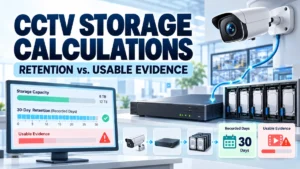
Industrial NVRs must handle continuous write operations, often 24 hours a day, 365 days a year, in conditions that would stress consumer-grade storage. Consumer hard drives are typically rated for 8 hours of use daily. Industrial-grade surveillance drives are rated for 24/7 operation with annual workloads of up to 180TB.
Storage architecture must also consider retention requirements. Regulatory frameworks in sectors like pharmaceuticals, food processing, and oil and gas may require footage to be retained for 30, 60, or 90 days or longer. Plan storage capacity for your retention needs plus 20% headroom.
Cloud hybrid architectures are increasingly popular in industrial settings, offering local storage for immediate access and cloud backup for compliance and redundancy.
Myth #10: Industrial Facilities Only Need Cameras at Entry Points
| Myth | Reality |
| Covering gates and doors is sufficient for industrial security. | Comprehensive industrial surveillance covers production zones, material storage, high-value equipment, utility areas, fire exits, and loading/unloading areas. |
Entry point coverage addresses only one threat vector. Insider threats, which account for a significant portion of industrial losses, typically occur inside the facility, away from monitored entrances. Safety incidents happen at workstations, near heavy machinery, and in storage areas. Fire often starts in utility rooms or near electrical panels.
A proper industrial surveillance design uses a layered approach: perimeter detection, internal zone monitoring, asset-level coverage for high-value equipment, and targeted monitoring for safety-critical areas. Leading platforms such as Impact by Honeywell CCTV provide comprehensive camera management tools that simplify this multi-zone deployment.
Future Trends in Industrial Video Surveillance
Industrial CCTV is evolving rapidly. Here are the key trends shaping the next five years:
- Edge AI processing: Cameras performing analytics onboard without relying on central servers, reducing latency and bandwidth requirements.
- Thermal imaging integration: Thermal cameras detect heat anomalies before they cause fires or equipment failures.
- Drone surveillance: Autonomous drones conducting perimeter and roof inspections at large industrial sites.
- Cybersecurity hardening: Industrial cameras becoming targets for cyberattacks, driving demand for end-to-end encrypted, firmware-secure systems.
- Digital twin integration: Camera feeds feed directly into digital models of facilities for real-time operational visibility.
Key Takeaways
| Summary: Industrial CCTV is a specialised discipline. The right system matches your environmental conditions, operational layout, safety requirements, and data retention obligations, not just your budget. |
- Industrial cameras must meet appropriate IP, IK, and hazardous-area certification standards.
- Resolution is one of many factors; low-light performance, frame rate, and WDR often matter more.
- AI analytics transform surveillance from reactive to proactive.
- Maintenance is not an optional plan for ongoing upkeep from day one.
- Storage must be specified for 24/7 industrial workloads and your regulatory retention requirements.
- Coverage must extend throughout your facility, not just at entry points.
Common Mistakes Checklist: Before You Buy
- Specifying cameras by megapixels alone, without considering environment or frame rate.
- Using commercial-grade cameras in dusty, humid, or chemically active environments.
- Failing to include storage capacity calculations in the planning phase.
- Overlooking cybersecurity features such as encrypted data transmission and authentication.
- Not mapping camera positions against operational layouts before installation.
- Choosing the lowest-cost NVR without verifying 24/7 workload ratings.
- Skipping a maintenance plan in the project budget.
Decision-Making Framework for Buyers
Use these five questions to evaluate any industrial CCTV solution:
1. Environment fit: Does the camera meet the IP, IK, and temperature ratings required by your specific operating conditions?
2. Coverage adequacy: Have all threat vectors been mapped in the perimeter, interior zones, assets, and safety-critical areas?
3. Analytics capability: Does the system support real-time alerting relevant to your operations, PPE compliance, zone intrusion, and fire detection?
4. Storage architecture: Is the storage solution rated for continuous operation and sized for your retention obligations?
5. Lifecycle support: Does the vendor provide maintenance, firmware updates, and local technical support?
Conclusion
Industrial surveillance is not a plug-and-play proposition. It requires careful specification, expert installation, ongoing maintenance, and a clear understanding of the unique demands your facility places on the system.
The misconceptions covered in this article are not just theoretical; they lead to real failures, real losses, and real risks to worker safety. By replacing myth with understanding, facility managers and security professionals can build surveillance infrastructure that genuinely protects their people, assets, and operations.
Whether you are upgrading an existing system or designing a new one from scratch, partner with specialists who understand industrial environments and can translate your operational requirements into a surveillance solution that performs when it matters most.
Read Also: CCTV Planning for Fast-Growing Logistics Networks
Read Also: What Makes a Surveillance System Enterprise-Ready?