| Quick Answer: What is a Fire Risk Assessment? A fire risk assessment is a structured evaluation of a building to identify fire hazards, assess risks to people and property and determine what protective measures are needed. For industrial buildings, it is a legal requirement and a critical tool for preventing catastrophic fire incidents. |
Understanding Fire Risk Assessment
Industrial buildings face fire hazards that are far more complex and severe than typical commercial environments. Heavy machinery, flammable chemicals, high-voltage electrical systems, and dense storage configurations create layered risks that demand a systematic approach to fire safety.
Why Industrial Buildings Face Unique Hazards
Unlike offices or retail spaces, industrial facilities combine multiple ignition sources, large volumes of combustible materials, and complex layouts that can obstruct evacuation. A single oversight can escalate into a major incident within minutes.
Legal and Compliance Obligations
Regulatory bodies, including OSHA (Occupational Safety and Health Administration), NFPA (National Fire Protection Association) and ISO standards, mandate that facility managers conduct and document fire risk assessments. Non-compliance can result in:
- Heavy fines and legal liability
- Forced shutdowns by regulatory authorities
- Invalidation of insurance policies
- Criminal prosecution in the event of fire-related fatalities
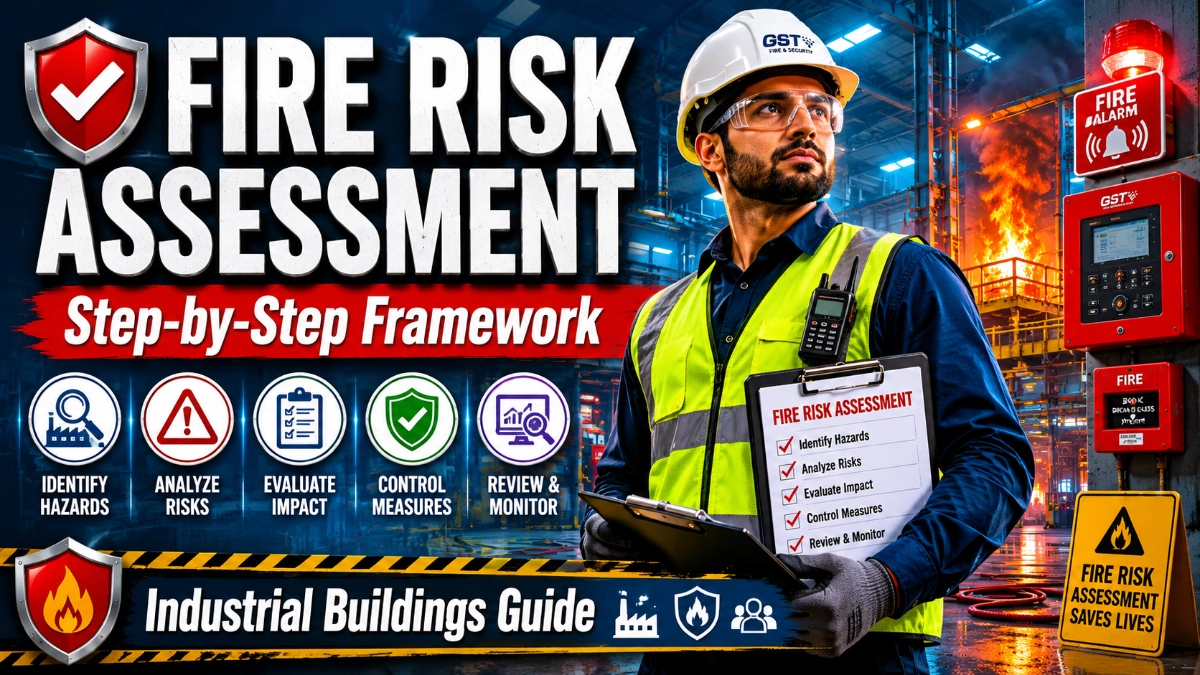
The 8-Step Fire Risk Assessment Framework
Follow this structured framework to conduct a thorough, compliant and actionable fire risk assessment for any industrial facility.
Step 1: Gather Building and Operational Information
Begin by collecting all relevant data about the facility. This includes:
- Floor plans and site layout diagrams
- Occupancy type and number of occupants
- Nature of operations and processes carried out
- Shift patterns and peak occupancy hours
- Previous fire incidents or near-miss records
This foundational step ensures every subsequent assessment is grounded in accurate, site-specific data.
Step 2: Identify Fire Hazards
Systematically identify all three elements of the fire triangle present on site.
Ignition Sources
- Electrical faults and overloaded circuits
- Hot work operations such as welding, cutting, and grinding
- Friction from machinery and conveyor systems
- Open flames, boilers, and furnaces
- Static electricity in dry or dusty environments
Fuel Sources
- Flammable liquids, gases, and solvents
- Raw materials, packaging, and finished goods
- Timber pallets, cardboard and paper
- Dust accumulations from production processes
- Waste materials and rubbish
Oxygen Sources
- Ambient air throughout the building
- Oxidising agents in chemical storage
- Ventilation and HVAC systems that can spread fire
Step 3: Identify People at Risk
Consider every person who may be present in or near the building during normal operations and emergencies.
- Employees working in production, warehousing, or maintenance areas
- Contractors and third-party workers on site
- Visitors, clients, and delivery personnel
- Vulnerable individuals, such as those with disabilities, night-shift workers in isolated areas, and lone workers
Pay particular attention to areas where people may be sleeping, working with headphones, or operating loud equipment that masks fire alarm signals.
Step 4: Evaluate Existing Fire Protection Measures
Assess all current fire safety systems and controls in place. This includes detection, suppression, and evacuation systems.
Fire Detection and Alarm Systems
Reliable detection infrastructure is the backbone of industrial fire safety. Modern facilities increasingly deploy addressable fire alarm panels, which can pinpoint the exact location of an activated detector. This enables faster response, reduces false alarms, and supports compliance reporting.
An addressable fire alarm panel assigns a unique address to each detector and device on the network, giving safety teams precise, real-time information. Conventional fire alarm panels, by contrast, identify zones rather than individual devices, and remain suitable for smaller or less complex industrial sites.
Both detector types play an important role. Addressable detectors provide granular data in large multi-zone environments, while conventional detectors offer a cost-effective solution for simpler layouts. Smoke detectors, heat detectors, and manual call points should all be included in the evaluation.
A complete GST fire alarm system, for example, integrates addressable and conventional detectors with a central fire alarm control panel, giving facility managers comprehensive visibility across the site. Leading GST fire alarm system distributors in India supply these integrated solutions to manufacturing plants, warehouses, and chemical facilities.
Suppression and Containment
- Automatic sprinkler systems and gaseous suppression systems
- Portable fire extinguishers appropriate to the fire class
- Fire doors, fire-rated walls, and compartmentation measures
Evacuation Infrastructure
- Clearly marked emergency exits and escape routes
- Emergency lighting on all evacuation paths
- Muster points and assembly areas
Step 5: Assess Risk Severity and Likelihood
For each identified hazard, assess two dimensions:
- Likelihood: How probable is it that this hazard will cause a fire? (Low / Medium / High)
- Severity: How serious would the consequences be if a fire occurred? (Minor / Significant / Critical)
Combine these to produce an overall risk rating. Prioritise corrective actions for High-Likelihood and Critical-Severity combinations. Document your reasoning clearly to demonstrate a defensible, evidence-based assessment.
Step 6: Document Findings
A fire risk assessment is only legally valid if it is properly documented. Your written record must include:
- A description of the premises and the scope of the assessment
- All identified hazards and the people at risk
- Existing protective measures and their adequacy
- Risk ratings for each hazard
- Recommended corrective actions with responsible owners and deadlines
- Name and qualifications of the assessor
- Date of assessment and next review date
Step 7: Implement Corrective Actions
Documentation without action provides no protection. Assign each corrective action to a named individual with a clear deadline. Corrective actions typically include:
- Removing or substituting hazardous materials where possible
- Installing or upgrading fire detection and alarm systems
- Improving housekeeping and waste management practices
- Servicing and testing suppression equipment
- Providing fire safety training to all staff
- Improving signage, emergency lighting, and exit routes
Step 8: Review and Update the Assessment Regularly
A fire risk assessment is a living document. Review it whenever:
- Significant changes occur to the building layout or operations
- New machinery, chemicals, or processes are introduced
- A fire incident or near-miss takes place
- The workforce or occupancy levels change significantly
- Regulatory updates or new compliance standards are issued
As a minimum, review the assessment annually. Industrial environments evolve continuously, and so do their fire risks.
Common Industrial Fire Risk Areas
Different industrial environments present distinct fire risk profiles. Key areas include:
- Manufacturing plants: Heat-generating machinery, metal dust, oil, and hydraulic fluids create multiple simultaneous hazards.
- Warehouses: High-rack storage of mixed materials can cause rapid fire spread and hinder suppression efforts.
- Chemical storage facilities: Flammable and oxidising substances demand specialised detection and suppression systems.
- Electrical rooms and server rooms: Equipment failures and arc flash events require heat detectors and gaseous suppression rather than water-based systems.
- Production lines: Accumulation of dust, debris, and process waste can ignite from friction or heat sources without warning.
Best Practices for Industrial Fire Safety
- Assign a competent fire safety officer with dedicated authority and resources.
- Conduct fire drills at least twice per year, covering different scenarios and shift patterns.
- Implement a hot work permit system for all heat-generating maintenance activities.
- Schedule regular inspection and testing of all detection and suppression systems.
- Maintain clear access to all fire-fighting equipment and emergency exits at all times.
- Integrate early warning systems that alert off-site personnel and emergency services automatically.
- Train staff to identify hazards and report concerns through a no-blame safety culture.
- Use zoned detection with either a conventional fire alarm panel or an addressable panel, depending on site complexity.
Fire Risk Assessment Checklist
Use this checklist as a practical tool during your assessment. All items should be completed before signing off on the assessment.
| Category | Checklist Item | Status |
| Building Info | Floor plans, occupancy type, and layout documented | ☐ |
| Ignition Sources | Electrical equipment inspected and maintained | ☐ |
| Ignition Sources | Hot work permits in place for welding/cutting | ☐ |
| Fuel Sources | Flammable materials stored safely away from ignition | ☐ |
| Fuel Sources | Waste and combustible debris regularly removed | ☐ |
| Oxygen Sources | Ventilation systems assessed and controlled | ☐ |
| People at Risk | All employees, contractors, and visitors identified | ☐ |
| People at Risk | Evacuation needs of vulnerable persons assessed | ☐ |
| Detection Systems | Fire alarm system tested and operational | ☐ |
| Detection Systems | Smoke/heat detectors positioned and functional | ☐ |
| Detection Systems | Addressable fire alarm panel correctly programmed | ☐ |
| Suppression | Sprinklers, extinguishers, and suppression systems checked | ☐ |
| Emergency Plans | Evacuation routes clearly marked and unobstructed | ☐ |
| Emergency Plans | Fire drills conducted within the last 12 months | ☐ |
| Documentation | Written fire risk assessment completed and signed | ☐ |
| Review | Assessment review date scheduled | ☐ |
Key Takeaways
| A fire risk assessment is a legal requirement for industrial facilities and a critical life-safety tool. The 8-step framework covers hazard identification, risk evaluation, documentation, and ongoing review. Industrial sites present unique risks from machinery, chemicals, dust, and electrical systems. Reliable detection infrastructure, including both addressable and conventional fire alarm systems, is essential. Corrective actions must be implemented and tracked, not just documented. Regular review keeps the assessment current as the facility evolves. |
Conclusion
A structured fire risk assessment framework is not a bureaucratic formality. It is a practical, life-saving discipline that protects workers, safeguards assets, and ensures business continuity in the face of one of the most destructive risks any industrial facility can face.
By following the 8-step framework outlined in this guide, facility managers and safety officers can build a comprehensive, defensible, and genuinely effective fire safety program. From identifying ignition sources and evaluating people at risk, to deploying the right mix of addressable fire alarm panels, conventional detectors, and early warning systems, every decision in the process matters.
Industrial fire safety demands ongoing commitment. Technologies evolve, operations change, and new hazards emerge. Keep your assessment current, act on your findings, invest in reliable detection and alarm infrastructure, and foster a culture where every employee understands their role in preventing and responding to fire.
The cost of a thorough fire risk assessment is minimal compared to the human and financial consequences of an industrial fire. Do it right, document it fully, and review it regularly.
Read Also: Fire Detection Considerations for E-Commerce Fulfilment Centres
Read Also: The Growing Importance of Early Fire Detection in Industrial Operations