Choosing the wrong surveillance system can cost a facility hundreds of thousands of dollars and leave critical blind spots in safety coverage. Yet many businesses still treat industrial and commercial CCTV as interchangeable, a mistake that leads to premature equipment failure, compliance violations, and security gaps.
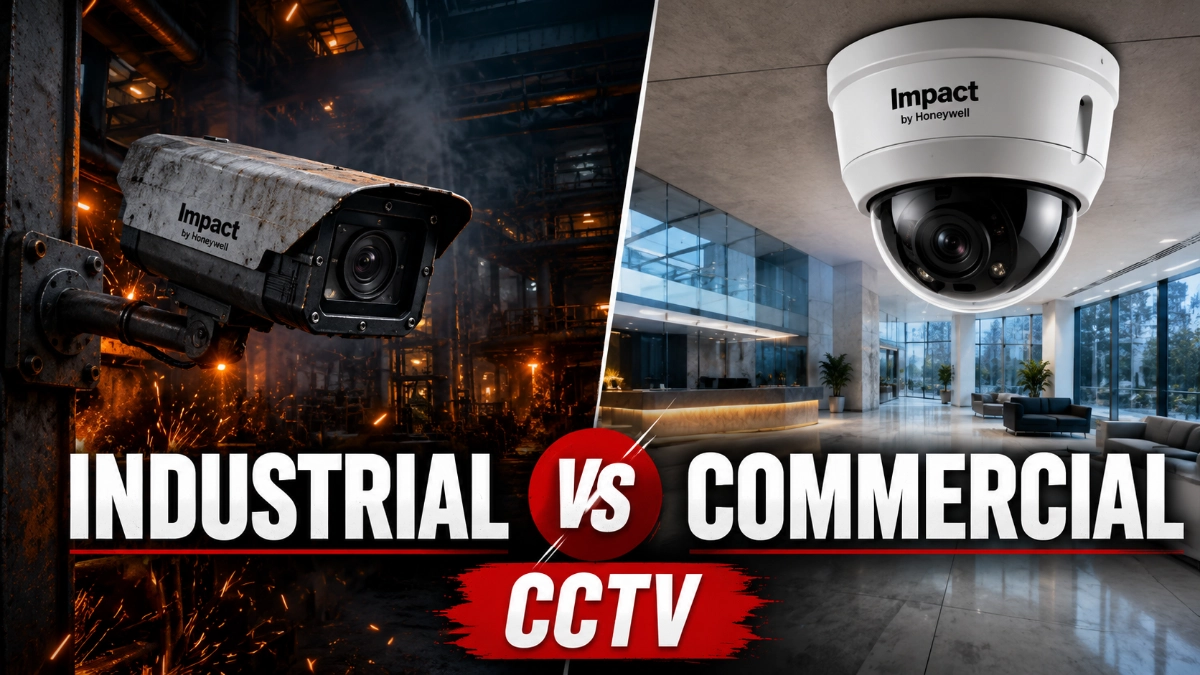
Industrial CCTV and commercial CCTV differ fundamentally in design philosophy, hardware durability, network architecture, and regulatory compliance. Understanding these differences is essential for facility managers, security consultants, system integrators and engineers who need reliable surveillance tailored to their operational environment.
This article provides a comprehensive, practical guide to both system types, helping you make informed, cost-effective decisions.
What Is Industrial CCTV?
Industrial CCTV refers to video surveillance systems engineered for harsh, high-risk operational environments such as manufacturing plants, oil refineries, chemical facilities, mining sites, and heavy logistics hubs. These systems prioritise extreme durability, regulatory compliance, and continuous operation under conditions that would destroy standard commercial cameras.
Industrial cameras typically carry IP66 to IP68 ingress protection ratings and are built to withstand temperature extremes (often -40°C to +70°C), corrosive chemicals, vibration, and explosive atmospheres. They are frequently integrated with process control systems, fire detection networks, and safety instrumented systems (SIS).
| Key Takeaway: Industrial CCTV is not simply a more expensive commercial system; it is a fundamentally different category of equipment engineered for environments where failure carries safety and regulatory consequences. |
What Is Commercial CCTV?
Commercial CCTV refers to video surveillance systems designed for standard business environments, including office buildings, retail stores, hotels, hospitals, educational institutions, and commercial complexes. These systems prioritise ease of installation, user-friendly management interfaces, remote access, and cost efficiency.
Commercial systems typically use IP cameras ranging from 2MP to 8MP, connect via standard Power over Ethernet (PoE) or Wi-Fi, and store footage on Network Video Recorders (NVRs) or cloud-based Video Management Systems (VMS). They meet general data protection standards such as GDPR and NDAA compliance requirements.
Quick Comparison Table: Industrial vs Commercial CCTV
| Parameter | Industrial CCTV | Commercial CCTV |
| Environment | Extreme heat, dust, chemicals, vibration | Controlled indoor/outdoor spaces |
| IP Rating | IP66–IP68 or higher | IP44–IP65 typical |
| Resolution | 2MP–12MP; thermal & IR options | 2MP–8MP standard |
| Storage | Edge + on-premise NVR (500GB–100TB+) | Cloud or NVR (1–30TB typical) |
| Cabling | Industrial Ethernet, fibre, PoE+ | Standard PoE, coax, Wi-Fi |
| Compliance | ATEX, IECEx, SIL, IEC 62443 | GDPR, NDAA, SOC 2 |
| Maintenance | Scheduled preventive every 6–12 months | Annual or as-needed |
| Scalability | Hundreds to thousands of cameras | Dozens to hundreds of cameras |
| Cost (per cam) | $800–$5,000+ | $100–$800 |
Key Differences Explained
Environmental Conditions
Commercial environments maintain relatively stable temperatures, humidity, and air quality. Industrial environments do not. A petrochemical refinery camera may face ambient temperatures exceeding 60°C, explosive vapours, and continuous vibration from heavy machinery simultaneously.
Industrial cameras certified to ATEX (Europe) or IECEx (international) standards are mandatory in Zone 1 and Zone 2 classified hazardous areas. Using a non-rated commercial camera in such zones is not just inadvisable, it violates safety laws in most jurisdictions.
Camera Durability
Commercial cameras typically achieve IP44 to IP65 ratings adequate for indoor use and light outdoor exposure. Industrial cameras must meet IP66 to IP68 as a minimum. Many are also rated for resistance to high-pressure washdowns (common in food processing and pharmaceutical manufacturing).
The optics and housings of industrial cameras use polycarbonate, stainless steel, or marine-grade aluminium rather than the ABS plastics common in commercial models. This directly affects lifespan: commercial cameras average 3–5 years in demanding deployments; industrial cameras are engineered for 7–15 years of continuous operation.
| Key Takeaway: Specifying a commercial camera for a washdown-heavy food production facility almost always results in premature housing failure within 12–18 months. |
Network Infrastructure
Commercial CCTV runs comfortably on standard IT network infrastructure, CAT6 cabling, Wi-Fi, and cloud connectivity. Industrial CCTV requires hardened network components: industrial Ethernet switches with extended temperature ranges, fibre optic cabling for EMI-heavy environments, and network designs that isolate surveillance traffic from operational technology (OT) networks.
Latency, bandwidth, and network resilience requirements also differ. A retail store can tolerate brief network interruptions; an oil refinery cannot, as surveillance supports real-time safety monitoring.
Storage Requirements
Commercial deployments typically require 1 to 30TB of storage, depending on camera count and retention period. Industrial facilities, particularly those in regulated industries, may retain footage for 90 to 365 days across hundreds of cameras requiring storage arrays of 100TB or more.
Industrial systems frequently employ edge storage (onboard SD cards or edge NVRs) as a failsafe against network outages, ensuring continuous recording even if central infrastructure fails.
Compliance and Safety Standards
Commercial CCTV primarily addresses data protection regulations: GDPR in Europe, NDAA Section 889 (restricting certain Chinese-manufactured equipment in US federal facilities), and SOC 2 for cloud-hosted systems.
Industrial CCTV faces a broader compliance landscape: IEC 62443 for industrial cybersecurity, ATEX/IECEx for explosive atmospheres, SIL (Safety Integrity Level) ratings for safety-critical applications, and sector-specific standards such as API RP 754 in the petrochemical industry. Non-compliance in these areas carries legal liability and insurance implications beyond simple data breaches.
| Key Takeaway: Compliance is a primary driver of industrial CCTV specification, not just a procurement checkbox. |
Maintenance Needs
Commercial CCTV maintenance is largely reactive clean lenses, replacing failed units, update firmware. Industrial CCTV requires proactive preventive maintenance schedules every 6 to 12 months, including thermal imaging inspections of housing seals, cable tray inspections, and vibration resistance checks. Predictive maintenance integration with facility CMMS (Computerised Maintenance Management Systems) is increasingly standard.
Scalability
A commercial system in a mid-size office building may operate 20–100 cameras on a single NVR or VMS instance. Industrial facilities, particularly large petrochemical complexes or automotive manufacturing plants, may deploy 500 to 5,000+ cameras across multiple buildings, requiring federated VMS architectures with hierarchical access control.
Cybersecurity Considerations
Industrial CCTV systems operating within OT networks face cybersecurity risks that commercial systems do not. A compromised camera on a factory network can potentially serve as an entry point into SCADA or DCS systems controlling physical processes. IEC 62443 compliance mandates network segmentation, encrypted video streams, certificate-based authentication, and regular penetration testing. Commercial systems, while requiring basic security hygiene (strong passwords, HTTPS, VLAN segmentation), operate in lower-risk IT environments.
Where Industrial CCTV Is Commonly Used
- Oil and gas refineries and offshore platforms
- Chemical manufacturing and pharmaceutical production
- Mining operations and quarries
- Automotive and heavy manufacturing assembly lines
- Power generation facilities (including nuclear)
- Food and beverage processing plants with washdown requirements
- Port terminals and heavy logistics hubs
Where Commercial CCTV Is Commonly Used
- Retail stores, shopping malls, and supermarkets
- Office buildings and corporate campuses
- Hotels, restaurants, and hospitality venues
- Hospitals, clinics, and healthcare facilities
- Schools, universities, and educational campuses
- Residential complexes and managed properties
- Light warehousing and distribution centres
Cost Comparison and Total Cost of Ownership
The upfront cost gap between industrial and commercial CCTV is significant. Commercial IP cameras typically cost $100–$800 per unit; industrial-grade cameras range from $800 to $5,000 or more, depending on hazardous area certifications and resolution requirements.
However, the total cost of ownership (TCO) over a 10-year lifecycle frequently favours proper industrial specification. Deploying commercial cameras in industrial environments results in accelerated failure, unplanned maintenance costs, and potential regulatory fines that can exceed the original cost difference many times over.
A manufacturing facility that deploys industrial cameras appropriately typically achieves 60–70% lower maintenance and replacement costs over 10 years compared to facilities that use mis-specified commercial equipment. Brands such as Impact by Honeywell CCTV have built their industrial product lines specifically around this TCO argument, engineering products for extended service lives in demanding environments.
| Key Takeaway: The correct question is not ‘How much does this camera cost?’ but ‘What is the 10-year cost of operating this surveillance system reliably in this environment?’ |
Common Mistakes Businesses Make When Choosing CCTV Systems
- Specifying cameras by price rather than IP rating and environmental suitability.
- Underestimating storage requirements, particularly for high-channel-count industrial sites with mandatory retention periods.
- Ignoring OT/IT network segmentation requirements when deploying IP cameras in industrial environments.
- Selecting systems without verifying NDAA compliance or IEC 62443 certification where required.
- Failing to account for explosion-proof certification requirements in chemical or oil and gas areas.
- Treating maintenance as reactive rather than scheduled in industrial deployments.
How to Select the Right CCTV System for Your Facility
Start with an environmental risk assessment. Document ambient temperature ranges, humidity levels, presence of corrosive substances, explosive atmosphere classifications, and vibration exposure. This assessment directly determines minimum camera IP and ATEX/IECEx certification requirements.
Next, define your compliance obligations. Facilities in regulated industries must confirm applicable standards before selecting hardware or software. An Impact by Honeywell CCTV distributor in India with industrial specialisation, for example, can provide pre-compliance documentation and certified system designs that accelerate regulatory approval.
Evaluate storage requirements based on camera count, resolution, frame rate, and required retention period. Use a storage calculator to model realistic needs before specifying NVR or SAN capacity.
Assess your network infrastructure. Industrial deployments require a network topology review with IT/OT convergence in mind. Commercial deployments should verify PoE switch capacity and VLAN configuration.
Finally, evaluate vendors on their service capability, not just product specifications. Industrial surveillance systems require specialist commissioning, preventive maintenance programs, and rapid response support that standard IT resellers cannot provide.
Future Trends in Industrial and Commercial Surveillance
Both segments are converging around AI-powered video analytics, but the applications differ substantially. In commercial environments, analytics focus on customer behaviour analysis, queue management, and occupancy monitoring. In industrial settings, analytics are increasingly applied to safety compliance, detecting PPE non-compliance, monitoring exclusion zones around heavy machinery, and identifying unsafe behaviours in real time.
Edge AI processing is accelerating in both markets, reducing bandwidth requirements and enabling analytics without continuous cloud connectivity. Industrial deployments particularly benefit from edge processing in remote or bandwidth-constrained sites.
Cybersecurity-by-design is becoming a baseline requirement rather than an optional feature. The integration of video surveillance into broader industrial IoT (IIoT) ecosystems demands that cameras and VMS platforms meet enterprise-grade security standards from initial deployment.
Thermal imaging is expanding beyond traditional perimeter security into industrial process monitoring, detecting hot spots in electrical infrastructure, monitoring pipeline integrity, and supporting predictive maintenance programs.
Conclusion
Industrial CCTV and commercial CCTV are not competing options for the same application; they are distinct technologies addressing fundamentally different operational requirements. Selecting the wrong category of system is one of the most expensive mistakes a facility manager or security professional can make.
Industrial environments demand cameras, network infrastructure, and VMS platforms that can withstand conditions that would quickly destroy commercial equipment. Commercial environments benefit from the cost efficiency, ease of management, and cloud integration that commercial systems provide, without the over-engineering that industrial applications require.
The key to correct system selection lies in starting with the environment, not the budget. Conduct a thorough environmental and compliance assessment, engage qualified system integrators with sector-specific experience, and evaluate the total cost of ownership over the full system lifecycle, not just upfront hardware costs.
Getting this decision right delivers more than reliable footage: it protects people, preserves compliance, and ensures that your surveillance investment delivers genuine operational value for its entire service life.
Read Also: The Biggest Misconceptions About Industrial CCTV Systems
Read Also: CCTV Planning for Fast-Growing Logistics Networks