Plant managers across India and globally have spent heavily on cameras, NVRs and video walls, yet incidents still slip through. A facility can have eighty cameras covering every corridor and still miss a forklift collision in a blind corner, a contractor entering a restricted zone unnoticed, or a stock discrepancy that took weeks to trace. The pattern repeats across manufacturing plants, warehouses, and processing units: hardware investment grows, but security gaps remain.
The reason isn’t poor equipment, it’s the absence of a plan. Industrial surveillance only works when it’s built around risk, operations, and response, not just lenses and storage drives. This article explains why a documented industrial surveillance strategy outperforms a camera-first approach, and how facility leaders can build one.
The Common Mistake: Treating Surveillance as a Hardware Purchase
Most industrial security projects begin with a budget line for cameras, not a security objective. Procurement teams compare resolution, night vision range, and storage capacity, then install units wherever conduit runs are easiest. This hardware-first mindset treats industrial CCTV systems as a checklist item rather than a risk-reduction tool.
The result is predictable: cameras cluster near entrances and parking areas because installation is convenient, while loading docks, chemical storage and unmanned night shifts, often the highest-risk zones, receive minimal coverage. Decisions get made by what’s easy to wire, not what needs to be watched.
A strategy reverses this order. It starts by asking what could go wrong, who could be harmed and what assets need protection, then selects hardware to fulfil those answers. Cameras become a tool inside a larger industrial security management plan, not the plan itself.
Why More Cameras Don’t Always Mean Better Security
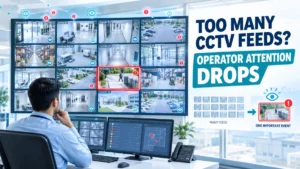
Adding cameras without a framework creates diminishing returns. Every additional feed needs to be monitored, stored, and reviewed; beyond a certain point, more footage means more noise, not more security. Operators staring at dozens of unprioritized screens are less likely to catch a genuine incident than someone watching a focused set of high-risk views.
Storage costs also scale with camera count, often pushing facilities toward shorter retention periods or lower resolution, both of which weaken evidentiary value during an investigation. A camera that’s poorly placed, has the wrong field of view, or duplicates coverage of a low-risk area provides little benefit, no matter how high its resolution is.
Effective facility security monitoring isn’t about quantity. It’s about strategic placement, intelligent prioritisation, and ensuring every camera contributes to a specific, defensible security outcome.
Understanding Industrial Security Risks Before Deployment
Every industrial site carries a distinct risk profile shaped by its layout, processes, materials and workforce. A chemical plant faces different threats than a cold storage warehouse or an automotive parts manufacturer. Theft, unauthorised access, equipment tampering, workplace injuries, sabotage and regulatory non-compliance can all coexist within the same facility, often with different likelihoods and consequences.
Before any surveillance planning begins, security leaders need to map these risks: where do people, vehicles and materials move? Which areas hold high-value inventory? Where have past incidents occurred? Which zones are unsupervised during shift changes?
This risk mapping draws from established physical security principles, where layered protection, deterrence, detection, delay, and response form the foundation of any defensible plan. Without this step, surveillance decisions default to guesswork.
How Risk Assessments Shape Effective Surveillance Strategies
A structured security risk assessment translates raw risk data into specific surveillance decisions. It typically evaluates asset value, threat likelihood, vulnerability and potential impact, then ranks areas by priority. High-value, high-vulnerability zones receive layered coverage, multiple camera angles, access control integration and motion analytics. Lower-risk areas may need only basic deterrent coverage.
This process also defines technical requirements: a perimeter fence line needs long-range thermal or infrared cameras to detect intrusion in darkness, while a quality-control bay may need high-resolution fixed cameras to document process compliance. The assessment becomes the bridge between business risk and camera specification.
A risk assessment isn’t a one-time exercise. As operations expand, new equipment arrives or incident patterns shift, the assessment should be revisited so the surveillance plan keeps pace with the facility’s actual risk landscape.
Critical Areas Every Industrial Surveillance Plan Must Cover
A comprehensive industrial surveillance strategy doesn’t treat the facility as one uniform space. It segments the site into functional zones, each with its own coverage logic, retention needs and response protocol. The following areas deserve focused attention in any industrial video surveillance plan.
Perimeter Protection
The perimeter is the first line of defence against unauthorised entry. Effective coverage combines fence-line cameras, motion detection and adequate lighting to detect intrusion attempts before they reach critical infrastructure. Thermal or infrared capability is essential for low-visibility hours, when many perimeter breaches occur. Strategic placement should eliminate blind spots along corners, gates and vegetation-heavy stretches where intruders typically attempt entry.
Entry and Exit Monitoring
Every entry and exit point should be monitored and, ideally, integrated with access control systems. This combination creates an audit trail linking who entered, when, and through which door. For vehicle gates, license plate recognition adds another verification layer. Entry-exit monitoring also supports compliance reporting and helps investigators quickly narrow down a timeline when an incident occurs, rather than reviewing hours of unrelated footage.
High-Value Asset Protection
Machinery, raw materials, finished goods, and sensitive documentation often represent the highest financial exposure in a facility. These assets warrant dedicated, high-resolution coverage with redundant angles to eliminate single points of failure. Tamper-detection alerts, which flag if a camera is blocked, moved, or disconnected, add another safeguard. Pairing visual coverage with inventory management systems strengthens accountability for valuable equipment and stock.
Restricted Zones
Server rooms, chemical storage, control rooms, and executive areas require stricter monitoring than general work areas. Access should be logged and cross-referenced with footage, so any unauthorised entry attempt is immediately flagged. Restricted-zone cameras should also be paired with credential-based access control, ensuring surveillance complements rather than substitutes for physical access restrictions in the highest-consequence areas of the facility.
Warehouse and Inventory Security
Warehouses present unique challenges: large open spaces, constant movement, and high-value stock in transit. Coverage should focus on receiving docks, staging areas and high-theft SKUs, supported by analytics that flag unusual dwell times or after-hours movement. Combining surveillance footage with inventory and dispatch records helps identify shrinkage patterns that would otherwise go unnoticed across thousands of stock movements each month.
Employee Safety Monitoring
Surveillance supports workplace safety, not just security. Cameras near machinery, loading areas, and confined spaces can detect missing personal protective equipment, unsafe behaviour, or near-miss incidents before they escalate. This footage also supports incident investigation and safety training, helping facilities identify recurring hazards. When positioned thoughtfully, surveillance becomes a tool for protecting people, not only assets, reinforcing a culture of accountability on the floor.
The Role of Analytics, Automation, and Intelligent Monitoring
Modern smart industrial surveillance goes beyond passive recording. Video analytics can detect intrusion, loitering, smoke, unauthorised vehicle movement, or PPE non-compliance in real time, alerting security teams before an incident escalates. Automation reduces the burden on human operators, who cannot realistically watch dozens of screens with consistent attention for an entire shift.
Motion-triggered alerts, license plate recognition, and behavioural analytics also reduce false alarms by filtering out irrelevant activity, such as wind-blown debris or wildlife.
The strategic value here is prioritisation: analytics tell teams which of fifty camera feeds actually need attention right now, shifting surveillance from a reactive evidence archive into a proactive risk-detection layer.
Integrating Surveillance with Overall Security Operations
Surveillance delivers far more value when it’s connected to access control, alarm systems, visitor management, and incident reporting platforms. An integrated industrial security systems approach means a denied access card swipe automatically pulls up the relevant camera feed, or a triggered alarm cross-references recent footage instantly.
Without integration, security teams work with disconnected data points: a camera here, an access log there, an incident report somewhere else. Investigations take longer, and pattern recognition across incidents becomes difficult.
A unified security operations approach, often centralised in a single command interface, lets teams correlate events, respond faster, and see the full picture across a facility in real time.
Compliance, Safety, and Incident Investigation Benefits
Surveillance footage frequently doubles as compliance documentation. Many industrial safety standards and insurance requirements call for verifiable records of access control, incident response, and operational procedures. A well-organised surveillance plan with defined retention periods makes audits faster and reduces liability exposure during regulatory reviews.
During incident investigations, timestamped, properly indexed footage shortens the time needed to establish facts. Poorly planned systems, by contrast, often lack footage of the exact moment needed or retention periods too short to recover relevant clips.
Strategic surveillance planning should always account for how long footage needs to be retained, who can access it, and how it integrates with safety reporting and compliance documentation.
Real-World Example of Strategic Surveillance Success
Consider a mid-sized manufacturing facility that had cameras installed over several years, added piecemeal as departments requested them. Coverage was inconsistent: the loading dock had three overlapping angles, while a chemical storage room had none. After a near-miss incident involving unauthorised access to that storage area, the facility commissioned a formal risk assessment.
The resulting plan reallocated several redundant dock cameras to the storage zone, added access control integration, and introduced motion analytics for after-hours alerts. Within months, unauthorised entries dropped, and the safety team reported faster incident resolution because footage was finally available where it mattered.
The hardware investment didn’t increase significantly. What changed was the strategy guiding where that hardware pointed and how it was used.
Common Industrial Surveillance Planning Mistakes
Several recurring mistakes undermine industrial surveillance investments: installing cameras based on wiring convenience rather than risk priority, skipping a formal risk assessment before procurement, ignoring retention requirements until an investigation reveals missing footage, failing to integrate surveillance with access control and alarms, overlooking employee safety zones in favor of asset-only coverage, neglecting maintenance until cameras go misaligned or stop working, and choosing hardware before defining what the system actually needs to achieve.
Avoiding these mistakes starts with treating surveillance as an ongoing program, not a one-time installation project.
Future Trends in Industrial Surveillance Strategy
Industrial surveillance is shifting toward predictive and integrated systems. Edge-based analytics now process footage closer to the camera, reducing bandwidth needs and enabling faster alerts, while cloud-connected platforms make multi-site monitoring practical for organisations with several facilities.
Artificial intelligence is increasingly used to detect behavioural patterns rather than simple motion, helping distinguish routine activity from genuine threats. Integration with IoT sensors, covering temperature, vibration, and gas detection, is expanding surveillance into broader operational monitoring, not just security.
These developments don’t replace strategy; they reward it. Facilities with a clear risk-based plan can adopt new technology purposefully, while those without one risk layer advance tools onto an already fragmented system.
Building a Long-Term Surveillance Roadmap
A surveillance roadmap should extend beyond initial installation. It needs scheduled reviews, at least annually, or after any significant operational change, to reassess risk, coverage gaps, and technology relevance. Budgeting should account for maintenance, software updates, and eventual hardware replacement, not just the initial purchase.
Vendor selection matters too. Facilities should work with experienced security partners who understand industrial environments, not just generic CCTV installers. When evaluating hardware brands, many industrial buyers consider established names such as Impact by Honeywell CCTV systems, often sourced through a verified Impact by Honeywell CCTV distributor in India, to ensure consistent product support and warranty coverage.
A roadmap turns surveillance from a static installation into an evolving program aligned with the facility’s growth and changing risk profile.
Key Takeaways
- Surveillance strategy, not camera count, determines real security outcomes.
- Risk assessments should precede any hardware purchase.
- Coverage must be prioritised across perimeter, entry points, high-value assets, restricted zones, warehouses, and employee safety areas.
- Analytics and automation turn footage into actionable alerts, not just archives.
- Integration with access control and alarm systems closes investigation and response gaps.
- Compliance and incident investigation depend on planned retention and indexing, not luck.
- A surveillance roadmap requires ongoing review, not a one-time installation.
Conclusion
Cameras alone don’t secure a facility; strategy does. The industrial sites that consistently avoid theft, safety incidents, and compliance failures treat surveillance as a planned, risk-based program rather than a hardware checklist. That means starting with a security risk assessment, prioritising coverage across perimeter, entry points, high-value assets, restricted zones, warehouses, and employee safety areas, then layering in analytics and integration with broader security operations.
Surveillance planning isn’t a one-time project. It’s a roadmap that evolves with the facility, its risks, and its operations. Facility leaders who invest in strategy first, and let hardware decisions follow from it, build security systems that hold up when it matters most.
Read Also: Could CCTV Systems Predict Incidents Before They Happen?
Read Also: How AI Is Changing the Role of CCTV Cameras in Industrial Facilities