Video surveillance is no longer a passive security measure. Today, it forms the backbone of intelligent security ecosystems that protect people, assets, and operations around the clock. As organisations grow more distributed and security threats evolve, the conversation has shifted from whether to install cameras to how and where to store and manage the footage.
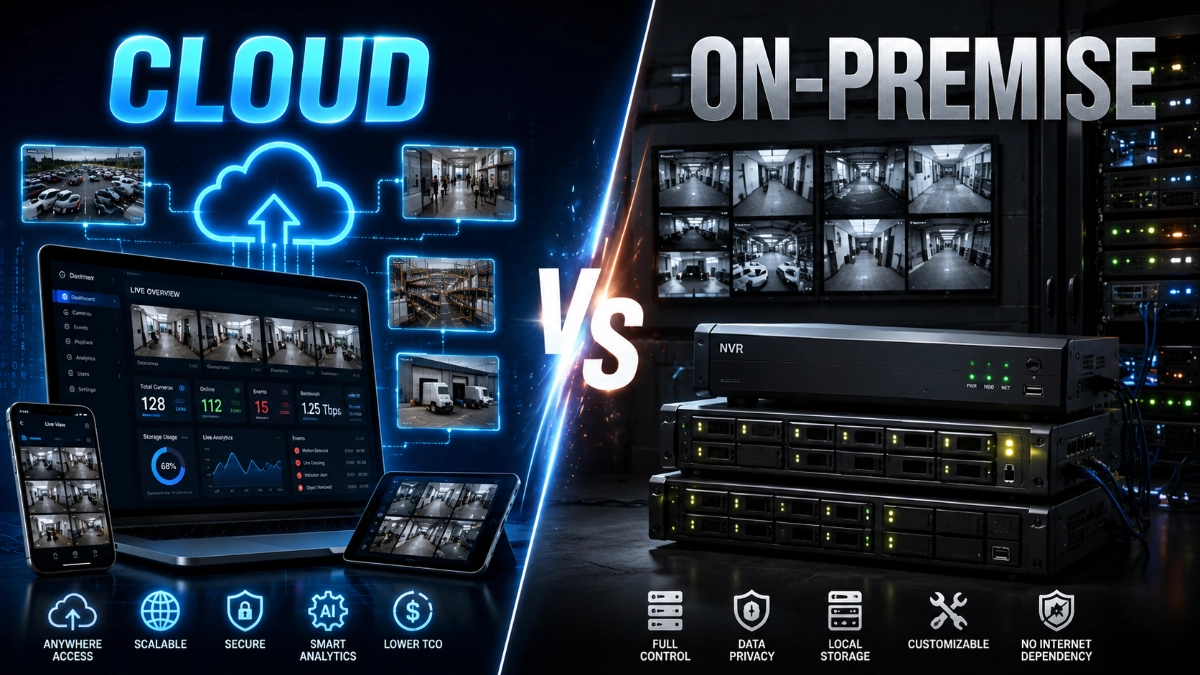
Two primary deployment models have emerged: cloud-based surveillance and on-premise CCTV systems. Each comes with a distinct set of capabilities, trade-offs, and ideal environments. For business owners, IT managers, and security professionals, choosing the right model requires a clear understanding of operational needs, compliance requirements, budget constraints, and long-term scalability goals.
This guide delivers an expert-level, head-to-head comparison to help you make an informed decision.
What Is Cloud-Based Surveillance?
Cloud-based surveillance is a video security model in which camera footage is captured, transmitted over the internet, and stored on remote servers managed by a third-party cloud provider. Users can access live and recorded video from any internet-connected device, making it highly accessible and flexible.
Core components include IP cameras (often with edge processing), a secure internet connection, cloud video management software (VMS), and encrypted cloud storage. Deployment can be as simple as connecting plug-and-play cameras to an existing network, with no on-site servers required.
Typical users: retail chains, multi-branch offices, educational institutions, SMEs, and healthcare networks.
What Is an On-Premise CCTV System?
An on-premise CCTV system records and stores video locally using on-site hardware such as Network Video Recorders (NVRs), Digital Video Recorders (DVRs), and dedicated storage servers. Cameras connect to these devices via wired or wireless networks, and footage stays entirely within the organisation’s physical infrastructure.
This model gives organisations complete ownership of their data and infrastructure, requiring dedicated IT management but offering maximum control and performance.
Typical users: manufacturing plants, data centres, government facilities, critical infrastructure operators, and high-security environments.
Cloud-Based Surveillance: Key Advantages
1. Remote Monitoring from Anywhere
Live and recorded footage is accessible from smartphones, tablets, or desktops from anywhere with an internet connection. This is invaluable for multi-location businesses and travelling security managers.
2. Simplified Scalability
Adding cameras or locations requires no new server hardware. Simply onboard new devices to the cloud platform. Scaling from 5 to 500 cameras is a matter of licensing adjustments.
3. Reduced Upfront Hardware Costs
Cloud systems eliminate the need for on-site NVRs and servers, significantly lowering initial investment and making enterprise-grade surveillance accessible to smaller organisations.
4. Automatic Software Updates
Security patches, firmware upgrades, and feature enhancements are handled by the cloud provider, reducing the IT burden on internal teams.
5. Disaster Recovery
Since footage is stored off-site, it remains protected even if on-site hardware is damaged, stolen, or destroyed. This provides a critical safety net for business continuity.
6. Multi-Location Centralised Management
A single dashboard can manage cameras across dozens or hundreds of locations, enabling standardised security policies and faster incident response.
Cloud-Based Surveillance: Limitations
- Dependence on internet connectivity: Any outage can disrupt live monitoring or footage upload.
- Recurring subscription costs: Monthly or annual fees for storage and platform access add up over time, especially at scale.
- Bandwidth consumption: High-resolution video requires significant upload bandwidth, which can strain networks.
- Data privacy concerns: Storing footage on third-party servers raises questions about access and jurisdiction.
- Compliance challenges: Industries like banking, defence and healthcare may face regulatory restrictions on cloud storage of surveillance data.
On-Premise CCTV Systems: Key Advantages
1. Full Data Ownership and Privacy
All footage stays on-site. The organisation retains complete control over who accesses data and how long it is retained critical for legally sensitive or regulated environments.
2. No Recurring Storage Fees
Once the hardware is purchased and installed, there are no ongoing cloud subscription costs. Long-term total cost of ownership (TCO) is often lower for large deployments.
3. Low-Latency Performance
Local storage and processing deliver real-time performance without network delays, essential for applications requiring immediate response, such as access control integration.
4. Regulatory Compliance
Sectors with strict data residency requirements (government, defence, banking) often mandate on-premise storage, making this model the compliant default.
5. Independence from the Internet
On-premise systems continue functioning during internet outages. Facilities in remote areas or those requiring 24/7 uptime regardless of connectivity greatly benefit from this.
On-Premise CCTV Systems: Limitations
- High upfront capital expenditure: Servers, NVRs, cabling, and installation can be costly.
- Ongoing maintenance responsibilities: Organisations must manage hardware health, storage expansion, and system updates internally.
- Complex upgrades: Replacing or scaling infrastructure requires procurement, installation, and configuration time.
- Disaster recovery risk: If on-site equipment is damaged or destroyed, footage may be permanently lost without off-site backup.
- Hardware lifecycle management: Equipment becomes outdated every 5-7 years, requiring replacement investment cycles.
Cloud vs On-Premise CCTV: Detailed Comparison
| Factor | Cloud-Based Surveillance | On-Premise CCTV |
| Installation Cost | Low – minimal hardware required | High – servers, NVRs, cabling |
| Long-Term Cost | Recurring subscription fees | Lower TCO after initial investment |
| Scalability | Highly scalable with no hardware | Limited by on-site hardware capacity |
| Data Ownership | Shared with cloud provider | Full organizational control |
| Remote Access | Anytime, anywhere via internet | Requires VPN or additional setup |
| Maintenance | Provider-managed updates | Internal IT team responsibility |
| Reliability | Depends on internet uptime | Functions offline; no internet needed |
| Compliance | Challenging in regulated sectors | Preferred for strict data residency |
| Storage Expansion | Instant, subscription-based | Physical hardware addition required |
| Cybersecurity | Provider-managed; shared model | Self-managed; full control |
| Best Use Cases | Retail, SMEs, multi-branch offices | Government, manufacturing, data centers |
Use Cases: When Cloud Surveillance Makes More Sense
- Retail chains managing dozens of stores need centralised visibility without individual IT setups at each location.
- Multi-branch businesses such as banks, pharmacies, or franchise networks benefit from unified remote management.
- Educational institutions with large campuses and seasonal changes in occupancy need scalable, low-maintenance systems.
- Healthcare facilities that prioritise quick deployment and remote administrative monitoring across clinics.
- Small and medium enterprises seeking professional-grade surveillance without the overhead of dedicated security IT staff.
- Remote site monitoring of construction sites, oil fields, and logistics depots with limited on-site IT support.
Use Cases: When On-Premise CCTV Is the Better Choice
- Manufacturing plants require real-time monitoring with zero tolerance for latency or connectivity-dependent downtime.
- Data centres where surveillance data must remain physically isolated and fully auditable.
- Government and defence facilities that operate under strict data sovereignty and classified environment policies.
- Critical infrastructure such as power stations, water treatment plants, and transportation hubs.
- High-security environments, such as prisons, research labs, and nuclear facilities, require data control to be non-negotiable.
- Industrial operations in remote locations with limited or unreliable internet access.
Hybrid Surveillance Systems: The Best of Both Worlds
Hybrid surveillance architectures combine local on-premise storage with cloud-based redundancy, analytics, and remote access. Cameras record footage locally via NVR or edge storage, while selected clips, alerts, or metadata are simultaneously sent to the cloud for off-site backup and centralised management.
Benefits of hybrid systems include disaster resilience, reduced bandwidth consumption (only critical data is uploaded), continued operation during outages, and access to cloud-based AI analytics without fully surrendering local data control.
A growing number of enterprise organisations, particularly in retail, logistics, and finance, are adopting hybrid models as a pragmatic middle ground, leveraging platforms from leading vendors, including Impact by Honeywell CCTV, which supports hybrid deployment architectures for Indian enterprises and global installations alike.
Cybersecurity Considerations for Modern Surveillance
Regardless of deployment model, surveillance systems are high-value targets for cyberattacks. A compromised camera network can expose organisational premises, operational data, and employee activity. Adopt these best practices:
- Encryption: Use end-to-end encryption for video transmission (TLS/SSL) and at-rest encryption for stored footage.
- Access Control: Implement role-based access controls (RBAC) to limit who can view, download, or modify footage.
- Network Segmentation: Place cameras on a dedicated VLAN, isolated from business-critical IT systems.
- Multi-Factor Authentication (MFA): Require MFA for all VMS logins, particularly for cloud platforms.
- Firmware Management: Apply security patches and firmware updates promptly. Outdated firmware is a leading attack vector.
- Regular Security Audits: Conduct quarterly audits to identify unauthorised access attempts, misconfigurations, or vulnerable devices.
- Zero Trust Architecture: Authenticate every device and user independently rather than relying on perimeter security alone.
Future Trends in Video Surveillance
- AI-Powered Video Analytics: Real-time detection of anomalies, crowd behaviour, license plates, and facial recognition directly within the VMS.
- Edge Computing: Processing video data on the camera itself reduces bandwidth usage and enables faster local decision-making.
- Cloud-Native VMS Platforms: Next-generation platforms built entirely for cloud environments offer superior uptime, global scalability, and API-first integrations.
- Predictive Security: AI models trained on historical incident data can predict and alert security teams to potential threats before they escalate.
- Smart Building Integration: Surveillance systems are increasingly integrated with access control, HVAC, and occupancy management to enable intelligent building operations.
- 5G Connectivity: Higher bandwidth and lower latency from 5G networks will accelerate cloud adoption for high-resolution and mobile surveillance deployments.
Expert Buying Considerations: A Decision Framework
| Decision Checklist: Cloud vs On-Premise CCTV: How many locations do you need to monitor? (3+ locations favour cloud)Do you have in-house IT resources to manage local infrastructure? Are you subject to data residency or industry compliance regulations? What is your monthly internet bandwidth capacity at each site? What is your upfront capital budget vs ongoing operational budget tolerance? Do you require 24/7 uptime independent of internet connectivity? Is scalability over the next 3-5 years a priority? Do you need AI-powered analytics or smart building integration? How sensitive is your surveillance footage from a privacy or legal standpoint? Is a hybrid model feasible to balance local control with cloud benefits? |
If you answered yes to most of the first five questions, cloud or hybrid surveillance is likely your best path. If data control, compliance, and offline reliability dominate your requirements, on-premise CCTV remains the gold standard. Organisations sourcing enterprise-grade solutions in South Asia should also evaluate offerings from an authorised Impact by Honeywell CCTV distributor in India for localised support, warranty, and integration services.
| Expert Insight: The surveillance industry is no longer debating cloud vs on-premise as an either/or choice. The most resilient and future-proof organisations are deploying hybrid architectures that provide local redundancy, cloud-based analytics, and centralised multi-site management. Key principle: Choose your deployment model based on your compliance obligations first, operational continuity requirements second, and total cost of ownership third. Organisations with 5+ locations and limited IT staff should default to cloud-first architectures with local edge backup. |
Conclusion
| Summary: Choosing the Right Surveillance Model: Cloud-based surveillance excels in scalability, remote accessibility, and ease of management best suited for distributed, internet-connected businesses. On-premise CCTV is the superior choice where data sovereignty, offline reliability, and compliance are non-negotiable. Hybrid architectures are becoming the enterprise standard, combining the strengths of both models. Cybersecurity is a shared responsibility regardless of deployment model. Always align your surveillance strategy with your compliance obligations, IT capacity, and 5-year growth plan. |
There is no universal winner in the cloud vs on-premise CCTV debate. The right choice is the one aligned with your organisation’s security objectives, operational environment, regulatory obligations, and budget realities. As technology evolves, the boundaries between these models continue to blur, and hybrid deployments are fast becoming the new baseline for enterprise security strategy.
Whether you operate a single site or a nationwide network, investing in the right surveillance infrastructure today is an investment in business resilience, compliance confidence, and operational intelligence for years to come.
Read Also: Edge Analytics vs Server-Based Analytics: Understanding the Technology Trade-Offs
Read Also: The Evolution of CCTV Technology Over the Last Two Decades