Industrial facilities operate under conditions that are fundamentally different from commercial or residential buildings. Manufacturing plants, warehouses, logistics hubs, pharmaceutical facilities, data centres, and power plants all share one common challenge: the consequences of a fire are rarely limited to property damage. They can result in loss of life, prolonged operational downtime, regulatory penalties, and irreversible reputational harm.
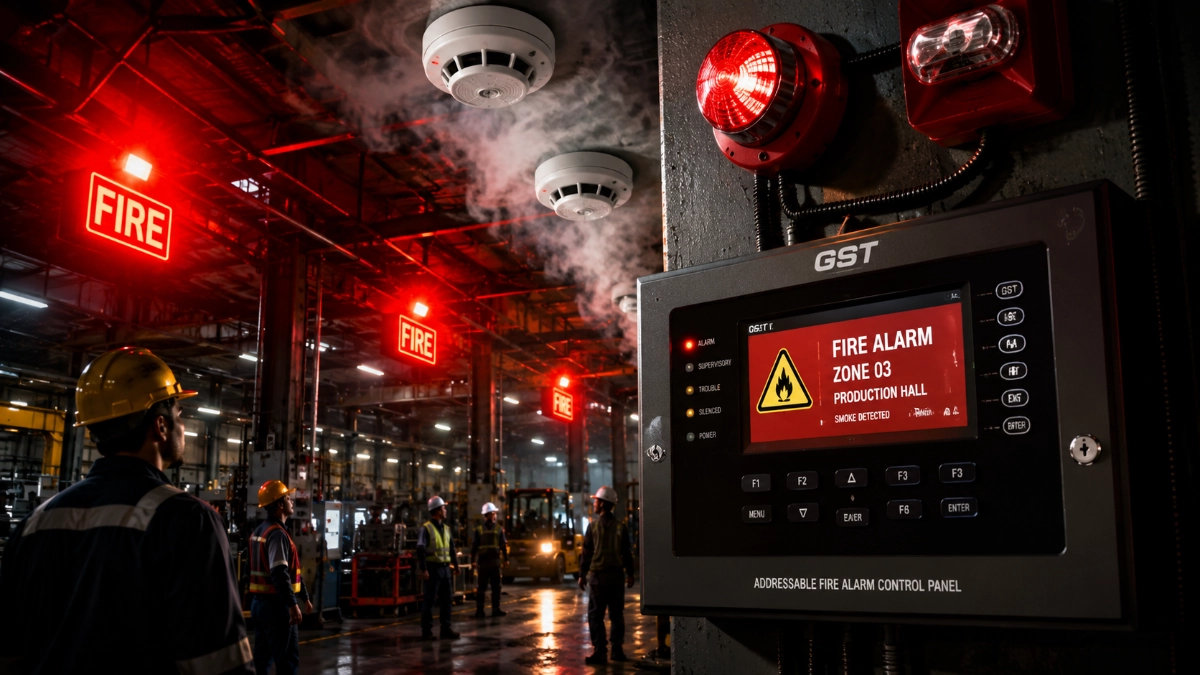
A fire alarm system is the first line of defence in any industrial safety strategy. But not all systems perform equally, and in industrial environments, performance gaps can be fatal.
This article examines the critical factors that determine how well a fire alarm system functions in demanding industrial settings, including environmental conditions, system design, technology choices, maintenance practices, and compliance requirements.
Quick Answer: What Factors Most Influence Fire Alarm System Performance in Industrial Environments?
Fire alarm system performance in industrial environments is shaped by six core factors: environmental conditions (dust, heat, humidity, corrosive atmospheres), detector selection and placement, system design and zone planning, network reliability and power stability, installation quality, and ongoing maintenance. Choosing addressable systems, meeting standards like NFPA 72 and IS 2189, and partnering with proven providers like GST significantly improves reliability.
Environmental Conditions That Affect Detector Accuracy
The industrial environment is one of the most challenging settings for any electronic equipment. Temperature extremes, airborne particles, moisture, and chemical exposure all degrade sensor sensitivity over time or trigger unwanted alarms.
Dust and Particulate Matter
In factories, cement plants, flour mills, and woodworking facilities, airborne dust is a constant presence. Photoelectric smoke detectors, the most common type in industrial deployments, use light-scattering to detect smoke particles. When dust accumulates inside the sensing chamber, it mimics the signal produced by actual smoke, causing false alarms. Conversely, heavy dust contamination can block the chamber entirely, preventing the detector from triggering even during a real fire.
Solution: Use dust-compensating addressable detectors with built-in drift compensation algorithms. GST fire alarm systems incorporate automatic sensitivity adjustment to maintain detection accuracy across varying dust levels.
Humidity and Moisture
High-humidity environments such as food processing plants, breweries, and chemical facilities introduce moisture into detector chambers. This causes corrosion on sensor contacts, shorts in circuit boards, and false readings. Steam, common in pharmaceutical and processing facilities, is particularly problematic because it scatters light similarly to smoke.
Solution: Specify IP-rated detectors designed for humid conditions, and install appropriate housing where steam venting is likely.
High Heat and Extreme Temperature Swings
Heat detectors rely on temperature thresholds to trigger alarms. In facilities with naturally high ambient temperatures, such as foundries, glass plants, or boiler rooms, standard fixed-temperature heat detectors may never activate because the baseline temperature already approaches the threshold. Rate-of-rise heat detectors solve this by triggering when the temperature increases by a defined margin per minute, regardless of the absolute value.
Corrosive Atmospheres
Chemical plants, battery manufacturing facilities, and wastewater treatment plants expose detectors to acidic or alkaline vapours. These corrode sensor components over time, reducing reliability and shortening service life.
Solution: Use detectors with corrosion-resistant housings and electronics sealed against chemical vapours. Always reference the site’s Material Safety Data Sheets (MSDS) before specifying detector types.
Key Takeaway #1
- Match detector type and housing rating to the specific environmental hazards at each location within the facility.
- Never apply a one-size-fits-all approach to industrial detector specification.
Detector Selection Based on Industrial Risk Profiles
No single detector type suits every industrial application. The right choice depends on the nature of the fire risk, the speed of fire development, and the ambient conditions at each zone.
| Detector Type | Best Application | Industrial Example | Key Limitation |
| Photoelectric Smoke | Slow-smoldering fires | Warehouses, server rooms | Prone to dust interference |
| Ionization Smoke | Fast-flaming fires | Paint booths, solvent areas | Sensitive to humidity |
| Fixed-Temp Heat | Areas with flammable liquids | Boiler rooms, kitchens | Slow response in high-ambient zones |
| Rate-of-Rise Heat | High-ambient temp areas | Foundries, glass plants | May not detect slow fires |
| Beam Detector | Large open spaces | Aircraft hangars, warehouses | Alignment-sensitive |
| Flame Detector (UV/IR) | Fast-flaming hydrocarbon fires | Oil refineries, chemical plants | High cost; false alarms from sunlight |
| Multi-Sensor / Addressable | Mixed-risk industrial zones | Pharmaceutical, logistics | Higher unit cost |
Multi-sensor addressable detectors, which combine smoke, heat, and CO sensing, are increasingly the preferred choice for complex industrial environments because they analyse multiple data streams simultaneously before triggering, dramatically reducing false alarms while maintaining sensitivity.
GST addressable detectors use intelligent multi-criteria algorithms that cross-reference environmental readings to confirm genuine fire events before activating the system.
Importance of System Design and Zone Planning
Even the most technically advanced detectors will underperform if the system design is flawed. Industrial facility managers must work with qualified fire protection engineers to produce a design that reflects the actual risk profile of every area.
Key design principles include:
- Zone segregation: Divide the facility into logical fire zones that match operational areas. This allows first responders to identify the location of a fire instantly.
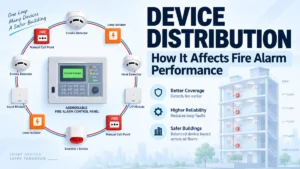
- Coverage calculations: Every detector has a coverage area specified by the manufacturer and local codes. In open industrial spaces with high ceilings, coverage may need to be reduced to account for heat dilution.
- Air movement: HVAC systems can carry smoke away from detectors or disperse it below detection thresholds. Detector placement must account for airflow patterns.
- Redundancy: Critical zones should include overlapping detection coverage so that no single detector failure creates a blind spot.
Addressable vs Conventional Fire Alarm Systems: Which Is Right for Industrial Use?
The choice between an addressable fire alarm panel and a conventional fire alarm panel is one of the most consequential decisions in industrial fire protection planning.
Conventional Fire Alarm Panels
A conventional fire alarm panel divides a building into detection zones. When a detector activates, the panel identifies the zone, not the specific device. For small facilities with a limited number of zones, this is cost-effective and straightforward. However, in large industrial facilities with dozens of zones, pinpointing the exact source of a fire becomes slow and difficult.
Addressable Fire Alarm Panels
An addressable fire alarm panel assigns a unique address to every detector, call point, and module on the system loop. When any device activates, the panel displays its exact location down to the individual device on the control panel display.
In industrial settings, this precision is not a luxury; it is a safety requirement. A fire in a 200,000 sq ft warehouse needs to be located within seconds, not minutes.
Additional advantages of addressable systems include:
- Remote device status monitoring and diagnostic reporting
- Sensitivity adjustment by zone or individual device
- Faster commissioning and fault isolation
- Support for complex cause-and-effect programming
- Integration with building management and suppression systems
GST fire alarm systems are built on an addressable architecture that supports thousands of devices per loop, making them highly scalable for large industrial campuses. GST panels are widely deployed across manufacturing plants, hospitals, and logistics hubs throughout India and the Gulf region.
Key Takeaway #2
- For any industrial facility above 5,000 sq ft or with multiple high-risk zones, an addressable system is strongly recommended over a conventional panel.
- Addressable systems save time in emergency response, and time saves lives.
Network Reliability and Communication Infrastructure
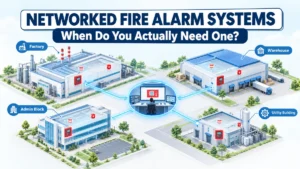
An industrial fire alarm system is only as reliable as its communication network. In large facilities, detectors communicate with the main panel over structured wiring loops or, increasingly, wireless mesh networks.
Critical reliability considerations include:
- Loop integrity: Class A (Style D/E) wiring ensures that a single cable break does not disable any device on the loop. Class B wiring, while less expensive, can leave entire segments of a facility unmonitored after a fault.
- Peer-to-peer networking: Multi-panel systems connected across a facility campus should use supervised communication paths with automatic failover.
- Signal supervision: Every device and communication link should be continuously supervised so that faults are reported immediately, not discovered during an emergency.
Power Supply Stability and Backup Requirements
Power supply failures are among the most common causes of fire alarm system downtime. Industrial facilities experience frequent voltage fluctuations, power cuts, and interference from heavy machinery.
A compliant industrial fire alarm power supply must include:
- Regulated primary mains supply with surge and transient protection
- Sealed lead-acid or lithium backup batteries sized to provide a minimum of 24 hours of standby, followed by 30 minutes of full alarm operation (as required by most standards, including IS 2189 and NFPA 72)
- Automatic battery management with low-battery fault reporting
- Earth fault monitoring on all circuits
In facilities with critical uninterrupted operations, such as pharmaceutical clean rooms or data centres, consider secondary UPS systems to bridge the gap between a mains failure and generator startup.
Installation Quality and Wiring Practices
A fire alarm system is only as good as its installation. Poor wiring practices, inadequate cable management, and improper terminations introduce faults that may not be visible during commissioning but emerge under operational stress.
Best practices include:
- Use fire-rated cable: All wiring in critical zones must use circuit integrity (CI) cable rated to maintain function at high temperatures during a fire, allowing the system to remain operational for evacuation.
- Segregate power and signal cables: Running fire alarm cables alongside high-voltage power cables introduces electromagnetic interference that degrades signal integrity.
- Label every device: Every detector, module, and junction box should be clearly labelled with its address and zone, essential for rapid fault diagnosis.
- Document as-built drawings: Complete, accurate as-built wiring documentation is essential for both maintenance teams and emergency responders.
Detector Placement and Coverage: Getting It Right
Incorrect detector placement is a leading cause of both missed detections and false alarms in industrial environments. Installation teams should follow the coverage guidelines defined by the detector manufacturer and the applicable national standard (e.g., IS 2189, BS 5839, NFPA 72).
Industrial-specific placement considerations:
- High-bay warehouses (>8m ceiling height): Use beam detectors or aspirating smoke detection (ASD) systems that draw air samples to a centralised detector.
- Areas with high airflow: Position detectors at ceiling level near return air intakes, not directly in the path of supply air.
- Conveyor systems: Install detectors at each transfer point where heat or friction fires are most likely.
- Cable trays and false floors: Ensure sub-floor and above-ceiling spaces have adequate coverage, especially in data centres.
Key Takeaway #3
- Always commission a site-specific detector placement design from a certified fire protection engineer.
- Generic placement based only on floor area will underperform in complex industrial geometries.
Integration with Emergency Response Systems
A fire alarm system does not operate in isolation. In industrial environments, it must be integrated with other emergency and building systems to achieve a coordinated response.
Critical integrations include:
- Fire suppression systems: Automatic sprinklers, gaseous suppression, or foam systems should be triggered or confirmed through the fire alarm panel.
- Smoke control and ventilation: HVAC systems must be automatically shut down or switched to smoke control mode on alarm.
- Access control: Doors should release to allow egress and be held open or closed depending on the fire compartment strategy.
- PA/Voice evacuation: Addressable voice alarm systems provide zone-specific evacuation instructions, critical in large industrial facilities where a single alarm tone may confuse.
- BMS/SCADA: Integration with building management or industrial SCADA systems allows facility managers to monitor alarm status alongside process data on a single platform.
GST fire alarm systems support open-protocol integration with third-party building management and suppression systems via relay outputs, BACnet, and Modbus communication interfaces.
Effect of Maintenance and Testing on System Performance
Fire alarm systems are life-safety equipment. Unlike most building systems, they must perform reliably on their very first activation, often after months or years of standby. This demands a rigorous maintenance and testing regime.
A compliant industrial fire alarm maintenance program should include:
| Activity | Frequency | Standard Reference |
| Visual inspection of all devices | Monthly | IS 2189 / NFPA 72 |
| Functional test of sample detectors | Quarterly | IS 2189 / NFPA 72 |
| Full system test of all devices | Annually | IS 2189 / NFPA 72 |
| Battery load test | Annually | Manufacturer + NFPA |
| Cable insulation resistance test | Annually | IS 2189 |
| Cause-and-effect verification | Annually or after system changes | Site-specific |
Maintenance records should be retained for a minimum of three years and made available to regulatory authorities on request.
GST provides complete after-sales support, including commissioning, preventive maintenance contracts, and spare parts availability through its authorised GST fire alarm system distributor network in India.
False Alarm Reduction Strategies
False alarms are a significant operational and safety problem in industrial environments. Every false evacuation disrupts production, desensitises workers to alarms, and increases the risk that a real fire event will not be taken seriously.
Proven strategies for reducing false alarms:
- Deploy multi-sensor addressable detectors that require multiple environmental criteria to be met simultaneously before triggering.
- Enable alarm verification delay (typically 30–60 seconds) to allow the system to confirm a sustained alarm signal before sounding the evacuation tone.
- Use cause-and-effect programming to require two-detector coincidence in high-sensitivity areas.
- Implement remote alarm investigation via CCTV integration before committing to full evacuation.
- Conduct regular detector cleaning and sensitivity recalibration to prevent drift-induced false alarms.
Key Takeaway #4
- False alarm reduction requires a systems approach; detector selection, programming, and maintenance must all align.
- A false alarm rate above 25 per 1,000 detectors per year is a signal that system review is urgently needed.
Compliance with Fire Safety Standards and Regulations
Industrial fire alarm systems must comply with the applicable national and international standards. Non-compliance exposes facilities to regulatory penalties, insurance claim rejections, and most seriously, inadequate protection during a real emergency.
Key standards relevant to industrial fire alarm systems include:
- IS 2189 (India): The Bureau of Indian Standards specification for fire alarm systems, covering design, installation, commissioning, and maintenance.
- NFPA 72 (USA): The National Fire Alarm and Signalling Code, widely referenced globally for system design and testing requirements.
- BS 5839 (UK): The British Standard for fire detection and fire alarm systems, specifying categories and design requirements.
- EN 54 (Europe): The European Standard defining performance requirements for fire detection and alarm system components.
GST fire alarm system components are certified to international standards, including EN 54, ensuring they meet the performance benchmarks required for both export markets and projects requiring international compliance.
Future Technologies Improving Industrial Fire Detection
The industrial fire detection landscape is evolving rapidly. Several emerging technologies are improving detection speed, reducing false alarms, and enabling smarter emergency response.
- AI-powered detection: Machine learning algorithms analyse environmental sensor data to distinguish real fire signatures from interference patterns with higher accuracy than threshold-based systems.
- Aspirating smoke detection (ASD): Systems like Very Early Warning Fire Detection (VEWFD) draw air samples through pipe networks to a centralised, highly sensitive detector, providing detection minutes or hours before visible smoke develops, ideal for pharmaceutical clean rooms and data centres.
- Video flame detection: Camera-based flame detection uses image processing algorithms to identify the visual characteristics of flames, suitable for open-area outdoor industrial sites where beam detectors cannot be used.
- IoT-connected fire systems: Cloud-connected fire alarm systems enable remote monitoring, predictive maintenance alerts, and real-time alarm notification to facility managers’ mobile devices.
- Wireless mesh detectors: For retrofitting fire detection into existing industrial buildings where cable runs are impractical, wireless mesh detector networks provide reliable, supervised coverage without structural disruption.
Why Choosing the Right Fire Alarm Partner Matters
A fire alarm system is a long-term investment. The technology matters, but so does the organisation supporting it. In industrial environments, choosing an experienced, accredited fire alarm provider reduces project risk and ensures ongoing system reliability.
When evaluating a fire alarm partner for your industrial facility, consider:
- Proven experience with industrial installations of similar scale and risk profile
- Product certification to relevant standards (EN 54, UL, IS)
- Local technical support and spare parts availability
- Ability to provide complete system integration, not just the supply of equipment
- References from similar facilities in your industry sector
GST (Gulf Security Technology) has established itself as a leading manufacturer of intelligent fire alarm systems, with deployments across industrial, commercial, and infrastructure projects throughout the Middle East and Asia. Through its authorised GST fire alarm system distributor network in India, GST provides local technical support, rapid spare parts availability, and comprehensive project assistance from design to commissioning and maintenance.
The GST fire alarm system range includes both addressable fire alarm panels and conventional fire alarm panels, addressable detectors, conventional detectors, and a full range of ancillary devices enabling facilities to build a complete, certified fire detection solution from a single trusted source.
Facility Manager’s Fire Alarm Performance Checklist
Use this checklist during annual fire safety reviews or when specifying a new fire alarm system.
- Has a site-specific fire risk assessment been completed within the last 12 months?
- Is the detector type matched to the specific environmental hazard in each zone?
- Is the system addressable, with individual device identification at the panel?
- Have all wiring runs been completed with fire-rated CI cable in critical zones?
- Does the battery backup meet the minimum 24-hour standby + 30-minute full alarm requirement?
- Are all integrations (suppression, HVAC, PA, access control) verified in the cause-and-effect matrix?
- Has the full system functional test been completed and documented within the past 12 months?
- Is the false alarm rate within acceptable limits? (Target: <25 false alarms per 1,000 detectors/year)
- Are maintenance records complete and available for regulatory inspection?
- Does the fire alarm provider offer local technical support and spare parts availability?
Conclusion: Actionable Recommendations for Industrial Facility Managers
Fire alarm system performance in industrial environments is not a product specification; it is the outcome of a series of deliberate decisions made across design, procurement, installation, integration, and maintenance.
The facilities with the most reliable fire detection share common characteristics: they conduct regular risk assessments, they match every detector to its specific environment, they invest in addressable systems that provide device-level visibility, and they treat maintenance as a non-negotiable safety obligation rather than a compliance checkbox.
Key recommendations for industrial facility managers:
- Conduct a site-specific fire risk assessment before specifying any fire alarm system or making changes to an existing one.
- Specify addressable systems for any facility above small scale, and require device-level identification at the control panel.
- Engage certified fire protection engineers for zone planning, detector placement calculations, and cause-and-effect design.
- Select detectors matched to environmental conditions, dust, heat, humidity, and chemical exposure profiles must drive detector specification, not cost alone.
- Implement a structured maintenance program including monthly visual inspections, quarterly functional tests, and annual full system tests.
- Choose a proven system provider with local technical support, certified products, and demonstrated industrial experience.
GST fire alarm systems deliver the intelligence, scalability, and reliability that industrial environments demand. Whether you are specifying a system for a new facility or upgrading an ageing conventional panel, GST’s addressable fire alarm platform provides a complete, standards-compliant solution backed by a nationwide distributor and support network. Contact your authorised GST fire alarm system distributor in India to arrange a technical consultation for your facility.
Read Also: Standalone Fire Detection vs Integrated Fire Safety Infrastructure: A Complete Comparison
Read Also: Intelligent Fire Detection vs Traditional Fire Detection