Walk through any large manufacturing plant, logistics hub, or power facility, and you will see dozens, sometimes hundreds, of CCTV cameras mounted at every corner. For decades, these cameras served a single, limited purpose: to record what happens and store the footage for review after an incident.
That era is ending.
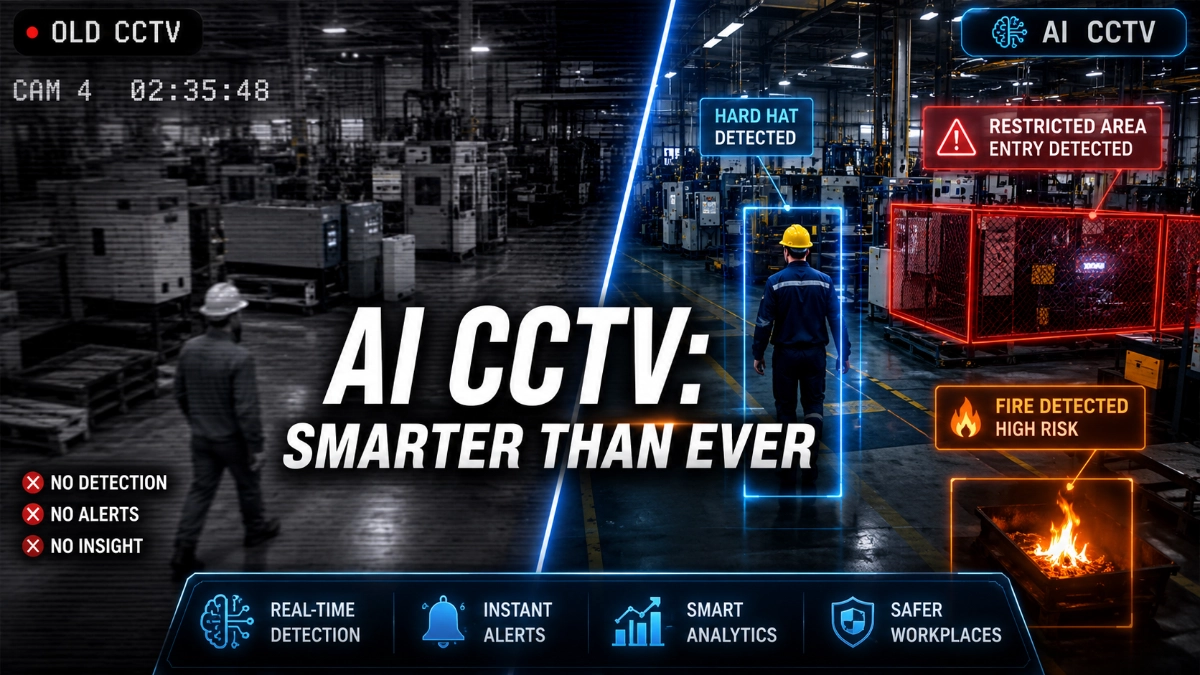
Artificial Intelligence is fundamentally reshaping what a CCTV camera can do. Today, AI-powered surveillance systems do not wait for something to go wrong. They watch, analyse, learn, and alert in real time. A camera on a factory floor can now identify a worker without a hard hat, detect the early signs of a fire, flag an unauthorised vehicle entering a restricted zone, and alert a supervisor within seconds.
For industrial business owners, plant managers, and safety officers, this shift is not merely a technological upgrade. It represents a genuine change in how facilities manage risk, ensure compliance, and drive operational efficiency. This article explains what AI-powered CCTV actually does, how it is being applied across real industrial environments, and what decision-makers need to know before adopting it.
What Makes AI-Powered CCTV Different from Traditional CCTV?
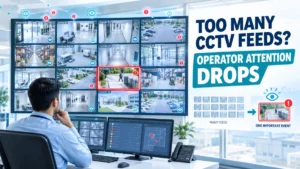
Traditional CCTV systems are fundamentally reactive. Cameras capture footage, footage is stored, and human operators review recordings after an event occurs. This model has three critical weaknesses in industrial environments:
- Human operators cannot realistically monitor dozens of live camera feeds simultaneously.
- Reviewing hours of archived footage is time-consuming and often inconclusive.
- By the time an incident is identified, the damage is already done.
AI-powered CCTV systems address all three limitations. Instead of simply recording, these systems apply computer vision and machine learning algorithms to analyse video feeds in real time. The camera or the server it connects to continuously processes what it sees, compares it against learned patterns, and generates instant alerts when it detects something that demands attention.
In short, traditional CCTV answers the question: “What happened?” AI-powered CCTV answers the question: “What is happening right now, and what might happen next?”
Key AI Technologies Used in Modern Industrial CCTV Systems
Several distinct technologies work together inside modern AI surveillance platforms:
- Computer Vision: Enables cameras to interpret visual information, identifying objects, people, vehicles, and actions within a video frame.
- Deep Learning: Neural networks trained on large datasets allow systems to improve their accuracy over time and adapt to the specific conditions of each facility.
- Video Analytics: Algorithms that process video streams to detect defined events, patterns, or anomalies without human intervention.
- Edge Computing: AI processing that happens directly at or near the camera, reducing latency and lowering bandwidth demands.
- Thermal Imaging Integration: Cameras combined with thermal sensors that detect heat signatures for fire risk, equipment faults, or human presence in low-light areas.
- Natural Language Alerting: Systems that translate detections into plain-language notifications sent instantly to supervisors via mobile or desktop platforms.
Top Ways AI Is Transforming Industrial Surveillance
Intelligent Intrusion Detection
Traditional motion-detection systems generate a high volume of false alarms triggered by shifting shadows, moving tree branches, or animals. AI-based intrusion detection systems distinguish meaningfully between a person, a vehicle, and irrelevant movement.
At a petrochemical facility, for example, an AI CCTV system can identify a human entering a defined perimeter after hours and immediately alert the security team, while ignoring a bird landing on the same fence. This precision dramatically reduces alarm fatigue, allowing security personnel to focus their attention on genuine threats.
PPE Compliance Monitoring
Personal Protective Equipment (PPE) compliance is a legal obligation and a life-or-death safety matter in most industrial environments. Manually auditing PPE use across a large plant is impractical.
AI cameras now automatically detect whether workers are wearing hard hats, high-visibility vests, safety goggles, gloves, and steel-toed boots. When a violation is identified, a worker entering a hazardous area without a helmet, for instance, the system logs the event, captures an image, and sends an alert. Over time, this data reveals patterns that help safety officers target training and reduce non-compliance.
Fire and Smoke Detection
Traditional smoke detectors respond to particles in the air. AI video analytics systems detect the visual signatures of smoke and flame in camera footage, often earlier than conventional sensor-based systems, and without requiring physical proximity to the fire source.
In a large warehouse with high ceilings, where smoke may take minutes to reach a ceiling-mounted detector, an AI camera can identify smoke forming near a storage rack and trigger an alert within seconds. This early warning can be decisive in preventing catastrophic loss.
Restricted Area Monitoring
Industrial facilities have numerous areas where only authorised personnel should be present: high-voltage substations, chemical storage zones, server rooms, and active machinery zones. AI CCTV systems monitor these boundaries continuously and alert immediately when an unauthorised person enters.
Unlike access control systems that only detect entry through a controlled point, AI cameras monitor the entire zone, catching individuals who may climb over barriers or enter through unguarded routes.
Vehicle and Asset Tracking
Logistics hubs, manufacturing yards, and large industrial campuses involve constant movement of vehicles, forklifts, heavy machinery, and valuable assets. AI surveillance systems can track vehicle licence plates, monitor routes, detect speeding or unsafe driving behaviour within facility grounds, and flag vehicles parked in prohibited zones.
In a busy distribution centre, AI cameras can track the dwell time of trailers at loading docks, identify bottlenecks, and provide operations managers with data to improve throughput.
Behaviour and Anomaly Detection
AI systems can learn what “normal” activity looks like within a given area and flag deviations automatically. A worker lying motionless on the factory floor, two individuals engaged in a confrontation, or a person loitering near a secure cabinet for an unusually long period, all of these can be detected and escalated without a human operator noticing them on a monitor.
This capability is particularly valuable for lone worker safety in remote areas of large industrial sites.
Operational Process Monitoring
AI CCTV is increasingly used not just for security, but for operational intelligence. Cameras positioned along production lines can monitor throughput, detect blockages, count product units, identify equipment sitting idle, and track worker positioning relative to machinery.
A food processing plant might use AI video analytics to verify that cleaning and sanitation protocols are followed between production runs, generating a timestamped visual audit trail for regulatory compliance.
| Did You Know? |
| AI-powered video analytics systems can process multiple camera feeds simultaneously, a task that would require dozens of human operators to replicate. A single AI platform managing 200 cameras can detect a PPE violation, a fire signal, and an unauthorised intrusion all within the same second and generate separate alerts for each. |
Benefits of AI CCTV for Industrial Facilities
- Faster incident response: Real-time alerts compress the time between detection and action from hours to seconds.
- Reduced operational costs: Automated monitoring reduces reliance on large security guard teams for routine surveillance tasks.
- Improved safety records: Consistent, automated PPE and behaviour monitoring lead to measurable reductions in workplace accidents.
- Regulatory compliance: Automated, timestamped video records support compliance with health and safety regulations and provide defensible evidence in the event of disputes.
- Operational insights: Data from AI video analytics feeds into process improvement, maintenance scheduling, and logistics optimisation.
- Scalability: AI platforms can manage hundreds of cameras without a proportional increase in staffing costs.
- 24/7 vigilance: Unlike human operators, AI systems do not suffer from fatigue or distraction.
Challenges and Considerations Before Deployment
AI-powered CCTV systems deliver significant benefits, but deployment is not without complexity. Decision-makers should carefully evaluate the following:
- Infrastructure requirements: AI video analytics demand reliable network bandwidth, computing power, and, in some cases, hardware upgrades to cameras and servers.
- Data privacy and compliance: Facilities must ensure that AI surveillance practices comply with applicable data protection laws and that employees are informed about how footage is used.
- System accuracy and calibration: AI systems must be trained and calibrated for the specific environment. A model trained on one facility may not perform optimally in another without adjustment.
- Integration with existing systems: AI CCTV platforms need to integrate with access control, alarm management, and incident reporting systems to deliver maximum value.
- Change management: Security and operations teams need training to interpret AI alerts and respond appropriately.
- Ongoing maintenance: AI models require updates as environments change, equipment is moved, or new risk areas are identified.
| Common Mistakes Companies Make When Implementing AI CCTV |
| 1. Buying hardware without a clear use-case strategy leads to underutilised systems. |
| 2. Underestimating network infrastructure requirements, causing processing delays. |
| 3. Failing to involve safety officers and operations managers in the selection process. |
| 4. Neglecting employee communication, which creates resistance and trust issues. |
| 5. Choosing systems that cannot scale as facility needs evolve. |
| 6. Skipping the calibration phase and accepting out-of-the-box settings that generate excessive false alerts. |
| 7. Not establishing clear escalation protocols for the alerts the system generates. |
Industries Benefiting Most from AI Surveillance
- Manufacturing plants: PPE compliance, process monitoring, equipment safety zones.
- Oil, gas, and petrochemical facilities: Perimeter security, hazardous area monitoring, fire and gas detection support.
- Logistics and warehousing: Vehicle tracking, dock management, theft prevention.
- Power generation and utilities: Critical infrastructure protection, restricted area enforcement.
- Food and beverage production: Hygiene compliance monitoring, sanitation verification.
- Pharmaceutical manufacturing: Clean room access control, handling procedure compliance.
- Construction sites: Worker safety monitoring, equipment tracking, after-hours intrusion detection.
| What to Ask Before Choosing an AI CCTV Solution |
| ▢ What specific use cases does this system address for industrial environments? |
| ▢ What are the hardware and network requirements for our facility size? |
| ▢ How is the AI model trained, and can it be calibrated for our specific site conditions? |
| ▢ What is the false-positive rate in environments similar to ours? |
| ▢ How does the system integrate with our existing access control and alarm infrastructure? |
| ▢ What data is retained, where is it stored, and how is it protected? |
| ▢ What support, training, and model update services are included? |
| ▢ Is the solution scalable as our facility expands? |
| ▢ What are the licensing terms per camera, per site, or per analytics module? |
| ▢ Can we see a live demonstration in an environment similar to ours? |
Future Trends in AI Video Analytics
The capabilities of AI-powered CCTV systems continue to advance rapidly. Several trends are shaping where this technology is heading:
- Predictive analytics: Moving beyond detecting what has already happened, next-generation systems will identify conditions that precede incidents, predicting equipment failure or unsafe behaviour before it occurs.
- Multi-sensor fusion: AI platforms will increasingly combine video feeds with data from IoT sensors, gas detectors, and environmental monitors to create a unified operational intelligence layer.
- Edge AI advancement: More processing power built into the cameras themselves will reduce dependence on centralised servers and enable faster response times in remote areas.
- Natural language interfaces: Operators will query surveillance data conversationally, asking the system to surface all PPE violations from the past week, or to show footage from a specific zone during a defined time window.
- Automated compliance reporting: Systems will generate regulatory audit reports automatically from video analytics data, reducing administrative workload.
For facilities evaluating their options today, solutions such as Impact by Honeywell CCTV represent the direction the market is heading, combining advanced video analytics with robust hardware designed specifically for demanding industrial environments.
Conclusion
The transformation of industrial CCTV from a passive recording tool into an active operational intelligence platform is well underway. For plant managers, safety officers, and facility administrators, this is not a distant technological possibility; it is a deployable reality that is already improving safety outcomes, reducing costs, and strengthening compliance across factories, warehouses, logistics hubs, and industrial campuses around the world.
The industrial organisations that move thoughtfully but decisively to adopt AI-powered surveillance will not only protect their people and assets more effectively, but also They will gain a measurable operational advantage over those still relying on passive recording systems and reactive incident management.
The cameras are already watching. AI makes them understand.
Read Also: Cloud-Based Surveillance vs On-Premise CCTV Systems: Pros, Cons, and Use Cases
Read Also: Edge Analytics vs Server-Based Analytics: Understanding the Technology Trade-Offs