Picture a control room in Singapore at 2 a.m. A sensor in a basement parking garage picks up a faint heat signature, long before any visible smoke appears. The system cross-checks it against airflow and temperature data, flags a probable fire, and alerts the nearest response team within a minute. No human watched a screen and caught it. The network did.
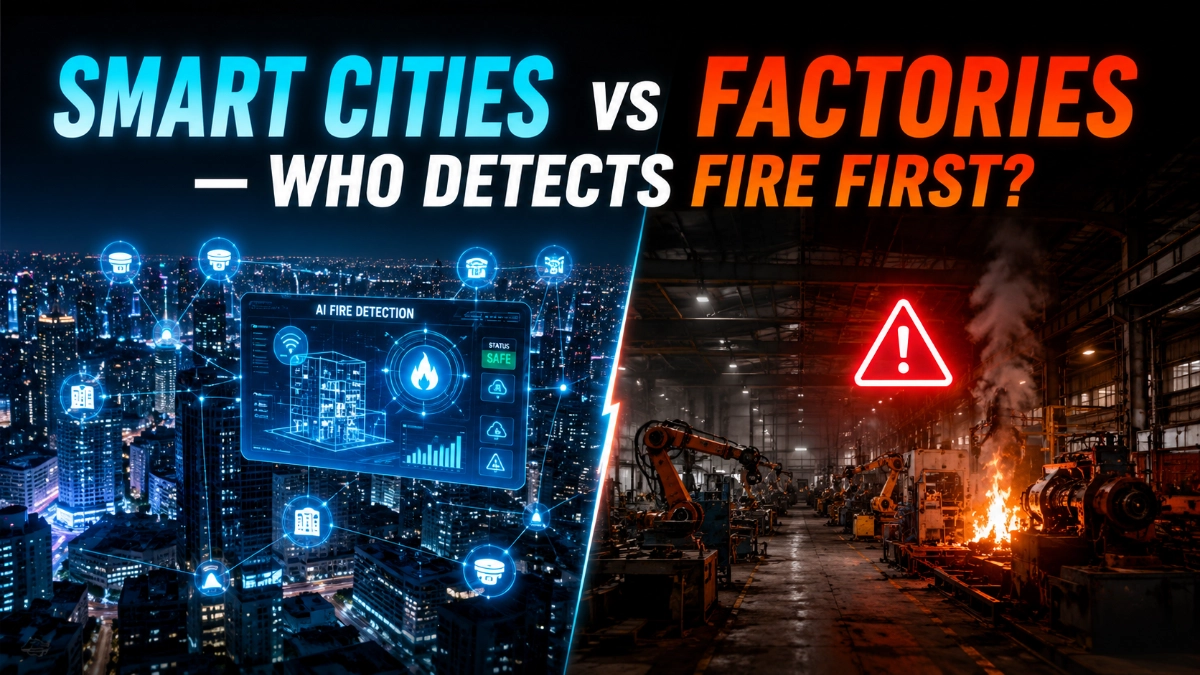
This is everyday infrastructure in modern smart cities. Fire detection has quietly moved from a wall-mounted device that reacts after smoke fills a room to a connected, predictive system that catches problems while they are still forming.
Industrial facilities face a strikingly similar challenge. Warehouses, manufacturing plants, chemical units and data centres deal with dense equipment, flammable materials, and large unmonitored spaces, the same conditions that pushed cities toward smarter detection in the first place. Yet many industrial sites still rely on technology that hasn’t meaningfully changed in two decades.
This article looks at what smart cities got right and how industrial safety teams can apply the same thinking without needing a city-sized budget.
Understanding Smart City Fire Detection Ecosystems
Smart city fire detection is a network of connected sensors, cameras, and software that monitors public and private infrastructure for fire risk in real time, and automatically alerts emergency responders before a fire spreads. It functions as one integrated system rather than a set of isolated alarms.
Instead of a single smoke detector in a single room, a smart city deploys thousands of sensors across buildings, transit stations, and public spaces. These devices share data continuously with a central monitoring platform, which uses software to detect patterns that a lone device would miss.
What makes this approach distinct isn’t any single sensor. It’s the connectivity. A heat spike in one location means little on its own. The same heat spike, combined with smoke density readings, electrical load data and ventilation patterns from nearby zones, becomes a reliable early warning.
Key takeaway: Smart city fire detection succeeds because it treats fire risk as a data problem, not just an alarm problem. Industrial sites that adopt the same mindset see the same gains in lead time.
Core Technologies Powering Smart City Fire Safety
A handful of technologies work together to make smart fire safety solutions practical at the city scale. Most industrial facilities already have pieces of this industrial safety technology in place; the opportunity lies in connecting them into one system.
IoT Sensors
Internet of Things sensors measure heat, smoke density, gas concentration and air quality continuously, transmitting readings to a central system every few seconds. Unlike standalone smoke detectors, they generate a constant stream of data that can reveal slow-building risks, like a generator running hotter than normal for several days straight.
AI-Based Monitoring
Artificial intelligence reviews sensor data and video feeds in real time, learning what “normal” looks like for a specific space and flagging deviations. This is the layer that separates a smart system from a digital one. It doesn’t just collect data; it interprets it.
Cloud Connectivity
Cloud platforms let fire data from hundreds of buildings reach a single dashboard, accessible to city control rooms and fire departments alike. For industries, this means a plant manager in Pune can monitor fire risk across a facility in Gujarat from the same screen.
Real-Time Alerts
When a sensor or AI model detects a credible risk, the system pushes alerts directly to responders, control rooms, and building management systems, often before any visible flame or smoke appears. A one-minute head start can be the difference between a contained incident and a shutdown.
Predictive Analytics
By analysing historical sensor data, predictive models flag equipment or zones at elevated fire risk before an incident occurs, for example, identifying a transformer trending toward overheating weeks in advance.
Key takeaway: No single technology creates AI-powered fire detection. It’s the combination of sensors that sense, AI that interprets, cloud platforms that connect, and analytics that predict working as one system.
Key Lessons Industries Can Learn from Smart Cities
Three lessons stand out when comparing how cities and industrial facilities approach fire safety.
First, connectivity beats isolation. A smart city never relies on a single sensor’s judgment. Industrial sites that link detectors across a facility, rather than treating each zone as separate, catch incidents that a standalone device would miss until it’s too late.
Second, data has to travel fast. Smart cities route alerts directly to the people who can act, skipping slow manual escalation chains. Industrial facilities with multiple shifts and buildings benefit from the same direct routing.
Third, maintenance becomes proactive. Smart systems automatically flag a faulty sensor or wiring fault, rather than waiting for a technician to discover it during a scheduled inspection months later.
| What Smart Cities Do | Industrial Equivalent |
| Connect sensors across the city | Connect detectors across a plant or campus |
| Route alerts to the nearest responder | Route alerts to the nearest shift supervisor |
| Flag failing hardware automatically | Run automatic fault diagnostics on panels |
| Use historical data to predict risk | Use equipment data to predict failure points |
Key takeaway: None of these lessons requires exotic technology. They require treating fire detection as an ongoing, connected process rather than a static installation.
From Reactive to Predictive Fire Protection
For most of fire safety’s history, detection meant reaction. A sensor detected smoke, an alarm sounded, and people responded. This model still saves lives, but it has a built-in limitation: by the time smoke is detectable, a fire is already underway.
Smart cities shifted the timeline backwards. Instead of asking “has a fire started?” AI-powered fire detection asks whether conditions are trending toward one. That single shift, from detection to prediction, is the most important change in fire safety in the past decade.
Industrial environments stand to gain even more from this shift than public spaces. A manufacturing plant’s equipment generates consistent, measurable data: temperature, vibration, and electrical load, which makes predictive modelling more accurate than in a typical city building.
Key takeaway: Predictive fire protection doesn’t replace traditional detection; it adds a warning layer in front of it, buying time that reactive systems can’t offer.
Why Traditional Fire Detection Approaches Are No Longer Enough
A standalone conventional fire alarm panel can certainly detect smoke and heat, which is part of its job that hasn’t changed. What it can’t do is tell a facility manager which conventional detectors in a 40,000-square-foot warehouse actually triggered, or whether the issue is spreading.
This isn’t a flaw in conventional systems; it’s simply a limitation of design. They were built for a single building with a handful of zones. Today’s industrial facilities often span multiple buildings, mezzanines, and outdoor storage yards environments where zone-level information isn’t precise enough.
Key takeaway: Conventional detection still has a place in smaller, simpler facilities. For complex industrial sites, it’s a starting point, not a complete strategy.
Building an Intelligent Industrial Fire Detection Strategy
Industries can adopt smart city strategies in three steps: mapping every fire-risk zone individually, connecting detection devices to a central monitoring platform, and prioritising fast, location-specific alerts over generic ones. The result pinpoints incidents instead of just announcing them.
The natural starting point is upgrading from a conventional panel to an addressable fire alarm panel, which identifies the exact device that triggered an alarm rather than just the general zone. In a sprawling facility, that precision can cut response time dramatically, since responders go directly to the source instead of searching an entire wing.
From there, facilities can layer in IoT fire detection sensors for gas leaks, temperature anomalies, and air quality, feeding all of it into one dashboard. Many Indian industrial sites have standardised around a GST fire alarm system for this reason, since it offers addressable precision with the flexibility to integrate sensors as a facility grows.
Key takeaway: A smart fire detection strategy doesn’t have to be built all at once. Most facilities start with addressable panels, then add sensor layers and analytics as budgets and risk assessments allow.
The Role of Addressable Fire Detection Systems in Smart Facilities
Addressable systems are the closest industrial equivalent to a smart city’s sensor network, because they treat every device as an individual data point rather than part of an anonymous zone.
Addressable detectors each carry a unique identifier, so the control panel knows precisely which unit triggered, where it sits on the floor plan, and whether it’s reporting a fault. This mirrors a smart city’s individually addressable streetlights and sensors granularity at the device level, not just the network level.
For facilities evaluating a switch, working with an established GST fire alarm system distributor in India can simplify the transition considerably, since proper zone mapping and device placement determine how much value the upgrade actually delivers. A poorly mapped addressable system performs little better than a conventional one.
Key takeaway: Addressable technology is the foundation on which smart fire detection is built. Without device-level precision, AI analytics and predictive models have far less useful data to work with.
Common Challenges and How to Overcome Them
Budget is the most common objection, and a fair one. Smart detection doesn’t mean replacing every panel overnight; most facilities phase upgrades in by priority zone, starting with areas holding the highest fire load or the most critical equipment.
Integration is the second challenge. Older facilities often run disconnected systems, fire, HVAC, and security installed at different times by different vendors. The fix isn’t ripping everything out; modern addressable panels generally integrate with existing building management systems through standard protocols.
Staff readiness matters more than most facilities expect. A connected system generates more data and more alerts, and teams need training to interpret them correctly; otherwise, alert fatigue sets in, and real warnings get treated like noise.
Key takeaway: Cost, integration, and training are real obstacles, but none of them is a reason to delay. There are reasons to plan a phased rollout instead of an all-at-once overhaul.
Future Trends in Industrial Fire Detection
Three trends are shaping where industrial fire detection heads are headed next. Digital twins will let facility managers simulate how a fire would spread through a specific building layout before it happens, refining sensor placement and evacuation plans in advance.
Drone-based thermal inspection is starting to supplement fixed sensors in large outdoor storage and logistics yards, covering ground that fixed installations can’t reach cost-effectively.
As more facilities adopt connected fire alarm systems, expect insurance providers to factor detection technology more directly into industrial risk assessments. [Insert latest verified statistic from a credible source] on insurance premium differences for facilities with advanced detection systems supports this shift.
Key takeaway: The facilities investing in connected detection today are positioning themselves ahead of where regulation, insurance, and industry standards are clearly heading.
Conclusion
Smart cities didn’t invent fire safety. They simply refused to treat it as a single device’s job. By connecting sensors, applying AI, and shifting from reaction to prediction, they built systems that catch problems while there’s still time to act.
Industrial facilities face the same fundamental risks, just at a smaller, more contained scale. The path forward looks similar: start with addressable detection, connect what’s already in place, and add predictive layers as the facility’s risk profile demands.
That’s the real promise of modern industrial fire prevention: knowing a problem is forming before it becomes one. That shift is already well underway in cities. Industry’s turn is now.
Read Also: How India’s EV Ecosystem Is Creating New Fire Protection Challenges
Read Also: The Next Decade of Fire Detection: What Will Change First?