What would it cost your business if your data centre went dark tonight, not due to a cyberattack, not a power failure, but a fire?
For most enterprises, the answer is uncomfortable. Yet as India races to build the digital infrastructure of a USD 5 trillion economy, fire safety remains one of the most underestimated risks in the sector. The facilities powering India’s cloud, AI, and fintech revolution are growing faster than the fire protection frameworks designed to safeguard them.
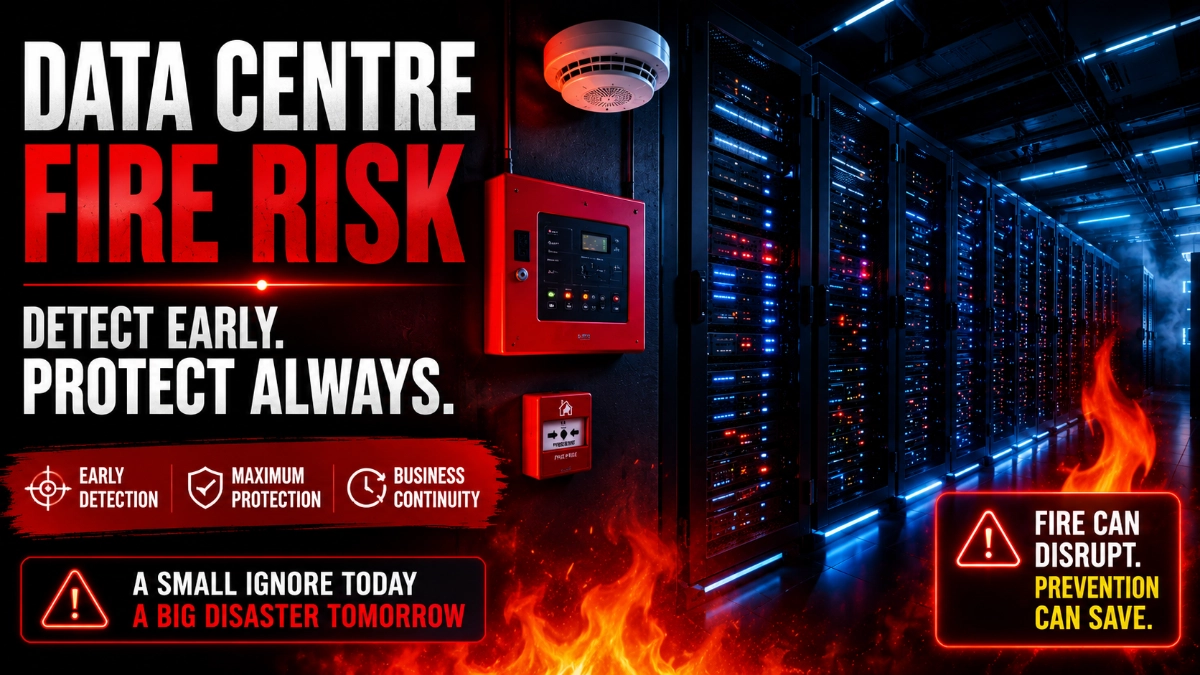
India is now racing to build the data centre capacity its digital economy demands. With billions of dollars flowing into hyperscale campuses, colocation facilities and edge nodes, the country faces the same fire safety vulnerabilities that have brought global operators to their knees, often without the mature fire-protection frameworks that took decades to develop in North America and Europe.
This article draws on engineering principles, operational realities, and global incident data to help facility managers, MEP consultants, fire protection engineers, and enterprise decision-makers understand the fire risks shaping India’s data centre sector and the intelligent protection strategies that can reduce them.
India’s Data Centre Boom: What Is Driving the Growth?
India’s data centre market is expanding at a pace few predicted even five years ago. Analysts at JLL and CBRE have documented cumulative investments exceeding USD 10 billion between 2022 and 2025, with Mumbai, Chennai, Hyderabad, Pune, and Delhi-NCR emerging as primary hubs.
Several forces are accelerating this growth:
- The Digital India programme and mandatory data localisation regulations are forcing global technology companies to build or lease in-country infrastructure.
- 5G rollout is creating demand for edge data centres at the network periphery.
- Rapid cloud adoption by Indian enterprises is filling hyperscale campuses operated by AWS, Microsoft Azure, Google Cloud, and domestic players such as NTT, Yotta, and STT GDC.
- A surge in AI and machine learning workloads demands high-density compute clusters with power densities far exceeding those of traditional server rooms.
Each megawatt of new capacity adds electrical load, heat generation, and fire risk. The question for operators is not whether fire safety matters; it is how to architect protection systems that match the speed, scale, and criticality of modern digital infrastructure.
Why Fire Safety Has Become a Strategic Priority
Fire safety in a data centre is fundamentally a business-continuity issue. Unlike a factory that can pause production, a mission-critical facility must remain operational 24 hours a day, 365 days a year. Industry benchmarks classify uptime requirements in Tier levels: Tier III facilities target 99.982% availability; Tier IV facilities target 99.995%. A single fire-related shutdown, even one lasting a few hours, can breach these commitments and trigger contractual penalties, customer churn, and reputational damage.
Three business imperatives drive fire safety investment in Indian data centres:
- Asset protection: Server racks, storage arrays, networking equipment, and power infrastructure represent capital investments of crores of rupees per hall.
- Business continuity: Colocation operators and cloud service providers carry service-level agreements that impose financial penalties for downtime.
- Regulatory compliance: India’s National Building Code, state fire department regulations, and insurance underwriter requirements increasingly mandate specific fire detection and suppression systems.
| Key Insight: Gartner estimates that IT downtime costs enterprises an average of USD 5,600 per minute. For a hyperscale operator serving hundreds of enterprise customers, even a partial fire-related shutdown can translate into losses of crores of rupees within hours. |
Major Fire Risks in Modern Data Centres
| The most common causes of data centre fires include electrical faults in power distribution systems, UPS battery failures, overheated cable trays, cooling system failures, and arc flash events. Battery Energy Storage Systems (BESS) and lithium-ion UPS batteries are increasingly significant ignition sources. |
Electrical Infrastructure
Power distribution is the single greatest fire risk in any data centre. High-capacity switchgear, bus ducts, power distribution units (PDUs), and automatic transfer switches all carry the potential for arc flash, short circuits, and insulation breakdown, particularly in ageing installations or poorly maintained systems.
UPS Rooms and Battery Banks
Uninterruptible power supply systems protect critical loads from utility fluctuations. However, valve-regulated lead-acid (VRLA) and lithium-ion battery banks release flammable gases during charging anomalies or thermal runaway. Lithium-ion BESS installations present particularly complex fire dynamics: once thermal runaway begins in one cell, it can propagate rapidly through adjacent cells, generating intense heat and toxic gases that standard suppression agents cannot reliably extinguish.
Cable Trays and Raised Floors
Data centre cable trays carry enormous quantities of power and data cabling. Overloading, mechanical damage, or poor installation can cause insulation to degrade over time, creating conditions for smouldering fires that begin producing smoke long before open flame appears. Raised floor plenums create hidden pathways through which smoke can travel undetected, complicating detection and suppression.
Cooling Systems
Computer room air conditioning (CRAC) units, in-row coolers, rear-door heat exchangers, and liquid cooling loops all incorporate electrical components that can fail. Refrigerant leaks can displace oxygen in enclosed spaces, creating both fire-suppression challenges and asphyxiation hazards for personnel.
High-Density Compute Zones
AI training clusters and GPU server farms operate at power densities of 30–100 kW per rack, far exceeding the 5–10 kW typical of traditional enterprise deployments. This concentrated heat load stresses cooling systems and increases the likelihood of thermal events if cooling fails even briefly.
Fire Safety Challenges Unique to High-Density Computing Environments
High-density data centres present fire-protection challenges that legacy systems were not designed to address:
- Rapid fire development: Fires in dense computing environments can transition from smouldering to open flame in minutes, leaving little time for evacuation or manual suppression.
- Sensitive equipment: Traditional water-based sprinkler systems cause equipment damage that often exceeds the direct fire damage. Gaseous suppression systems are preferred but require sealed, well-designed rooms.
- Airflow complexity: Hot-aisle/cold-aisle containment, blanking panels, and precision airflow management alter how smoke propagates, potentially defeating conventional smoke detector placement.
- Continuous operation constraints: Detection and suppression systems must avoid false alarms that trigger unnecessary equipment shutdowns or gaseous agent releases, both of which cause operational disruption.
- Evolving risk profiles: The rapid introduction of lithium-ion batteries, hydrogen fuel cells, and immersion cooling fluids creates fire scenarios for which historical risk data is still limited.
Key Fire Safety Lessons from Data Centre Expansion
India’s data centre sector can learn from both domestic incidents and global experience. The following lessons stand out:
Lesson 1: Early Detection Saves Assets and Uptime
The earlier a fire event is detected, the more options operators have: alert staff, initiate controlled shutdown of affected systems, activate suppression, and prevent propagation. Aspirating Smoke Detection (ASD) systems can detect combustion aerosols at concentrations measured in parts per million, providing warning minutes or even hours before conventional point detectors would activate.
Lesson 2: Zone-Level Precision Avoids Collateral Damage
An addressable fire alarm panel enables precise, zone-by-zone identification of alarm sources. In a data centre with dozens of rooms and hundreds of racks, knowing exactly which detector has activated and what type of event it signals allows operators to respond proportionately rather than shutting down entire halls unnecessarily.
Lesson 3: Multi-Sensor Detection Reduces False Alarms
False alarms are operationally damaging. They can cause unnecessary agent releases, equipment shutdowns, and staff complacency. Multi-sensor detectors combining optical smoke sensing, carbon monoxide detection, and heat measurement apply intelligent algorithms to distinguish genuine fire signatures from cooking fumes, steam, or dust, dramatically reducing nuisance alarms without compromising sensitivity.
Lesson 4: Integration with BMS and DCIM Is Essential
Standalone fire alarm systems are insufficient for modern data centres. Fire alarm control panels must integrate with Building Management Systems (BMS) and Data Centre Infrastructure Management (DCIM) platforms so that a fire event automatically triggers HVAC isolation, access control lockdown, gaseous suppression release, and generator transfer without requiring manual intervention at each system.
Lesson 5: UPS and BESS Rooms Need Dedicated Protection Strategies
Battery rooms require specialised detection: early-warning gas sensors that detect hydrogen off-gassing, thermal cameras for hotspot identification, and multi-sensor detectors capable of recognising the specific signatures of battery thermal runaway. Standard smoke detectors alone are inadequate for these environments.
The Role of Intelligent Fire Detection Systems
| Intelligent fire detection systems combine addressable detectors, multi-sensor technology, and AI-based signal processing to provide early, accurate fire warnings with minimal false alarms. They enable zone-level incident response, integrate with building management platforms, and deliver real-time diagnostic data to facility managers. |
Modern intelligent fire alarm systems go far beyond simple smoke detection. They incorporate:
- Distributed intelligence: Each detector performs local signal processing, reducing reliance on the central panel for basic alarm decisions.
- Event logging and diagnostics: Comprehensive logs of alarm, fault, and maintenance events support post-incident analysis and regulatory reporting.
- Predictive maintenance alerts: Detectors that flag contamination, end-of-life sensor drift, or communication faults before they cause failures.
- Remote monitoring capability: Supervisory software allows facility managers to monitor the status of fire alarm systems across multiple sites from a central operations centre.
GST Fire Alarm Systems represents one of the established manufacturers serving the Indian market, offering a range of addressable fire alarm panels and conventional fire alarm panels designed for mission-critical and commercial applications. Facility managers evaluating fire alarm infrastructure can consult a GST fire alarm system distributor in India for site-specific guidance on system selection and installation.
Addressable vs Conventional Fire Alarm Systems for Data Centres
| Addressable fire alarm systems are strongly preferred for data centres because each detector has a unique address, enabling the control panel to identify the precise location of an alarm. This zone-level precision is essential in large, complex facilities where rapid, targeted response prevents unnecessary shutdowns and limits damage. |
The distinction between addressable and conventional systems is fundamental to fire alarm design:
| Feature | Addressable System | Conventional System |
| Detector identification | Exact device location | Zone only |
| Scalability | Hundreds of devices per loop | Limited per zone |
| False alarm discrimination | Advanced — multi-sensor algorithms | Basic threshold trigger |
| Integration | BMS, DCIM, suppression | Limited |
| Maintenance | Remote diagnostics | Manual inspection required |
| Best for | Hyperscale & enterprise DCs | Small server rooms, edge sites |
Addressable detectors offer the granularity that large data centre environments require. In a 50,000 sq ft colocation hall with hundreds of addressable detectors installed, a fire alarm control panel running addressable protocols can tell the operations team that the alarm originated at a specific detector above a specific rack row, not simply that zone 4 has activated. This precision drives faster, more targeted responses.
Conventional fire alarm panels and conventional detectors remain appropriate for smaller installations, edge data centres, single-room server closets, or secondary support areas where the simplified topology and lower upfront cost are justified. The key is matching the system architecture to the facility’s scale and risk profile.
Best Practices for Data Centre Fire Protection
Layered Detection Strategy
No single detection technology is optimal for every zone in a data centre. A layered strategy typically includes:
- Aspirating smoke detection above and below raised floors, and in return air plenums.
- Multi-sensor addressable detectors in server halls and network operations centres.
- Specialist gas and thermal detectors in UPS rooms and BESS enclosures.
- Beam smoke detectors in high-bay areas such as loading docks and cable halls.
Gaseous Suppression Systems
Water-based suppression is generally unsuitable for active IT spaces. Clean agent systems using inert gases (IG-100, IG-541) or halocarbon agents (FK-5-1-12, HFC-227ea) suppress fires without damaging equipment or leaving residue. FM-200 and Novec 1230 remain widely specified in Indian data centres. Critically, these systems must be deployed in properly sealed rooms with maintained integrity to achieve effective agent concentration.
Regular Fire Drill and Response Planning
Technology alone does not ensure safety. Operators must conduct regular fire drills, test suppression system interlocks, and maintain updated emergency response plans that reflect the current layout and occupancy of the facility. Staff should understand which alarms require evacuation versus which trigger only a localised response.
Regulatory and Compliance Considerations
India’s regulatory framework for data centre fire safety is evolving. Key requirements currently include:
- National Building Code of India (NBC 2016): Part 4 covers fire and life safety, specifying detector types, spacing, and alarm system requirements for different occupancy classes.
- State Fire Department NOCs: Most states require a No Objection Certificate from the fire department before a data centre can operate. Requirements vary by state but typically mandate automatic fire detection, suppression, and annual inspection.
- Insurance underwriter requirements: Global and domestic insurers increasingly require compliance with NFPA 75 (Standard for the Fire Protection of Information Technology Equipment) or equivalent standards as a condition of coverage.
- BIS standards: Bureau of Indian Standards specifications govern detector and alarm equipment sold in India, requiring type-tested and certified products.
Operators planning new data centre construction or significant expansion should engage fire protection engineers early in the design process to ensure compliance with all applicable codes and to design systems that will satisfy both current requirements and anticipated future regulations.
Future Trends in Data Centre Fire Safety
- Lithium-ion-specific detection: As battery deployments grow, manufacturers are developing detectors tuned to the specific gas signatures of lithium-ion thermal runaway events, enabling detection before visible smoke or open flame.
- AI-driven alarm analytics: Machine learning algorithms applied to detector signal data are beginning to reduce false alarm rates and enable predictive identification of developing faults before they become fire events.
- Immersion cooling fire risks: As liquid immersion cooling gains traction for high-density AI infrastructure, the fire-safety implications of dielectric fluid spills and vapour generation are an area of active research.
- Digital twin integration: Fire safety systems feeding real-time data into facility digital twins enable scenario modelling, evacuation planning, and regulatory reporting with far greater sophistication than traditional paper-based systems.
Expert Recommendations for Facility Managers
Based on engineering principles and operational realities, the following recommendations apply to data centre fire safety planning in India:
- Conduct a fire risk assessment at the design stage, not as an afterthought. Engage a certified fire protection engineer alongside MEP consultants from project inception.
- Specify addressable fire alarm systems with multi-sensor addressable detectors for all primary data halls. Reserve conventional systems only for ancillary low-risk areas.
- Invest in aspirating smoke detection for raised floors, cable trays, and return air plenums environments where conventional point detectors respond too slowly.
- Integrate fire alarm, suppression, HVAC, and access control systems into a unified building management platform to enable automated, coordinated response.
- Plan for BESS and UPS room protection from day one. Specify gas-sensing detectors and thermal imaging cameras alongside standard smoke detection.
- Require factory-tested and BIS-certified equipment from established manufacturers. Evaluate the service and support network of any GST fire alarm system or equivalent brand before committing to a long-term installation.
- Schedule annual third-party fire safety audits and quarterly system tests. Maintain comprehensive maintenance logs to support regulatory inspections and insurance reviews.
Conclusion
India’s data centre sector is building the digital foundations of a USD 5 trillion economy. The pace of that construction is extraordinary, but pace without proportionate investment in fire safety creates risk that no operator, investor, or enterprise customer can afford to ignore.
The fire safety lessons from global data centre incidents are clear: early detection saves assets and uptime; addressable systems provide the precision that large facilities require; multi-sensor technology reduces false alarms without compromising sensitivity; and integration with building management platforms enables the automated, coordinated response that mission-critical operations demand.
As India’s data centre ecosystem matures, proactive fire detection and intelligent fire alarm infrastructure are transitioning from compliance requirements to competitive differentiators. Operators who invest in best-in-class fire protection demonstrate to enterprise customers, institutional investors, and insurance underwriters that their facilities are engineered for long-term resilience, not simply built to minimum code.
The time to design that resilience into your data centre is at the beginning of the project. The cost of doing so is a fraction of the cost of a single fire-related outage.
Read Also: The Overlooked Relationship Between Facility Design and Fire Response Speed
Read Also: How Industry 4.0 Is Changing Fire Detection Requirements Across Factories