How AI, machine learning, and behavioural analytics are rewriting the rules of physical security and what every security professional needs to know.
Introduction: The Camera That Sees the Future
Picture this: a warehouse security system detects an employee who has altered their normal walking route three times in two hours, spent 40 seconds near a high-value storage bay without scanning an access badge, and glanced toward a corridor camera twice in rapid succession. No alarm has been triggered. Nothing has been stolen. Yet the system flags the behaviour pattern and silently alerts the duty manager, 14 minutes before a theft attempt occurs.
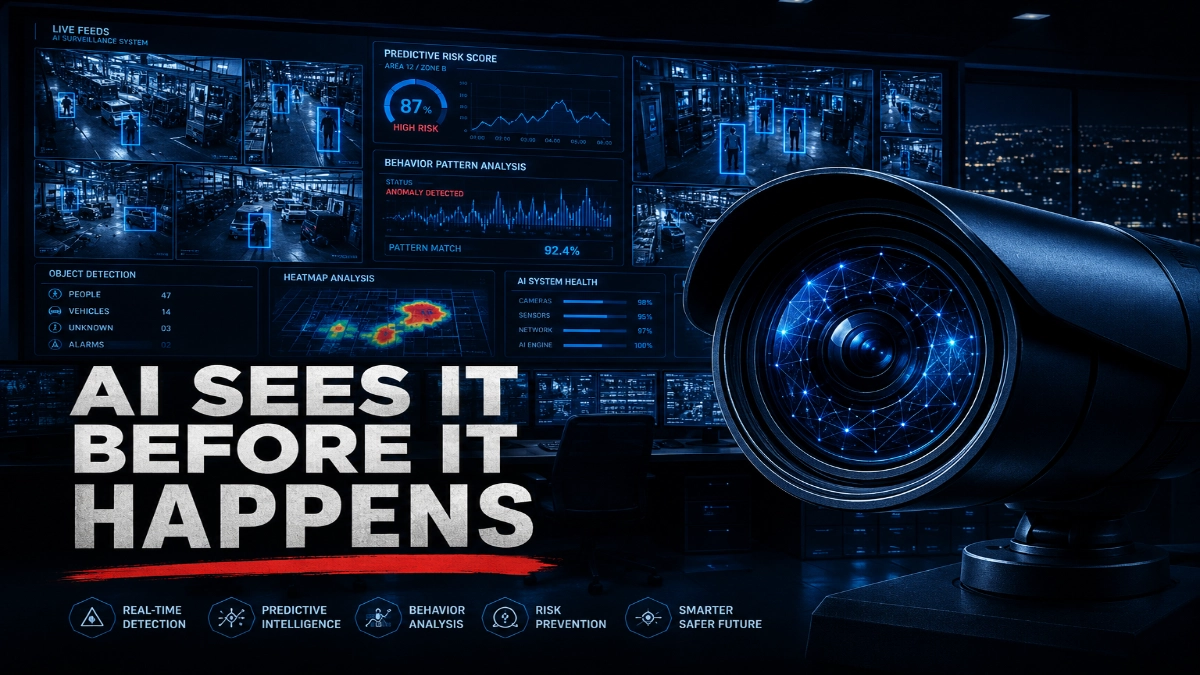
This is not science fiction. It is the operational reality of predictive surveillance, and it is reshaping how organisations approach security, safety and risk management across every major industry.
According to MarketsandMarkets, the global video analytics market is projected to reach $21.8 billion by 2027, driven by rising demand for AI-powered security intelligence. The shift from passive recording to active prediction represents the most significant transformation in surveillance technology since the introduction of digital CCTV.
The Shift from Reactive to Predictive Security
Traditional CCTV systems function as digital witnesses. They record what happens, store the footage, and allow investigators to review events after an incident has occurred. This reactive model has served organisations for decades, but it carries a fundamental limitation: it cannot prevent the incidents it records.
Predictive surveillance reverses this paradigm. Instead of asking “What happened?” after an event, predictive systems continuously answer a more valuable question: “What is likely to happen next?”
The transition follows three clear stages:
- Reactive Monitoring: Footage is recorded and reviewed after incidents occur.
- Real-Time Alerting: Systems detect rule violations (perimeter breaches, crowd thresholds) and trigger immediate alarms.
- Predictive Intelligence: AI analyses behavioural patterns, environmental data, and historical baselines to anticipate incidents before they materialise.
What Is Predictive Surveillance?
Predictive surveillance is an AI-driven security methodology that uses machine learning, computer vision, and behavioural analytics to identify patterns, anomalies, and risk indicators in real time, enabling intervention before an incident escalates.
Unlike traditional systems that operate on fixed rules (“alert if motion is detected”), predictive surveillance systems learn. They build dynamic models of what “normal” looks like in a given environment, then surface deviations from that baseline, even subtle ones that a human operator would never catch across a bank of 50 screens.
The technology does not simply watch. It understands context. A person standing near an emergency exit for 90 seconds at 2 pm in a busy retail environment carries a very different risk profile than the same behaviour at 11 pm in an empty warehouse. Predictive systems can distinguish between these scenarios and respond accordingly.
Technologies Powering Predictive Surveillance
Predictive surveillance is not a single technology; it is an ecosystem of converging capabilities working in concert.
Computer Vision and AI-Powered Video Analytics
Computer vision algorithms process video feeds frame by frame, identifying objects, people, vehicles and behaviours with a level of precision and consistency that far exceeds human monitoring. Deep learning models trained on millions of hours of footage can detect specific postures, gestures, crowd density thresholds, left baggage, or loitering in real time, across dozens of camera feeds simultaneously.
Machine Learning and Behavioural Analytics
Machine learning models continuously ingest data from surveillance feeds, access control systems, IoT sensors, and even external sources such as weather or public event schedules. Over time, these models develop granular behavioural baselines for what normal foot traffic looks like on a Monday morning versus a Friday evening, which zones in a facility generate anomalous dwell times, and how movement patterns change ahead of historical incident clusters.
Edge AI and Edge Computing
Edge AI moves processing intelligence directly onto cameras and local gateway devices rather than sending raw video to centralised servers. This dramatically reduces bandwidth consumption, eliminates cloud-dependency latency, and allows systems to make split-second decisions even when network connectivity is limited. In critical infrastructure or large campus environments, edge computing makes real-time prediction operationally viable.
IoT Integration and Sensor Fusion
Predictive systems gain further intelligence by fusing video data with inputs from IoT sensors, door contacts, vibration detectors, environmental monitors, access badge readers, and even audio analytics. A camera detecting unusual crowd density near a fire exit, combined with an audio sensor detecting elevated noise levels, produces a far more reliable risk assessment than either signal alone.
How AI Learns Human and Environmental Patterns
The learning process begins with a baseline calibration period, typically 2 to 4 weeks, during which the system silently observes and categorises normal activity patterns. It maps pedestrian flow routes, identifies authorised access zones, records typical occupancy curves across different times of day, and catalogues regular behavioural signatures of known personnel.
Once baseline models are established, the system shifts to active monitoring. Every subsequent observation is assessed against the learned baseline. Deviations are ranked by severity and probability. A single anomaly might generate a low-priority flag, while a cluster of coincident anomalies triggers an urgent alert to security personnel.
Critically, modern systems continue learning after deployment. They adapt to seasonal changes, shift patterns, facility modifications, and evolving workforce behaviours, reducing false positive rates over time and maintaining accuracy even as operational environments change.
Real-World Examples of Predictive Monitoring Across Industries
Manufacturing: Equipment Failure Prediction
A tier-1 automotive components manufacturer implemented thermal imaging cameras with AI analytics across its production floor. The system began detecting micro-level heat signatures that preceded bearing failures by 6 to 12 hours. Maintenance teams received predictive alerts before equipment failed, reducing unplanned downtime by 34% in the first year.
Airports: Crowd and Threat Management
Major international airports now deploy predictive crowd analytics to identify queue buildup, bottleneck formation, and anomalous passenger behaviour before they cause operational disruption or security incidents. Systems can detect individuals moving against the flow of foot traffic, abandoning baggage, or repeatedly accessing restricted areas, generating alerts within seconds.
Healthcare: Patient Safety and Facility Security
In hospital environments, AI-powered surveillance monitors for patient fall-risk indicators, such as specific postures, unsteady gait, or patients sitting on the edge of beds unsupported. Systems alert nursing staff before a fall occurs. The same platforms monitor restricted medication storage areas and flag unauthorised access attempts in real time.
Retail: Loss Prevention and Operational Intelligence
Retail operators use predictive analytics to identify shoplifting precursor behaviours, such as specific movement patterns near high-value merchandise, unusual dwell times in blind spots, or individuals who enter and exit a section repeatedly. Equally, the same systems track queue length prediction, staff deployment optimisation, and planogram compliance.
Smart Cities and Critical Infrastructure
City-wide deployments integrate traffic camera networks, public space surveillance, and environmental sensors to monitor for incident precursors, illegal dumping, road surface deterioration, graffiti activity escalation, or congregation patterns associated with organised protest or disorder. Infrastructure managers use the same platforms to monitor bridges, utility substations, and water treatment facilities for tampering or structural anomalies.
Benefits Beyond Security: Operational and Business Impact
The value of predictive surveillance extends well beyond threat detection. Organisations that deploy these systems consistently report measurable benefits across multiple operational domains:
- Reduced insurance premiums: Insurers increasingly offer premium reductions for facilities with certified AI surveillance systems and demonstrable incident reduction records.
- Operational efficiency gains: People counting, flow analysis, and queue management tools directly improve throughput in warehouses, logistics hubs, and customer-facing environments.
- Workforce productivity insights: Heatmapping and occupancy analytics identify bottlenecks in facility design, enabling better space utilisation.
- Compliance and audit trail integrity: AI systems maintain tamper-evident, searchable records that support regulatory audits, HSE investigations, and legal proceedings.
- Reduced operator fatigue: By filtering irrelevant footage and surfacing only relevant events, AI significantly reduces the cognitive load on human monitoring teams.
Challenges, Limitations, and Ethical Considerations
The adoption of predictive surveillance is not without complexity. Security professionals and decision-makers must navigate a range of technical, organisational and ethical challenges.
Privacy and Data Protection
The collection and analysis of biometric and behavioural data at scale raises significant privacy concerns. Organisations must ensure that deployments comply with applicable data protection frameworks, including GDPR in Europe, PDPB provisions in India, and sector-specific regulations. Transparent signage, purpose limitation principles, and robust data retention policies are non-negotiable.
Algorithmic Bias and Accuracy
AI models trained on non-representative datasets can exhibit demographic biases in detection accuracy. Rigorous model validation, regular accuracy audits, and diverse training data are essential safeguards. No AI system is infallible; human oversight must remain embedded in alert response workflows.
False Positives and Alert Fatigue
Poorly calibrated systems can generate excessive false positive alerts, overwhelming security teams and creating the risk that genuine threats go unaddressed. Effective deployment requires careful baseline calibration, threshold tuning, and ongoing model refinement based on operational feedback.
Cybersecurity Risks
Connected surveillance infrastructure creates new attack surfaces. IoT cameras, edge devices, and network video recorders can be targeted by adversaries seeking to disrupt systems, harvest footage, or use compromised cameras as entry points into corporate networks. Cyber hardening firmware updates, network segmentation, and encrypted data transmission must be integral to any deployment strategy.
The Future of Predictive Surveillance Systems
The next decade will see predictive surveillance capabilities evolve dramatically across several key dimensions.
- Multimodal AI Fusion: Systems will increasingly combine video, audio, LiDAR, thermal, and olfactory sensor data to build richer situational awareness models.
- Federated Learning: AI models will train across distributed camera networks without centralising raw footage, improving accuracy while reducing privacy exposure.
- Digital Twin Integration: Surveillance systems will feed real-time data into digital twin models of buildings and campuses, enabling predictive simulation of security scenarios before they occur.
- Autonomous Response Orchestration: AI systems will move beyond alerting to coordinating autonomous responses, locking access points, redirecting automated guided vehicles, or issuing localised PA announcements in predefined scenarios.
- Regulatory Convergence: Governments across Asia, Europe, and North America are developing AI surveillance governance frameworks that will shape permissible use cases and mandatory transparency requirements.
Expert Insights and Industry Perspectives
Security technology strategists and system integrators working at the frontier of intelligent surveillance highlight three consistent priorities for successful deployments.
- First, integration depth matters: Predictive surveillance systems deliver their greatest value when deeply integrated with access control, building management, incident response, and HR systems, not when deployed as standalone CCTV replacements.
- Second, trust and transparency are prerequisites: Workforces and communities that understand how surveillance AI operates, what data it collects, and how it is governed are more likely to accept and support deployment. Stakeholder engagement is not optional; it is operationally essential.
- Third, the human layer is irreplaceable: AI surfaces insights; experienced security professionals act on them. Predictive surveillance augments human judgement; it does not replace it. Organisations that understand this distinction design more effective, more defensible security operations.
For organisations seeking enterprise-grade predictive surveillance infrastructure, platforms such as Impact by Honeywell CCTV offer the integrated, scalable architecture professional deployments require, combining high-resolution imaging, edge AI capabilities, and centralised management within unified systems designed for demanding environments.
Facilities managers and security integrators across the Indian subcontinent have increasingly turned to specialist distributors for deployment support and infrastructure design. Working with an authorised Impact by Honeywell CCTV Distributor in India ensures that system design, installation, and post-deployment support meet manufacturer specifications and local compliance requirements.
Intelligence That Acts Before the Alarm Sounds
The evolution from reactive surveillance to predictive intelligence is not a distant aspiration; it is unfolding today in warehouses, hospitals, airports, smart cities, and corporate campuses around the world. Organisations that understand this shift and deploy the right technology infrastructure will achieve a fundamentally different security outcome: fewer incidents, faster responses, and a security operation that anticipates risk rather than merely documenting it.
The camera that watches is giving way to the system that thinks, learns, and acts. For security professionals, system integrators, and business leaders, the strategic question is no longer whether to adopt predictive surveillance but how to deploy it responsibly, effectively, and with the governance frameworks that the technology demands.
The future of security is predictive. The organisations that act on that insight today will define the safety standards of tomorrow.
Read Also: Has Surveillance Technology Advanced Faster Than Surveillance Strategy?
Read Also: Why Operational Visibility Is Emerging as a Safety Metric