Most organisations trust their fire alarm panel, their evacuation plan, and their fire drills to keep an incident small. Far fewer ask a more fundamental question: did the building itself give the fire a head start?
Fire response speed is not decided in the seconds after smoke appears. It is decided years earlier, when architects set ceiling heights, MEP engineers route corridors, and project teams place mechanical rooms relative to the nearest detector. By the time an alarm activates, the building has already set the limit on how fast that alarm can come.
This is the overlooked relationship between facility design and fire response speed: design does not just house life safety systems, it sets the upper limit on how well those systems can perform. This article examines how layout, occupancy, and infrastructure decisions shape every stage of response, from detection to firefighter arrival.
How Fire Response Time Is Actually Measured
| Quick Answer: How does facility design affect fire response speed? Fire response speed is measured across six stages: detection, alarm notification, human reaction, evacuation, firefighter access, and incident containment. Facility design influences every stage, often more than the alarm equipment itself. |
Each stage compounds on the one before it. A two-minute delay in detection does not cost two minutes overall; it pushes every later stage later as well.
- Detection time: How long a sensor takes to identify smoke, heat, or flame after ignition.
- Alarm notification time: How long does it take for the detection to reach occupants as an audible or visual alert?
- Human reaction time: How long occupants take to recognise the alarm as real and begin moving.
- Evacuation time: How long it takes occupants to reach a place of safety.
- Firefighter access time: How long responders take to reach the fire floor or origin point after arriving on site.
- Incident containment time: How long it takes to stop the fire and smoke spread once response begins.
Why Building Layout Directly Influences Fire Detection Performance
| Quick Answer: Why is building layout important for fire safety? Layout determines how quickly smoke or heat physically reaches a detector. Large open spaces dilute smoke before it rises; high ceilings delay heat detection; hidden compartments and mechanical rooms can burn unseen for minutes. Detector placement must match each space’s geometry, not a generic spacing rule. |
Several layout patterns repeatedly slow detection in practice:
- Large open spaces, such as atriums and warehouses, dilute smoke before it reaches ceiling-mounted spot detectors, often requiring beam or aspirating detection instead.
- High ceilings above roughly four to six meters delay activation because thermal stratification keeps hot gas layers from reaching ceiling-level sensors quickly.
- Hidden compartments, such as false ceilings and equipment voids, can conceal fire growth from any detection until smoke escapes through a gap.
- Mechanical rooms are rarely visited, so detection there depends entirely on automatic devices.
- Warehouses with high-piled storage create vertical fire-spread paths that can outrun detector response calculated for floor-level fires.
- Multi-floor facilities need detection and notification zoning that identifies which floor is affected, not just that a fire exists somewhere.
The Impact of Occupancy Design on Emergency Response
Occupancy type changes both fire risk and the population that must respond, so the same layout can perform very differently depending on what fills the building.
- Office buildings: Open-plan layouts speed evacuation but often lack compartmentation, letting smoke travel between floors if stairwell doors are propped open.
- Hospitals: Rely on fire-rated compartments and smoke barriers because relocating bedridden patients quickly is rarely realistic, favouring defend-in-place strategies.
- Manufacturing plants: Need higher detector density and visual strobes that remain visible and audible over machinery noise and combustible materials.
- Educational campuses: Require wide, marked egress routes and zoned notification so unaffected buildings are not unnecessarily evacuated during large occupant loads.
- Data centres: Benefit from early-warning aspirating smoke detection rather than waiting for visible smoke, given high equipment value and low fuel load.
- Commercial complexes: Need zoned alarm notification so a fire in one tenant space is not lost inside a single building-wide signal.
Common Facility Design Mistakes That Slow Fire Response
| Quick Answer: What are the biggest facility design mistakes affecting fire safety? The most common mistakes include long or indirect evacuation routes, exits obscured by signage gaps, corridors blocked by storage, missing fire-rated compartmentation, inconsistent emergency signage, and site layouts that restrict fire truck or ladder access. |
- Long, winding evacuation routes that force occupants past the fire’s likely origin point to reach an exit.
- Exit signage that is inconsistent, poorly lit, or contradicts the safest available route.
- Storage or equipment that narrows or blocks corridors over time, even when the original design met code.
- Missing fire-rated compartmentation, including doors propped open or poorly sealed penetrations.
- Mismatched emergency signage across different sections of the same facility, especially after renovations.
- Site access that restricts fire apparatus, locking gates, or has no clear path to standpipe and hydrant connections.
Design Factors That Improve Evacuation Efficiency
| Quick Answer: What design factors improve emergency evacuation? Evacuation improves with short, direct egress routes, redundant exits, illuminated and consistent signage, adequately sized stairwells, and pressurised, smoke-free stairs. Zoned notification that tells occupants which area is affected, rather than one building-wide alarm, also reduces panic and crowding. |
How Fire Alarm System Architecture Supports Faster Response
| Quick Answer: How can fire alarm systems reduce response time? Addressable fire alarm systems identify the exact device that triggered an alarm, instead of only the circuit it sits on. Operators and responders can go straight to the affected zone instead of searching an entire floor, removing the investigation step that consumes minutes in conventional systems. |
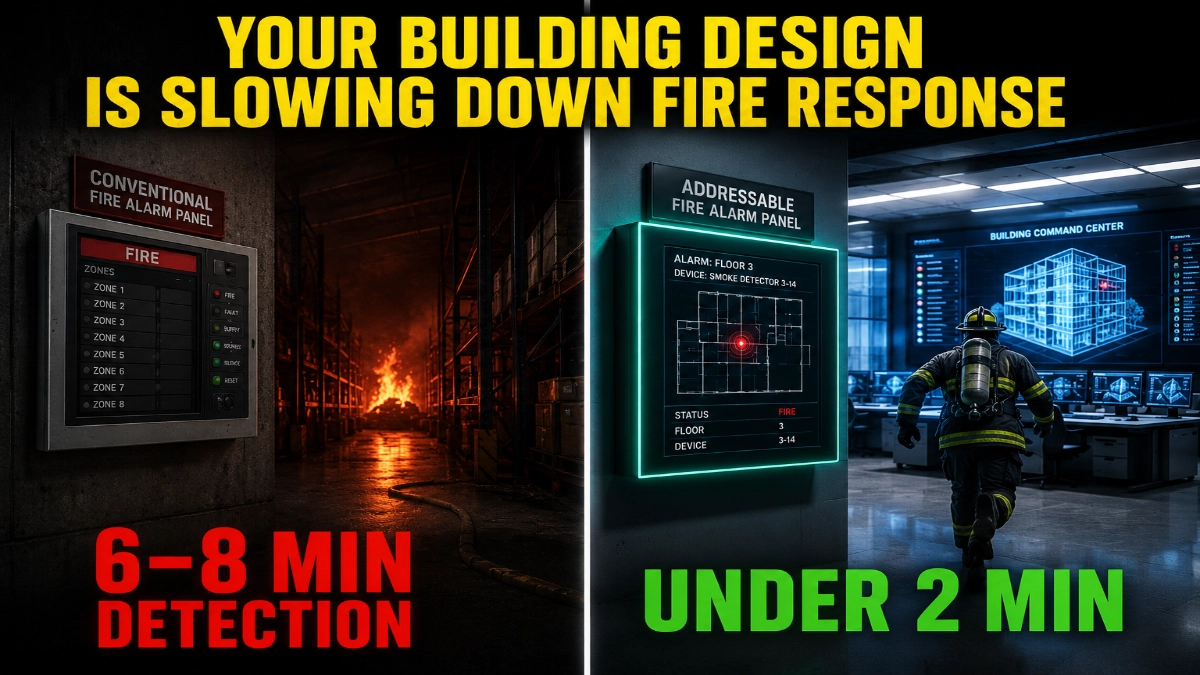
A conventional fire alarm panel groups several detectors on one circuit, narrowing an alarm only to a zone, sometimes an entire floor. An addressable fire alarm panel gives each device its own identity on the loop, reporting the exact unit and location, often saving more time than any other single design choice.
Intelligent alarm verification, where the panel distinguishes real smoke from dust, steam, or cooking vapour, reduces false-alarm fatigue, a real concern since frequent false alarms make occupants discount genuine ones. Faster fault detection lets maintenance teams repair a failed detector before it becomes a blind spot during an actual fire.
Centralised monitoring, tying multiple buildings into one panel or graphic workstation, gives facility teams a current picture of where an alarm originated the moment it activates. Specifying a fully addressable platform, such as a GST fire alarm system, extends this device-level visibility across an entire installation, especially useful on phased construction projects. Coordinating early with an established GST fire alarm system distributor in India helps ensure device compatibility and correct loop commissioning before handover.
Role of Detection Technology in Modern Facility Design
Smoke detectors remain the most common first line of defence, but detector type must match the hazard. Heat detectors suit kitchens and dusty areas prone to nuisance alarms, while multi-sensor detectors cross-check smoke and heat signals before alarming, reducing both false alarms and missed detections.
Intelligent detection devices report real-time status and contamination level back to the panel, often before performance degrades enough to cause a missed alarm. Strategic detector zoning, grouping devices by area rather than only by floor, tells responders not just that a fire exists, but where on a large floor plate. Addressable detectors support this zoning far more precisely than conventional detectors, since each device reports individually.
Designing Facilities for Emergency Responder Efficiency
Even a fast-detecting building can lose time if firefighters cannot find their way in quickly. Clear, code-compliant access routes to every building face let crews position hoses and ladders without delay.
- Fire command centres, near the main entrance, give crews one location to view system status, control panels, and floor plans.
- Emergency communication systems, including two-way radio amplification and firefighter telephones, keep crews connected in below-grade or steel-frame areas where standard radios fail.
- Building information accessibility, such as current floor plans, hazardous material locations, and utility shutoffs, saves critical minutes during incident size-up.
- Protecting critical infrastructure, such as fire pumps, risers, and electrical rooms, from being buried behind storage keeps it usable when needed most.
Smart Buildings and Data-Driven Fire Response
| Quick Answer: How do smart buildings improve emergency response? Smart buildings feed real-time sensor and building management system data into one platform, so operators see fire, smoke, door, and HVAC status together. IoT-connected detectors flag degrading performance before failure, and predictive maintenance closes the blind spots that would otherwise delay detection. |
IoT integration connects detectors, dampers, and door controllers so that one tripped detector can trigger HVAC shutdown, door release, and elevator recall automatically. Building management system integration places fire alarm data alongside security, lighting, and energy data on one dashboard, giving teams full situational awareness instead of partial views from separate systems.
Real-time monitoring platforms alert remote teams the moment a device goes into trouble, often before any occupant notices. Predictive maintenance flags detectors that are contaminated, drifting, or near end-of-life, replacing them before they create an undetected coverage gap.
Case Example: Two Facilities, Two Outcomes
Consider two mid-size manufacturing facilities with comparable fire loads. Facility A had no fire safety input at the layout stage; Facility B incorporated detection zoning, addressable devices, and responder access planning from the start. The same fire produced very different timelines.
| Response Stage | Facility A — Conventional Layout | Facility B — Optimised Layout |
| Detection time | 6–8 minutes (wide-spaced conventional detectors, high ceiling) | Under 2 minutes (addressable detectors, zoned for ceiling height) |
| Notification time | About 2 minutes (manual confirmation required) | Immediate (auto-verified, zone-specific alert) |
| Evacuation time | 9 minutes (long, indirect route past storage) | 4 minutes (short, marked, redundant exits) |
| Firefighter access | 5 minutes lost locating the fire floor | Located immediately via the command centre display |
| Outcome | Fire spread beyond room of origin; partial production loss | Contained to the room of origin; minimal downtime |
Both buildings met code. The difference lay entirely in how layout, zoning, and access were designed before either system was installed.
Future Trends in Facility Design and Fire Response
- AI-assisted fire detection: Analyses sensor data patterns to flag developing fire risk before a detector reaches alarm threshold, rather than reacting only after smoke appears.
- Digital twins: Let teams simulate smoke movement and evacuation flow inside a virtual model before construction finishes, catching layout problems while they remain cheap to fix.
- Smart evacuation systems: Use real-time occupancy and fire-location data to direct people away from the affected zone through dynamic signage, instead of one fixed exit route.
- Intelligent building design: Increasingly treats fire safety as a data input alongside HVAC and structural design, not a compliance checklist completed at the end.
Together, these trends point toward integrated life safety ecosystems, where detection, notification, evacuation, and responder support operate as one coordinated system, not separate add-ons.
Conclusion: Facility Design Is a Fire Safety Strategy
Fire response speed is not purely a function of how capable a fire alarm system is, but of how well the facility was designed to let that system, and the people inside it, perform. Detection, notification, evacuation, and responder access time are all set in motion long before a project finishes through decisions about ceiling height, corridor length, compartmentation, and detector zoning.
Treating facility design as a fire safety strategy, not purely an architectural exercise, gives every later investment in alarm panels, detectors, and training a far better chance of working when it matters most.
Expert Insight
From a fire safety engineering perspective, the most expensive design mistakes are rarely visible on a routine site walk. A detector spaced correctly for a three-meter ceiling but installed in a seven-meter warehouse still passes inspection, yet may take several extra minutes to reach the alarm threshold.
The fix is rarely more equipment; it is matching detector type, spacing, and zoning to the actual geometry of the space, and reviewing that match whenever occupancy or layout changes. Facilities treating detection design as an ongoing fit, not a one-time installation step, are far less likely to discover a coverage gap during a real fire instead of an audit.
Read Also: How Industry 4.0 Is Changing Fire Detection Requirements Across Factories
Read Also: What Smart Cities Can Teach Industries About Fire Detection