Industry 4.0 is reshaping factories at a pace that traditional fire safety planning never anticipated. Robots work alongside fewer people. Sensors report machine health every few seconds. Lithium-ion batteries power forklifts, automated guided vehicles, and backup power systems. Data centres now sit inside manufacturing halls rather than in separate buildings.
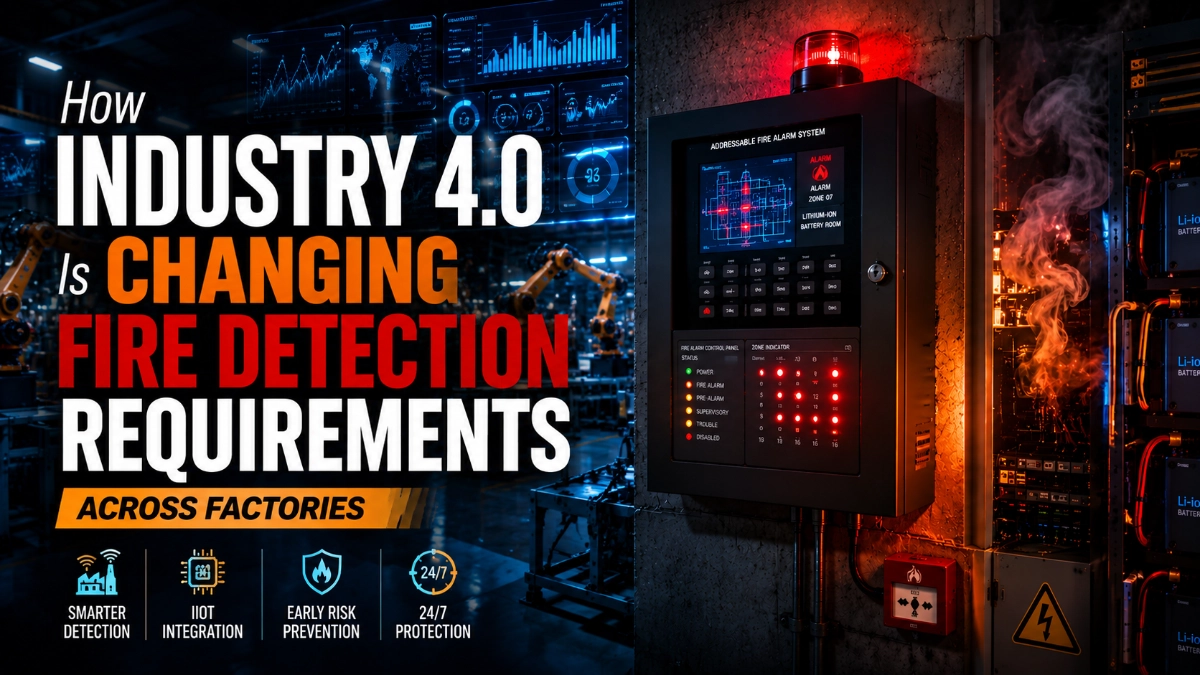
These changes raise the stakes for fire detection. A conventional smoke detector designed for an open warehouse floor was never built to monitor a server rack, a battery room, or a densely packed control cabinet. As factories digitise, fire detection systems need to digitise too, protecting production uptime, equipment investment, and worker safety along the way.
This article explains what is changing, why it matters, and how plant managers and safety officers can adapt their fire detection strategy for the Industry 4.0 era.
Key Takeaways
- Industry 4.0 increases fire risk density by packing more electrical, robotic, and data infrastructure into less floor space.
- Lithium-ion battery storage and high-density control panels need faster, more targeted detection than open-area smoke detectors provide.
- Addressable fire alarm systems integrate with IIoT networks to enable real-time, zone- and device-level reporting.
- Predictive maintenance and data analytics can flag fire risk conditions before a full alarm event occurs.
- Integrating fire alarm systems with building management systems reduces downtime through faster, coordinated response.
Understanding Industry 4.0 and Smart Manufacturing
Industry 4.0 describes the integration of digital technology into physical manufacturing. It combines Industrial Internet of Things (IIoT) sensors, automation, robotics, cloud computing, and real-time data analytics to make factories more connected and self-monitoring.
In an Industry 4.0 facility, machines report their own status. Programmable logic controllers talk to cloud dashboards. Digital twins simulate production lines before changes go live. Predictive maintenance software flags a failing bearing or motor before it breaks down.
This connectivity changes more than productivity. It changes what counts as a fire risk. A facility built around dense electrical infrastructure, continuous automated operation, and on-site energy storage carries a different ignition profile than the manually operated plants that older fire codes were written for.
How Factory Risks Are Changing in the Age of Automation
Traditional fire risk assessments focused on a handful of known hazards: flammable material storage, welding operations, and standard electrical panels. Industry 4.0 multiplies the number and type of potential ignition sources.
Automated lines run for longer stretches with less direct human supervision, so a developing fault may go unnoticed longer. Robotics introduce motors, servo drives, and cabling that run hot during continuous cycles. Control cabinets pack more power electronics into smaller enclosures, concentrating heat. Battery-powered material handling equipment introduces thermal runaway risk that barely existed in older plants.
This does not make smart factories inherently more dangerous. It means risk has shifted from a few large, visible hazards toward many smaller, distributed ones, and the detection strategy must follow that shift.
New Fire Detection Challenges in Smart Factories
Several specific changes are driving new fire detection requirements across modern plants.
- Automated production lines: Run continuously, often unattended for long stretches. Faults an operator might once have smelled or seen early can now smoulder longer before anyone notices.
- Robotics: Add servo motors, drive electronics, and cable bundles that generate localised heat, especially inside enclosed robot cells with limited airflow.
- High-density electrical equipment, including variable frequency drives and power distribution panels, packs more current into smaller cabinets, raising the consequences of a single loose connection or insulation fault.
- Data centres inside factories, common where plants run manufacturing execution systems or edge computing, need detection sensitive enough for electronic equipment, not just open-area smoke.
- Lithium-ion battery storage, used in automated guided vehicles, forklifts, and backup power, can enter thermal runaway, a self-sustaining reaction that ordinary smoke detectors are not designed to catch early.
- Industrial control systems concentrate critical wiring in cabinets, where early detection prevents a small fault from halting an entire production line.
- Network-connected machinery adds switches, routers, and powered network devices throughout the floor, each a small but real electrical fire source.
- Energy storage systems, including battery banks supporting backup power, fall under newer codes such as NFPA 855 precisely because their failure modes differ from conventional electrical fires.
Why Traditional Fire Detection Strategies May Not Be Enough
Many existing factories still rely on a small number of conventional detectors covering large open areas. This approach works reasonably well for simple, low-density spaces.
It struggles in Industry 4.0 environments for three reasons. Detection coverage is often too coarse to identify which machine or cabinet triggered an alarm, slowing response. Conventional systems cannot easily distinguish between nuisance conditions such as dust and an early-stage fault, leading to false alarms or desensitised staff. And conventional panels offer limited remote visibility, so a developing problem during a lightly staffed shift may not be caught quickly.
Key Fire Detection Technologies Supporting Industry 4.0
Modern manufacturing facilities are shifting toward detection systems built for distributed, data-rich environments.
- Intelligent smoke detection: Uses onboard processing to analyse smoke characteristics in real time, reducing false alarms from steam, dust, or welding fumes while still catching genuine fire signatures early.
- Multi-criteria detectors: Combine smoke, heat, and sometimes carbon monoxide sensing in a single unit, helping distinguish a genuine fire from a nuisance condition faster than a single-sensor detector can.
- Addressable fire alarm systems: Assign a unique address to each detector, so the panel identifies exactly which device or cabinet triggered an alarm. This is a meaningful advantage over a conventional fire alarm panel, where an entire zone activates without pinpointing the device involved.
- Network-integrated fire safety systems: Connect the fire alarm panel to the plant’s broader IIoT and building management network, letting fire data flow alongside production data.
- Remote monitoring: Let’s safety officers and fire safety consultants check system status from a central dashboard rather than relying solely on local panel indicators.
- Predictive maintenance features: Flag detector faults, sensitivity loss, or wiring issues before they become compliance gaps.
- Data-driven alarm management: Uses historical alarm data to refine detector sensitivity and reduce nuisance trips over time.
The Role of IoT and Real-Time Monitoring in Fire Safety
IIoT does for fire safety what it already does for production: it turns isolated devices into a connected, observable system.
In a connected fire detection setup, each detector or addressable fire alarm panel reports status continuously, not only when an alarm triggers. Fault conditions, low battery signals, sensor drift and even environmental changes like a rise in cabinet temperature can surface as actionable data rather than waiting for a full alarm event.
This real-time visibility matters most during unattended or low-staffing periods, including overnight shifts, weekends, and fully automated production runs, when a developing fire risk would otherwise go unnoticed until it triggers a full alarm.
Fire Detection and Business Continuity
Fire safety in a smart factory is not only about life safety, though that remains the priority. It is also about business continuity.
Faster, more precise detection directly reduces production downtime, because a small electrical fault caught early can often be addressed with a brief shutdown rather than a full evacuation. It limits equipment damage, since robotics, servo drives, and control electronics are expensive to replace and slow to source. It reduces supply chain disruption, since a single line stoppage at a contract manufacturer can ripple through a customer’s own production schedule. And it lowers overall operational losses, from insurance costs to lost output, by shrinking the gap between ignition and detection.
Integration Between Fire Alarm Systems and Building Management Systems
Industry 4.0 favours integrated systems over isolated ones. Connecting the fire alarm panel to the building management system allows a single alarm event to trigger a coordinated response automatically: shutting down ventilation to limit oxygen flow to a fire, isolating power to an affected zone, unlocking emergency exits, and alerting maintenance and safety teams at the same time.
This integration also supports compliance reporting. Inspection records, test logs, and alarm history can sit in one accessible system rather than scattered paper logs, helping facility managers respond faster to audits and demonstrate due diligence to insurers and regulators.
Future Trends in Industrial Fire Detection
Several developments are likely to shape the next phase of industrial fire detection.
- AI-assisted detection: Will increasingly analyse sensor patterns rather than single threshold values, catching subtle pre-fire conditions earlier.
- Machine learning analytics: Will compare a detector’s current readings against its own historical baseline, flagging gradual drift that a fixed threshold would miss.
- Predictive risk modelling: Will combine fire detection data with production schedules and maintenance records to forecast where risk is rising before an incident occurs.
- Cloud-connected fire monitoring: Will let multi-site manufacturers oversee fire safety status across several factories from one dashboard.
- Smart safety ecosystems: Will tie fire detection, gas detection, access control and production monitoring into one coordinated safety layer rather than separate systems.
Expert Recommendations for Manufacturing Facilities
Plant managers and safety officers evaluating their current fire detection setup can start with a few practical steps.
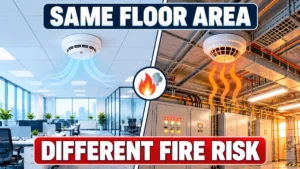
- Audit detection coverage against actual equipment density, not just floor area, since Industry 4.0 facilities concentrate risk in zones such as battery rooms and control cabinets.
- Prioritise addressable detectors over conventional detectors in any area with critical equipment, since pinpoint identification shortens response time.
- Confirm that any lithium-ion battery storage area meets current standards, such as NFPA 855, rather than older general electrical codes.
- Build remote monitoring and building management system integration into any retrofit from the start, rather than treating connectivity as an afterthought.
- Work with a qualified fire safety consultant or system integrator familiar with both fire codes and industrial automation environments.
| Expert Insight: Fire protection engineers increasingly describe Industry 4.0 facilities as high-density risk environments rather than larger versions of older plants. The distinguishing factor is not floor area but concentration: more electronics, more automated equipment, and more energy storage packed into the same footprint than older fire codes anticipated. Detection strategy now needs to track equipment density, not just square footage, when planning detector type, spacing, and zoning. |
Comparison: Traditional Factory Fire Detection vs Industry 4.0 Fire Detection Requirements
| Aspect | Traditional Approach | Industry 4.0 Requirement |
| Detector type | Conventional smoke and heat detectors | Addressable, multi-criteria detectors |
| Coverage | Zone-level, broad open areas | Device-level, pinpoint identification |
| Monitoring | On-site panel checks | Remote, real-time monitoring |
| Primary risk focus | Open storage, welding, and general electrical | Battery storage, control cabinets, robotics, data infrastructure |
| Maintenance approach | Scheduled manual inspection | Predictive maintenance, automated fault alerts |
| System integration | Standalone fire panel | Integrated with building management systems and IIoT |
| Response speed | Minutes to locate the source | Seconds to identify the exact device or zone |
Industry 4.0 Fire Detection Checklist
- Map equipment density across the facility, not just square footage.
- Identify all lithium-ion batteries and energy storage locations.
- Replace conventional detectors with addressable detectors in critical zones.
- Verify that control cabinets and in-plant data centre areas have appropriate detection.
- Enable remote monitoring and alerts for off-shift hours.
- Integrate the fire alarm panel with the building management system.
- Schedule predictive maintenance checks alongside routine fire system testing.
- Confirm compliance with current standards for battery and energy storage areas.
Conclusion
Industry 4.0 has changed what a factory looks like on the inside: more automation, more connected equipment, and more energy stored on site. Fire detection requirements are catching up to that reality.
Manufacturers relying on a handful of conventional detectors covering open floor space are protecting yesterday’s risk profile, not today’s. Moving toward addressable detection, real-time monitoring, predictive maintenance, and building management system integration brings fire safety in line with how a modern plant operates.
Plant managers and safety officers evaluating an upgrade can work with an experienced fire safety consultant or a distributor such as Innxeon Technologies, a GST fire alarm system distributor in India serving manufacturing facilities, to match detection technology to a connected factory’s risk profile.
Read Also: What Smart Cities Can Teach Industries About Fire Detection
Read Also: How India’s EV Ecosystem Is Creating New Fire Protection Challenges