Walk into the security operations centre of a modern logistics hub, and you will see a wall of crisp 4K monitors, AI dashboards flagging loitering and unattended packages, and dozens of cloud-connected cameras quietly running license-plate reads and behavioural analytics in the background. Walk into the back office of that same facility, and you will often find a single outdated spreadsheet that nobody fully owns, listing who reviews footage, how long it is stored, and what happens after an alert fires.
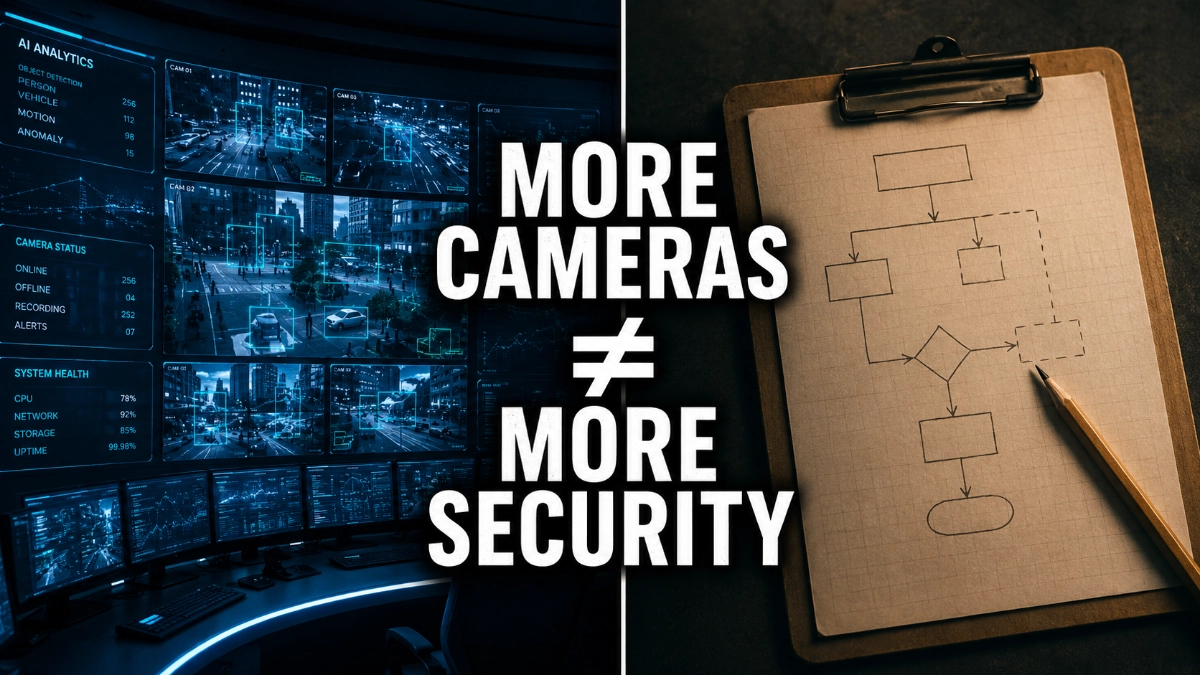
That gap is the real story of surveillance in 2026. Camera hardware, video management software, and AI analytics have advanced at a pace few industries can match. Multiple market analyses put AI-enabled video surveillance on track to grow at a compound annual rate well above 15 per cent through the early 2030s, with edge processors that once handled basic motion detection now running object classification and predictive analytics directly inside the camera housing.
Yet more cameras, sharper resolution, and smarter chips do not automatically translate into better security outcomes. A facility with 300 AI-enabled cameras and no documented response plan is, in practical terms, less secure than one with 50 cameras and a trained team that knows exactly what to do when an alert sounds. The real question facing security leaders, system integrators, and facility managers is not whether the technology works. It is whether organisational strategy, covering governance, training, cybersecurity, and process, has kept pace with what technology can now do.
This article examines that gap: where it comes from, why it persists, and what a modern surveillance strategy actually requires.
How Surveillance Technology Has Changed in the Last Decade
A decade ago, video surveillance mostly meant analogue cameras streaming to a digital recorder, reviewed only after something went wrong. That baseline has shifted dramatically.
AI-powered analytics now let cameras recognise objects, vehicles and behaviours instead of simply recording motion. A manufacturing plant can flag a worker entering a restricted zone without protective equipment; a retail store can detect a shopper lingering near a high-theft shelf.
Edge computing pushes much of that processing onto the camera or a local appliance rather than a centralised server. This cuts bandwidth needs and speeds up response, which matters in warehouses and logistics hubs where hundreds of cameras would otherwise overwhelm a network.
Cloud video management systems let organisations centralise footage from multiple sites without maintaining on-premises servers everywhere. A retail chain with 200 stores can review footage from any location through one dashboard instead of visiting each site’s local recorder.
Smart video search has replaced scrubbing through hours of footage. Operators can now search by attributes such as a red jacket or a white van and locate a relevant clip in seconds.
Automated alerts and behavioural analytics flag deviations from normal patterns: a vehicle parked too long near a commercial building entrance, a person loitering after hours near a school, a forklift moving in the wrong direction down a warehouse aisle.
Together, these advances turned passive recording systems into active monitoring platforms. The technology genuinely can do more. The open question is whether organisations are equipped to use what it can now do.
The Strategy Gap Most Organisations Overlook
Most surveillance deployments still start with a purchasing decision rather than a planning exercise. A facility manager identifies a problem area, requests cameras, and a vendor recommends hardware. Few organisations ask a more fundamental question first: what is this system actually supposed to achieve? That missing step creates four recurring problems.
- Lack of clear objectives: A system installed to “improve security” without defining specific outcomes, such as theft reduction or faster incident response, has no real way to measure whether it is succeeding.
- Poor risk assessment: Coverage decisions often track available budget or convenient mounting points rather than an honest analysis of where loss, intrusion, or liability risk actually concentrates.
- Reactive rather than proactive monitoring: Many teams only review footage after an incident occurs, instead of using analytics to catch developing problems, such as a fence breach or a tailgating attempt, in real time.
- Technology-first purchasing: Decision-makers frequently choose cameras based on resolution, brand reputation, or price, then figure out workflows afterwards, when strategy should drive technology selection instead.
A school district that buys 150 cameras after a single incident, without a documented coverage plan or incident response procedure, illustrates the pattern clearly. The hardware is modern. The strategy behind it does not exist yet.
When Advanced Technology Produces Limited Security Value
Even well-funded, technically sophisticated systems frequently underdeliver, and the reasons stay consistent across commercial buildings, manufacturing plants and critical infrastructure sites.
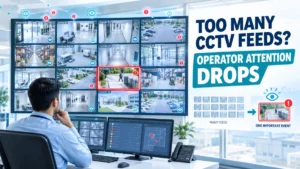
Data overload tops the list. A mid-sized facility with 100 cameras can generate enough footage in a single day to take a human reviewer weeks to watch in full. Without analytics tuned to specific risks, that footage becomes a passive archive rather than an operational tool.
Alert fatigue compounds the problem. Research into security operations consistently finds that the overwhelming majority of automated alerts turn out to be false positives, and that teams eventually start ignoring notifications altogether once that pattern sets in. The same dynamic shows up in video monitoring centres: alerts triggered by shadows, weather, or wildlife train operators to dismiss notifications by reflex, including the rare one that matters.
Underutilised analytics is a quieter failure point. Many organisations purchase AI-enabled cameras with facial recognition, license-plate reading, and behavioural analysis built in, then run them in basic motion-detection mode because nobody configured or trained staff to use the advanced features.
Inadequate staff training rounds out the list. A camera that detects a perimeter breach is only useful if the person receiving that alert knows the correct escalation procedure. In logistics hubs and manufacturing plants running multiple shifts, training gaps between shifts often leave coverage inconsistent.
Cybersecurity: The Missing Layer in Modern Surveillance Strategy
Surveillance cameras are computers on the network now, and many organisations still treat them like passive hardware.
Connected cameras carry real network risk. Every IP camera, encoder, and cloud-linked sensor is a potential entry point. Research on connected devices consistently finds that a meaningful share of internet-facing cameras still operate on factory-default credentials nobody ever changed, a detail attackers actively scan for.
A widely reported 2021 breach of a cloud video platform offers a sobering case study: attackers used a single set of legitimate but exposed administrative credentials to view live feeds from roughly 150,000 cameras installed across factories, hospitals, schools, and other sensitive sites. The cameras themselves were not faulty. The access governance around them was.
Access control weaknesses extend beyond cameras to the video management platform itself. Shared logins, unrevoked former-employee accounts, and unencrypted remote access remain common findings in security audits of surveillance systems.
Video data protection deserves equal attention. Recorded footage often includes faces, license plates, and behavioural patterns that qualify as sensitive personal data under regional privacy regulations. Storing it without encryption, access logging, or a defined retention policy creates legal exposure alongside security risk.
Security-by-design practices, including network segmentation for camera traffic, regular firmware updates, credential rotation, and least-privilege access for video management accounts, should be standard from day one rather than a fix applied after a breach. Distributors and integrators that field daily support calls, among them Impact by Honeywell CCTV Distributor in India, report that the most frequent service request is not a malfunctioning camera but a forgotten password or a flat network that a routine IT audit just flagged as a risk.
AI Surveillance: Powerful Tool or Untapped Potential?
AI analytics can genuinely do what the marketing materials describe: classify objects, detect specific behaviours, recognise patterns across large camera networks, and search footage by description instead of timestamp. In a manufacturing plant, AI can verify protective equipment compliance across hundreds of workers simultaneously, a task no human team could perform continuously.
Misconceptions persist, though. AI does not replace human judgment; it surfaces information faster so people can decide. It is not plug-and-play, since most analytics need calibration for a site’s specific lighting, layout, and traffic patterns before accuracy improves. And it is not a substitute for physical security measures like access control and lighting; it is a layer that works alongside them.
Operational workflows ultimately determine whether AI delivers value. An anomaly alert that routes to an empty inbox or an untrained guard accomplishes nothing. The technology’s potential is real, but organisations only realise it once they build the process around it: who gets notified, how fast, and what happens next.
Building a Modern Surveillance Strategy Framework
A surveillance strategy translates technology into outcomes. The following seven-pillar framework gives security leaders, IT managers, and integrators a structure for evaluating or building a strategy from scratch.
- Risk assessment: Identify what is being protected, including assets, people, data, and operations, and where realistic threats concentrate, before selecting hardware.
- Coverage planning: Map camera placement to risk priorities rather than convenient mounting points. Critical infrastructure sites, such as water treatment facilities or power substations, carry the highest stakes when this step fails.
- Data retention policies: Define how long footage is stored, where, and under what access controls, balanced against legal requirements and storage cost.
- Incident response procedures: Document exactly what happens when an alert fires, including who is notified, how fast, and what action follows.
- Integration with access control: Connect video systems with badge readers and entry logs so an alert can be cross-referenced against who was actually present.
- Cybersecurity governance: Apply network segmentation, credential management, and firmware update schedules to surveillance infrastructure with the same rigour as IT systems.
- Performance measurement: Track metrics such as incident response time, false-alarm rate, and analytics utilisation, not just camera uptime.
What Security Leaders Should Prioritise in 2026 and Beyond
Outcome-based planning is replacing device-count metrics. Security leaders increasingly justify systems by measurable results, such as reduced incident response time or lower shrinkage, rather than camera totals.
Cross-functional collaboration is becoming essential. Surveillance decisions now involve IT for network and cybersecurity, legal for privacy and retention, operations for workflow integration, and facilities for physical coverage, not security alone.
Data intelligence is overtaking device count as the real differentiator. A smart-city deployment with fewer, well-integrated cameras feeding structured data into an operations platform consistently outperforms a larger network of disconnected, unmonitored feeds.
Strategic AI use means treating analytics as a configurable tool tied to specific objectives rather than a feature checkbox. Forward-looking integrators, Impact by Honeywell CCTV among them, increasingly start client conversations with the outcome a system needs to deliver, then work backwards to the camera count and analytics package that achieves it.
Technology-First vs. Strategy-First Surveillance
The difference between these two approaches shows up across nearly every dimension of a surveillance program, from how cameras get selected to how incidents get resolved.
| Dimension | Technology-First Approach | Strategy-First Approach |
| Driving question | “What cameras should we buy?” | “What outcome must this system deliver?” |
| Camera selection | Resolution, brand, and price | Risk assessment and coverage priorities |
| Data handling | Stored indefinitely, rarely reviewed | Defined retention tied to legal and operational need |
| Incident response | Improvised after an alert fires | Documented procedure per alert type |
| Cybersecurity posture | Default credentials, flat network | Segmented network, managed credentials |
| Success metric | Camera count and resolution | Response time and analytics utilization |
In short: a strategy-first approach treats every decision, from camera placement to credential management, as something tied to a defined risk and a measurable outcome.
Expert Takeaways
Security leaders evaluating an existing surveillance program, or planning a new one, can act on these recommendations immediately.
- Audit existing coverage against actual risk, not against where cameras happen to be mounted today.
- Document a written incident response procedure for every alert type the system generates.
- Treat every camera and video management account as a network endpoint requiring the same cybersecurity hygiene as a laptop or server.
- Review analytics configuration with the vendor or integrator at least once a year, since default settings rarely match a site’s actual layout.
- Set a data retention policy that satisfies legal requirements without indefinitely storing footage nobody will ever review.
- Measure success with response-time and utilisation metrics, not camera count or resolution specs.
- Build surveillance planning into cross-functional reviews involving IT, legal, and operations, not security alone.
Key Takeaways
| At a Glance: Surveillance technology has outpaced surveillance strategy at most organisations, not the other way around. More cameras and sharper AI features do not equal better security outcomes without governance behind them. Data overload and alert fatigue are the most common reasons advanced systems underdeliver in practice. Cybersecurity is the most overlooked layer of surveillance strategy, even though cameras are now full network endpoints. A documented framework, covering risk assessment, retention, response, integration, governance, and measurement, closes the gap. Outcome-based planning and cross-functional ownership will define effective surveillance programs through 2026 and beyond. |
Conclusion
Surveillance technology will keep advancing. AI models will get better at distinguishing a genuine threat from a stray cat, edge chips will get cheaper, and cloud platforms will keep adding features. None of that solves the underlying problem facing most organisations today.
The gap between what surveillance systems can do and what organisations actually get out of them is not a technology problem. It is a strategy problem, built from missing risk assessments, undocumented response procedures, unmanaged cybersecurity exposure, and purchasing decisions made before objectives were ever defined.
Closing that gap does not require replacing hardware. It requires treating surveillance the way organisations treat any other critical business system, with defined objectives, documented processes, cross-functional ownership, and metrics that prove the investment is working. Organisations that make that shift will get dramatically more value from the cameras they already own than those who simply keep adding more.
Read Also: Why Operational Visibility Is Emerging as a Safety Metric
Read Also: Why Industrial Surveillance Needs a Strategy, Not Just Cameras