Every minute of downtime in a hospital, data centre, airport, or manufacturing plant can carry significant operational and financial consequences. In these environments, fire detection is no longer viewed purely as a compliance requirement; it is a critical component of business continuity and operational resilience.
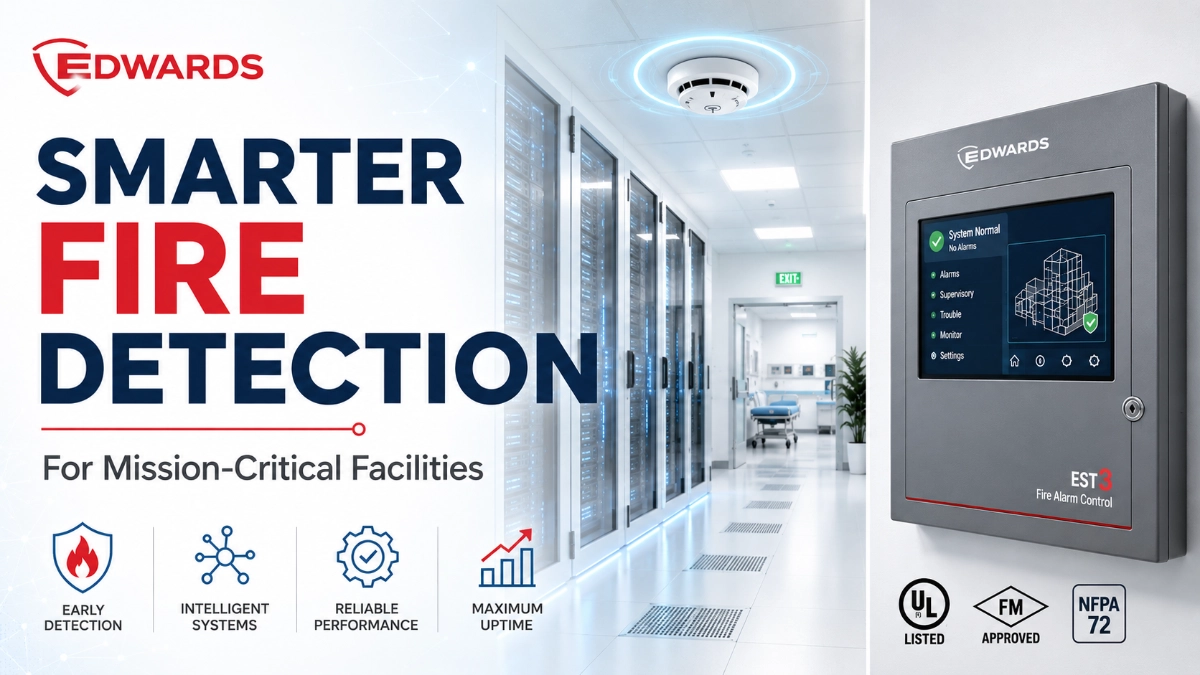
As infrastructure grows more complex, facilities are layering in redundant power systems, dense server racks, automated production lines, and interconnected building networks. A fire event in any one of these environments doesn’t just threaten life safety; it can halt patient care, interrupt cloud services, ground flights, or shut down a production line for days. This is why an increasing number of engineers, consultants, and facility owners are moving away from basic fire alarm setups and toward intelligent fire detection platforms systems designed not just to sound an alarm, but to detect, diagnose, and communicate with precision.
This article examines what separates mission-critical facilities from standard commercial buildings, why conventional fire detection often falls short in these settings, and what factors experienced consultants weigh when specifying fire protection systems for high-stakes environments.
What Defines a Mission-Critical Facility?
What is a mission-critical facility? A mission-critical facility is a building or operation where downtime, equipment failure, or safety incidents result in severe operational, financial, or life-safety consequences. Examples include hospitals, data centres, airports, and pharmaceutical plants, environments where continuous operation, occupant safety, and asset protection are non-negotiable priorities.
Not every commercial building carries the same operational risk profile. A retail store experiencing a fire alarm fault is an inconvenience. A data centre experiencing the same fault, if it triggers unnecessary suppression activation or forces an evacuation during peak load, can mean lost revenue, breached service-level agreements, and reputational damage that outlasts the incident itself.
Several characteristics typically define a mission-critical facility:
- High operational availability requirements: Many of these facilities target 99.9%+ uptime, where even short interruptions are measured and reported.
- Business continuity dependence: The facility’s function is tied directly to revenue, public safety, or essential services.
- Safety-critical environments: Occupants may include patients, travellers, or workers who cannot self-evacuate quickly or who depend on continuous life-support systems.
- Concentrated asset value: Server racks, medical equipment, production lines, or pharmaceutical inventory represent significant capital investment in a confined footprint.
- Elevated regulatory expectations: Codes, insurance requirements, and industry standards often exceed baseline commercial fire code minimums.
Common examples include:
- Hospitals and healthcare campuses
- Airports and aviation infrastructure
- Data centres and colocation facilities
- Manufacturing and industrial plants
- Pharmaceutical and biotech facilities
- Power generation and utility infrastructure
- Logistics and distribution hubs
These facilities share one trait above all others: the cost of an undetected or poorly managed fire event extends far beyond the physical damage itself.
Why Conventional Fire Detection May Not Be Enough
Conventional fire alarm systems, particularly conventional (non-addressable) zoned systems, were designed for a simpler era of building operations. In many commercial and light-industrial settings, they still perform adequately. But as facilities scale in size, complexity, and operational sensitivity, several limitations tend to surface.
- Limited scalability: Conventional systems are typically wired in zones rather than individually addressed devices. Adding new areas, floors, or buildings often means significant rewiring and panel replacement rather than incremental expansion.
- Slower diagnostics: When an alarm activates on a conventional system, responders often know only which zone triggered, not which specific detector. In a large hospital wing or warehouse, that ambiguity costs valuable response time.
- Basic monitoring capability: Conventional panels cannot generally report device-level status, drift in sensor sensitivity, or early degradation, issues that intelligent systems can flag before they become failures.
- Expansion and integration challenges: Modern facilities increasingly want fire systems to communicate with building management systems (BMS), HVAC controls, access control, and mass notification platforms. Conventional architecture wasn’t built with this level of interoperability in mind.
- Higher long-term maintenance effort: Without granular diagnostics, maintenance teams often rely on manual, floor-by-floor testing rather than centralised, addressable verification, a slower and more labour-intensive process.
None of this means conventional systems are unsafe when properly designed and maintained. But for facilities where speed of detection, precision of response, and operational continuity are paramount, the architecture itself becomes a limiting factor.
What Makes Intelligent Fire Detection Platforms Different?
What is an intelligent fire detection platform? An intelligent fire detection platform is a fire alarm system built on addressable architecture, where each detector, module, and call point communicates individually with the fire alarm control panel. This enables precise location identification, continuous device diagnostics, event prioritisation, and integration with broader building systems, improving both detection speed and operational reliability.
The shift from conventional to intelligent, addressable fire detection is fundamentally an architectural one. Instead of a panel simply knowing “zone 4 has an alarm,” an intelligent system knows exactly which device, in which room, on which floor, reported the condition and how confident that reading is.
Key characteristics include:
- Addressable architecture: Every device on the loop has a unique address, allowing the fire alarm control panel to identify and communicate with it individually rather than through grouped zones.
- Intelligent device communication: Devices like SIGA smoke detectors and SIGA heat detectors continuously report status back to the panel, rather than simply opening a circuit when a threshold is crossed.
- Advanced diagnostics: The panel can distinguish between a genuine fire condition, a dust-contaminated sensor, a communication fault, or a device nearing end-of-life, reducing both false alarms and missed detections.
- Event prioritisation: In a large facility, multiple signals may arrive close together. Intelligent panels can prioritise genuine fire conditions over supervisory or trouble signals, helping response teams act on what matters first.
- Fault isolation: If a fault occurs on a signalling line circuit, intelligent systems can often isolate the affected segment without taking the entire loop offline, a meaningful reliability advantage in facilities that cannot tolerate detection gaps.
- Centralised monitoring: Networked panels such as configurations built around platforms like EST4 or EST3 allow a single operations team to monitor detection status across multiple buildings or an entire campus from one interface.
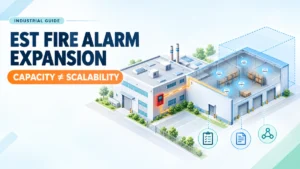
- Scalability: Addressable loops and networked panel architecture allow facilities to add devices, floors, or buildings incrementally, without redesigning the entire system.
- Integration with modern building systems: Intelligent fire detection infrastructure is increasingly expected to share data with BMS platforms, supporting coordinated responses such as HVAC shutdown, elevator recall, or access control changes during an event.
Why do mission-critical facilities require advanced fire detection? Mission-critical facilities require advanced fire detection because the operational, financial, and safety stakes of an undetected or slow-responding fire event are disproportionately high. Intelligent platforms reduce false alarms, pinpoint incidents faster, and support integration with building systems, all of which directly protect uptime, occupant safety, and critical assets.
The Five Pillars of Mission-Critical Fire Protection
Experienced consultants tend to evaluate fire detection design for critical facilities against five consistent pillars.
| Pillar | Why It Matters | Design Consideration |
|---|---|---|
| Early Detection | Faster identification of developing conditions reduces damage, downtime, and life-safety risk | Sensor type, placement density, environmental tuning |
| System Reliability | Life safety systems must function correctly every time, without exception | Redundant power, supervised circuits, fault tolerance |
| Scalability | Facilities expand; the system must grow without a full redesign | Addressable loop capacity, networked panel architecture |
| Intelligent Diagnostics | Reduces false alarms and identifies device issues before failure | Device-level status reporting, drift compensation |
| Operational Integration | Coordinated response across building systems improves outcomes | BMS integration, mass notification, access control tie-ins |
What makes intelligent fire alarm systems different? Intelligent fire alarm systems differ from conventional systems primarily in how devices communicate. Rather than relying on simple threshold-triggered circuits, intelligent systems use addressable devices that continuously report status, allowing for precise fault location, device-level diagnostics, and reduced false alarm rates, capabilities that are essential in high-occupancy or high-value facilities.
Industry Applications
Hospitals
Healthcare facilities present a unique combination of challenges: non-ambulatory patients, life-support equipment, oxygen-enriched environments, and 24/7 operations that cannot pause for maintenance. Fire detection must minimise false alarms, which can be disruptive and desensitising to staff while ensuring genuine events are identified and located immediately, often down to the specific patient room or department.
Data Centres
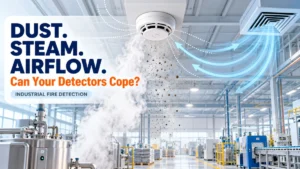
In data centres, false alarms carry a unique risk: an unnecessary clean-agent suppression discharge can be as costly as an actual fire event, both financially and operationally. Intelligent detection with advanced diagnostics helps distinguish between genuine incipient fire conditions and environmental anomalies like dust or airflow disturbances from cooling systems.
Airports
Airport terminals, concourses, and back-of-house operations combine high occupant density with complex, often irregular architecture. Detection systems must cover vast, varied spaces while integrating with mass notification and evacuation management systems that coordinate large crowd movements safely.
Manufacturing Plants
Industrial environments often involve combustible materials, heat-generating machinery, and process areas where standard smoke detection may not be suitable. Facility designers frequently combine heat detectors, specialised sensing technology, and manual call points positioned along evacuation routes and process lines.
Warehouses
Large open floor plates, high storage racking, and limited compartmentalisation make early detection especially important in warehouses, where fire can spread quickly through stored goods before it becomes visible at ceiling-mounted detection points.
Pharmaceutical Facilities
Cleanroom environments, controlled atmospheres, and high-value inventory require detection systems that perform reliably without introducing contamination risks or triggering unnecessary environmental disruptions in sensitive production areas.
Commercial Campuses
Multi-building corporate or institutional campuses benefit from networked fire alarm architecture that allows centralised monitoring across a portfolio of buildings, simplifying both emergency response coordination and long-term facilities management.
Utility Infrastructure
Power generation and utility facilities often combine industrial-scale equipment with public safety obligations, requiring detection systems engineered for harsh environments alongside strict reliability and regulatory compliance standards.
Which industries benefit the most from intelligent fire detection? Hospitals, data centres, airports, pharmaceutical manufacturers, and utility operators benefit most from intelligent fire detection because each combines high occupancy or asset value with low tolerance for false alarms and operational interruptions. In these environments, precise, fast, and reliable detection directly protects continuity of critical services.
How Intelligent Fire Detection Supports Business Continuity
How do intelligent fire alarm systems improve operational resilience? Intelligent fire alarm systems improve operational resilience by detecting developing conditions earlier, reducing false alarms that disrupt operations, and providing precise location data that speeds emergency response. Their integration with building management systems also enables coordinated actions, such as HVAC shutdowns or access control changes, that limit damage and downtime during an actual event.
The connection between fire detection quality and business continuity is often underappreciated in early-stage facility planning. A few key relationships stand out:
- Reduced downtime: Faster, more accurate detection limits fire spread and reduces the scope of post-incident remediation and business interruption.
- Faster incident response: Device-level location data allows responders to act with precision rather than searching an entire zone.
- Fewer disruptive false alarms: Intelligent diagnostics distinguish real threats from environmental noise, protecting productivity and reducing alarm fatigue among staff.
- Asset protection: Early detection limits damage to high-value equipment, inventory, or infrastructure before it becomes catastrophic.
- Occupant safety: Accurate, fast detection supports safer evacuation or shelter-in-place decisions, particularly in facilities with vulnerable occupants.
- Long-term infrastructure planning: Scalable, networked systems reduce the cost and disruption of future expansions or renovations.
Choosing the Right Fire Detection Platform
Specifying a fire detection system for a mission-critical facility is a long-term infrastructure decision, not a one-time procurement task. Consultants typically evaluate several factors before recommending a platform architecture:
- Facility size and layout: Larger or more complex floor plans generally favour addressable, networked architecture over simple zoned systems.
- Expansion plans: If a facility anticipates future construction, additional buildings, or floor build-outs, a scalable platform such as networked panels built around EST4 or EST3 architecture, or modular options like the IO1000, avoids costly redesigns later.
- Integration needs: Facilities that already operate a building management system, mass notification platform, or access control infrastructure benefit from fire detection systems designed for open integration.
- Maintenance strategy: Facilities with in-house maintenance teams may prioritise systems with strong self-diagnostic reporting, while those relying on third-party service providers may prioritise remote monitoring capability.
- Operational complexity: Facilities with 24/7 operations, sensitive equipment, or life-safety-dependent occupants generally require systems with stronger false-alarm management and fault isolation capabilities.
- Lifecycle planning: Total cost of ownership, including device longevity, panel software support, and ease of future upgrades, often matters more than the initial installation cost alone.
Common Mistakes in Mission-Critical Fire Protection Planning
Even experienced teams occasionally fall into avoidable planning traps:
- Designing only for code compliance: Meeting minimum code requirements doesn’t necessarily address the facility’s actual operational risk profile.
- Ignoring scalability: Selecting a system sized only for current needs, without accounting for future growth.
- Underestimating diagnostics: Treating detection as binary (alarm or no alarm) rather than leveraging device-level health data.
- Poor detector placement: Applying generic spacing rules without accounting for airflow, ceiling height, or process-specific hazards.
- Lack of integration planning: Specifying fire detection in isolation from BMS, HVAC, and notification systems that should work together during an event.
- Delayed modernisation: Continuing to expand ageing conventional systems rather than evaluating a transition to addressable architecture at the right renovation cycle.
Future Trends in Intelligent Fire Detection
Fire detection technology continues to evolve alongside broader building intelligence trends:
- AI-assisted diagnostics: Pattern recognition that helps distinguish genuine fire signatures from environmental interference with greater accuracy.
- Predictive maintenance: Using device performance data to flag components likely to need service before they fail.
- IoT integration: Deeper connectivity between fire detection devices and broader building sensor networks.
- Smart building convergence: Fire detection becoming one data layer within a unified smart building ecosystem rather than a standalone system.
- Cloud-based monitoring: Remote visibility into system status across multi-site portfolios, supporting centralised facilities management.
- Digital twins: Virtual models of building systems, including fire detection layouts, used for planning, training, and incident simulation.
- Enterprise-wide life safety management: Centralised oversight of fire, security, and notification systems across large organisations with multiple facilities.
Expert Recommendations
- For engineers: Design detection layouts around actual airflow patterns and occupancy risk, not just minimum code spacing tables.
- For consultants: Evaluate scalability and integration requirements at the earliest design stage; retrofitting these capabilities later is typically more disruptive and costly.
- For facility managers: Prioritise systems with strong device-level diagnostics to reduce both false alarms and unplanned maintenance visits.
- For procurement teams: Weigh lifecycle cost and vendor support continuity alongside upfront capital cost when comparing fire alarm control panel options.
- For infrastructure developers: Treat fire detection architecture as a long-term infrastructure investment tied to operational resilience, not a line-item compliance cost.
Read Also: Why Small and Medium Facilities Choose Edwards IO1000 Panels
Read Also: Edwards EST3 vs EST4: Which Fire Alarm Platform Is Right for Your Facility?