Choosing a fire alarm control panel is no longer just about meeting fire codes. As facilities become larger, smarter, and more interconnected, the fire alarm platform becomes the backbone of an organisation’s life safety strategy. Understanding the evolution from EST3 to EST4 helps decision-makers plan not only for today’s needs but also for future growth.
Introduction
For fire protection engineers and facility owners, a fire alarm control panel is a decades-long infrastructure commitment, not a one-time purchase. The platform selected today will govern how a building detects fire, communicates emergencies, integrates with building management systems, and adapts as the facility expands.
Enterprise fire safety requirements have shifted considerably over the past two decades. Buildings are larger, campuses span multiple structures, IT departments now have a say in life-safety design, and cybersecurity has become as relevant to a fire alarm control panel as smoke-detection sensitivity. These pressures are why Edwards, a long-established name in intelligent fire alarm systems, maintains multiple enterprise-grade platforms in its product line.
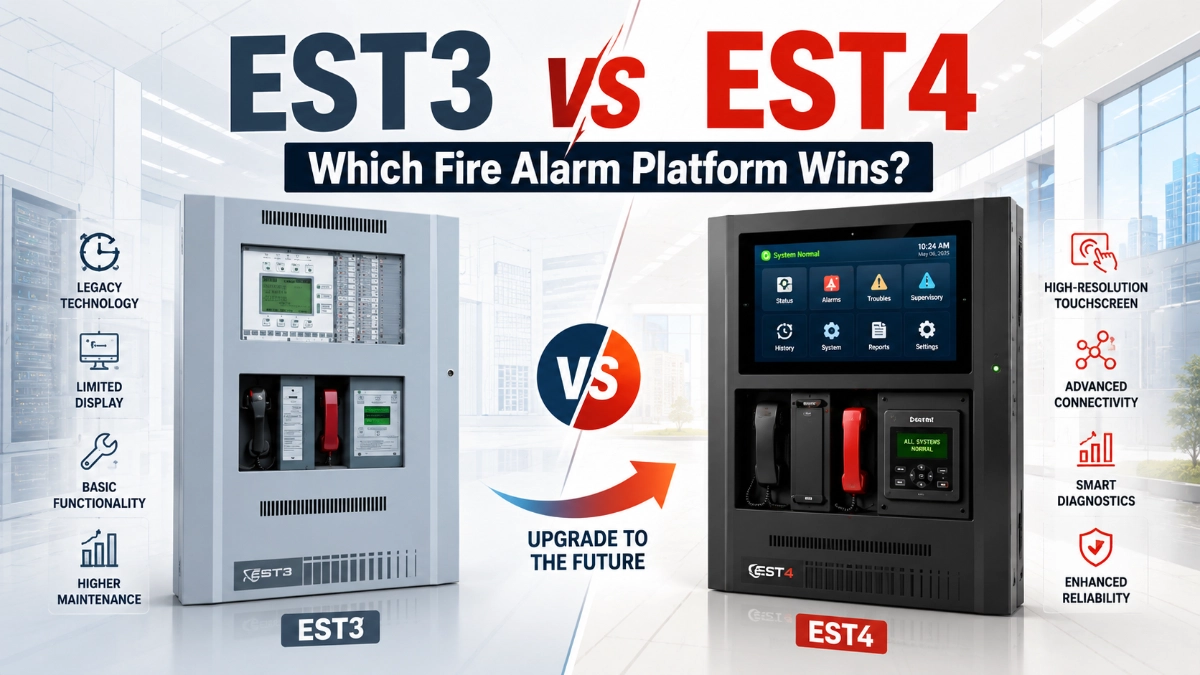
Edwards EST3 and Edwards EST4 represent two generations of the same engineering philosophy: modular, networkable, addressable fire alarm control built for large and complex facilities. EST3 was the platform that defined enterprise-grade fire detection infrastructure for many organisations for years. EST4 is Edwards’ current-generation networked life safety platform, built with a new network architecture, expanded capacity, and modern cybersecurity protections.
This article compares the two platforms in detail: architecture, networking, scalability, diagnostics, and long-term viability so that consultants, engineers, and procurement teams can make an informed, facility-specific decision.
Understanding the Edwards Fire Alarm Platform Evolution
Enterprise fire alarm technology has evolved alongside the buildings it protects. Early addressable fire alarm control panels served single buildings with modest device counts. As campuses, hospitals, airports, and industrial complexes grew, facilities needed networked fire alarm systems capable of unifying multiple buildings under a single fire detection infrastructure, often alongside mass notification and security functions.
This is the environment EST3 was engineered for: a modular fire alarm control platform that could scale from a single standalone panel to a multi-panel, multi-building network. Over its service life, EST3 became a widely deployed enterprise fire alarm system, valued for its flexibility and its ability to unify fire alarm, security, and mass notification functions using common components.
As IT infrastructure, cybersecurity requirements, and building intelligence expectations advanced, Edwards Fire Alarm System developed EST4 to address needs that EST3’s original architecture was not designed around, including larger node counts, IPv6 networking, flexible mesh topologies, and integrated cyber-defence features such as AES-encrypted proxy firewalls.
A simplified timeline:
| Era | Platform Milestone |
|---|---|
| Earlier generation | EST3 introduced as a modular, cabinet-based enterprise fire alarm control platform |
| Mid-life update | EST3X released as a refreshed control panel within the EST3 architecture, with modern displays and controls |
| Current generation | EST4 launched with an all-new network architecture, IPv6 design, and cybersecurity-focused engineering |
| Present day | EST3 reaches end-of-life status for new specification; EST4 becomes the actively supported enterprise platform, with a defined migration path from EST3 |
This progression is a normal pattern in enterprise fire alarm networking: platforms are supported for long service lifecycles, then succeeded by architectures built for contemporary networking and cybersecurity standards, with manufacturers typically providing backwards-compatible migration paths to protect the facility’s existing investment in wiring and field devices.
Edwards EST3 Overview
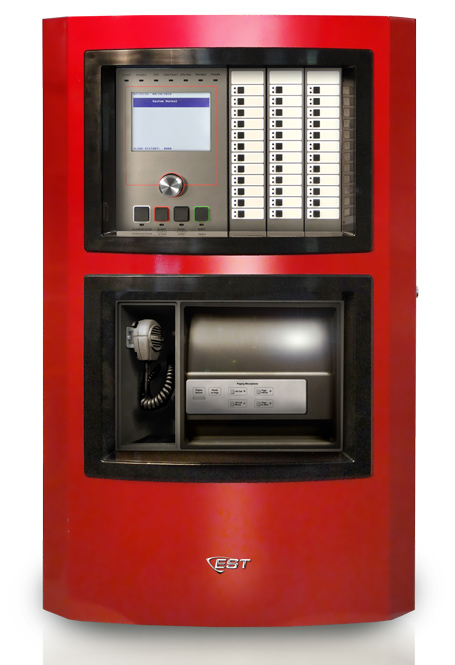
EST3 is a modular fire alarm control platform designed around a cabinet-based architecture. Each cabinet houses a controller board, power supply, and a local rail (LBUS) that accepts plug-and-play local rail modules (LRMs), allowing a panel’s function fire alarm, security annunciation, mass notification to be customised without redesigning the core system.
Architecture and networking
EST3 panels communicate over a multi-priority, peer-to-peer network historically described in Edwards documentation as a token ring–style protocol, later supported by an Autonomous Control Engine (ACE) for network communication between cabinets. The network supports copper, multi-mode fibre, single-mode fibre, or a combination of all three, and can span more than 160,000 feet of total network wiring.
Scalability
An EST3 network supports up to 64 nodes, with each node capable of supporting up to 2,500 devices, giving the platform substantial capacity for large, multi-building enterprise fire alarm deployments. The EST3X control panel, a later refresh within the EST3 family, offered standalone operation, networking with up to eight nodes on its own, or integration into a larger 64-node EST3 network useful for retrofits and phased additions.
Strengths
- Distributed intelligence: because each panel stores a copy of the system database, alarm response and reporting can continue even if network connectivity to other panels is interrupted.
- Broad support for Edwards Signature Series addressable detectors and modules.
- Established compatibility with voice evacuation, mass notification, and security integration on shared hardware.
- Long, proven deployment history across commercial and institutional buildings.
Typical applications
EST3 has historically been specified in hospitals, universities, high-rise office buildings, and multi-building campuses that required a unified, networked fire alarm ecosystem across several structures.
Where EST3 stands today
Edwards has designated EST3 as having reached end-of-life status for new specification, citing the declining availability of certain legacy components. Existing EST3 installations remain serviceable, and Edwards has published a defined migration path to EST4 that reuses existing wiring and Signature Series field devices, which matters for any facility currently operating on this platform.
Edwards EST4 Overview
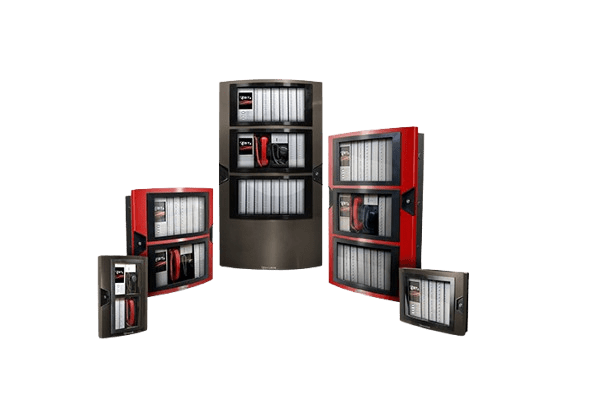
EST4 is Edwards’ current flagship networked life safety platform, built on what Edwards describes as an entirely new network architecture rather than an incremental revision of EST3’s design.
Modern architecture and networking
EST4 uses a flexible IPv6 network design and can operate in Class B, Class A, Class X, Class N, or full mesh topologies over fibre, Ethernet, or copper wiring. Nodes are self-configuring, adapting to rings, stars, redundant segments, or full mesh layouts largely without manual network administration, and the platform supports hot-swappable network connections and physical-layer changes (for example, copper to fibre) without redesigning the network.
Scalability
EST4 supports up to 150 nodes and as many as 375,000 addressable Signature Series devices across a network, a substantially larger capacity envelope than EST3, relevant for large industrial campuses, multi-building healthcare systems, and airport-scale deployments.
Intelligent diagnostics and survivability
Each EST4 CPU card includes onboard memory sufficient to store roughly two hours of pre-recorded audio messaging locally, so mass notification messages can continue to play from an individual node’s memory even if connectivity to other panels is lost. The system also retains a large onboard event history, space for thousands of alarm events, plus separately retained locked or frozen events for investigative review.
User experience
EST4 panels are built around a large, full-colour LCD touchscreen with tactile buttons for fast access to service and responder functions, a notable interface shift from EST3’s monochrome LCDs.
Cyber-ready design
Cybersecurity is a defined engineering focus of EST4 rather than an add-on. The platform supports proxy firewalls using AES encryption, is FIPS Pub 197–certified for its encryption implementation, and connects to Edwards ConnectedSafety+, a cloud-based service that provides secure remote access to system status, diagnostics, and event notifications for authorised technicians and facility managers.
Future expansion capabilities
Because EST4 is backwards compatible with existing Signature Series devices, Genesis notification appliances, and much of the wiring used in EST3 installations, it is positioned as both a new-construction platform and a forward migration target for facilities currently operating EST3, minimising rework during a system transition.
EST3 vs EST4: Complete Comparison
| Category | Edwards EST3 | Edwards EST4 |
|---|---|---|
| System architecture | Cabinet-based, modular local rail architecture | All-new network architecture, IPv6-based |
| Network topology | Peer-to-peer / token-ring-style, ACE network engine | Class B/A/X/N and full mesh; self-configuring nodes |
| Physical media | Copper, multi-mode fibre, single-mode fibre | Copper, Ethernet, fibre; hot-swappable, mixable |
| Device capacity | Up to 64 nodes, ~2,500 devices per node | Up to 150 nodes, up to 375,000 devices network-wide |
| User interface | Monochrome LCD (168-character display) | Full-colour LCD touchscreen with tactile controls |
| Diagnostics | Panel-level event logging, distributed database | Expanded onboard event history, locked/frozen event storage |
| Cybersecurity | Not originally engineered around modern cyber standards | AES-encrypted proxy firewall, FIPS Pub 197 certified |
| Remote connectivity | Limited/legacy remote service tools | Edwards ConnectedSafety+ cloud-based SaaS access |
| Survivability | Distributed database per panel | Local audio storage per CPU; continues messaging if a node is isolated |
| Maintenance/lifecycle | End-of-life for new specification; parts increasingly sourced from speciality suppliers | Actively manufactured and supported; current flagship platform |
| Migration path | Defined forward-migration path to EST4 | N/A – is the migration target |
| Integration flexibility | Fire, security, mass notification on shared hardware | Fire, mass notification, and broader building integration; ClassiFire AI-enabled detection options via ModuLaser |
| Typical deployment size | Mid-size to large multi-building campuses | Small standalone buildings up to very large, multi-building enterprise campuses |
Decision Framework: Which Platform Fits Your Facility?
Because EST3 is now end-of-life for new specifications, this framework is written primarily to help consultants evaluate new EST4 deployments versus decisions about existing EST3 systems.
| Facility Type | Recommended Approach | Why |
|---|---|---|
| Small commercial buildings | Neither — consider Edwards’ smaller iO Series panels | EST3/EST4 enterprise architecture exceeds typical device counts and budget for small single-tenant buildings |
| Office complexes | EST4 (new); evaluate migration if on EST3 | Benefits from centralised diagnostics, ConnectedSafety+ remote monitoring, and future tenant fit-out flexibility |
| Hospitals | EST4 | Survivability features, mass notification capacity, and cybersecurity matter in life-safety-critical, 24/7 environments |
| Hotels | EST4 | Voice evacuation, mass notification, and scalable device counts across guest floors |
| Warehouses | EST4, often paired with aspirating detection (e.g., ModuLaser) | Large open areas benefit from flexible detection integration and reduced nuisance alarms |
| Manufacturing plants | EST4 | Industrial fire protection needs benefit from mesh network resilience and expanded diagnostics |
| Universities | EST4 | Multi-building campuses need the larger node/device capacity and centralised network management |
| Airports | EST4 | Very large device counts and multi-building integration favour EST4’s expanded node capacity |
| Data centers | EST4, with cybersecurity as a primary driver | AES-encrypted network communication is directly relevant to data centre security postures |
| Industrial campuses | EST4 | Scale and mesh topology options suit distributed industrial sites |
| Multi-building facilities | EST4 | Node capacity, self-configuring networking, and remote diagnostics reduce operational overhead across sites |
Key principle: platform selection should be driven by device count, network topology needs, cybersecurity requirements, and long-term expansion plans, not by facility size alone. A large but electrically simple warehouse may need less network sophistication than a mid-size hospital with mass notification and phased expansion requirements.
Should Existing EST3 Users Upgrade?
This is the question most facility managers and building owners are actually asking, and it deserves an objective answer rather than a sales pitch.
When upgrading makes sense
- The facility is planning a significant expansion that would exceed practical EST3 device or node capacity.
- Cybersecurity requirements (from IT policy, insurance, or regulatory pressure) now require encrypted network communication that EST3’s original architecture was not built around.
- Replacement parts for the specific EST3 configuration are becoming difficult to source, since sourcing increasingly relies on fire alarm speciality suppliers rather than general distributors.
- The facility wants centralised remote diagnostics through a service like ConnectedSafety+.
- A planned renovation already involves disruption to fire alarm wiring, making it a natural point to transition.
When EST3 still meets operational needs
- The system is fully functional, adequately serviced, and not approaching device or node capacity limits.
- Replacement components for the installed configuration remain available and supportable.
- No near-term expansion, renovation, or cybersecurity mandate is driving change.
- A full system replacement is not currently budgeted, and a phased, monitored maintenance strategy is acceptable to the authority having jurisdiction (AHJ) and facility risk management.
Planning for expansion and lifecycle
Because Edwards has engineered EST4 for backward compatibility, reusing existing network wiring and Signature Series field devices in many cases, migration does not always require a full rip-and-replace. Facility owners should treat this as a multi-year capital planning decision, ideally timed around other renovation or infrastructure work, rather than an emergency response to end-of-life notices. A phased migration, panel by panel or building by building, is often more budget-realistic than a single large-scale cutover.
Common Misconceptions About EST3 and EST4
“Newer always means replacing existing systems.” Not necessarily. EST4’s backward compatibility with Signature Series devices and existing wiring means many EST3 sites can migrate incrementally rather than replacing an entire fire detection infrastructure at once.
“Bigger panels are always better.” A facility’s actual device count, node requirements, and network topology should drive the decision, not panel capacity for its own sake. Over-specifying an enterprise platform for a facility that doesn’t need it adds unnecessary cost and complexity.
“Scalability only matters for large facilities.” Even mid-size facilities benefit from scalable architecture if they have multi-phase construction plans, tenant changes, or anticipated device additions over the building’s lifecycle.
“Enterprise panels are only for high-rise buildings.” Enterprise fire alarm platforms are equally relevant to horizontally distributed facilities, industrial campuses, warehouses, and multi-building healthcare or education sites, where node count and network resilience matter more than building height.
How Consultants Choose Between EST3 and EST4
With EST3 at end-of-life for new specifications, this decision in practice is largely: specify EST4 for new work, and evaluate migration timing for existing EST3 sites. Consultants typically weigh:
- Facility size and device count: Current and projected addressable device totals relative to node capacity.
- Future growth: Planned expansions, additional buildings, or campus phases.
- Networking needs: Topology requirements (mesh, redundant segments, fiber/copper mix) and IT department involvement.
- Integration requirements: Mass notification, security annunciation, building management system (BMS) integration, and aspirating detection needs.
- Maintenance strategy: In-house facilities staff capability versus reliance on system integrators and Edwards Partner network support.
- Operational complexity: Number of stakeholders (fire, security, facilities, IT) who need visibility into system status.
- Budget planning: Capital budget cycles, phased migration feasibility, and total cost of ownership over the panel’s expected service life.
Future Trends in Enterprise Fire Alarm Platforms
Enterprise fire alarm systems are increasingly expected to function as part of a facility’s broader intelligent infrastructure, not as an isolated life safety silo. Several trends are shaping where platforms like EST4 are headed:
- AI-assisted detection: Technologies such as Edwards’ ClassiFire AI, used with aspirating smoke detection integrations, analyse air particle data to reduce nuisance alarms while preserving early detection sensitivity.
- Predictive maintenance: Cloud-connected diagnostics through services like ConnectedSafety+ move maintenance from reactive to condition-based, flagging component issues before they cause a trouble condition.
- Building intelligence and BMS convergence: Fire alarm networking increasingly needs to coexist with, and sometimes feed data to, building management systems for holistic facility monitoring.
- IoT and remote access: Secure, encrypted remote connectivity is becoming a baseline expectation rather than an optional feature, particularly for multi-site organisations.
- Cybersecurity as a core requirement: As fire alarm networks touch IT infrastructure more directly, encryption, firewalls, and certified security protocols (such as FIPS Pub 197) are becoming standard specification criteria, not differentiators.
- Digital twins and system documentation: Richer onboard event history and diagnostics support more accurate as-built documentation and lifecycle planning for large facilities.
Expert Recommendations
For consultants: Specify EST4 for new enterprise fire alarm projects by default, given EST3’s end-of-life status. Reserve EST3-specific evaluation for facilities that already operate the platform and need a maintenance or migration recommendation.
For facility managers: If operating an EST3 system, begin tracking parts availability and service costs now. A rising maintenance burden or difficulty sourcing SIGA components is a practical signal that migration planning should begin, independent of any formal end-of-life pressure.
For procurement teams: Treat fire alarm platform selection as a lifecycle investment, not a single line-item purchase. Evaluate total cost of ownership across the expected 15–20+ year service life, including diagnostics, remote service capability, and future device expansion costs.
For building owners: Ask your fire protection engineer or consultant directly whether your facility’s current or planned device count, network topology, and cybersecurity requirements are better served by EST4’s expanded capacity, and request a phased migration cost estimate if you currently operate EST3.
Read Also: What Makes Edwards EST4 Panels Suitable for Enterprise Fire Safety?
Read Also: Understanding the Difference Between EST3, EST4, and IO Series Panels