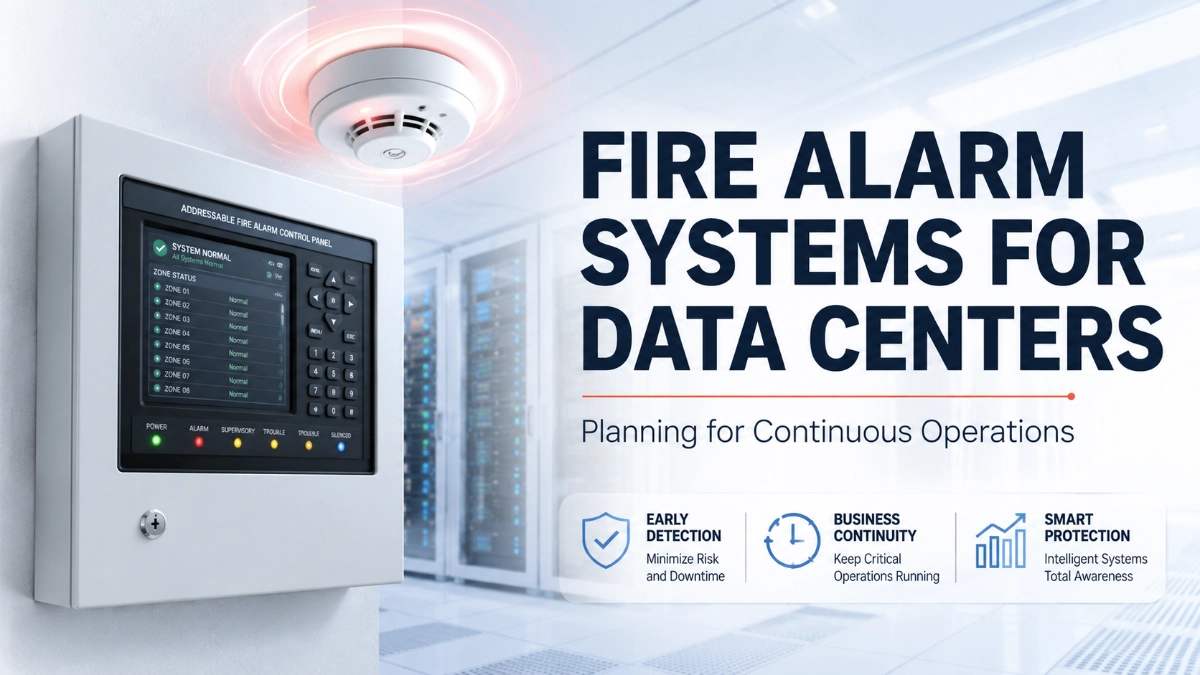
Modern data centres process millions of transactions every minute, making operational continuity one of their highest priorities. While redundancy is built into power, cooling, and networking, fire detection often becomes the first line of defence in protecting critical infrastructure from costly downtime. A single false alarm can trigger an unnecessary shutdown; a single missed detection can destroy racks of equipment and interrupt services relied on by thousands of businesses. Few facility systems carry that much weight while receiving so little day-to-day attention.
Introduction
Data centres are not conventional commercial buildings. They house dense concentrations of high-value electronic equipment, operate around the clock, and support services where even minutes of downtime can translate into significant financial loss, contractual penalties, or reputational damage. Unlike an office or retail space, a data centre’s occupancy is low, but its asset density and criticality are extremely high.
This changes the calculus for fire protection. In most buildings, life safety is the dominant design driver, and asset protection is secondary. In a data centre, both goals matter equally; people must be protected, but so must the servers, storage arrays, and power infrastructure that keep business operations running. Fire strategies built for general occupancies rarely translate well into this environment without significant adaptation.
This is where intelligent, addressable fire alarm systems play a central role. Rather than functioning as a simple compliance requirement, a well-designed fire detection platform becomes part of the facility’s broader resilience strategy, working alongside redundant power, cooling, and network architecture to reduce the risk of unplanned outages.
Enterprise-grade platforms such as Edwards Fire Alarm Systems are frequently specified in mission-critical facilities because they are built around addressable architecture, scalable networking, and diagnostic capabilities suited to environments where early warning and fast fault isolation matter more than in a typical commercial building. This article examines why data centres require a specialised fire protection approach, how intelligent fire alarm systems support continuous operations, and what consultants and facility teams should consider when planning a system that will need to perform reliably for the life of the facility.
Why Fire Safety Is Different in Data Centres
Data centres combine several characteristics that rarely appear together in other building types, and each one affects fire alarm system design.
- High-value IT assets: Server racks, storage arrays, and networking hardware represent enormous capital investment. Damage from smoke, heat, or fire suppression activity can be as costly as the fire itself, which is why early intervention is prioritised over waiting for a fire to develop into something visually obvious.
- Continuous uptime requirements: Many data centres operate under service-level agreements that leave little tolerance for downtime. A fire alarm system that generates unnecessary nuisance alarms or one that fails to isolate a fault quickly can itself become a source of operational disruption.
- Dense cabling and airflow patterns: Raised floors, cable trays, and hot-aisle/cold-aisle containment change how smoke moves through a space. Detection strategies designed for open office ceilings often do not translate directly into these environments.
- Cooling infrastructure: Computer room air handlers and in-row cooling units create airflow patterns that can dilute or redirect smoke before it reaches a conventional ceiling-mounted detector, which is one reason specialised detection methods are often considered in these spaces.
- Battery rooms and energy storage: Uninterruptible power supply (UPS) rooms and battery energy storage systems introduce unique fire risks, including thermal runaway, that require dedicated detection and notification strategies separate from the general server environment.
- Electrical distribution: Power distribution units, switchgear, and busway systems carry significant electrical loads, and faults in this equipment are a recurring cause of data centre fire incidents.
- Occupancy patterns: Data centres are typically low-occupancy but not unoccupied. Life safety planning must still account for staff, contractors, and visitors, even though the facility’s primary risk profile is asset protection.
Together, these factors mean fire alarm system design in a data centre is less about meeting a minimum code requirement and more about engineering a detection strategy matched to the specific risks of the space.
Common Fire Risks in Modern Data Centres
Understanding where fires are most likely to originate helps shape a more effective detection and zoning strategy.
- Electrical faults in wiring, connectors, and distribution equipment remain one of the most frequently cited causes of data centre fire incidents, often linked to loose connections, insulation breakdown, or overloaded circuits.
- UPS systems can experience internal component failure or battery-related thermal events, particularly as systems age or are poorly maintained.
- Battery energy storage systems (BESS), increasingly common as data centres integrate on-site power resilience, introduce thermal runaway risks that require early gas or smoke detection strategies.
- Power distribution units (PDUs) are a common ignition point due to their high utilisation and constant electrical load.
- Overheating equipment, including servers running beyond design thresholds or cooling failures that go undetected, can produce early smouldering conditions before visible fire develops.
- Human error, such as improper cable management, unauthorised equipment installation, or maintenance mistakes, contributes to a meaningful share of incidents.
- Maintenance activities, including hot work or testing procedures, can introduce temporary risk if not properly coordinated with the fire detection system.
A practical example: a PDU experiencing a slow-developing connection fault may release trace smoke particles hours before any visible sign of trouble. In a facility using early warning detection, this can be identified and addressed during a scheduled maintenance window rather than escalating into an emergency shutdown.
Why Early Detection Matters More Than Fire Suppression Alone
Fire suppression systems, whether clean agent, water mist, or other technologies, are an essential part of data centre fire protection, but they are a last line of defence. By the time a suppression system activates, some level of disruption has already occurred, whether from the fire itself, smoke contamination, or the suppression discharge.
Early detection changes this timeline. Fires typically progress through recognisable stages: an incipient stage marked by invisible combustion particles, a visible smoke stage, a flaming stage, and finally a heat stage. Conventional smoke detectors are generally designed to respond during the visible smoke stage. In a data centre, that can already be too late to prevent equipment damage or an unplanned shutdown.
Detection strategies aimed at the incipient stage, sometimes supported by aspirating smoke detection (ASD), a technology that continuously draws air samples through a network of pipes to a highly sensitive detection chamber, are intended to identify combustion particles before they reach concentrations visible to the human eye. This approach is not a guarantee against fire, but it extends the window for intervention, allowing facility staff to investigate and resolve a developing issue before it triggers suppression or forces equipment offline.
It is worth noting that no detection technology eliminates risk. Early warning systems reduce the likelihood of undetected fire development, but they must be paired with sound maintenance practices, proper documentation, and a suppression strategy appropriate to the space. Overstating what early detection alone can achieve is one of the more common mistakes in data centre fire protection planning.
How Intelligent Fire Alarm Systems Support Continuous Operations
Intelligent, addressable fire alarm systems are built around the idea that every device on the network should be individually identifiable, testable, and diagnosable rather than treated as part of an anonymous group circuit.
Addressable Architecture
In an addressable fire alarm system, each smoke detector, heat detector, module, and notification device has a unique address on the network. This allows the fire alarm control panel to report the exact device generating an alarm or trouble condition, rather than a general zone. For a facility spanning multiple server rooms, this level of precision significantly reduces the time needed to locate and assess an event.
Intelligent Device Communication
Addressable devices communicate continuously with the control panel, reporting status information rather than simply opening or closing a circuit. This ongoing dialogue allows the system to distinguish between a genuine alarm condition, a developing fault, and routine maintenance needs such as dust accumulation in a detector chamber.
Fast Fault Identification
Because each device reports individually, troubleshooting a fault such as a wiring issue or a failing sensor can be narrowed down to a specific device address almost immediately. In facilities where unnecessary system downtime is unacceptable, this reduces the time technicians spend diagnosing issues and reduces the risk of a fault being misattributed to the wrong area.
Scalable Networking
Data centres rarely stay the same size. Facilities expand in phases as capacity demand grows, and a fire alarm system needs to expand with them. Enterprise platforms such as Edwards EST4 are designed around a networkable architecture that allows additional panels, loops, and devices to be added as new server halls, cooling plants, or support buildings come online, without requiring a full system redesign.
Centralized Monitoring
Larger data centre campuses often operate multiple buildings or zones under a single life safety strategy. Centralised monitoring through a networked fire alarm system, such as the Edwards EST3 platform, allows facility teams to view status and alarm information across the entire site from a unified interface, supporting faster decision-making during an event.
Maintenance Diagnostics
Ongoing device-level diagnostics covering sensitivity drift, contamination levels, and communication health support a proactive maintenance approach. Instead of relying solely on periodic manual testing, facility teams can identify devices that need attention before they fail a scheduled inspection or, worse, fail during an actual event.
Integration with Building Systems
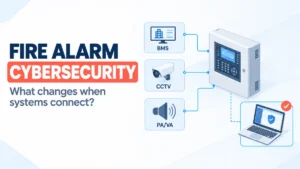
Fire alarm systems in data centres increasingly need to communicate with other building infrastructure, including building management systems (BMS), access control, and mechanical systems. Interface modules, such as those in the Edwards SIGA device family, allow the fire alarm system to monitor and, where appropriate, control related equipment such as dampers, air handlers, or door releases as part of a coordinated response.
Designing a Fire Alarm System for Data Centres
A structured planning approach helps ensure that detection, notification, and zoning decisions align with both code requirements and operational goals.
| Planning Step | Key Considerations |
|---|---|
| 1. Risk Assessment | Identify high-risk areas: UPS rooms, battery storage, electrical rooms, server halls, cable pathways |
| 2. Detection Strategy | Match detection technology to the risk profile of each space; consider early warning detection for critical IT spaces |
| 3. Zoning | Define zones that align with server hall layout, containment aisles, and mechanical/electrical rooms for precise event location |
| 4. Device Placement | Account for airflow, raised floors, cable trays, and ceiling height when positioning detectors |
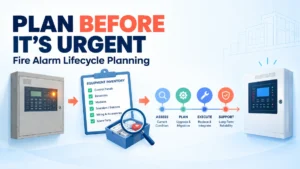
| 5. Expansion Planning | Select a networkable panel architecture that supports future loops, panels, and campus growth |
| 6. Network Redundancy | Design communication paths with backup routing to avoid single points of failure |
| 7. Maintenance Accessibility | Position devices and panels for safe, practical access during routine testing and service |
A note on risk assessment: Every data centre should begin with a room-by-room risk review rather than applying a single detection standard uniformly across the facility. A battery room, a server hall, and an electrical switchgear room each carry different risk characteristics and may warrant different detection approaches within the same overall system.
A note on zoning: Precise zoning is particularly valuable in data centres because it directly affects how quickly staff can locate and respond to an event without needing to walk an entire facility. Zoning that mirrors the physical layout of server halls, containment aisles, and support rooms tends to perform better operationally than zoning based purely on electrical circuit convenience.
Recommended Fire Alarm Components for Data Centres
A data centre fire alarm system typically includes several core component types, each serving a distinct function.
- Fire Alarm Control Panels (FACP): The control panel is the central intelligence of the system, processing input from field devices and managing outputs to notification appliances and related building systems. Platforms such as Edwards EST4, Edwards EST3, and the smaller-footprint Edwards IO1000 are examples of panels used across different facility sizes, from single-building deployments to large networked campuses.
- Smoke Detectors: Addressable smoke detectors, such as those in the Edwards SIGA Smoke Detectors line, provide point-based detection suited to general server hall and office areas within a data centre.
- Heat Detectors: In spaces where smoke detection is impractical, such as areas with high dust levels or where nuisance alarms are a concern, heat detectors like the Edwards SIGA Heat Detectors provide an alternative detection method calibrated to rate-of-rise or fixed temperature thresholds.
- Manual Call Points: Manual pull stations, including the Edwards SIGA Manual Call Points, allow personnel to initiate an alarm directly, supplementing automatic detection as part of a complete life safety strategy.
- Monitor Modules: Devices such as the Edwards SIGA Monitor Modules interface with other life safety equipment, including sprinkler flow switches and suppression system releases, bringing their status into the addressable fire alarm network.
- Control Modules: Control and relay modules, such as the Edwards SIGA Relay Modules, allow the fire alarm system to activate related equipment, such as damper closures or door hold-open releases, as part of a coordinated response sequence.
- Notification Appliances: Horns, strobes, and combination devices alert occupants to an alarm condition. In data centres, notification appliance placement must account for high ambient noise levels from cooling equipment, which can affect audibility and candela requirements.
Common Fire Protection Planning Mistakes
Even experienced teams can fall into planning patterns that reduce system effectiveness over time.
- Treating data centres like standard commercial buildings: Applying generic office-building detection spacing and zoning logic overlooks the unique airflow, asset density, and risk profile of server environments.
- Delayed maintenance: Skipping or postponing scheduled testing allows sensitivity drift, contamination, or device faults to go unnoticed until they affect performance.
- Poor detector placement: Failing to account for containment aisles, raised floor airflow, or cooling unit discharge patterns can leave detection gaps in critical areas.
- Ignoring future expansion: Selecting a non-networkable or capacity-limited panel can force a costly system replacement when the facility grows.
- Inadequate zoning: Overly broad zones slow down event location and response, particularly in large, multi-room facilities.
- Lack of integration planning: Designing the fire alarm system in isolation from BMS, mechanical, and access control systems creates coordination gaps during an actual event.
Future Trends in Data Centre Fire Protection
Fire protection technology in data centres continues to evolve alongside the facilities it protects.
- AI-assisted diagnostics: Pattern recognition applied to device-level data can help distinguish between genuine developing conditions and normal environmental variation, supporting more accurate alarm decisions.
- Predictive maintenance: Trend analysis of detector sensitivity and communication health is shifting maintenance models from purely calendar-based schedules toward condition-based servicing.
- Smart data centres: As facilities adopt broader IoT-enabled monitoring across power, cooling, and security systems, fire alarm platforms are increasingly expected to share data within a unified operational dashboard rather than operate as a standalone system.
- Cloud-based life safety management: Remote monitoring and reporting tools are giving facility teams visibility into system status across multiple sites without requiring on-site access for every check.
- Digital twins: Virtual models of facility infrastructure, including fire detection layouts, are beginning to support design validation and scenario planning before physical installation.
- Sustainability considerations: Facility teams are increasingly factoring in the environmental footprint of fire protection equipment, including detector lifecycle and energy consumption of notification devices, as part of broader sustainability commitments.
Expert Recommendations
- For data centre operators: Treat the fire alarm system as part of your operational resilience strategy, not a standalone compliance item. Review detection coverage whenever cooling, power, or layout changes occur.
- For consultants: Conduct a room-by-room risk assessment rather than applying uniform detection standards across the entire facility. Document the reasoning behind detection technology choices for each space.
- For engineers: Design zoning and device placement around actual airflow patterns, not assumed ceiling-level smoke movement. Validate assumptions with airflow modelling where budget allows.
- For facility managers: Build a maintenance calendar around manufacturer-recommended testing intervals, and use device diagnostic data to flag components needing attention before formal inspection cycles.
- For procurement teams: Prioritise networkable, scalable panel architecture even if current facility size does not require it. Retrofitting a non-expandable system is significantly more disruptive than planning for growth upfront.
Key Takeaways
- Data centres require fire protection strategies distinct from standard commercial buildings due to asset density, uptime requirements, and unique airflow conditions.
- Early detection, ideally at the incipient combustion stage, is more valuable in data centres than relying on suppression alone.
- Addressable fire alarm systems provide device-level precision that speeds up fault identification and event response.
- Battery rooms, UPS systems, and BESS installations require dedicated detection consideration due to thermal runaway risk.
- Scalable panel architecture, such as networked platforms, prevents costly redesigns as facilities expand.
- Zoning should reflect physical server hall layout, not just electrical circuit convenience.
- Detector placement must account for raised floors, containment aisles, and cooling airflow patterns.
- Integration with building management systems supports faster, more coordinated emergency response.
- Predictive, diagnostic-driven maintenance is becoming more important than purely calendar-based servicing.
- Fire alarm system design should be revisited whenever facility power, cooling, or layout undergoes significant change.
Read Also: How Edwards Fire Alarm Systems Support Long-Term Infrastructure Planning
Read Also: How Edwards Fire Alarm Systems Support Long-Term Infrastructure Planning