It’s 2:47 a.m. at a distribution centre on the outskirts of a mid-sized city. A camera mounted above the loading dock flags “unauthorised person detected” for the fourth time that night. Three of those alerts were a stray cat, a swinging tarp, and a security guard’s own shadow. The fourth is a real intruder, but by the time the fatigue-worn operator gets around to checking it, thirty seconds have already passed.
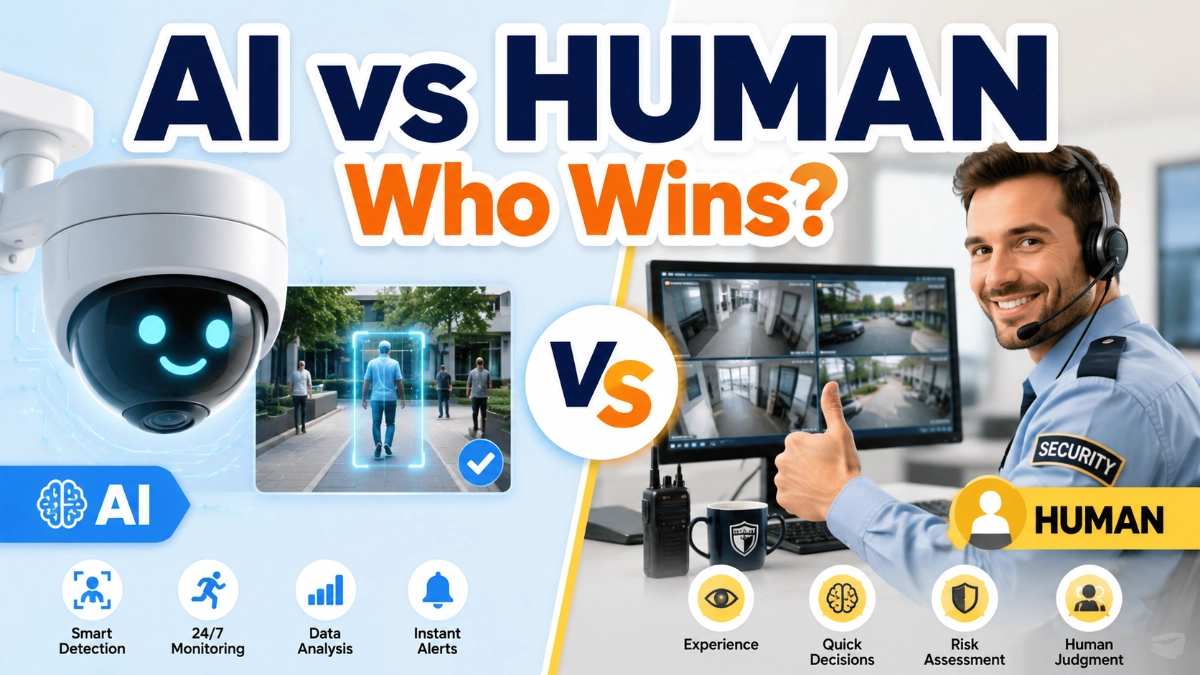
This scenario plays out in security operations centres around the world every single night. It captures, in miniature, the central question facing every facility manager, integrator, and business owner investing in surveillance today: should you trust the algorithm, the human, or both?
The honest answer is neither extreme works well alone. AI video monitoring brings speed and tireless attention; human operators bring judgment, context, and accountability. This article breaks down where each technology excels, where it falls short, and how a hybrid approach is increasingly the standard recommended by organisations such as the Security Industry Association (SIA) and ASIS International, delivering the most dependable outcome.
What Is AI Video Monitoring?
AI video monitoring uses computer vision, machine learning, and video analytics software to automatically detect, classify, and respond to events captured by security cameras, without requiring a human to watch every frame. Instead of passively recording footage, an AI-enabled system actively interprets it, flagging motion, identifying objects such as people or vehicles, and in more advanced deployments, recognising specific behaviours like loitering, perimeter breaches, or object removal.
Modern AI monitoring platforms typically run on edge devices (built into the camera or NVR) or on centralised servers, processing video streams frame by frame. Standards bodies like ONVIF (Open Network Video Interface Forum) help ensure these AI-enabled cameras and recorders from different manufacturers can communicate using a common protocol, which matters enormously for integrators building multi-vendor systems.
At its core, AI monitoring is a pattern-recognition engine. It has been trained on large datasets of labelled video to recognise what a “person,” a “vehicle,” or “suspicious loitering” typically looks like. It does not understand intent; it recognises statistical likelihood.
How Traditional Human Monitoring Works
Human monitoring relies on trained security operators watching live camera feeds, often across dozens of screens in a security operations centre (SOC), to identify threats, verify alarms, and coordinate a response. This model has been the backbone of physical security for decades, particularly in high-stakes environments like banking, correctional facilities, and critical infrastructure.
A human operator doesn’t just see an event; they interpret it. They know that a person lingering near a loading dock at 6 a.m. might be a delivery driver rather than a trespasser, because they recognise the truck, the time, or the routine. That contextual reasoning is difficult to replicate in software.
However, human monitoring has a well-documented weakness: sustained attention. Research in vigilance psychology, referenced in security industry training materials, has long shown that human attentiveness to monotonous visual tasks, such as watching static camera feeds, degrades significantly after even 20 minutes. This is precisely the gap AI was built to fill.
Strengths of AI Surveillance
AI-powered systems bring several structural advantages over human-only monitoring:
- Constant attention: AI never blinks, gets bored, or takes a bathroom break. It can watch 100 camera feeds as attentively as it watches one.
- Speed: Detection and initial classification can happen in milliseconds, far faster than a human scanning a bank of monitors.
- Consistency: An algorithm applies the same detection logic every time, without being influenced by mood, fatigue, or personal bias.
- Scalability: Adding more cameras to an AI system is largely a matter of processing capacity, not hiring and training additional staff.
- Data logging: AI systems can automatically timestamp, tag, and archive every detected event, creating a searchable record for investigations.
Actionable takeaway: If your facility has more cameras than staff can realistically monitor, AI analytics should be the first line of detection, not the last line of decision-making.
Limitations of AI Systems
AI is not infallible, and understanding its blind spots is essential for any technical decision-maker.
- Context blindness: AI can detect that something moved but often struggles to judge why it matters. A maintenance worker and an intruder can look identical to a motion-detection model.
- Environmental sensitivity: Poor lighting, heavy rain, fog, glare, and even moving shadows can trigger false positives or cause the system to miss real events. This is a widely acknowledged limitation across the video analytics industry.
- Training data bias: An AI model is only as good as the data it was trained on. Systems trained predominantly on daytime, clear-weather footage may underperform in low-light or adverse-weather conditions, and models can show reduced accuracy across different clothing styles, skin tones, or body types if training datasets aren’t sufficiently diverse a concern the National Institute of Standards and Technology (NIST) has studied extensively in its facial recognition and biometric evaluation programs.
- No moral judgment: AI cannot weigh ethical nuance; for instance, distinguishing a medical emergency from a physical altercation without additional contextual cues.
- Cybersecurity exposure: Every AI-enabled camera is also a networked IoT device, and each one expands the attack surface. The Cybersecurity and Infrastructure Security Agency (CISA) has repeatedly flagged IP-based surveillance devices as targets for botnets and unauthorised access when left with default credentials or unpatched firmware.
Strengths of Human Operators
Human monitoring remains indispensable for reasons that go beyond simple detection.
- Contextual judgment: Humans can distinguish between an employee behaving unusually because they’re injured versus someone behaving suspiciously with intent to harm.
- De-escalation and communication: A human operator can speak over an intercom, call police with nuanced situational detail, or coordinate an on-site response in ways current AI cannot.
- Accountability: When a human operator makes a decision, there’s a clear chain of responsibility, useful for legal, insurance, and compliance purposes.
- Adaptability to novel situations: Humans can reason about scenarios they’ve never encountered before; AI models can only recognise patterns similar to what they were trained on.
Where Humans Outperform AI
Humans still outperform AI in situations requiring empathy, ambiguous judgment calls, or real-time verbal interaction, such as calming a distressed individual, interviewing a witness on camera, or deciding whether an unusual event warrants dispatching emergency services. These are inherently social and contextual tasks that current AI models are not designed to handle.
Common False Alarms and Detection Challenges
False alarms remain one of the biggest frustrations in both AI and human-monitored systems. Common triggers include:
- Wildlife and pets crossing detection zones
- Weather elements like rain, snow, or wind-blown debris
- Reflections and shadows shifting with sunlight
- Insects on the camera lens (especially with infrared illumination)
- Vehicle headlights sweeping across a scene at night
The National Fire Protection Association (NFPA) and similar standards bodies note that alarm fatigue, whether from fire, intrusion, or video systems, is a recognised operational risk because it causes both machines and people to under-react to genuine emergencies over time.
Actionable takeaway: Tuning detection zones, sensitivity thresholds, and analytics rules during commissioning is not optional; it is the single highest-leverage step in reducing false alarms for either AI or human-reviewed systems.
AI Fatigue vs. Human Fatigue
AI doesn’t experience fatigue in the biological sense, but it can suffer a functional equivalent: alert fatigue on the human side caused by excessive AI-generated false positives. If an AI system floods an operator with low-quality alerts, the operator begins to distrust and ignore them, effectively neutralising the benefit of automation. Human fatigue, meanwhile, is well-established: prolonged, monotonous monitoring reduces detection accuracy regardless of operator skill or motivation. The solution isn’t choosing one system over the other; it’s using AI to filter noise so human attention is reserved for events that genuinely require judgment.
Response Time Comparison
AI systems can flag an event in milliseconds, but flagging is not the same as resolving. Total response time in a real-world scenario includes detection, verification, and dispatch of a physical response (security personnel, police, or an on-site team). AI shortens the detection phase dramatically, but a human or a human-supervised protocol is still typically required to verify the alert isn’t a false positive and to authorise an appropriate response, particularly in facilities where liability and legal accountability matter.
Accuracy Comparison
Accuracy depends heavily on the specific task. AI models generally outperform humans at consistent, repetitive detection tasks like counting vehicles or flagging motion in a defined zone over an eight-hour shift, where human attention naturally degrades. Humans generally outperform AI at ambiguous, context-dependent judgment calls, such as determining intent or assessing an unfamiliar situation. Neither is universally “more accurate”; accuracy is task-specific, and this is precisely why hybrid models exist.
Cost Considerations
AI monitoring typically involves higher upfront investment in analytics-capable cameras, licensing, and server or cloud processing costs but lower ongoing labour costs, since fewer operators are needed to cover the same camera count. Human monitoring has lower upfront costs but significant ongoing labour expenses, including salaries, shift coverage, training, and turnover. For most mid-to-large facilities, a hybrid model AI handling first-pass detection with a smaller human team handling verification and response tends to offer the best long-term cost-to-coverage ratio.
Scalability in Large Facilities
This is where AI’s advantages become most pronounced. A large distribution centre, airport, or campus with hundreds of cameras cannot realistically be monitored by a proportional number of human operators around the clock. AI analytics allow a smaller human team to supervise a much larger camera footprint by surfacing only the events that matter, rather than requiring constant manual scanning of every feed.
Privacy and Ethical Considerations
AI video analytics raise legitimate privacy questions, particularly around facial recognition, behaviour profiling, and data retention. Organisations should align deployments with applicable data protection regulations and internationally recognised frameworks, including ISO/IEC standards on information security management (such as ISO/IEC 27001), which guide securing the data these systems collect and store. Transparency with employees and the public about what is being monitored, how long footage is retained, and who has access to it is a foundational trust-building practice, not just a compliance checkbox.
Cybersecurity Concerns in AI Surveillance
Because AI-enabled cameras and NVRs are networked devices, they inherit all the cybersecurity risks of any IoT endpoint. CISA has issued advisories about vulnerabilities in internet-connected surveillance hardware, particularly around default credentials, outdated firmware, and exposed remote access ports. Best practices include network segmentation (keeping surveillance traffic off the general corporate network), regular firmware updates, strong unique credentials, and encrypted video transmission, all of which should be built into procurement and IT policy from day one, not treated as an afterthought.
AI Bias and Environmental Limitations
Beyond training-data bias, AI systems face genuine environmental constraints: extreme temperatures affecting sensor performance, backlighting washing out detail, and dense fog or heavy precipitation reducing effective detection range. Facilities in variable climates should evaluate AI analytics performance across seasonal conditions, not just in ideal daylight demo environments, before committing to a fully AI-reliant strategy.
Industries Where AI Monitoring Delivers the Highest Value
- Warehousing and logistics: High camera counts, repetitive perimeter and dock monitoring, and clear detection zones make this an ideal AI use case.
- Retail loss prevention: AI can flag specific behaviours like shelf-sweeping or self-checkout discrepancies at a scale human staff can’t match.
- Manufacturing and industrial sites: AI can monitor for safety compliance, such as PPE detection, continuously across large floor areas.
- Traffic and parking management: License plate recognition and vehicle counting are strong AI use cases with well-defined parameters.
Industries Where Human Monitoring Remains Indispensable
- Correctional facilities: Judgment-heavy, high-stakes environments where context and rapid human decision-making are legally and operationally critical.
- Healthcare facilities: Situations involving patient behaviour, medical distress, or sensitive interactions require human interpretation.
- Banking and financial institutions: High liability environments where verified human judgment supports legal and insurance requirements.
- Critical infrastructure and utilities: Environments where a false negative could have catastrophic consequences benefit from layered human oversight alongside automated detection.
Real Examples of Hybrid Monitoring
A common hybrid model in commercial and industrial settings works like this: AI-enabled cameras such as bullet cameras covering long perimeter lines and dome cameras covering interior common areas continuously scan for motion and object classification. Solutions marketed under lines like Impact by Honeywell CCTV, including Impact by Honeywell Bullet Cameras and Impact by Honeywell Dome Cameras, paired with Impact by Honeywell NVRs, are examples of commercially available hardware that supports this kind of layered analytics-plus-recording architecture, often sourced through regional partners such as an Impact by Honeywell CCTV Distributor in India for local deployment and support.
When the AI flags a genuine anomaly, it routes only that clip, not the entire feed, to a human operator for verification and response. This dramatically reduces the volume of footage a person needs to actively watch while preserving human judgment at the decision point.
Future Trends in AI-Assisted Surveillance
Expect continued advancement in edge AI processing (reducing latency by analysing video directly on the camera rather than sending it to a central server), improved multi-camera behaviour correlation (tracking a person’s path across multiple cameras rather than treating each feed in isolation), and tighter integration between video analytics and access control systems. Industry bodies like ONVIF continue to expand interoperability profiles specifically to support these AI-driven analytics use cases across multi-vendor systems.
Best Practices for Implementing AI With Human Oversight
- Start with clear detection zones and rules rather than enabling every available analytic at once.
- Tune sensitivity during a pilot period before full deployment to minimise false alarms.
- Define a clear escalation protocol which alerts go straight to a human, and which are logged for later review.
- Invest in operator training on how to interpret AI-flagged events, not just raw footage.
- Segment surveillance networks from general IT infrastructure to reduce cybersecurity exposure.
- Review and retrain models periodically as environmental conditions or facility layouts change.
Common Mistakes Organisations Make
- Assuming AI monitoring eliminates the need for any human oversight, leading to unverified false alarms or missed context.
- Deploying analytics without tuning them to the specific site, resulting in alert fatigue.
- Neglecting cybersecurity hardening on networked cameras and recorders.
- Failing to train human operators on how to work alongside AI-generated alerts effectively.
- Treating AI and human monitoring as competing investments rather than complementary layers of the same security strategy.
Final Recommendations for Choosing the Right Monitoring Strategy
There is no universal answer; the right balance depends on facility size, risk profile, budget, and regulatory requirements. As a general framework: use AI to handle volume and consistency, and use trained human operators to handle judgment, verification, and response. Organisations that treat this as a partnership rather than a replacement strategy tend to see the strongest security outcomes.
Comparison Table: AI vs Human vs Hybrid Monitoring
| Factor | AI Monitoring | Human Monitoring | Hybrid Monitoring |
|---|---|---|---|
| Detection speed | Milliseconds, constant | Slower, degrades with fatigue | Fast detection, human-verified |
| Accuracy | High for repetitive, defined tasks | High for contextual judgment | Combines strengths of both |
| Adaptability | Limited to trained scenarios | High, handles novel situations | High, AI flags + human adapts |
| Operational cost | Higher upfront, lower ongoing labour | Lower upfront, higher ongoing labour | Balanced, optimised staffing |
| Scalability | Very high | Limited by staffing | High, efficient scaling |
| Maintenance | Requires firmware/model updates | Requires training and scheduling | Requires both |
| Learning capability | Improves with retraining/data | Improves with experience | Continuous improvement on both fronts |
| False alarm handling | Prone to environmental false positives | Prone to fatigue-based misses | AI filters noise, human confirms |
| Threat assessment | Pattern-based, lacks intent judgment | Context and intent aware | Strongest overall assessment |
| Best use cases | Large-scale perimeter/motion detection | High-liability, judgment-heavy environments | Most commercial and industrial facilities |
Key Takeaways
- AI video monitoring excels at constant, scalable, consistent detection but lacks contextual judgment.
- Human operators bring irreplaceable context, empathy, and accountability, but are limited by fatigue and scale.
- False alarms and alert fatigue affect both AI and human monitoring, and are best reduced through proper tuning and escalation protocols.
- Cybersecurity hardening is essential for any AI-enabled, networked surveillance deployment.
- Hybrid monitoring AI for detection, humans for verification and response is the most reliable strategy for most organisations.
- The right balance depends on facility size, industry risk profile, and regulatory requirements, not a one-size-fits-all rule.
Conclusion
The debate over AI versus human monitoring isn’t really a competition; it’s a division of labour. AI brings tireless, scalable detection; humans bring judgment, context, and accountability. The organisations getting the best security outcomes aren’t the ones betting everything on one side. They’re the ones building layered systems where AI does the watching at scale, and trained people do the deciding when it counts.
Read Also: Why Edge AI Is Reshaping Commercial Surveillance
Read Also: Why Intelligent Video Analytics Matters More Than Higher Resolution