A factory floor generates thousands of small events every hour: a pallet moved too close to a walkway, a machine running hotter than usual, a worker skipping a safety step because the line is behind schedule. Most of these moments pass unnoticed until they turn into a breakdown, an injury, or a compliance violation. Intelligent CCTV changes that by watching continuously and flagging what actually matters, turning routine video footage into a working part of factory management.
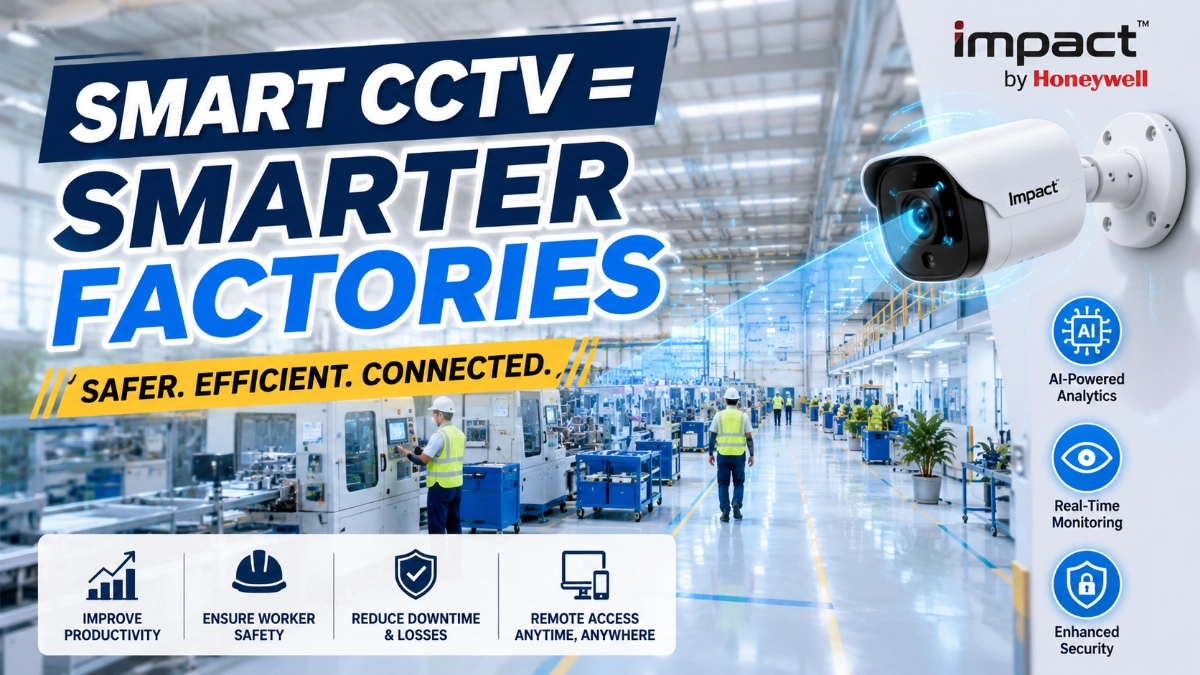
This shift is not about replacing security guards or adding more cameras. It is about making existing camera networks smarter, so they can support safety, production, and decision-making at the same time.
What Intelligent CCTV Means
Intelligent CCTV, often called AI-powered video surveillance, is a camera system that can interpret what it sees rather than just record it. Instead of producing hours of footage that someone has to review manually, the system uses computer vision and machine learning to detect people, objects, movements, and patterns in real time.
In simple terms, intelligent CCTV can tell the difference between a person walking past a machine and a person reaching into it without protective gear. That distinction is what allows the system to send a meaningful alert instead of just a video clip.
Traditional CCTV vs Intelligent CCTV
Both systems use cameras, but the way they process information is fundamentally different. The table below outlines the core distinctions.
| Feature | Traditional CCTV | Intelligent CCTV |
|---|---|---|
| Primary function | Records video for later review | Analyses video in real time |
| Response to incidents | Reactive, after the fact | Proactive, immediate alerts |
| Human involvement | Requires constant manual monitoring | Reduces manual monitoring workload |
| Data use | Footage only | Footage plus actionable analytics |
| Detection capability | Motion or basic triggers | Object, behaviour, and pattern recognition |
| Integration | Standalone system | Connects with IoT, access control, fire alarms |
| Value to operations | Security only | Security, safety, productivity, and compliance |
This comparison shows why many facility managers describe traditional CCTV as a recording tool and intelligent CCTV as a decision-support tool.
How AI Analytics Work in a Factory Setting
Intelligent CCTV relies on video analytics software that runs either on the camera itself (edge AI) or on a connected server. The software is trained to recognise specific objects and behaviours, such as a forklift, a hard hat, a restricted zone boundary, or an unusual crowd of people near an exit.
When the camera detects a match to one of these trained patterns, it triggers a rule-based response. This could be a notification to a supervisor’s phone, a log entry for compliance records, or an automatic signal to another connected system, such as an access control door lock.
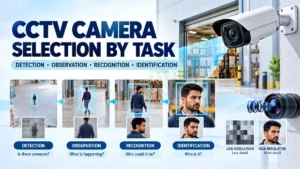
The accuracy of this process depends on camera placement, lighting, and how well the AI model has been trained for the specific environment. A model built for a warehouse will not automatically perform the same way in a welding bay, which is why calibration matters during setup.
Why Factories Are Adopting Intelligent Surveillance
Manufacturing environments involve constant movement of people, machines, and materials, which makes manual oversight difficult to sustain at scale. As facilities grow or operate across multiple shifts, relying on a security team to watch every camera feed becomes impractical.
Intelligent CCTV addresses this gap by working continuously without fatigue and by prioritising the events that need human attention. Plant managers increasingly view it as part of digital transformation in manufacturing, alongside sensors, automation, and data analytics platforms, rather than as a standalone security expense.
Practical Applications on the Factory Floor
Intelligent CCTV supports a wide range of use cases that go well beyond theft prevention.
Worker Safety and PPE Detection
Cameras can identify whether workers are wearing required protective equipment, such as helmets, gloves, or safety vests, in designated zones. If someone enters a hazardous area without proper gear, the system can alert a supervisor before an incident occurs.
Restricted Area and Perimeter Monitoring
AI-based zone detection can flag when a person or vehicle enters a restricted section of the plant, such as a high-voltage room or a chemical storage area. This reduces reliance on physical barriers alone and adds a digital layer of monitoring.
Machine and Production Line Visibility
Cameras positioned along production lines can help supervisors observe line speed, stoppages, or unusual idle time without walking the floor constantly. This visibility supports faster troubleshooting when a line slows down unexpectedly.
Inventory Protection and Loading Dock Monitoring
Warehouses and loading docks are common points for shrinkage and mishandling. Intelligent CCTV can track vehicle movement, verify loading sequences, and flag unattended activity near high-value inventory.
Fire and Smoke Detection Support
While not a replacement for dedicated fire detection systems, AI cameras can act as a secondary layer by identifying smoke or flame patterns visually and alerting staff faster than manual observation alone.
Quality Control Assistance
Some facilities use camera-based analytics to visually check for obvious defects or misalignment on a production line, supporting quality teams without slowing down the process.
Vehicle and Warehouse Surveillance
Tracking the movement of forklifts, trucks, and personnel vehicles helps reduce collisions and supports better traffic flow across large facility yards.
Operational Analytics and Energy Optimisation
By analysing occupancy patterns and equipment usage through video data, facilities can identify underused spaces or equipment left running unnecessarily, contributing to energy savings.
Predictive Maintenance Support
Visual monitoring of machine behaviour, such as unusual vibration, smoke, or fluid leaks, can complement sensor-based predictive maintenance programs by adding a visual confirmation layer.
Remote and Multi-Site Management
Cloud-connected intelligent CCTV allows managers to monitor multiple factory locations from a single dashboard, which is particularly useful for organisations with distributed manufacturing operations.
Measurable Business Benefits
The value of intelligent CCTV becomes clearer when mapped against specific operational challenges.
| Business Challenge | Intelligent CCTV Solution | Operational Benefit |
|---|---|---|
| Delayed incident response | Real-time alerts to supervisors | Faster corrective action |
| Unplanned downtime | Early visual detection of equipment anomalies | Reduced production disruption |
| PPE non-compliance | Automated PPE detection | Improved worker safety and compliance |
| Manual monitoring workload | AI-based automated review | Lower staffing burden on security teams |
| Inventory shrinkage | Continuous loading dock and warehouse monitoring | Reduced losses |
| Fragmented multi-site oversight | Centralised cloud dashboards | Consistent management across locations |
| Limited operational data | Behavioural and traffic analytics | Better-informed management decisions |
Together, these improvements translate into reduced downtime, faster incident response, improved productivity, and more consistent regulatory compliance across the facility.
Technology Trends Shaping Industrial Surveillance
Several technologies are converging to make intelligent CCTV more capable and easier to deploy at scale.
- Edge AI: Processing video analytics directly on the camera reduces latency and bandwidth use, which matters for large facilities with many camera points.
- Video analytics and object detection: These form the core capability behind identifying people, vehicles, and equipment automatically.
- Behavioural analysis: Systems can now recognise patterns like loitering, crowding, or unusual movement, not just static objects.
- Heat mapping: Visualising where people spend the most time helps optimise layout and workflow.
- Cloud monitoring: Enables remote access and centralised management across sites.
- Smart alerts and AI-assisted search: Instead of scrubbing through hours of footage, teams can search for specific events, such as “forklift near dock 3 after 6 PM.”
- Integration with IoT, access control, and fire alarm systems: Intelligent CCTV increasingly works as one node in a broader connected facility, rather than an isolated system.
Solutions such as Impact by Honeywell CCTV reflect this direction, combining camera hardware with analytics capabilities designed for industrial environments rather than retail or residential use cases.
Implementation Considerations
Deploying intelligent CCTV effectively requires planning beyond simply installing cameras.
- Camera placement determines detection accuracy, so cameras need clear, unobstructed views of the zones they are meant to monitor. Network infrastructure must support the bandwidth demands of continuous video analytics, particularly in facilities with dozens or hundreds of cameras.
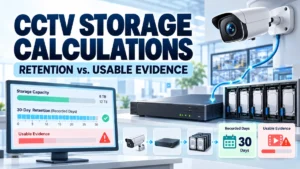
- Storage planning should account for both raw footage retention and metadata generated by analytics, since compliance requirements often dictate how long footage must be kept. Cybersecurity is equally important, as connected camera systems can become entry points for network intrusions if not properly secured and updated.
- Scalability matters for growing facilities, so systems should be chosen with the ability to add cameras or sites without a complete overhaul. Lighting conditions affect detection accuracy, especially in areas with glare, low light, or rapid brightness changes such as loading docks.
- Privacy considerations need attention as well, particularly around where cameras are placed relative to break rooms or personal spaces, and how footage is accessed and stored. Finally, AI model accuracy should be tested against the specific factory environment before full deployment, since a model trained on generic data may need fine-tuning for a particular facility.
Hardware choices also play a role in reliability. For instance, facilities evaluating an Impact by Honeywell CCTV Distributor in India often compare options like Impact by Honeywell Bullet Cameras for long-range corridor and perimeter coverage, Impact by Honeywell Dome Cameras for wide-angle indoor monitoring, and Impact by Honeywell NVRs for centralised recording and storage management across a facility.
Key Takeaways
- Intelligent CCTV analyses video in real time using AI, unlike traditional CCTV, which only records footage for later review.
- Core factory applications include worker safety monitoring, PPE detection, production line visibility, and warehouse surveillance.
- Business benefits include reduced downtime, faster incident response, better compliance, and lower operational costs.
- Technologies like edge AI, behavioural analysis, and IoT integration are expanding what surveillance systems can do.
- Successful deployment depends on planning for camera placement, network capacity, storage, cybersecurity, and privacy.
Conclusion
Intelligent CCTV is moving factory surveillance from a purely security-focused function into a broader operational tool. By combining real-time detection with data that supports safety, productivity, and maintenance decisions, it gives plant managers a clearer, continuous view of what is actually happening on the floor.
As manufacturing facilities continue to digitise their operations, intelligent CCTV is likely to become a standard part of the infrastructure, working alongside sensors, automation, and access control systems rather than as a separate add-on. Facilities that plan their deployment carefully, from camera placement to cybersecurity, will get the most consistent value from these systems over time.
Read Also: CCTV ROI: Measuring Business Value Beyond Loss Prevention
Read Also: Why CCTV Infrastructure Should Be Planned Like IT Infrastructure