A fire alarm panel that performs well in a small office building can struggle in a large industrial facility. The difference is not detection technology alone. It is scale. As device count, building complexity, zoning requirements, and network demands increase, the panel has to manage far more than triggering an alarm when smoke is detected.
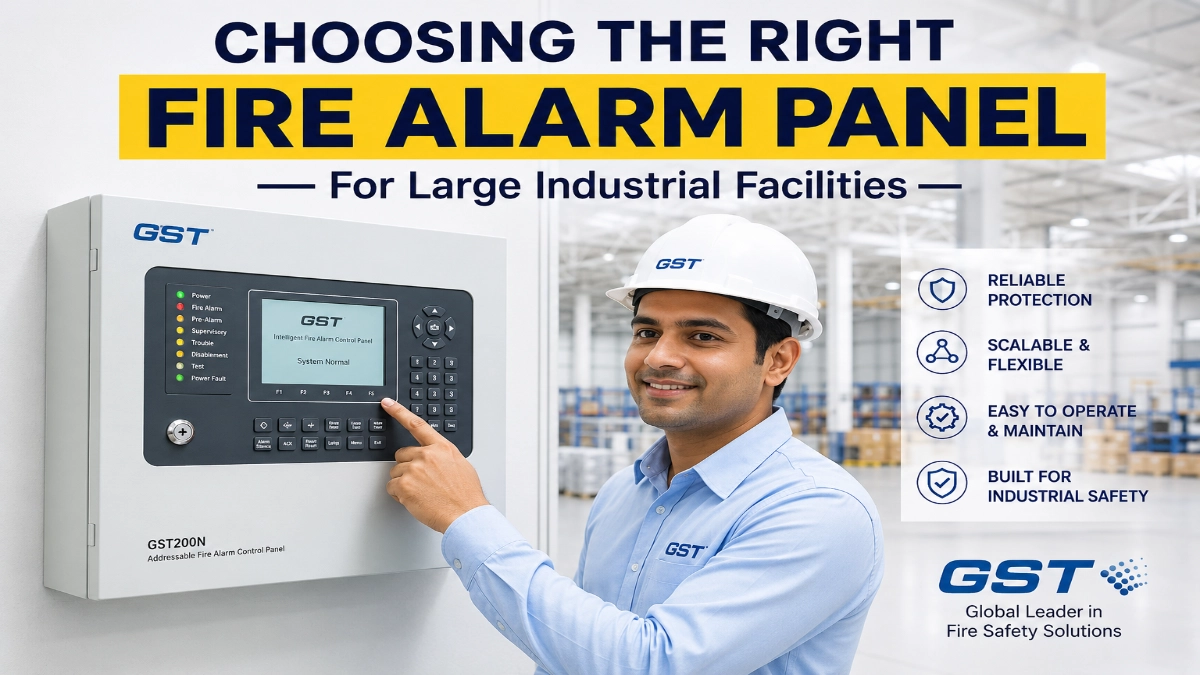
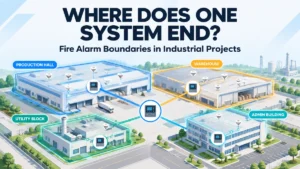
A production plant, warehouse, or process facility may span multiple buildings, contain hundreds or thousands of detection points, and combine high-risk process areas with offices, control rooms, and utility spaces. The fire alarm control panel sits at the centre of this environment. It has to identify exactly where an event occurred, communicate reliably across the site, tolerate industrial conditions, and remain serviceable years after commissioning.
This article explains the engineering factors that separate a panel suited for a small facility from one capable of reliably protecting a large industrial site, and what engineers, consultants, and facility managers should evaluate before making a selection.
What Makes a Fire Alarm Panel Suitable for a Large Industrial Facility?
A fire alarm panel becomes suitable for a large industrial facility when it can reliably manage scale and complexity, not just device count. In short, engineers should look for:
- Adequate device and loop capacity, with spare capacity for future changes, not just enough for the current design.
- Addressable architecture that identifies individual devices and their exact locations, speeding up fault diagnosis across large layouts.
- Support for complex zoning, allowing production areas, warehouses, electrical rooms, and hazardous zones to be logically and physically separated.
- Networking capability that connects multiple panels across buildings to a central monitoring point.
- Detailed fault detection and event logging so that maintenance teams can pinpoint problems quickly.
- Reliable power supply and battery backup, sized for the facility’s operating requirements.
- Tolerance for industrial environmental conditions, including dust, heat, humidity, vibration, and electrical interference.
- Compliance with applicable standards and project specifications, verified against the actual authority having jurisdiction, not assumed.
The sections below explain why each of these factors matters specifically in large industrial environments.
System Capacity and Device Scalability
Every fire alarm panel has a rated capacity: a maximum number of addressable points, loops, zones, and modules it can support. In a large industrial facility, this number is only a starting point for evaluation, not the deciding factor.
Panel capacity is not the same as system design capacity. A panel rated for a high number of devices does not automatically mean the design should use all of that capacity. Engineers should size the system around the actual detection requirements of the facility, then evaluate how much spare capacity remains for future changes.
Capacity planning in an industrial context should account for:
- Current detector, module, and manual call point count.
- Number of loops required to cover the physical layout without excessive cable runs.
- Zones needed for logical separation of production, storage, and support areas.
- Sounder and strobe circuit requirements where local notification is required.
- Spare loop and zone capacity for planned or likely expansion.
- Input/output modules needed to interface with other building systems.
A facility that adds a new production line, warehouse extension, or additional building a few years after commissioning will need spare capacity built into the original design. Retrofitting a panel that is already at its limit often means replacing the panel entirely, which is more disruptive and costly than allowing for expansion during the initial engineering phase.
Addressable Architecture and Why It Matters at Scale
Why Are Addressable Panels Commonly Used in Large Facilities?
Addressable panels are commonly used in large facilities because they identify each device individually, which allows faults and alarms to be located precisely instead of narrowed down to a general zone. In a facility with hundreds of detectors spread across multiple buildings, this distinction has a direct impact on response time and maintenance efficiency.
An addressable fire alarm panel assigns a unique address to each detector, module, or call point on a loop. When an event occurs, the panel reports the specific device, not just the zone it belongs to. This has several practical benefits in large facilities:
- Faster event location: Responders and maintenance staff know exactly which detector triggered, rather than searching an entire zone.
- Device-level fault identification: A fault on a single detector, such as a dirty sensor or a wiring issue, is reported individually rather than disabling an entire circuit.
- Simplified troubleshooting on complex layouts: Large facilities with long cable runs, multiple floors, and separated buildings benefit from loop architecture that supports many devices on a single wiring run while retaining individual identification.
- Maintenance efficiency: Technicians can test, isolate, or replace individual devices without affecting the rest of the loop.
A conventional fire alarm panel wires conventional detectors into zones, and an alarm or fault is reported at the zone level rather than the individual device level. This does not make conventional systems unsuitable in every case. Conventional architecture can still be appropriate for smaller, well-defined areas, standalone utility buildings, or facilities where the number of zones is genuinely limited and the added cost of addressable architecture is not justified by the layout.
The distinction that matters for large industrial facilities is precision of detection and fault reporting. As device count and building complexity increase, the ability to identify an exact device location becomes increasingly valuable, and this is the primary reason addressable systems are more commonly specified for industrial-scale projects.
Zoning in Large and Complex Facilities
Industrial facilities rarely consist of a single, uniform space. A typical site may include production areas, warehouses, utility rooms, electrical rooms, control rooms, server rooms, offices, loading areas, and one or more higher-risk process areas, sometimes spread across multiple buildings.
The fire alarm panel must support logical and physical segmentation that reflects this layout. Zoning should be planned around:
- How responders will interpret an alarm and locate the affected area quickly.
- Which areas require separate detection strategies due to different fire risks.
- How the facility’s operations are physically organised, including production lines and storage blocks.
- Areas that require isolation during maintenance or process shutdowns without disabling protection elsewhere.
A panel with flexible zoning and addressable device reporting allows the design team to map the physical facility onto the fire alarm system in a way that makes sense operationally, rather than forcing the building layout to fit the panel’s limitations.
Networked Fire Alarm Panels for Multi-Building Sites
Why Is Networking Important in Large Fire Alarm Systems?
Networking is important in large fire alarm systems because a single facility often requires more than one panel, and those panels need to share event information with a central monitoring location. Without a network connection, staff would need to check each panel individually to understand the full status of the site.
Large industrial sites frequently include multiple buildings, remote structures, or a large campus layout. In these cases, a single fire alarm control panel is rarely sufficient. Instead, the design typically uses multiple panels connected through a network architecture that allows:
- Panel-to-panel communication, so events at one panel are visible at others.
- Central event visibility, typically through a network controller, graphic workstation, or central monitoring panel.
- Fault monitoring across the network, so a communication failure between panels is itself reported as a fault.
- Expansion, allowing new panels to be added as the facility grows.
Engineers should verify the specific networking architecture supported by a given panel line, including how many panels can be networked, what communication media is used, and how network faults are supervised. These details vary by manufacturer and product generation, so they should be confirmed against current technical documentation rather than assumed.
Fault Detection and Event Management
A large facility generates far more system activity than a small building simply because it has more devices, more wiring, and more points of potential failure. The panel’s ability to detect and clearly report faults becomes essential for maintaining system integrity over time.
Panels intended for large industrial use should be able to identify and report, at minimum:
- Individual detector faults, including issues that affect sensitivity or response.
- Open circuit and short circuit conditions on wiring.
- Loop faults, including breaks that could affect multiple devices.
- Communication failures, both within a panel and across a network.
- Power supply problems, including loss of primary power.
- Battery faults, including low charge or disconnection.
- Module faults, including input/output devices used for system interfaces.
This matters because a fault that goes unnoticed can quietly reduce the system’s protective coverage. Detailed, device-level fault reporting gives maintenance teams the information they need to prioritise repairs, rather than treating every fault as an unknown problem requiring a full system inspection.
Power Supply and Battery Backup
Fire alarm panels operate from a primary power supply with standby batteries that maintain operation during a power interruption. In an industrial setting, power reliability deserves particular attention because these facilities often have larger electrical loads, more complex distribution systems, and a higher likelihood of power quality issues caused by heavy machinery.
Key considerations include:
- Primary power requirements, including dedicated circuits as required by the applicable code.
- Standby battery capacity, sized to support the required standby and alarm operating periods for the specific system design.
- Charger supervision, so the panel reports if the battery is not charging correctly.
- Power supply monitoring, including detection of loss of primary power or low battery voltage.
- Emergency operating requirements, which depend on the applicable code and the facility’s risk profile.
Battery sizing should be calculated for the specific project based on connected load, required standby time, and alarm current draw, following the applicable code and manufacturer guidance. General figures should not be treated as a substitute for a project-specific calculation.
Environmental and Industrial Conditions
A fire alarm panel does not only need to function correctly in a clean, temperature-controlled control room. Detectors, modules, and field wiring are often installed throughout the facility, in areas exposed to conditions that differ significantly from a typical commercial building.
Engineers should evaluate the full environment the system will operate in, including:
- Dust and airborne particulates, common in manufacturing and material handling areas, which can affect detector sensitivity and false alarm rates.
- Heat, from process equipment, furnaces, or poor ventilation in mechanical spaces.
- Humidity, particularly in areas with washdown processes or outdoor-adjacent spaces.
- Vibration, from heavy machinery, which can affect mounting and long-term reliability of devices.
- Electromagnetic interference, from large motors, variable frequency drives, and industrial electrical equipment.
- Corrosive environments, found in certain process industries.
- False alarm sources, including combustion processes, welding, or dust-generating operations that can trigger nuisance alarms if detector types are not selected correctly.
A panel or detector should not be assumed suitable for a hazardous area unless the required certification and installation arrangement have been specifically verified for that area. Hazardous location classification, required approvals, and installation methods depend on the specific area classification and must be confirmed with qualified personnel and the applicable code.
Integration With Other Safety Systems
Large industrial facilities often require the fire alarm system to interact with other building and safety systems. It is important to distinguish between three different functions: alarm detection, which identifies a fire condition; monitoring, which reports status and events to operators or a central location; and control/interface functions, which allow the fire alarm system to activate or communicate with other equipment.
Common integration points include:
- Fire suppression systems, where the panel may monitor or interface with the suppression system’s status and activation.
- Smoke control systems, where the panel may initiate or coordinate smoke management sequences.
- HVAC shutdown, where the panel signals air handling equipment to shut down or change mode during a fire event.
- Access control, where doors may be released or reconfigured during an alarm condition.
- Emergency communication systems, where voice evacuation or mass notification may be coordinated with the fire alarm system.
- Building management systems (BMS), for centralised visibility of fire alarm status alongside other building systems.
- Industrial control or monitoring systems, where relevant to the facility’s process safety requirements.
Not every fire alarm panel supports every type of integration, and the extent of integration depends on the specific product, the input/output modules used, and the overall system design. These requirements should be defined early in the design process and verified against the panel’s actual documented capabilities.
Redundancy and Reliability
As a fire alarm system grows to cover a large facility, the consequences of a single point of failure grow with it. Reliability becomes a design priority, not an afterthought.
Relevant concepts include:
- Redundant architecture where required, such as duplicate network paths or controllers, depending on the project’s risk profile and applicable requirements.
- Fault tolerance, including the system’s ability to continue operating and reporting correctly when a single fault occurs.
- Supervised circuits, so wiring faults are detected rather than silently disabling protection.
- Network survivability, so a fault in one part of a networked system does not compromise the entire site’s protection.
- Power redundancy, including backup power arrangements appropriate to the facility.
- Critical-path considerations, identifying which components, if they failed, would have the greatest impact on the facility’s protection.
Redundancy requirements should be based on a documented risk assessment and the applicable code, not assumed. Claims that a specific product is inherently redundant should be verified against the manufacturer’s documented architecture and the actual system design.
Maintenance and Troubleshooting
A fire alarm system is only as effective as the maintenance program that keeps it functioning correctly. Panel selection has a direct effect on how easily a facility’s maintenance team, or a third-party service provider, can maintain the system over its lifecycle.
Design teams should consider:
- How clearly the panel identifies individual devices during testing and fault diagnosis.
- The quality and accessibility of event logs, including historical alarm and fault records.
- How quickly a technician can locate the source of a reported fault.
- Testing workflow, including whether devices can be tested individually without disabling coverage elsewhere.
- Time required for routine maintenance across a large device count.
- Planning for device replacement as components reach the end of their service life.
- Availability of clear system documentation, including as-built drawings and device schedules.
Maintainability should be considered during the design phase, not treated as a problem to solve after installation. A system that is difficult to troubleshoot will typically cost more to maintain over its lifecycle, even if the initial installation cost was lower.
Future Expansion
Industrial facilities change. Production lines are added, warehouses are extended, new buildings are constructed, and process areas are reconfigured. A fire alarm system designed only for the facility’s current state can require significant rework when these changes occur.
Engineers should account for likely future changes, including:
- New production lines that will require additional detection coverage.
- Warehouse or storage area expansion.
- Additional buildings that may need to be networked into the existing system.
- New detectors and modules required by process changes.
- Additional fire safety interfaces, such as new suppression zones or HVAC interlocks.
- Additional network nodes as the site grows.
Leaving reasonable engineering and physical capacity for expansion, such as spare loop capacity, spare zones, and network expansion capability, can significantly reduce the cost and disruption of future modifications compared with redesigning the system after it has reached capacity.
Standards, Approvals, and Compliance
The fire alarm panel and the complete system it is part of should be evaluated against the standards, codes, authority requirements, and project specifications applicable to that specific project. This depends on the jurisdiction, the authority having jurisdiction, the facility type, and the project’s own specifications.
Relevant references that may apply, depending on the project, include:
- NFPA requirements, such as NFPA 72, commonly referenced in projects following US-based codes.
- EN 54, the European standard series covering fire detection and fire alarm system components.
- Local fire authority requirements, which can vary by jurisdiction and may add requirements beyond a base standard.
- Project-specific specifications, defined by the consultant, owner, or insurer.
- Applicable product certifications, which should be verified directly against current manufacturer documentation for the specific product and market.
No single standard automatically applies to every industrial project. The correct requirements should be confirmed with the project’s fire protection engineer or consultant and the relevant authority having jurisdiction before a panel is selected. Product certification for a component is not the same as project compliance; a certified product still needs to be applied correctly within a compliant system design.
Addressable vs Conventional for Large Facilities
| Factor | Addressable | Conventional |
|---|---|---|
| Device identification | Individual device address and location reported | Reported at zone level, not individual device |
| Troubleshooting | Faster, since faults are traced to a specific device | Slower, since faults must be traced within a zone |
| Large/complex facilities | Generally better suited due to precise event location | Can become impractical as zone count and layout complexity increase |
| Wiring architecture | Loop-based, supporting many devices per loop with individual addressing | Zone-based circuits, typically supporting fewer devices per circuit |
| Expansion | Generally easier to add devices within loop capacity | Often requires additional zone circuits and wiring |
| Typical application | Large, complex, or multi-building facilities | Small buildings, standalone areas, or limited zone counts |
How Engineers Can Evaluate a Fire Alarm Panel for an Industrial Facility
A structured evaluation reduces the risk of selecting a panel that looks adequate on paper but does not match the facility’s actual requirements. Engineers should work through the following areas:
- Facility size and layout: Map the physical extent of the site, including the number of buildings and floor areas.
- Device count: Estimate detectors, modules, and notification devices based on the design basis, not a rough guess.
- Loop requirements: Determine how many loops are needed based on device count, cable routing, and physical distances.
- Expansion requirements: Identify known or likely future changes and build in spare capacity.
- Zoning: Define zones that reflect the facility’s operational layout and risk areas.
- Networking: Confirm whether multiple panels are required and how they will communicate.
- Environmental conditions: Assess dust, heat, humidity, vibration, and interference across all installation areas.
- Integration requirements: Define which other systems the fire alarm system needs to interface with, and how.
- Power and backup: Calculate standby battery requirements based on the specific system design.
- Standards and approvals: Confirm applicable codes, local authority requirements, and product certifications for the project.
- Maintenance: Evaluate how the system supports ongoing testing, fault diagnosis, and documentation.
- Total lifecycle considerations: Weigh installation cost against long-term maintainability, expansion cost, and system longevity.
GST Fire Alarm System Example
GST fire alarm systems are one example that engineers and system integrators may evaluate when developing fire detection solutions for commercial and industrial applications. As with any manufacturer, the suitability of a specific GST panel for a given project depends on the facility’s actual device count, zoning needs, networking requirements, environmental conditions, and the applicable standards for that project.
Engineers evaluating a GST fire alarm system as part of a broader panel selection process should confirm current technical specifications, capacities, and certifications directly from official GST documentation, since product details can vary between models and update over time. In India, GST fire alarm systems are supplied through Innxeon Technologies Pvt. Ltd., which operates as a GST fire alarm system distributor in India. This distribution role covers the supply of GST equipment; project-specific design, installation, and commissioning are typically handled by the design consultant, contractor, and system integrator involved in the project.
Read Also: How Fire Alarm Standardisation Reduces Procurement Complexity
Read Also: What Happens Inside an Addressable Fire Alarm Network During an Alarm?