Most fire alarm procurement problems do not start on-site. They start weeks or months earlier, when a system is approved based on panel price, device count, or brand familiarity without a structured technical evaluation. By the time the gap surfaces, it usually shows up as a failed inspection, a rejected submittal, or a change order that nobody budgeted for.
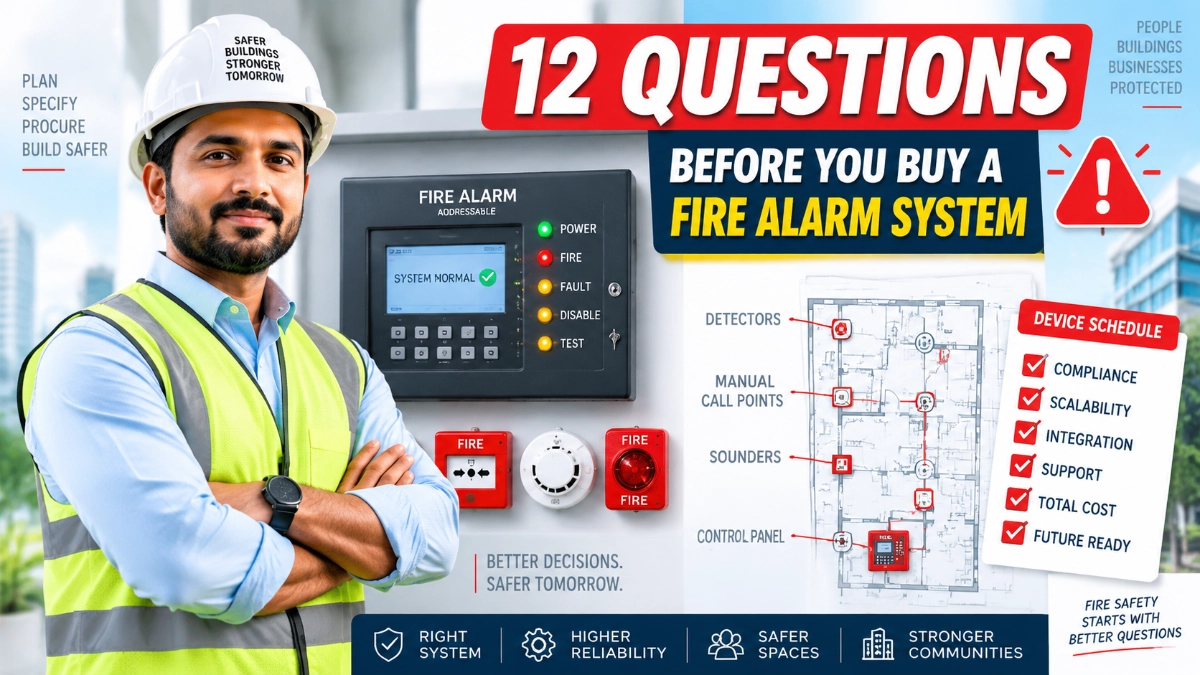
A fire alarm system is not a commodity purchase. It is a life-safety installation that must match the building’s risk profile, integrate with other building systems, comply with applicable codes, and remain serviceable for the life of the facility. Selecting a system without verifying these factors can create compliance gaps, integration failures, or maintenance dead ends that surface long after handover.
This article sets out 12 questions a fire alarm consultant should work through before approving or specifying a system for procurement. Each question includes what to verify, what documentation to request, a common mistake to avoid, and how the answer affects the final decision.
What Should Consultants Verify Before Procurement?
Before approving a fire alarm system for procurement, a consultant should confirm:
- The system meets the applicable codes, standards, and project specification.
- The architecture (addressable or conventional) matches the building’s size, risk, and zoning requirements.
- Loop, zone, and device capacity covers the full device schedule with reasonable spare capacity.
- Detection technology is matched to the actual environment, not a default selection.
- Cause-and-effect and emergency sequences can be programmed as required.
- Third-party integrations (HVAC, lifts, access control, PA/PAVA, fire pumps) are technically supported.
- Networking, redundancy, and fault tolerance meet the project’s survivability requirements.
- Power supply and battery calculations are documented, not assumed.
- The system can be expanded without a full panel replacement.
- Full technical documentation and submittals are available for approval and handover.
- The manufacturer and distributor can support the product for the project lifecycle.
- Total cost of ownership, not just purchase price, has been compared.
The sections below explain the reasoning behind each of these checks.
The 12 Questions Consultants Should Ask
1. What codes, standards, approvals, and project specifications must the system comply with?
Why it matters
Fire alarm requirements are jurisdiction-specific and project-specific. A system that is technically sound in one context can be non-compliant in another because of local code adoption, authority having jurisdiction (AHJ) requirements, or project-specific specification clauses.
What consultants should verify
Confirm which code basis applies, for example, NFPA 72 in jurisdictions that follow US-based codes, EN 54 component standards in jurisdictions that follow European frameworks, or local civil defence and BIS-referenced requirements where applicable. Also confirm any third-party listings or certifications the project specification calls for, such as UL or LPCB listing where required.
Documents to request
Product certification documents, listing reports, and a compliance matrix mapping the proposed system against the project specification clause by clause.
Common mistake
Assuming a system is compliant because it is certified somewhere, without confirming it is certified against the standard the project actually requires.
Procurement takeaway
Compliance should be verified against the specific code basis and AHJ requirements for that project, not assumed from general manufacturer reputation.
2. Does the project require an addressable or conventional fire alarm architecture and why?
Why it matters
This decision affects wiring topology, fault isolation, diagnostic capability, and long-term flexibility. Choosing the wrong architecture early is expensive to reverse later.
What consultants should verify
In an addressable fire alarm panel, each detector or module has a unique address, allowing exact device-level identification of an alarm or fault condition, and typically supporting short-circuit isolation on the loop. A conventional fire alarm panel instead reports alarms and faults by zone, which is usually adequate for smaller, simpler layouts but gives less precise location information as building size and zoning complexity increase.
Consultants should evaluate the building size, the number of zones, the complexity of cause-and-effect requirements, and whether the specification mandates addressable detection. Larger or more complex facilities generally justify addressable detectors for faster fault location and more flexible programming; simpler, smaller premises may be adequately served by conventional detectors.
Documents to request
System architecture diagrams, loop/zone capacity specifications, and confirmation of isolator placement on addressable loops.
Common mistake
Selecting conventional architecture purely on lower upfront cost for a building where zoning complexity will make fault diagnosis and future changes difficult.
Procurement takeaway
Architecture should be selected based on building size, zoning complexity, and diagnostic requirements, not on price alone.
3. How many devices, zones, loops, modules, and notification appliances will the system need?
Why it matters
Capacity mismatches are one of the most common procurement errors. A panel that is undersized for the device schedule requires additional panels or network expansion; a grossly oversized panel adds unnecessary cost.
What consultants should verify
Cross-check the device schedule (detectors, manual call points, input/output modules, sounders, strobes) against the panel’s rated loop capacity and the number of loops the panel supports. Confirm notification appliance circuit (NAC) capacity against the number and current draw of sounders and strobes required.
Documents to request
The device schedule, panel loop capacity datasheet, and NAC circuit load calculations.
Common mistake
Sizing the panel to exactly match today’s device count, leaving no spare loop or zone capacity for future modifications.
Procurement takeaway
Consultants should confirm the panel’s maximum loop and device capacity against the project device schedule, while also allowing practical spare capacity for future modifications.
4. What detection technology is appropriate for the actual risk and environment?
Why it matters
Detection technology should match the fire risk and ambient environment of each space, not default to a single detector type across the entire building.
What consultants should verify
Confirm whether spaces require optical smoke detectors, heat detectors, multi-sensor detectors, aspirating smoke detection, flame detectors, or beam detectors, based on ceiling height, ventilation, dust or steam presence, and combustible material type. Confirm detector compatibility with the specified panel detectors, and panels from different protocol families are not always interoperable.
Documents to request
Detector datasheets, environmental suitability data, and a compatibility statement confirming the detector range is approved for use with the specified panel.
Common mistake
Specifying optical smoke detection in areas prone to steam or dust without evaluating multi-sensor or heat detection alternatives, leading to nuisance alarms after commissioning.
Procurement takeaway
Detection technology should be matched to the space’s risk and environmental conditions, then checked for confirmed compatibility with the selected panel.
5. Does the proposed system support the required cause-and-effect logic and emergency sequences?
Why it matters
Cause-and-effect programming defines what the building actually does during a fire event: which doors release, which dampers close, which lifts recall, which zones sound first. If the panel’s programming logic cannot support the required sequence, the building’s fire strategy cannot be implemented as designed.
What consultants should verify
Confirm the panel supports the required logic complexity: staged evacuation, phased alarm, zone-dependent outputs, and any building-specific sequences defined in the fire strategy report. Confirm firefighter interface requirements, such as a firefighter’s control panel or repeater, are supported.
Documents to request
A cause-and-effect matrix from the fire strategy, and a statement from the manufacturer or integrator confirming the panel’s programming can implement it.
Common mistake
Finalising panel selection before the cause-and-effect matrix is confirmed, then discovering the panel’s logic engine cannot support the required staged evacuation sequence.
Procurement takeaway
Cause-and-effect requirements should be confirmed before, not after, panel selection is finalised.
6. What third-party systems must the fire alarm system integrate with?
Why it matters
Integration requirements can change the required system architecture entirely. A panel that works well as a standalone system may lack the interface capability a project needs.
What consultants should verify
Identify every system the fire alarm panel must interface with: HVAC shutdown, lift/elevator recall, access control door release, BMS monitoring, PA/PAVA voice evacuation, fire pump status monitoring, and any other fire protection system interfaces. Confirm whether integration is via relay/input-output modules, a dedicated gateway, or a network-level protocol, and whether that integration method is proven on prior installations.
Documents to request
An integration matrix listing each third-party system, the interface method, and manufacturer confirmation of supported protocols.
Common mistake
Assuming a generic input/output module can handle every integration without checking whether the specific third-party system requires a dedicated gateway or protocol conversion.
Procurement takeaway
Integration requirements should be mapped out before architecture is finalised, since they can change the required panel capability, not just the wiring.
7. What level of networking, redundancy, fault tolerance, and system survivability is required?
Why it matters
Single-building projects have different survivability requirements than multi-building campuses, high-rise towers, or facilities with critical operations. Networked panels, repeater panels, and redundant power or communication paths all address different failure scenarios.
What consultants should verify
Confirm whether the project needs a single standalone panel, networked panels across buildings, or repeater panels for remote indication. For networked systems, confirm the network communication method (for example, RS-485 or Ethernet-based networking), fault tolerance in the event of a network segment failure, and whether the network can continue operating each panel independently if the network link is lost.
Documents to request
Network architecture diagrams and a statement describing panel behaviour during a network fault condition.
Common mistake
Specifying a networked system without confirming that individual panels retain full standalone functionality if network communication is lost.
Procurement takeaway
Survivability requirements should be defined by building complexity and risk, and the proposed network architecture should be tested against realistic fault scenarios, not just normal operating conditions.
8. Have power supply, standby battery capacity, voltage drop, and load calculations been properly considered?
Why it matters
Power calculations directly affect whether the system performs correctly during a real alarm condition and during a mains power failure. Underestimating standby or alarm load is a common cause of non-compliant installations.
What consultants should verify
Confirm standby and alarm current load calculations account for all connected devices, including notification appliances at full alarm draw. Confirm standby battery sizing supports the required standby and alarm duration specified by the project or applicable code. Confirm voltage drop across NAC circuits and detector loops has been calculated for cable length and gauge, since excessive voltage drop can cause devices at the end of a circuit to operate outside their rated range.
Documents to request
Battery calculation sheets, load calculation worksheets, and voltage drop calculations for the longest circuit runs.
Common mistake
Using a generic battery sizing estimate instead of a calculation based on the project’s actual connected load and required standby duration.
Procurement takeaway
Power and battery calculations should be documented and reviewed as part of the technical submittal, not assumed to be adequate because the panel is rated for the building size.
9. How easily can the system be expanded if the building changes in the future?
Why it matters
Buildings change tenant fit-outs, floor additions, and use changes. A system with no practical expansion path forces a costly panel replacement instead of an incremental upgrade.
What consultants should verify
Confirm available spare loop and zone capacity, whether additional loop cards or network nodes can be added to the existing panel, and whether the product range has a clear upgrade path within the same platform.
Documents to request
Panel expansion specifications and manufacturer documentation on maximum configurable capacity.
Common mistake
Selecting a panel at or near full capacity for the current device count, with no room for even modest future additions.
Procurement takeaway
Spare capacity and a documented expansion path should be treated as a procurement requirement, not an afterthought.
10. What documentation, programming information, testing records, approvals, and technical submittals will be available?
Why it matters
Documentation gaps create problems at handover, during future maintenance, and during any system modification. A system without complete documentation is difficult to service or expand later.
What consultants should verify
Confirm the supplier will provide complete technical submittals before installation, along with programming records, as-built cause-and-effect documentation, test certificates, and commissioning records at handover.
Documents to request
A sample technical submittal package, commissioning test report template, and confirmation of what documentation will be handed over on project completion.
Common mistake
Accepting verbal assurance that documentation “will be provided later” instead of confirming submittal content before procurement approval.
Procurement takeaway
Documentation requirements should be defined and confirmed before procurement, not negotiated after installation begins.
11. Can the selected products be consistently sourced and supported throughout the project lifecycle?
Why it matters
A project may take months to construct, and the building will operate for decades afterwards. If a product is discontinued or difficult to source, future maintenance, repairs, and modifications become difficult or impossible without replacing compatible components.
What consultants should verify
Confirm the manufacturer’s product lifecycle status, whether replacement parts and compatible detectors will remain available, and whether the local distribution channel can reliably supply the product for both the current project and future maintenance needs.
Documents to request
Product lifecycle statements from the manufacturer and confirmation of authorised distribution in the project’s region.
For projects in India, for example, a GST fire alarm system can be sourced through Innxeon Technologies, a PAN-India distributor of GST fire alarm systems, which is a relevant consideration when consultants are assessing regional product availability as part of the evaluation.
Common mistake
Approving a product based on technical merit alone without confirming that the distribution channel can reliably support the project region over the maintenance period.
Procurement takeaway
Lifecycle availability and regional distribution support should be verified with the same rigour as technical specifications.
12. What should consultants compare beyond the initial purchase price?
Why it matters
The lowest initial price does not necessarily reflect the lowest lifecycle cost. Systems with poor documentation, limited expansion capacity, or weak local support often generate higher costs later through rework, compatibility issues, or difficult maintenance.
What consultants should verify
Compare installation complexity, spare parts availability, warranty terms, training and support availability, expected maintenance cost, and the cost of future expansion, not only the panel and device unit prices.
Documents to request
A total cost of ownership comparison covering purchase, installation, commissioning, and estimated maintenance costs over the system’s expected service life.
Common mistake
Comparing two systems purely on unit price per detector without accounting for differences in installation labour, programming complexity, or long-term support.
Procurement takeaway
Price comparisons should account for total lifecycle cost, not just the initial procurement figure on a bill of quantities.
Procurement Comparison: What Should Consultants Compare?
| Evaluation Area | What to Compare |
|---|---|
| Technical compliance | Certification against the applicable code basis and AHJ requirements |
| System architecture | Addressable vs conventional fit for building size and zoning |
| Device compatibility | Confirmed compatibility between detectors, modules, and panel |
| Capacity | Loop, zone, and NAC capacity against device schedule plus spare capacity |
| Integration | Supported interfaces for HVAC, lifts, access control, BMS, PA/PAVA, fire pumps |
| Redundancy | Network fault tolerance and standalone panel behaviour during faults |
| Documentation | Completeness of submittals, programming records, and test certificates |
| Availability | Regional distribution and manufacturer lifecycle status |
| Lifecycle | Long-term parts availability and platform upgrade path |
| Maintenance | Service complexity, training availability, and spare parts access |
| Total cost of ownership | Purchase, installation, commissioning, and projected maintenance cost |
Addressable vs Conventional: A Short Consultant Perspective
Neither architecture is universally correct. An addressable fire alarm panel with addressable detectors generally suits larger buildings, multi-zone layouts, and projects requiring detailed cause-and-effect programming, because it allows device-level fault and alarm identification and more flexible loop wiring with short-circuit isolation.
A conventional fire alarm panel with conventional detectors can be a reasonable fit for smaller, simpler premises with limited zoning, where the cost and complexity of addressable technology may not be justified by the building’s risk profile.
The decision should follow from building size, zoning complexity, and project specification requirements, not from habit or default vendor recommendations. Some projects, such as brands like GST fire alarm system ranges, offer both addressable and conventional product lines, which allows consultants to evaluate architecture options within a single, compatible product family where appropriate for the project.
Final Procurement Checklist
- Confirm the applicable code basis, standards, and AHJ requirements.
- Confirm required certifications and listings against the project specification.
- Decide addressable vs conventional architecture based on building size and zoning.
- Cross-check device schedule against loop, zone, and NAC capacity.
- Confirm detection technology matches each space’s risk and environment.
- Verify detector-to-panel compatibility with manufacturer documentation.
- Confirm cause-and-effect logic and emergency sequences are supported.
- Map all required third-party integrations and confirm interface methods.
- Confirm network architecture and standalone fault behaviour.
- Review standby battery, load, and voltage drop calculations.
- Confirm available spare capacity and expansion path.
- Request complete technical submittals, programming records, and test certificates.
- Confirm manufacturer lifecycle status and regional distribution support.
- Compare total cost of ownership, not only purchase price.
- Document all findings in a formal technical evaluation before approval.
Selecting a fire alarm system is a technical evaluation, not a purchasing decision made on price or familiarity. Consultants who work through these 12 questions before procurement reduce the risk of compliance gaps, integration failures, and costly rework, and provide the project with a system that can be documented, maintained, and expanded reliably over its service life.
Read Also: What Makes a Fire Alarm Panel Suitable for Large Industrial Facilities?
Read Also: How Fire Alarm Standardisation Reduces Procurement Complexity