Two vendors quote the same project: 120 detectors, one fire alarm panel, addressable architecture. On paper, the offers look identical. In practice, one system may protect the building the way it was designed to, and the other may fall short the moment an auditor, an insurer, or a real fire tests it.
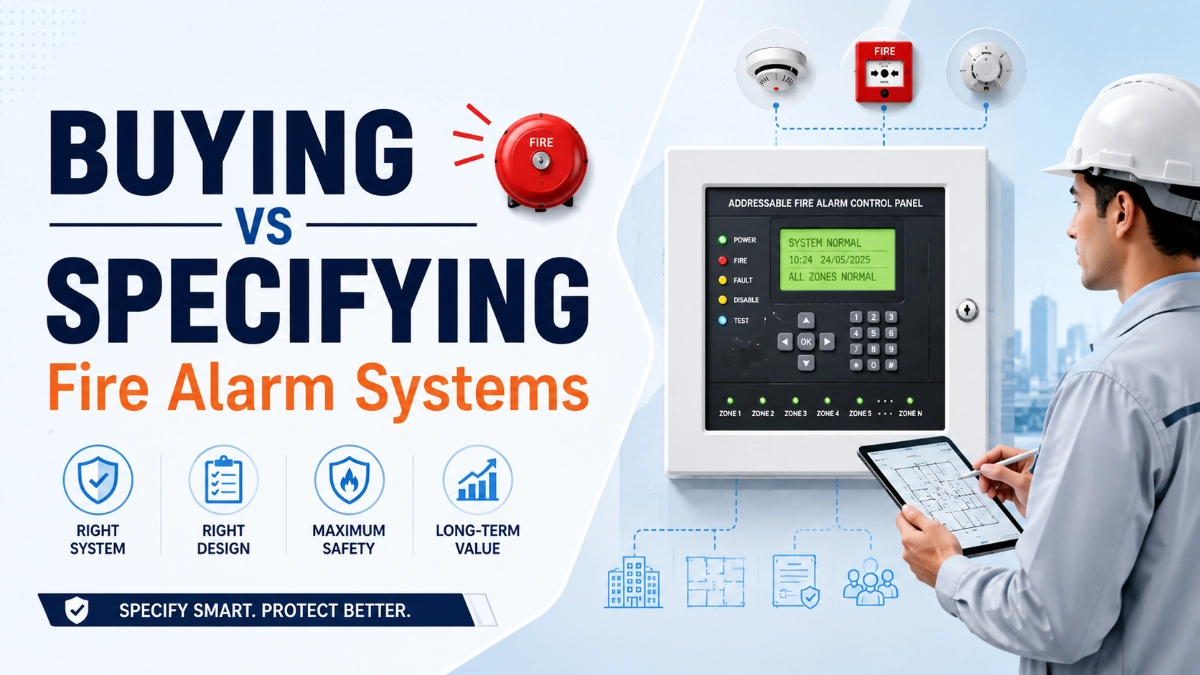
The gap between those two outcomes rarely shows up in the quotation. It shows up earlier, in whether the system was specified or simply bought.
Buying a fire alarm system is a purchasing decision. Specifying one is an engineering and risk-management decision. Confusing the two is one of the most common and most expensive mistakes made on commercial and industrial projects.
Buying a Fire Alarm System Is Not the Same as Specifying One
What is the difference between buying and specifying a fire alarm system? Buying focuses on acquiring a product at an acceptable price. Specifying focuses on defining what the building actually needs before any product is selected.
A buyer typically asks: What’s the price? Is the panel addressable or conventional? Which brand is it? What’s the delivery time? These are valid commercial questions, but they assume the technical requirement has already been decided correctly.
A specifying engineer or consultant asks a different set of questions first: What fire risks exist in this facility? What detection strategy suits the occupancy and construction? How many loops and zones are actually required? What cause-and-effect functions does the building need? What will this system need to do in five years, not just on handover day?
When specification happens properly, buying becomes a straightforward comparison of compliant offers. When it doesn’t, buying becomes a gamble dressed up as a comparison.
What Happens When Price Becomes the Main Selection Criteria?
A low quotation can become an expensive system once the gaps surface during installation or after handover. This happens in predictable, avoidable ways:
- The panel has enough loop capacity for today’s device count but no room for future additions without a second panel or a cabinet swap.
- Detectors selected for a clean office environment start giving nuisance alarms in a workshop, kitchen, or dusty plant area.
- Interface modules for lifts, HVAC shutdown, fire doors, or sprinkler monitoring were never priced into the original scope.
- Cause-and-effect programming turns out to be far more complex than the quotation assumed, adding cost and time during commissioning.
- Replacement devices for an unfamiliar or discontinued product line are difficult to source a few years later.
- Local technical support is limited, so faults that should take a day to resolve take weeks.
None of these issues is visible on a one-page comparison of price per detector. They surface later, usually during commissioning, an insurance audit, or the first real fault, which is the worst possible time to discover them.
What Does a Proper Fire Alarm Specification Actually Consider?
Fire alarm selection should begin with the building’s fire risks, occupancy, detection requirements, and required cause-and-effect functions, not with the cheapest panel available. A specification built this way typically works through the following, in roughly this order:
- Building type and occupancy: A warehouse, a hospital, a data centre, and a multi-storey office all present different evacuation needs and fire loads, even if they’re similar in floor area.
- Fire risk: Storage of flammable materials, process equipment, kitchens, and server rooms each demand a different detection response than a standard corridor or office.
- Detection strategy: Smoke, heat, multi-sensor, aspirating, or flame detection are not interchangeable; each suits specific risks and environments.
- System architecture: Addressable or conventional, decided by scale and functional need, not habit.
- Device selection: Detector and call point types matched to the physical environment, not a generic catalogue default.
- Notification: Sounders, beacons, and voice alarm sized and located for audibility and, where applicable, intelligibility.
- Manual call points: Positioned per escape route requirements, not just wherever is convenient to wire.
- Modules and interfaces: Every connection to lifts, dampers, doors, gas suppression, or building management systems accounted for and priced.
- Loop and zone capacity. Sized for current devices plus a defined margin for expansion.
- Power and standby batteries: Sized against actual standby and alarm current draw, not a generic assumption.
- Cause-and-effect logic: Documented functionally, not left to be worked out on site.
- Integration requirements: With BMS, security, or process control systems, where relevant.
- Environmental conditions: Temperature, humidity, dust, and vibration all affect detector choice and enclosure rating.
- Expansion requirements: What the building or the client’s plans for it will need in the next several years.
- Installation and commissioning requirements: Cable routes, containment, and test access planned rather than improvised.
- Documentation: As-built drawings, cause-and-effect matrices, and test certificates that make the system maintainable.
- Maintenance and lifecycle support: A servicing plan and a realistic view of spare-parts availability over the system’s working life.
Listing these factors is easy. The value is in why they matter: each one changes either the risk the system is meant to manage or the total cost of owning it. Skip one during specification, and it usually reappears later as a variation order, a compliance gap, or a maintenance headache.
System Architecture Comes Before Product Selection
Should you choose an addressable or conventional fire alarm system? The right choice depends on the project, not on which architecture is generally considered more advanced.
An addressable fire alarm panel identifies each connected device individually, which is genuinely useful in larger or more complex buildings where knowing the exact detector in alarm, not just the zone, speeds up response and simplifies fault-finding. Addressable systems also tend to offer more flexibility for future expansion and more granular cause-and-effect programming.
A conventional fire alarm panel groups detectors into zones and is often the more practical and cost-effective choice for smaller buildings with straightforward layouts and a limited number of detection points, where zone-level identification is genuinely sufficient.
Relevant factors include building size, number of detection points, complexity of the required zoning, how important individual-device fault identification is to the operation, installation considerations, ongoing maintenance, budget, and any need to integrate with other systems. Neither conventional detectors nor addressable detectors are the automatically “correct” answer; the building’s requirements decide the architecture, not the other way around.
The Detector Count Does Not Tell the Whole Story
Two quotations listing “40 smoke detectors” can still represent very different systems. Detector type, sensing technology, environmental suitability, and placement all matter more than the raw count.
A photoelectric smoke detector suited to a clean office corridor may not be the right choice for a boiler room, a car park, or a dusty storage area. Placement matters just as much: detector spacing, distance from HVAC diffusers, and ceiling height all affect response time and false-alarm rates. A quotation that specifies detector quantity without addressing type and placement has answered the buying question, not the specification question.
Cause-and-Effect Is Where Many “Complete” Systems Become Incomplete
Why are cause-and-effect requirements important? Because a fire alarm system rarely operates in isolation, it usually needs to trigger, or be triggered by, other building systems, and those interactions have to be defined before installation, not during it.
Depending on the building, cause-and-effect logic might need to release fire doors, shut down specific HVAC sections to control smoke spread, recall lifts to a safe floor, or interface with a sprinkler or gas suppression system. Not every building needs all of these; the point is that whichever interfaces the building does need must be identified, documented, and priced during specification. A system that is technically “complete” in terms of panel and detector count can still be functionally incomplete if the cause-and-effect matrix was assumed rather than engineered.
Why Two Fire Alarm Quotations May Not Be Technically Equivalent
This is where the buying-versus-specifying distinction has the most financial impact. Two quotations can show the same quantity, the same panel model, the same number of detectors, without representing the same technical scope.
One quotation might include interface modules, commissioning support, as-built documentation, and a properly sized battery calculation. Another, at a lower price, might exclude all four and simply supply the panel and detectors, leaving the contractor to work out cause-and-effect wiring and interfaces on site. Compared side by side on price per point, the second quotation looks like better value. Compared on technical scope, it is not the same system at all.
This is exactly why procurement teams and specifying engineers need to work from the same technical document. An RFQ that lists device quantities without a defined cause-and-effect matrix, interface schedule, and environmental requirements invites quotations that are cheaper because they are less complete, not because the vendor is more efficient. The fix isn’t to distrust every quotation; it’s to make sure every vendor is pricing against the same technical baseline before price becomes the deciding factor.
Specification Also Means Thinking Beyond Installation
A fire alarm system’s usefulness doesn’t end at handover. Specification should account for how the system will be commissioned, documented, and supported over its working life.
Commissioning should include functional testing of every cause-and-effect sequence, not just a panel power-up check. Documentation as-built drawings, zone charts, cause-and-effect matrices, and test certificates determines how easily the system can be maintained, extended, or audited years later. And because fire alarm systems are typically in service for a long time, realistic access to spare devices, local technical support, and a distributor network matters as much as the initial installation quality.
In the Indian market specifically, this often comes down to practical questions: Is there a local distributor network for the specified product line? Are spare parts and replacement detectors readily available, or does a fault mean a long wait for an import? Is technical support available close to the project location, or only through a distant regional office? These aren’t regulatory questions; they’re serviceability questions, and they affect total cost of ownership as much as any line item in the original quotation. Applicable fire safety codes, National Building Code provisions, and any authority-specific requirements should always be confirmed with the relevant consultant or authority having jurisdiction, since requirements can vary by state, occupancy, and project type.
Distributors who understand both the product and the local project environment, for example, an established GST fire alarm system distributor in India, are generally better positioned to support a specification through installation, commissioning, and years of maintenance than a purely transactional supplier.
A Better Way to Evaluate Fire Alarm System Quotations
Price should be compared only after technical equivalence has been established, not before. A practical sequence looks like this:
- Understand the building construction, occupancy, and use.
- Identify the fire risks, process hazards, storage, and high-risk areas.
- Define the detection strategy, detector types and coverage suited to each area.
- Select the system architecture: addressable or conventional, based on scale and complexity.
- Define interfaces and cause-and-effect for every connection to other building systems.
- Calculate current and future capacity loops, zones, and power, with margin for expansion.
- Define installation and commissioning requirements: cabling, containment, and test procedures.
- Evaluate lifecycle support spares, documentation, and maintenance access.
- Compare technically equivalent quotations: same scope, same interfaces, same documentation.
- Then compare price.
Buying Focus vs Specification Focus:
| Buying Focus | Specification Focus |
|---|---|
| Initial price | Total project requirement |
| Product availability | Suitability for application |
| Brand | Technical capability |
| Number of devices | Correct detection strategy |
| Basic warranty | Lifecycle support |
| Delivery time | Project schedule and technical readiness |
| Panel capacity as quoted | Current and future requirements |
| Product selection | System architecture |
| Quotation | Technical compliance |
| Purchase decision | Engineering decision |
The Bottom Line
A fire alarm system bought on price alone will pass a quick comparison. A fire alarm system that’s properly specified will pass an audit, adapt to the building’s next expansion, and still be serviceable in ten years. Both approaches can look the same on the day of handover. Only one of them holds up afterwards.
For any project of meaningful size or complexity, involving a qualified fire alarm designer, consultant, or engineer during specification before quotations are requested is the single decision most likely to prevent the gaps described above. Whether the final system uses an addressable fire alarm panel, a conventional fire alarm panel, or a combination across a larger site, the technical groundwork should come first. Price comparison works best when it’s the last step, not the first.
Read Also: How Warehouse Expansion Can Affect an Existing Fire Alarm System
Read Also: What Makes a Fire Alarm System Practical for Large Indian Facilities?