A fire alarm system can pass every checklist and still fail the people who have to live with it. It can have advanced software, a sleek touchscreen panel and a long feature list, and still become a problem the moment someone tries to add a new wing, find a faulty device, or train a new technician to operate it. Large Indian facilities factories, warehouses, hospitals, data centres, malls, IT parks expose this gap quickly, because size multiplies every weakness.
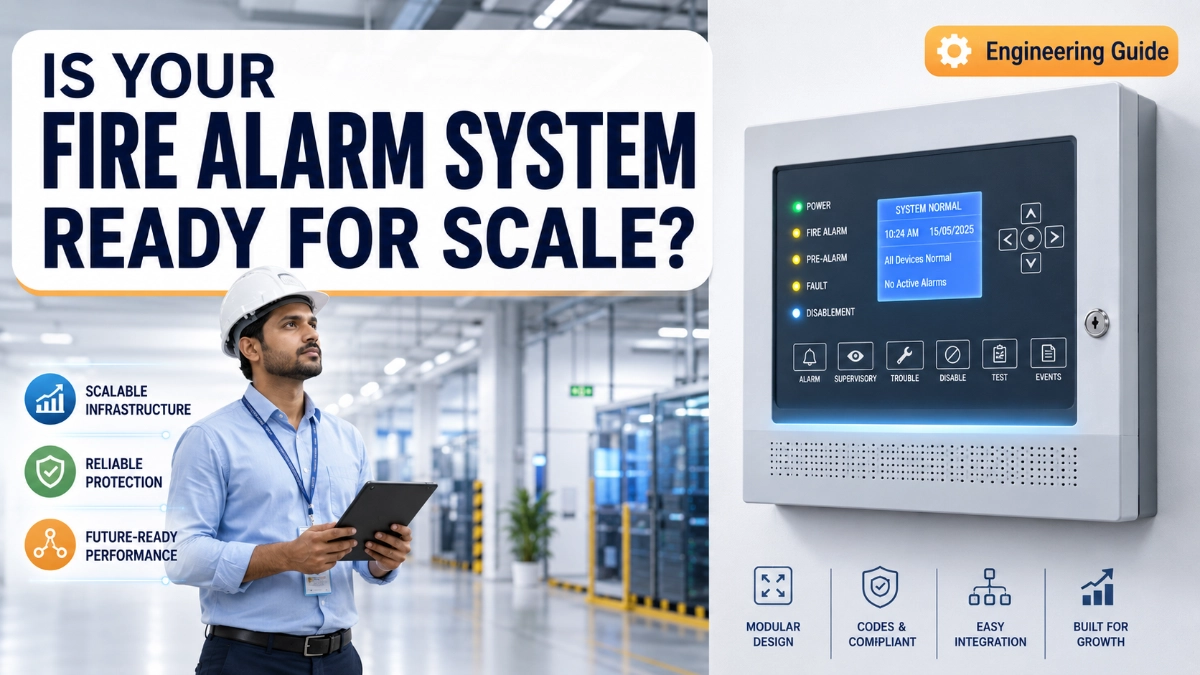
Practicality is not about how advanced a system looks on a datasheet. It is about how well the system holds up over years of operation, expansion, staff turnover and maintenance across a large, often distributed site. This article examines the engineering factors that determine whether a fire alarm system remains usable, serviceable, and scalable once installed.
What Does a Practical Fire Alarm System Mean?
From an engineering and facility-management standpoint, a practical fire alarm system is one that:
- Matches its architecture to the facility’s size and layout
- Can be expanded without redesigning the entire system
- Makes faults and alarms easy to locate
- Uses detectors suited to the environment they monitor
- Keeps false alarms manageable
- Integrates cleanly with other building systems where required
- Can be maintained by locally available technicians with accessible spare parts
- Meets applicable Indian regulatory requirements and relevant standards
None of these factors works in isolation. A system that scores well on detection technology but poorly on maintainability will still create operational problems. A simple way to frame this is:
Practicality = Scalability + Maintainability + Detectability + Compliance + Lifecycle Support
Each of these pillars is discussed below, with the trade-offs engineers actually weigh during design.
Scalability for Large and Growing Facilities
Large Indian facilities rarely stay the same size. Warehouses add mezzanines, manufacturing plants add production lines, hospitals add wings, and IT parks add towers in phases. A fire alarm system designed only for day-one requirements often runs out of room within a few years.
Practical scalability means planning for:
- Spare loop and zone capacity so new devices don’t require a new controller.
- Modular expansion cards that add capacity without replacing the main panel.
- Networked panels that let multiple buildings or floors report to a common point while still operating independently if a link fails.
- Repeater panels at security desks or control rooms so operators away from the main panel still get real-time status.
- Cable and conduit routing that anticipates future device additions, not just the current layout.
Under-sizing a system to save cost at the outset is a common trap. The cheaper option upfront can become the more expensive one once expansion requires a parallel system instead of an extension of the existing one.
Addressable vs Conventional Architecture
This is one of the first architectural decisions in any large facility, and it is often oversimplified as “addressable is always better.” In practice, the right choice depends on facility size, device count, layout complexity and budget.
An addressable fire alarm panel assigns a unique identity to each detector or call point on a loop, so the panel can report the exact device in alarm or fault. A conventional fire alarm panel groups multiple devices on a single zone circuit, identifying only the zone, not the individual device.
| Consideration | Addressable | Conventional |
|---|---|---|
| Device identification | Individual device address shown on panel | Only the zone circuit is identified |
| Troubleshooting | Faster — technician goes directly to the flagged device | Slower — requires checking every device on the zone |
| Wiring approach | Single loop wiring, fewer cable runs, easier to extend | Home-run wiring per zone, more cable for large layouts |
| Expansion | Devices added to existing loop within loop capacity | Each addition may need a new zone circuit |
| Typical application | Large, multi-building or multi-floor facilities with many devices | Small buildings, single-zone areas, or low device counts |
| Practical consideration | Higher initial device cost, lower long-term maintenance effort | Lower initial cost, higher long-term troubleshooting effort as device count grows |
For a large manufacturing plant, hospital, or IT park with hundreds of detection points spread across multiple floors, an addressable fire alarm panel generally reduces troubleshooting time and simplifies future changes, because each addressable detector reports its own status rather than sharing a circuit with dozens of other devices. For a small standalone building, a compact area, or a facility with a genuinely limited and stable device count, a conventional fire alarm panel with conventional detectors can remain a practical and cost-effective choice. The decision should follow device count and layout complexity, not brand preference.
Detector Selection Based on the Environment
Choosing smoke detectors as the default for every space is a common shortcut that can create problems later, particularly in industrial and warehouse environments. Detector type should follow the conditions of the space, not a single standard specification applied everywhere.
Relevant environmental factors include:
- Dust and particulate levels: Common in manufacturing and warehousing, where optical smoke detectors can be prone to false triggering unless dust-resistant or environmentally compensated types are used.
- Heat-generating processes: Areas near furnaces, ovens, or heavy machinery may need heat detectors rather than smoke detectors.
- Humidity and condensation: Cold storage, food processing and some pharmaceutical areas require detectors rated for the operating environment.
- Airflow and ceiling height: High-bay warehouses and large atriums affect smoke stratification and may require beam detectors or aspirating smoke detection rather than standard point detectors.
- Electrical and server rooms: These areas often warrant early-warning detection given the value of the equipment and the difficulty of stopping a fire once it establishes.
- Outdoor or semi-outdoor areas: Loading docks and open sheds need detectors rated for the exposure they will face.
Matching detector type to environment reduces both false alarms and missed detection risk, which directly affects whether staff trust and respond to the system.
Easy Fault Identification and Maintenance
A fire alarm system is tested and inspected far more often than it is triggered by an actual fire. If faults are hard to trace, routine maintenance becomes slow, expensive and prone to being deferred, which defeats the purpose of the system.
Practical fault management includes:
- Clear fault indication down to device or loop-segment level, not just a generic “system fault” message.
- Event logging that records fault history, not only current status.
- Isolators on addressable loops so a single wiring fault does not take an entire loop offline.
- Test modes that let technicians verify devices without triggering full-building evacuation alarms.
- Documentation (as-built drawings, zone charts, device schedules) that stays current as the facility changes.
For a large facility with dozens of electrical rooms, production areas and public spaces, the time it takes to locate a fault has a direct operational cost both in maintenance labour and in the risk of a fault going unaddressed.
Power Supply and Backup
A fire alarm system has to keep functioning through power interruptions, since that is often when other building systems are already compromised. Indian facilities frequently experience grid fluctuations, and standby power design should not be treated as a formality.
Key considerations include:
- A supervised primary power supply, so the panel reports mains failure rather than failing silently.
- Standby battery backup sized to cover the expected outage duration for the facility, based on applicable standards and the facility’s own risk assessment.
- Battery supervision that flags low charge or battery faults before they become failures.
- Charging circuits rated for the battery capacity installed, to avoid undersized or oversized charging that shortens battery life.
Exact backup duration requirements depend on the applicable code and the specific occupancy, so battery sizing should be confirmed against the relevant standard and the facility’s fire risk assessment rather than assumed.
Integration With Other Building Systems
Large facilities rarely run the fire alarm system in isolation. It typically needs to interface with other systems to trigger a coordinated response during an alarm condition. Common integration points include:
- HVAC systems: To shut down air handling units or activate smoke control sequences.
- Access control: To release electromagnetic locks on designated egress doors during an alarm.
- Building management systems (BMS): For centralised monitoring and event logging
- Public address and voice alarm (PAVA) systems: For phased or zoned evacuation messaging.
- Emergency systems: Such as fire pumps, smoke exhaust fans and elevator recall.
It is worth distinguishing between what the fire alarm system does natively and what it does through an interface. The alarm system detects fire and raises the alarm; triggering HVAC shutdown, door release or elevator recall generally happens through relay outputs, interface modules or a protocol-level connection to the other system. The practicality of integration depends on whether the panel supports the necessary interface modules and open or documented protocols, and whether the other systems’ vendors can actually commission that interface on site.
Compliance and Standards
Fire alarm system design and installation in India is guided primarily by IS 2189, the Bureau of Indian Standards code of practice covering the selection, installation and maintenance of automatic fire detection and alarm systems, first published in 1962 and revised over multiple editions. Building-level requirements, including provisions for fire detection and alarm systems within different occupancy types, are addressed in Part 4 of the National Building Code of India (NBC), where the clause on fire detection and alarm systems has been reviewed and updated in recent revisions, and state or local fire department regulations, which can add further requirements on top of the national code.
Product-level certification is also evolving. India has historically relied on IS 2189 as a code of practice without comprehensive mandatory product certification, but this is changing with the adoption of the IS/ISO 7240 series as the national product standard for fire alarm components, combined with a Quality Control Order covering fire detection and alarm systems. Engineers should verify current certification requirements for the specific devices being specified, since this framework is still being implemented.
International standards such as NFPA 72 (United States) or EN 54 (Europe) are frequently referenced in India for design practice, particularly on projects with international stakeholders, multinational occupiers, or insurance requirements that call for a specific standard. These are useful references for design philosophy and testing rigour, but they are not automatically Indian legal requirements. Where a project specification calls for NFPA or EN compliance, that requirement typically comes from the client, insurer or a specific contractual clause, not from Indian law by default. Engineers should treat IS 2189, NBC Part 4 and applicable state fire rules as the mandatory baseline, and treat NFPA, EN or UL references as additional design or certification benchmarks where the project specifically calls for them.
Availability, Procurement and Lifecycle Considerations
A fire alarm system is a long-term asset, typically in service for well over a decade. Several practical factors affect it over that lifecycle:
- Spare device availability: If a detector model is discontinued or not stocked locally, replacing a single faulty unit can become a multi-week wait.
- Trained technician access: Large facilities in industrial belts or tier-2/tier-3 locations may have fewer technicians familiar with a specific panel brand.
- Documentation quality: Clear wiring diagrams, programming records and device schedules reduce dependence on any single technician’s memory.
- Procurement lead times: For facilities undergoing phased expansion, consistent availability of compatible devices avoids mismatched generations of hardware on the same loop.
- Long-term ownership cost: This includes not just the panel price, but ongoing device replacement, battery replacement cycles, and annual maintenance contracts.
These factors are easy to overlook during initial system selection, when the focus is often on upfront capital cost, but they tend to determine how much a system actually costs over its working life.
Where GST Fire Alarm Systems Can Fit
Among the fire alarm system ranges available to Indian consultants and system integrators, a GST fire alarm system is one option evaluated when facilities need both addressable and conventional architectures under a single product range. GST, or Gulf Security Technology, is a manufacturer of fire detection and alarm systems that has served commercial, industrial and residential projects internationally since 1993, and its range spans addressable and conventional panels, detectors and interface modules.
For engineers evaluating options, the relevant questions are the same regardless of brand: does the panel’s loop capacity and expansion architecture match the facility’s projected size, are the detector types available for the specific environmental conditions on site, and is there a reliable local supply chain for spares and documentation? Innxeon Technologies operates as a GST fire alarm system distributor in India, supplying panels, detectors, modules and accessories to consultants, system integrators and contractors; installation, commissioning and after-sales service are carried out by the project’s appointed system integrator or contractor, not by the distributor. Any product-specific performance or certification claim should be verified against the manufacturer’s current datasheets and certification documentation before it is specified on a project.
A Practical Selection Framework for Engineers
A structured way to walk through fire alarm system selection for a large facility is:
Facility → Risk → Architecture → Detection → Capacity → Integration → Maintenance → Compliance → Lifecycle
- Facility: Understand the layout, occupancy type, construction, and planned phases of expansion.
- Risk: Identify fire load, hazard classification and occupancy sensitivity (for example, a hospital ward versus a warehouse racking area).
- Architecture: Decide between addressable, conventional, or a hybrid approach based on device count and layout complexity.
- Detection: Match detector types to the environmental conditions of each area rather than applying a single detector type facility-wide.
- Capacity: Size loops, zones and panels with genuine spare capacity for future devices.
- Integration: Define which other systems the fire alarm system must interface with, and confirm the interface method is supported.
- Maintenance: Design for fault visibility, testing access and technician availability from the outset.
- Compliance: Confirm the applicable Indian codes and any project-specific international standards required by the client or insurer.
- Lifecycle: Evaluate spare parts availability, documentation quality and long-term ownership cost before finalising the system.
Working through these steps in order helps avoid a common failure mode: selecting architecture or detection technology before risk and facility layout are properly understood.
Practical Example
Consider a hypothetical large warehouse with multiple storage bays, a packing area, administrative offices, a few electrical rooms, and a battery charging area for material-handling equipment, with a second phase of storage space planned within two years.
An engineer evaluating this facility would likely start by separating it into risk zones: high-bay storage (higher fire load, dust-prone), offices (lower risk, standard smoke detection), electrical rooms (heat-sensitive equipment, early-warning detection preferred), and the battery charging area (specific hazard considerations for that process). Given the device count across a facility this size and the planned expansion, an addressable architecture would generally offer easier fault tracing and simpler capacity growth than a conventional system, provided the panel’s loop capacity leaves genuine spare capacity for the second phase. Detector selection would vary by zone rather than defaulting to smoke detectors throughout, and the design would include a repeater panel at the site’s security or control room, since the main panel may be located some distance from where operators are stationed.
This is a hypothetical scenario to illustrate the evaluation process, not an actual project or case study.
Conclusion
The most practical fire alarm system is not necessarily the one with the most features. It is the one that fits the facility’s risk, size, architecture, maintenance capability, expansion plans and compliance requirements. For large Indian facilities, that means treating fire alarm system selection as a facility-specific engineering decision, weighing scalability, detector suitability, fault management, integration needs and long-term lifecycle support together, rather than defaulting to the most technically advanced option on the market.
Read Also: Difference Between a Fire Alarm Product Supplier and a Technical Solution Partner
Read Also: Fire Alarm System Selection: 12 Questions Consultants Should Ask Before Procurement