A detector faults on Monday. A technician resets the panel and the log shows normal. Two weeks later, the same fault reappears and gets reset again. Six weeks later, it happens once more during a site walkdown, when nobody has time to dig in.
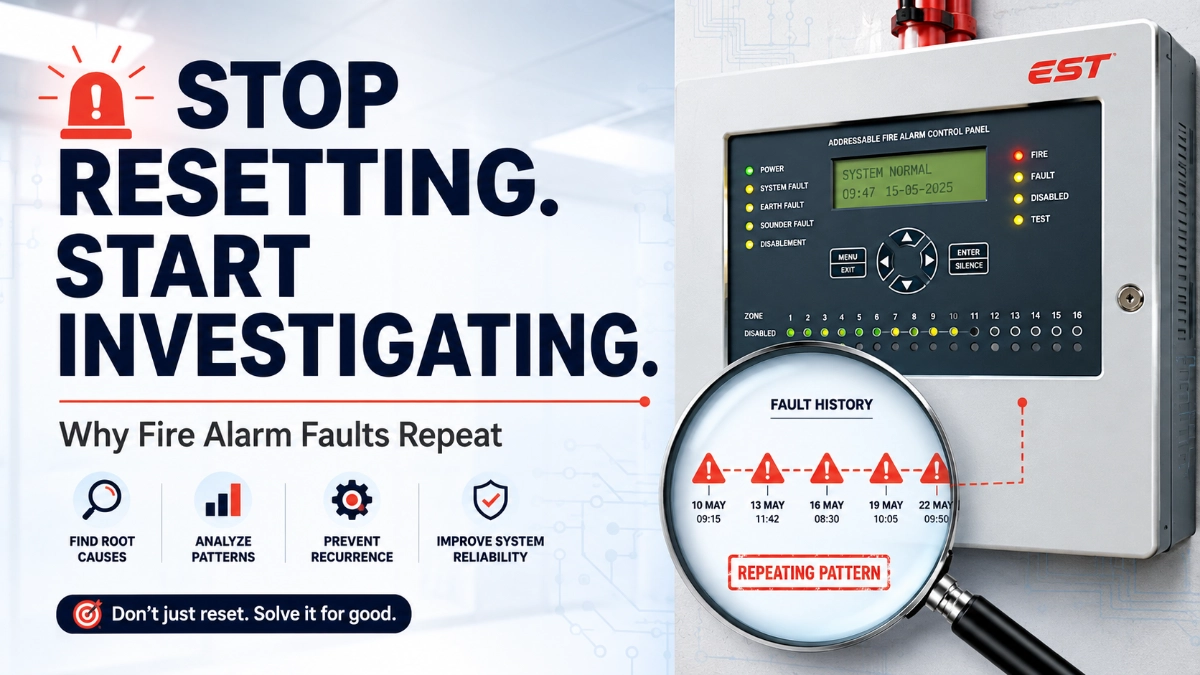
Viewed alone, each event looks minor. But three faults on the same device, spaced weeks apart, aren’t three unrelated problems; they’re one story told in three parts. Most troubleshooting handles faults individually: something happens, someone clears it, the work order closes. What gets missed is the relationship between events: location, timing, device type, and conditions that connect them.
This article explains why recurring faults deserve to be read as patterns, and how event history and site context move troubleshooting from “what happened” to “why does this keep happening.”
Fire alarm faults should be analysed as patterns because a single fault often shows limited information, while recurring faults can reveal relationships involving location, device type, timing, frequency, environment, wiring, power, maintenance history, and system interactions. Pattern analysis doesn’t replace investigating individual faults; it adds context that helps engineers distinguish a random occurrence from a developing problem.
Why Treating Every Fault as an Isolated Event Can Be Misleading
Individual event analysis asks: what fault occurred, and how do we clear it? That matters, but it stops at the surface.
Pattern-based analysis asks something different: has this happened before, and what do the occurrences share? A single fault might reflect a momentary condition and may not justify extensive investigation alone.
The same fault recurring is different. It can point to an unstable device or connection, a shared loop affecting multiple points, a recurring environmental trigger, a timing relationship with equipment operation, or an unaccounted-for building change. Pattern analysis doesn’t replace individual investigation; it tells engineers when a fault deserves closer attention than a routine reset.
What Does a Fire Alarm Fault Pattern Actually Look Like?
Pattern 1 — Same Detector, Repeated Fault. One device generates the same fault repeatedly, pointing to device condition, base connection, wiring, environment, or installation quality.
Pattern 2 — Multiple Devices on One Loop. Several devices on one loop report faults within a similar period, justifying checks on loop wiring, cable integrity, and power conditions.
Pattern 3 — Faults at Similar Times. Faults repeatedly appear during a particular window, prompting engineers to examine HVAC cycling, nearby machinery, or electrical loads.
Each pattern is a starting point, not a conclusion. A device that faults three times in a month may still have three unrelated causes; recurrence simply earns it a closer look.
The Five Dimensions Engineers Should Track
WHAT — Device, communication, wiring, power, battery, or network fault: each points investigation differently.
WHERE — Device, loop, floor, room, panel, or building; location narrows the shared infrastructure involved.
WHEN — Time of day, day of week, season, equipment operation, post-maintenance, or occupancy change.
HOW OFTEN — Once, intermittent, repeated, or increasing in frequency, which deserves faster attention.
WHAT CHANGED — Building modifications, HVAC changes, electrical work, new equipment, or construction activity.
Recording these five points turns a stack of work orders into a dataset engineers can actually analyse.
Why the Event Log Is More Than a Record of What Happened
The event log is often treated as confirmation of what happened, not a diagnostic tool. Over time, it can surface repeated device addresses, fault clusters, and loop-level trends invisible from any single entry.
The log is most useful alongside as-built drawings, maintenance records, site observations, and current device configuration.
An event log showing five faults on one loop over three months is a lead. Cross-referencing it with a maintenance record showing cable work nearby turns it into a workable hypothesis. The log alone rarely identifies a root cause; it identifies where to look.
From Symptom to Root Cause: A Better Troubleshooting Method
Event → Pattern → Context → Hypothesis → Physical Inspection → Testing → Root Cause → Corrective Action → Verification
An event is recorded. If it recurs, it becomes a pattern. Context: location, timing, maintenance history, environment layers on, forming a hypothesis. That hypothesis is tested through inspection and, where needed, instrumented testing. Only then is a root cause confirmed and the fix verified.
A reset is not the same as a resolution. It can be a legitimate operational step; the system needs to return to normal monitoring status. The problem is when reset becomes the entire response, repeated without anyone asking whether this is the third or fifth occurrence.
Device-Level Patterns vs System-Level Patterns
| Pattern Type | What It May Indicate | Investigation Focus |
|---|---|---|
| Same detector repeatedly faults | Local/device issue | Device, base, wiring, environment |
| Multiple devices on one loop fault | Shared infrastructure issue | Loop wiring and related infrastructure |
| Multiple loops affected | Wider system issue | Panel, power, network, configuration |
| Faults across multiple buildings | Distributed issue | Network, common infrastructure, environment |
| Faults after modifications | Change-related issue | Recent work, configuration, wiring |
These are diagnostic directions, not definitive conclusions. A pattern that looks device-level can still trace back to a loop-wide issue affecting one device first.
Environmental and Operational Patterns Engineers Should Not Ignore
The electronic fault message rarely tells the whole story. Recurring faults often correlate with conditions the panel doesn’t report: dust, moisture, temperature swings, vibration, HVAC cycling, electrical work, and cleaning activities involving aerosols or water.
A detector in a warehouse loading zone that faults every winter morning is a different investigation than the same fault in a climate-controlled office. Environmental context explains why two devices with the same fault code may need different corrective actions.
How EST Fire Alarm Systems Fit Into Pattern-Based Fault Analysis
When engineers evaluate a fault on an EST Fire Alarm System, it helps to consider the overall architecture rather than reading one fault message in isolation; how the control panel, devices, loops, and network relate, alongside recorded event information.
This system’s view matters because an addressable, networked platform is built from interdependent parts, each with its own failure modes, which lets engineers tell a local issue from a shared one.
Why EST Detectors and Devices Matter When Fault Patterns Repeat
When faults keep recurring at the same point, investigation should centre on the device before any replacement decision. For EST Detectors and Devices, that means reviewing location, type, environment, connection quality, and wiring.
Replacing a detector is sometimes the right action, but shouldn’t be the first move. A device swapped out without understanding why it faulted can leave the actual cause in place, ready to affect the next detector installed there.
When to Involve an EST Fire Alarm System Distributor in India
Some investigations extend beyond routine maintenance, planning a replacement program, expanding a system, or modernising across buildings. Here, an EST Fire Alarm System Distributor in India can help with product identification, sourcing, and technical coordination.
This is a project-support step, not a substitute for engineering investigation, and is most useful once the team has identified what needs replacing.
Pattern-Based Fire Alarm Fault Investigation Checklist
- Record the exact fault
- Identify the affected device or circuit
- Check whether the event has occurred previously
- Review event history
- Identify common locations
- Check timing patterns
- Review recent maintenance
- Review recent building changes
- Inspect physical infrastructure
- Test the suspected cause
- Apply corrective action
- Verify the pattern has stopped
- Update documentation
Real-World Engineering Examples
Example 1 — Repeated Detector Fault. A smoke detector in a hospital corridor faults intermittently over several months and gets replaced each time. The fault returns within weeks, a sign that swapping the detector without checking its base connection or wiring left the cause untouched.
Example 2 — Multiple Loop Faults. In a warehouse, four devices on one loop report faults within a two-week window. The pattern justifies checking shared loop wiring, isolation points, and power supply before device-level work.
Example 3 — Time-Based Pattern. At a data centre, a fault repeatedly appears during the same early-morning maintenance window, correlating closely enough with a scheduled HVAC cycle to justify investigating airflow rather than a device defect.
Common Mistakes in Fire Alarm Fault Troubleshooting
- Resetting without checking recurrence, clearing the fault without asking if it’s happened before.
- Replacing devices immediately, before confirming the cause.
- Ignoring event history, treating the log as a formality.
- Looking only at the fault message, missing context.
- Ignoring location patterns across devices.
- Ignoring timing patterns that reveal a recurring trigger.
- Failing to review recent building work.
- Not comparing maintenance records against fault onset.
- Ignoring environmental conditions.
- Treating related faults as unrelated, missing a shared cause.
Expert Insights
- A recurring fault deserves different investigation than a one-time event.
- Fault location can be as informative as the fault code itself.
- Repeated device replacement without root-cause analysis can simply move the problem forward.
- A pattern is not proof of a root cause; it’s a reason to investigate a relationship.
- Event history is more valuable combined with maintenance and site information.
- Timing data is frequently underused, though it can point directly to an operational trigger.
Key Takeaways
- Treat recurring faults differently from one-time events.
- Use event history as a diagnostic input, not just a log.
- Track what, where, when, how often, and what changed.
- Separate device-level from system-level patterns before deciding on corrective action.
- Consider environmental and operational conditions alongside the fault message.
- Cross-reference maintenance and building-change records with fault timing.
- Diagnose before replacing devices.
- Verify a corrective action actually stopped the pattern, not just the symptom.
Read Also: The Hidden Engineering Behind a Multi-Building Fire Alarm Network
Read Also: Why Every Large Fire Alarm System Needs a Lifecycle Strategy