The panel has passed its tests. The cause-and-effect sequence has been verified point by point. The commissioning engineer has signed the report and packed up the laptop. So is the project finished? Not necessarily.
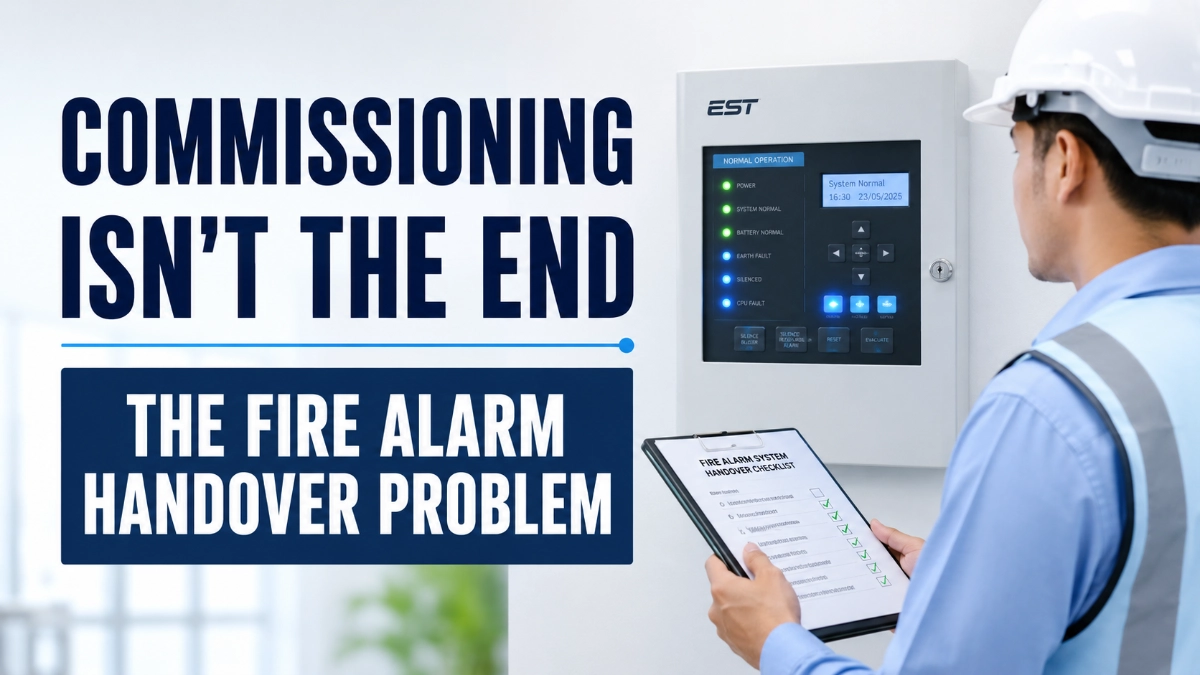
A commissioned system proves something specific: the installed devices, loops, and programmed logic performed as expected under the conditions tested. It does not prove the facility team can operate the panel, interpret a fault at 2 a.m., or find the right device schedule when a detector fails months later. That gap between technical sign-off and operational readiness is where well-executed projects quietly fail their owners. This article examines why commissioning and handover serve different purposes and where the process typically breaks down.
Why is commissioning not the end of a fire alarm project?
Commissioning verifies system performance against defined testing requirements at a single point in time. Handover is a separate milestone: it ensures the owner or operator actually receives the documentation, training, configuration records, maintenance information, and operational knowledge needed to run the system once the project team has left site.
Commissioning and Handover Are Not the Same Thing
Commissioning is easy to treat as the finish line because it’s the most visible, testable part of the process. But commissioning and handover answer different questions.
Commissioning asks whether the installed and configured system performs according to the approved design and sequences of operation, a verification activity carried out largely by the project team.
Handover asks whether the system, and everything needed to operate and maintain it, has actually been transferred to the people who will own it: documentation, training, configuration information, maintenance data, test records, as-built information, outstanding-item status, and defined responsibilities.
Not every project defines handover identically; contract scope shapes what’s included. What stays constant is the shift in focus: commissioning proves performance, handover transfers ownership.
What Commissioning Actually Proves
Depending on scope, commissioning typically verifies device operation across the loop, alarm initiation and notification, fault and trouble conditions, cause-and-effect sequences, panel and network functions, and interface operation with BMS or other third-party systems.
These checks are valuable, but a successful test demonstrates performance under the conditions tested nothing more. It doesn’t transfer operational knowledge to whoever inherits the building afterwards. A facility engineer who wasn’t present gains none of that context just because the report says “pass.”
The Handover Gap: A Working System Isn’t Always an Operationally Ready One
This is where projects quietly lose value. The system works, and the paperwork exists somewhere but the people who now have to live with it are missing pieces they didn’t know they needed: the facility team never walked through the panel interface, operators who can’t distinguish alarm, supervisory, and trouble indications, as-built drawings that don’t reflect field changes, device schedules that no longer match, configuration records never handed over usably, undocumented integration behavior, unassigned maintenance responsibilities, and punch-list items that exist only in someone’s memory.
None of this shows up on a commissioning test sheet. It surfaces months later, once the project team is unreachable and the facility manager is troubleshooting alone.
What Should Be in a Fire Alarm Handover Package?
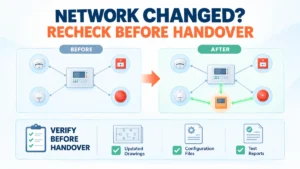
Contents vary by project and contract, but a reasonably complete package generally covers: approved and as-built drawings, device schedules, loop and network diagrams, cause-and-effect matrix, testing records, configuration records, equipment documentation, maintenance and battery information, warranty details, training records, outstanding-item status, and relevant inspection records.
Treat this as a starting framework, not a universal checklist. What matters most is that whatever is included is accurate, current, and usable by someone who wasn’t on the project.
Why Configuration and Programming Records Matter
A panel functioning correctly today still has an internal logic device addressing, cause-and-effect programming, network structure, and interface behaviour that someone eventually has to understand. If that isn’t documented and handed over, the facility inherits a system that works but that nobody fully understands.
The risk compounds over time. A device gets replaced, a zone gets relabeled, an interface gets adjusted, and without a controlled change record, the as-built and documented configurations drift apart. Future troubleshooting starts from guesswork instead of records. This is a documentation issue, not a reason to bypass safety functions; modifications should always follow approved procedures and manufacturer instructions.
Operator Training Is Part of Operational Readiness
Handing over a functioning panel without the knowledge to run it creates an operational blind spot. Training, where applicable, generally covers normal panel operation, alarm acknowledgement, interpreting alarm/supervisory/trouble events, authorised silence and reset procedures, escalation, basic visual checks, and maintenance coordination.
Training should follow the approved system procedures and the site’s emergency plan, not replace either. A facility team that understands what the panel is telling them responds faster than one simply told to “call this number if it beeps.”
The Punch List Problem
Almost every project reaches commissioning with something still open: a mislabeled device, a documentation correction, an interface tweak. That’s normal. The real question is whether these items are identified, documented, assigned, tracked, and verified once resolved.
An undocumented punch list effectively disappears once the project team disperses. A documented one, with clear ownership, stays visible until it’s actually finished.
Why Integrated Systems Need a Better Handover
Systems tied into BMS, HVAC, access control, smoke control, or suppression interfaces raise the stakes considerably. The handover package should communicate not just what happens at the panel, but how each connected interface behaves during an event.
A useful way to document this is the relationship itself: Interface → Trigger → Action → Verification. Without this chain documented, a facility team inherits a web of connected systems with no map of how they interact.
EST Fire Alarm System: Why the Platform Matters During Handover
Understanding the complete system architecture is part of a thorough handover, and platform-level knowledge matters here. For a facility running an EST Fire Alarm System, the handover package should give the team a working understanding of the control panels, intelligent devices, loop and network structure, notification arrangement, and configuration as actually commissioned, not a generic description of the platform’s capabilities. This isn’t about one platform being superior to another; it’s about ensuring whoever operates it afterwards understands what was installed.
EST Detectors and Devices: Handover Is More Than the Panel
A fire alarm system is a distributed ecosystem, not a single box on a wall, which is especially true for EST Detectors and Devices. The handover package needs to give the facility team visibility into the field side: detector locations, device identification, device schedules, modules, notification devices, and how each device relates to its loop.
Replacement and maintenance records matter too, so future work starts from an accurate baseline. An existing device inventory is useful reference information, but it shouldn’t be assumed every device can automatically be reused in a future modification.
When an EST Fire Alarm System Distributor in India Can Add Value
Once a project closes out, ongoing support often runs through a specialist supplier rather than the original installer. An EST Fire Alarm System Distributor in India can play a useful, understated role helping with product identification, documentation support, sourcing replacement parts, and technical coordination as the system ages, particularly for lifecycle planning long after the commissioning team has moved on.
Commissioning vs. Handover at a Glance
| Area | Commissioning | Handover |
|---|---|---|
| Purpose | Verify system performance | Transfer operational ownership |
| Testing | Functional verification | Records and continuity |
| Documentation | Validate project information | Transfer usable information |
| Training | Specialist testing | Owner/operator readiness |
| Configuration | Verify programmed operation | Transfer configuration information |
| Outstanding items | Identify/track issues | Confirm status and responsibility |
| Long-term operation | Not the primary focus | Central objective |
This is a general framework, not a regulatory standard; actual requirements should be checked against applicable codes and contracts.
Fire Alarm Handover Checklist
- Final approved/as-built drawings
- Device schedule
- Loop/network information
- Cause-and-effect documentation
- Commissioning and test records
- Configuration/programming records where appropriate
- Equipment documentation
- Maintenance information
- Training completed
- Outstanding items documented
- Responsibilities clearly assigned
- Support/contact information transferred
- Future maintenance requirements communicated
- Final documentation reviewed by responsible parties
Adapt this list to your project’s specifications and applicable requirements.
Real-World Engineering Examples
Commercial Building: An office system passes commissioning cleanly, but the as-built drawings still reflect original design intent, not field changes. Months later, a fit-out team can’t locate two relocated detectors, causing delays.
Industrial Facility: A system is commissioned with BMS and HVAC shutdown interfaces. Testing confirms they work, but the logic is never documented, and no one is trained. The first real fault leaves operators unsure whether it was a fire response or a separate failure.
Multi-Building Campus: A networked campus system is successfully commissioned, but the incoming maintenance contractor receives no network architecture documentation; a single-node fault takes far longer to isolate without a map of how the buildings communicate.
Common Handover Mistakes
- Treating commissioning as project completion
- Incomplete as-built drawings
- Outdated device schedules
- Missing configuration records
- Inadequate operator training: mistaking a walkthrough for training
- Poorly documented outstanding items; punch lists kept informally
- Ignored integrated interfaces documenting the panel, not what it triggers
- Unclear maintenance responsibilities; no defined service owner
- Undocumented modifications; changes never reaching the as-built record
- Unverified document handover treating delivery as a formality
Expert Insights
- A commissioned system is not automatically an operationally prepared system.
- Handover documentation proves its value most once the original project team is gone.
- If the system changes but the as-built information doesn’t, future troubleshooting gets harder.
- Training should focus on what the facility team needs to do, not a feature tour.
- A handover should transfer knowledge, not just equipment and documents.
- Configuration records are only useful if someone can find and understand them later.
- An undocumented punch-list item tends to become a permanent one.
Key Takeaways
- Commissioning verifies performance at a point in time; it isn’t operational readiness.
- Documentation is an operational asset, not a project formality.
- Training should be tied to what operators actually need to do.
- Configuration records need to be transferred, not just retained by the installer.
- Interface behaviour on integrated systems should be documented as clearly as the panel.
- Outstanding items need ownership, tracking, and verified closure.
- Maintenance responsibilities should be assigned before the project team leaves.
- Long-term reliability depends more on handover quality than most timelines allow for.
Read Also: Why Fire Alarm Faults Should Be Analysed as Patterns, Not Individual Events
Read Also: The Hidden Engineering Behind a Multi-Building Fire Alarm Network