Every fire alarm system is designed around a specific building: a fixed number of detectors, modules, notification appliances, zones or loops, and interfaces. That design is correct on the day it’s commissioned.
Years later, buildings rarely stay the same. Floors get added, open areas get partitioned, a warehouse becomes a production line, or new tenants bring new occupancy types. HVAC, access control, or BMS systems start needing to talk to the fire alarm panel.
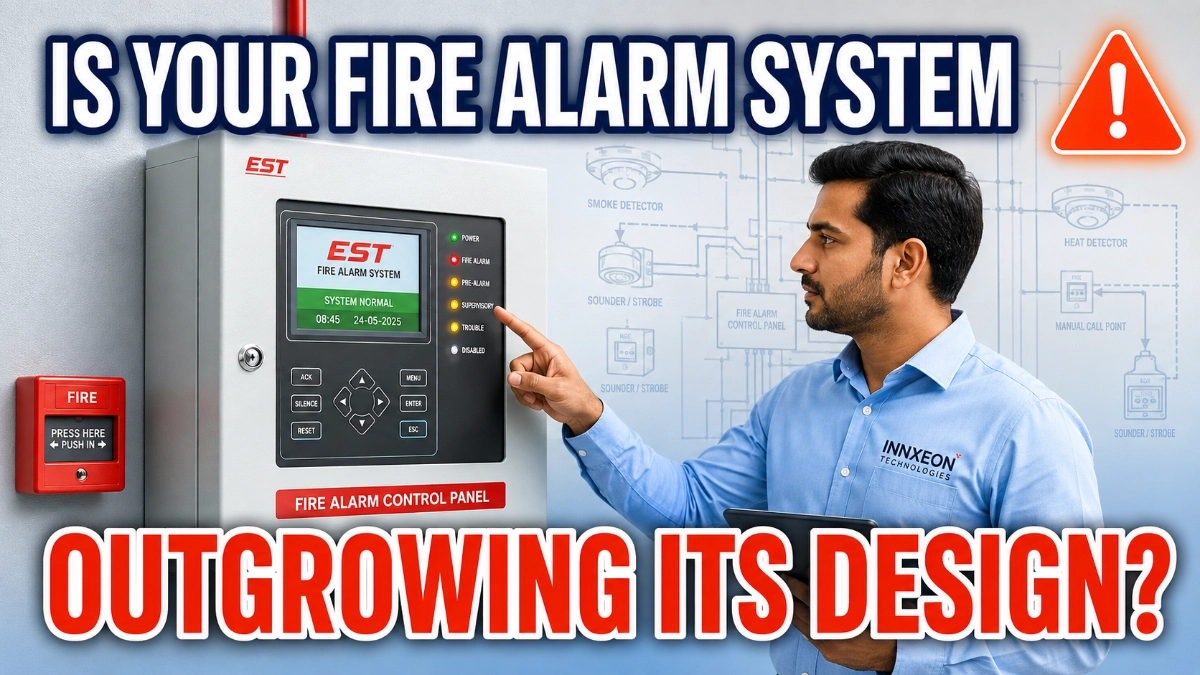
At that point, a question is easy to underestimate: can the existing system simply be extended, or has it outgrown the assumptions it was engineered around? This isn’t just a device-count question; it touches panel capacity, loop loading, power, notification, cause-and-effect logic, and documentation, all at once.
When a fire alarm system outgrows its original design, the facility’s actual requirements device count, floor area, occupancy, or integration needs exceed what the system was engineered to support. This shows up as insufficient addressable device or loop capacity, inadequate power or battery reserve, notification circuits reaching their limits, network or panel architecture that can’t scale, or cause-and-effect programming too complex to manage reliably. Rather than adding detectors or modules as a quick fix, engineers should reassess the complete system panel, loops, power, notification, network, and documentation against current manufacturer specifications and present-day requirements before any expansion proceeds.
Why Do Fire Alarm Systems Outgrow Their Original Design?
Common triggers include:
- Building expansion: New wings, floors, or extended footprints.
- Occupancy changes: Office space converted to production, or vice versa.
- New production or storage areas with different detection needs.
- Increased device count across successive renovations.
- Partition changes that alter zoning and detector spacing.
- New notification requirements or additional interfaces for lifts, HVAC, or dampers.
- BMS, HVAC, or access control integration outside the original scope.
- Operational changes, including shift patterns or process changes.
- Platform limitations or minimal original expansion margin, often set by initial budgets.
Individually, each change looks minor. Together, they can push a system past its engineered limits.
The First Warning Sign: Available Capacity Is Disappearing
Capacity has several dimensions, not just one:
- Addressable device and loop capacity, and number of loops supported.
- Zone capacity on conventional or hybrid systems.
- Input/output module allocation.
- Notification appliance circuit loading.
- Overall panel capacity, including networked configurations.
- Power supply and battery capacity for standby/alarm conditions.
- Network capacity across multiple panels or buildings.
Each must be verified against the manufacturer’s current documentation and approved project design, not assumed from a similar past project. Two systems from the same manufacturer, configured differently, can have very different remaining capacity.
Why Adding More Devices Is Not Always the Answer
A common mistake is treating unused terminals or spare addresses as proof that expansion is straightforward. Physical space available and engineered capacity available are not the same thing:
- Device limits already close to maximum on a loop or panel.
- Loop loading and power budget, covering standby and alarm conditions.
- Voltage drop on longer cable runs to new areas.
- Notification appliance loading as coverage areas grow.
- Programming and network architecture limitations, particularly on older or multi-panel platforms.
- Cause-and-effect complexity, where new devices trigger unintended interactions.
- Existing system condition, including age and fault history.
A system that still functions correctly may nevertheless be poorly positioned for future expansion. Capacity should be evaluated as a complete system, not a single device count.
How to Determine Whether the Existing System Can Be Expanded
- Review original design documents and as-built drawings.
- Verify actual installed device count against panel records.
- Check panel, loop, and device capacity against manufacturer documentation.
- Review power and battery calculations for current and proposed load.
- Review notification appliance loading for new areas.
- Review cause-and-effect programming for conflicts.
- Check existing faults and system condition.
- Review existing interfaces to other systems.
- Assess future expansion requirements, not just immediate scope.
| Area to Check | Why It Matters | Typical Question |
|---|---|---|
| Panel capacity | Determines expansion capability | Is sufficient capacity available? |
| Loop/device capacity | Limits additional field devices | How many devices can be added? |
| Power supply | Supports connected equipment | Is the power budget adequate? |
| Batteries | Supports standby/alarm operation | Do revised calculations remain adequate? |
| Network | Important for larger/distributed systems | Can the existing architecture support expansion? |
| Cause & effect | Additional devices may create new actions | Does programming need modification? |
| Documentation | Prevents engineering errors | Are drawings/configuration records current? |
Exact numerical limits for device counts, loop loading, and battery calculations vary by manufacturer and product generation, and should always be confirmed against the system’s specific technical documentation.
When an Existing Fire Alarm System Can Still Be Expanded
Expansion is often practical when:
- Sufficient device, loop, and panel capacity remains.
- Power and battery calculations stay within acceptable limits after the addition.
- Existing cabling, pathways, and enclosures suit the new scope.
- Proposed devices are compatible with the existing platform and firmware.
- Programming can accommodate new cause-and-effect logic without excessive complexity.
- The system is in good condition, with future requirements already factored in.
Final decisions should rest on current manufacturer documentation, actual system configuration, and applicable project and code requirements.
When Expansion Starts Becoming an Upgrade Project
Watch for:
- Capacity nearly exhausted across panel or loops.
- Multiple future expansion phases already planned.
- An ageing or unsupported panel platform, or difficulty sourcing replacement devices.
- Wiring unsuitable for additional load, or recurring faults on the installation.
- Network architecture limiting further growth.
- Integration requirements more complex than originally scoped, with incomplete documentation.
- An original design basis that no longer matches building use.
There’s a meaningful difference between adding to an existing system and re-engineering or upgrading the fire alarm system. The first assumes the underlying architecture is sound; the second acknowledges it needs to change. A building modification can shift the design basis even while the panel keeps operating normally, which is why assessment matters more than uptime.
EST Fire Alarm System as Part of a Scalable Fire Alarm Strategy
When evaluating any platform for a facility likely to grow, scalability deserves as much attention as day-one functionality, architecture for additional loops, spare capacity at the design stage, integration, and lifecycle support.
The EST Fire Alarm System is one example of a platform used in commercial and industrial projects where future expansion is a design consideration. As with any manufacturer’s line, actual capacity and expansion options depend on the specific model installed, and should be confirmed against EST’s own technical documentation. The point isn’t which brand is chosen, but whether the platform’s architecture, documentation, and support fit the facility’s growth path.
Don’t Forget the Field Devices
Expansion often focuses on the control panel, but field devices deserve equal attention:
- Detector placement relative to new layouts and partitions.
- Device compatibility with the existing panel and firmware.
- Availability of input/output modules and manual call point locations.
- Notification appliance coverage in newly occupied areas.
- Interfaces to dampers, lifts, or shutdown systems.
- Wiring pathway capacity and environmental suitability for the area.
- Address allocation and configuration records for every new point.
Selecting appropriate EST Detectors and Devices for a given environment is part of this, alongside confirming each device type is supported by the installed panel version and address capacity is genuinely verified, not assumed.
Why the Right Distributor Matters During Expansion
Expansion projects surface practical questions beyond the drawings: is a device still available, does the firmware support a newer module, and can documentation for the original installation be retrieved?
This is where working with a knowledgeable EST Fire Alarm System Distributor in India can matter. Access to current product availability, documentation, configuration guidance, and replacement planning support can make the difference between a smooth expansion and one delayed by sourcing issues- a practical planning consideration, not a substitute for engineering assessment.
Real-World Example — A Building That Added New Areas
Consider a facility originally built as office space across a few floors, sized accordingly. Over time, the ground floor became a small production area, an additional floor was added, and a new HVAC system needed a shutdown interface with the panel.
On paper, the changes looked incremental. In practice, the assessment revealed several issues at once: the added floor pushed loop device counts close to their limit; the production area’s notification appliances changed the power budget; the HVAC interface required cause-and-effect logic that hadn’t existed before; and undocumented earlier renovations meant the as-built drawings no longer matched the installed system.
None of this was visible from a simple device count; it only became clear once the system was evaluated as a whole.
10 Warning Signs Your Fire Alarm System May Be Outgrowing Its Design
- Frequent concerns about remaining device or loop capacity.
- Repeated small modifications instead of one planned expansion.
- Devices on-site not reflected in current documentation.
- Outdated drawings and configuration records.
- Little to no spare capacity on loops or the panel.
- A growing number of interfaces to other building systems.
- Recurring faults or nuisance alarms.
- Difficulty sourcing compatible replacement components.
- Major occupancy or layout changes since the original design.
- Known future expansion plans not yet factored into capacity.
How Engineers Can Design for Future Fire Alarm Expansion
- Include a reasonable expansion margin in loop, panel, and power calculations.
- Maintain accurate, current documentation and configuration records.
- Keep an updated device schedule as changes are made.
- Consider known future building phases at the original design stage.
- Review power and battery calculations whenever devices are added.
- Plan cable pathways with spare capacity, and document every new interface.
- Periodically reassess system capacity, not just after major renovation.
- Avoid short-term fixes that add complexity without addressing capacity limits.
Documentation quality directly affects the safety and maintainability of future modifications; a well-documented system is far easier to expand safely than one relying on institutional memory.
Key Takeaways
- A system can outgrow its design even while operating without faults.
- Capacity should be assessed as a complete system, not a single device count.
- Unused terminals don’t automatically mean usable engineered capacity.
- Building modifications can shift the design basis even when the panel is unchanged.
- A structured assessment should precede any expansion decision.
- Some situations call for an upgrade or redesign, not incremental addition.
- Documentation and planned margin reduce the risk of repeating the problem.
Read Also: The Fire Alarm Handover Problem: Why Commissioning Is Not the End
Read Also: Why Fire Alarm Faults Should Be Analysed as Patterns, Not Individual Events