An EST3 system has often been protecting a building for a decade or more. The facility has expanded, some field devices have aged past their comfortable service life, documentation has thinned out through years of small modifications, and new interfaces access control, HVAC shutdown, elevator recall, PA/VA have been added along the way. At some point, the question of moving to EST4 comes up.
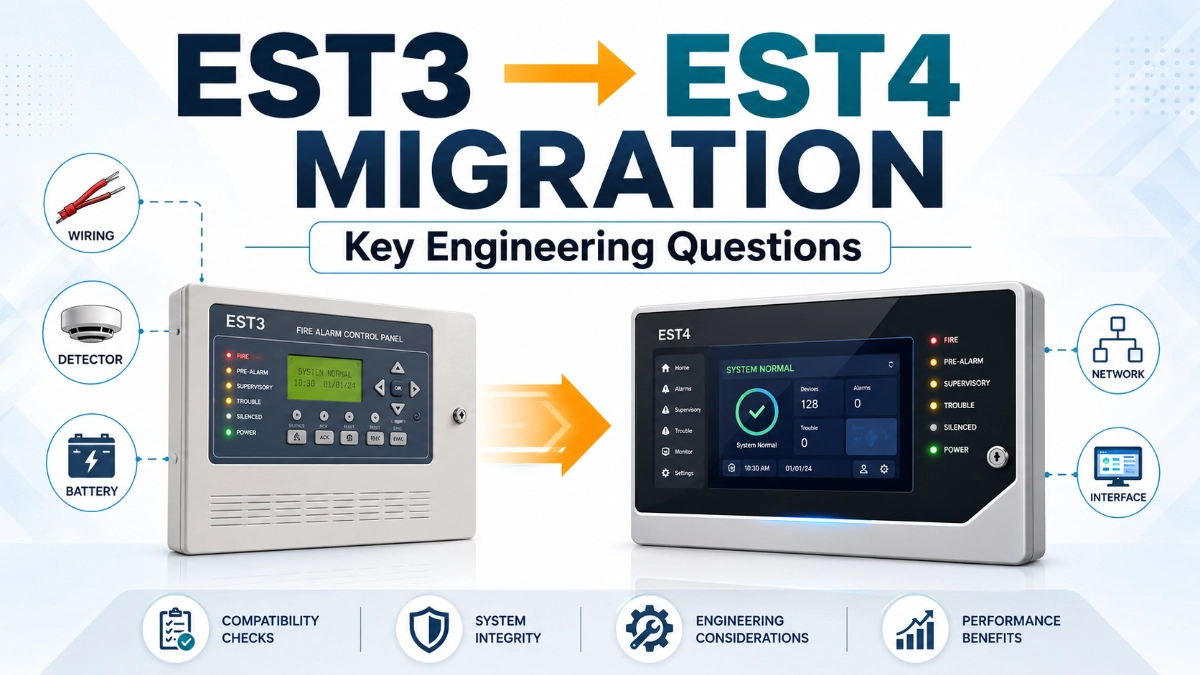
The instinct is to frame this as a simple question: can we replace the panel? In practice, that is the wrong starting question. A fire alarm installation is not just a control panel. It is a full ecosystem made up of control equipment, field devices, wiring, notification appliances, third-party interfaces, network architecture, programming and cause-and-effect logic, and the documentation and maintenance history that ties it all together.
Any one of these elements can affect whether and how an EST3 to EST4 migration can proceed. Skipping the assessment stage is where most avoidable migration problems start. This article sets out the engineering questions that should be answered before a migration plan, budget, or timeline is finalised.
Before migrating from EST3 to EST4, engineers should establish what the existing system actually contains, verify how accurate the current documentation is, and assess the condition and compatibility of installed devices, wiring, and power supplies. The existing system architecture and network topology need to be understood, along with how cause-and-effect programming and third-party interfaces currently function.
Compatibility between installed components and EST4 must be confirmed against current manufacturer documentation rather than assumed. Finally, the plan should address downtime, whether a phased approach is appropriate, what post-migration testing will confirm, and how the new system supports future expansion and long-term support.
Why Do Organisations Consider Moving From EST3 to EST4?
There are several legitimate engineering and lifecycle reasons a facility might evaluate a migration, rather than continuing to maintain an existing EST3 installation:
- Ageing infrastructure: Panels, power supplies, or field devices approaching or past their practical service life.
- Future expansion requirements: New wings, floors, or buildings that the existing system was not designed to accommodate.
- Changing building use or occupancy: Requirements that have evolved since the original design.
- Technology lifecycle considerations: Manufacturers periodically shift focus and support toward current platforms.
- Maintenance challenges: Increasing difficulty sourcing specific legacy components.
- Growing integration requirements: More building systems needing to interface with fire alarm logic.
- Standardisation across a portfolio: Organisations consolidating on a single platform across multiple sites.
- Long-term support planning: Wanting a platform with a longer runway ahead of it.
None of this means EST4 is automatically the right answer for every facility, or that every EST3 system is a candidate for immediate migration. The decision should follow from an honest assessment of the existing installation and the facility’s actual requirements, not from platform preference alone.
Question 1 — What Does the Existing EST3 System Actually Contain?
The first step in any migration project is establishing an accurate baseline of what is physically installed today. This means reviewing:
- Control panels and their configuration
- Remote annunciators
- Loops and circuits
- Detectors, by type and location
- Modules (input, output, relay, isolator)
- Manual call points
- Notification appliances
- Third-party interfaces
- Network nodes, where the system is networked
- Power supplies and batteries
- Auxiliary equipment
It is common for the actual installed condition of a system to differ from the original design drawings, sometimes significantly, after years of maintenance work, tenant changes, and minor field modifications. A migration plan built on outdated drawings rather than verified field conditions is a plan built on assumptions.
Question 2 — Is the Existing Documentation Accurate?
Documentation accuracy directly affects how confidently a migration can be scoped. Engineers should review:
- As-built drawings
- Device schedules
- Loop and device information
- Cause-and-effect documentation
- Configuration records
- Programming backups, where available
- Maintenance records
- Records of previous modifications
Undocumented changes a relocated detector, an added interface relay, a rewired zone are frequently the source of the biggest migration risks. They are also the hardest issues to catch without a physical field survey, since they simply will not appear on paper.
Question 3 — What Existing Devices and Infrastructure Need to Be Assessed?
Engineers should assess existing field devices and associated infrastructure directly, rather than assuming every installed component will automatically transfer into the new architecture. This is where a structured review of EST Detectors and Devices becomes part of the migration scope, not an afterthought.
Points to assess include:
- Detector condition and cleanliness
- Device age relative to expected service life
- Device type and how it maps to current product offerings
- Modules and their configuration
- Notification appliances and their condition
- Wiring and terminations at each device
- Environmental conditions at device locations
- Compatibility requirements for the proposed design
- Availability of replacement parts, where replacement is needed
Compatibility should be confirmed against current manufacturer documentation and the specific installed configuration, not assumed because devices share a product family name or general appearance.
Question 4 — Is the Existing System Architecture Suitable for the Migration?
Before deciding on a migration approach, engineers need a clear picture of how the existing EST3 installation is architected. This includes:
- Overall system topology
- Networked panels and how they communicate
- Distributed versus centralised equipment
- Remote equipment locations
- Existing third-party interfaces
- Building-to-building connections, on multi-building sites
- Which functions are centralised and which are distributed
- Operational dependencies between panels and subsystems
This step is about understanding the system as it currently operates functionally, not just as a set of panel locations on a drawing. Architecture drives a large part of the migration approach, including whether phasing is realistic.
Question 5 — What Changes With the EST4 Architecture?
Once the existing architecture is understood, the assessment should turn to how those same functions would be represented in a proposed EST4 design. At a high level, this involves reviewing:
- Proposed system architecture
- Network considerations for the new design
- Configuration requirements
- System expansion capacity for future needs
- Integration requirements with existing or planned third-party systems
- Operational workflows for facility staff
Specific product capacities, protocols, and feature sets are manufacturer- and configuration-dependent. Any technical detail that affects design decisions should be verified against current official EST documentation rather than treated as fixed or assumed.
Question 6 — What Happens to Cause-and-Effect Programming?
Cause-and-effect logic is often the least visible part of a fire alarm system, and one of the most consequential to get right during a migration. Existing logic frequently governs:
- Alarm notification sequencing
- Supervisory condition handling
- Trouble reporting
- HVAC shutdown or damper control interfaces
- Access control interfaces
- Elevator recall interfaces
- Smoke control functions
- Fire door release
- PA/VA interfaces
- Monitoring station connections
Existing cause-and-effect programming should be documented, reviewed, tested, and formally validated as part of the migration, not blindly copied across from the old system to the new one. Logic that was correct for the original design intent may need adjustment if the building, occupancy, or interfaced systems have changed since it was written.
Question 7 — Can the Existing Wiring and Power Infrastructure Support the New Design?
Wiring and power infrastructure often outlast several generations of control equipment, but that does not mean they can be assumed suitable without reassessment. This should cover:
- Field wiring condition
- Cable condition and insulation integrity
- Circuit loading under the proposed design
- Voltage drop, where applicable to the design
- Power supply capacity
- Standby and alarm power requirements
- Battery condition and calculations
- Notification circuit loading
- Grounding and earthing arrangements
- Network infrastructure, where the design is networked
Revised power and battery calculations should be performed according to the actual proposed design, using manufacturer and project-specific requirements, not generic assumptions carried over from the original installation.
Question 8 — How Much Downtime Will the Migration Require?
For occupied buildings and critical facilities, the amount and timing of downtime is often as important as the technical design itself. Planning should address:
- Whether a phased migration reduces downtime exposure
- Temporary protection measures during transition periods
- Work sequencing to minimise disruption
- Outage windows and how they align with building operations
- Coordination with stakeholders, including facility management and, where applicable, local authorities
- Fire watch or other temporary measures where required by the specific project or site
- Testing performed before systems are returned to normal service
Downtime planning should be developed against the specific project and site, and against any applicable local requirements not assumed from general practice.
Question 9 — Should the Migration Be Phased?
Phased migration is not appropriate for every project, but it is worth evaluating seriously for:
- Large campuses with multiple buildings
- Hospitals and other continuously occupied critical facilities
- Industrial facilities with process-critical operations
- Sites that cannot tolerate a full system outage
- Systems with extensive third-party interfaces that need careful cutover sequencing
Where phasing is used, defining a clear boundary between the existing and migrated portions of the system, including how alarm, supervisory, and trouble signals are handled across that boundary during the transition, is one of the more technically demanding parts of the design.
Question 10 — What Will Be Tested After Migration?
A completed migration means more than confirming that the new panel powers up correctly. A practical post-migration testing framework should cover:
- Individual device operation
- Alarm initiation from each device type
- Supervisory condition reporting
- Trouble condition reporting
- Notification appliance operation
- Cause-and-effect sequences, tested end-to-end
- Third-party interfaces
- Network communications, where applicable
- Monitoring station connections
- Battery and power system performance
- Operator control functions at panels and annunciators
- Event reporting and history logging
- Updated documentation reflecting the as-migrated condition
It is worth distinguishing between installation verification (confirming wiring and devices are correctly installed), functional testing (confirming individual functions work as designed), integrated testing (confirming interfaces and cause-and-effect work together as a system), and final commissioning (formal sign-off that the system meets the design intent). Each stage serves a different purpose, and skipping one does not save time so much as defer risk to later.
EST Fire Alarm System Migration Should Be Treated as a Lifecycle Decision
Migration planning is easier to get right when it is treated as a lifecycle decision for the EST Fire Alarm System as a whole, rather than a one-time equipment swap. That means weighing:
- Present operational requirements
- Realistic future expansion plans
- How maintainable the resulting system will be
- The system architecture that best fits the site
- What documentation will exist once migration is complete
- Training needs for facility and maintenance staff
- A spare-parts and replacement strategy going forward
- Availability of ongoing technical support
- How the system will accommodate future modifications
This framing does not mean EST is the right platform for every facility or that it is universally superior to alternatives. It means that whichever platform is chosen, the decision should be made with the next 10–15 years in mind, not just the next project milestone.
Choosing the Right Support for an EST3 to EST4 Migration
The technical capability of the supply and distribution partner involved in a migration project has a real effect on how smoothly it proceeds. When evaluating a partner, including an EST Fire Alarm System Distributor in India, it is worth assessing:
- Product availability and lead times
- Access to current technical documentation
- Project coordination capability
- Application-level support during design
- Replacement planning for legacy devices
- Coordination with the system integrator carrying out the work
- Lifecycle support commitments
- After-sales assistance once the system is commissioned
Authorised or certified status, where claimed, should be independently verified rather than taken at face value, and any distributor relationship should be evaluated on documented technical capability rather than marketing claims alone.
EST3 to EST4 Migration Assessment Checklist
Existing System
- Panel configuration
- Installed devices
- Wiring
- Network architecture
- Interfaces
- Power and batteries
- Current faults
Documentation
- As-built drawings
- Device schedules
- Cause-and-effect
- Configuration records
- Maintenance history
Migration Planning
- Compatibility
- Replacement requirements
- Phasing
- Downtime
- Temporary protection
- Testing
Post-Migration
- Functional testing
- Integrated testing
- Documentation updates
- Training
- Configuration backup
- Maintenance handover
3 Real-World Migration Scenarios
These are illustrative engineering scenarios, not documented case studies, intended to show how assessment findings shape the migration approach.
Scenario 1 — Commercial building with strong documentation, future expansion pending. An office building has reasonably complete as-built drawings and maintenance records. The main driver for migration is an upcoming expansion that will add floors beyond the current system’s planned capacity. Here, the assessment focuses heavily on architecture and expansion planning rather than documentation recovery.
Scenario 2 — Industrial facility with documentation gaps from years of modifications. A manufacturing facility has undergone repeated process changes over 15 years, with fire alarm modifications made incrementally and inconsistently recorded. Here, a field survey to re-establish an accurate device and interface baseline becomes the critical first phase, before any migration design work begins.
Scenario 3 — Multi-building campus better suited to phased migration. A campus with several interconnected buildings cannot tolerate a full simultaneous outage across all buildings. Here, the assessment centres on defining migration boundaries building by building, and on how alarm and interface signals will be handled at each boundary during the transition period.
10 Common Mistakes During EST3 to EST4 Migration
- Treating migration as a simple panel replacement
- Not auditing installed devices before design begins
- Ignoring undocumented field modifications
- Assuming compatibility without verification
- Failing to review existing cause-and-effect programming
- Skipping power and battery recalculation
- Underestimating the scope of existing interfaces
- Not planning downtime and outage windows early
- Failing to update documentation after migration
- Not accounting for future expansion in the new design
Expert Insights
- The existing system should be treated as evidence of the building’s current fire alarm design, not automatically as the design for the future system.
- A successful migration preserves intended life-safety functions while creating a maintainable foundation for future changes.
- The most difficult migration problems often come from undocumented field modifications rather than the control panel itself.
- Compatibility should be verified; it should never be assumed because two systems belong to the same product family.
- Cause-and-effect logic deserves the same scrutiny as the hardware design; copying it forward without review carries its own risk.
- A field survey is not a formality; it is often where the real scope of a migration project becomes clear.
- Phasing decisions should be driven by operational constraints of the site, not by convenience for the installation team.
- Post-migration testing is where design assumptions are either confirmed or corrected; it should never be treated as a formality.
Key Takeaways
- An EST3 to EST4 migration involves far more than swapping out a control panel.
- Establishing an accurate baseline of installed equipment is the necessary first step.
- Documentation gaps and undocumented modifications are common sources of migration risk.
- Device and wiring compatibility must be verified against current manufacturer documentation, not assumed.
- Existing system architecture shapes what migration approaches are realistic.
- Cause-and-effect programming and third-party interfaces need dedicated review and testing, not a direct copy-over.
- Downtime planning and phasing decisions should reflect the specific site and its operational constraints.
- Post-migration testing and updated documentation are what confirm a migration has actually succeeded.
Read Also: What Happens When a Fire Alarm System Outgrows Its Original Design?
Read Also: The Fire Alarm Handover Problem: Why Commissioning Is Not the End