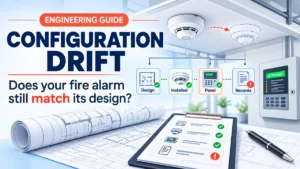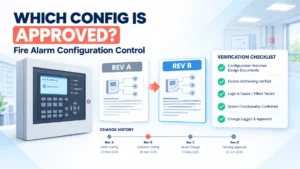
A fire alarm system is commissioned and handed over. Months later, a detector is replaced, a device is added during a layout change, and a cause-and-effect setting is adjusted. A maintenance engineer opens the project folder and finds several configuration files and scattered records. None is clearly marked as the approved operational state.
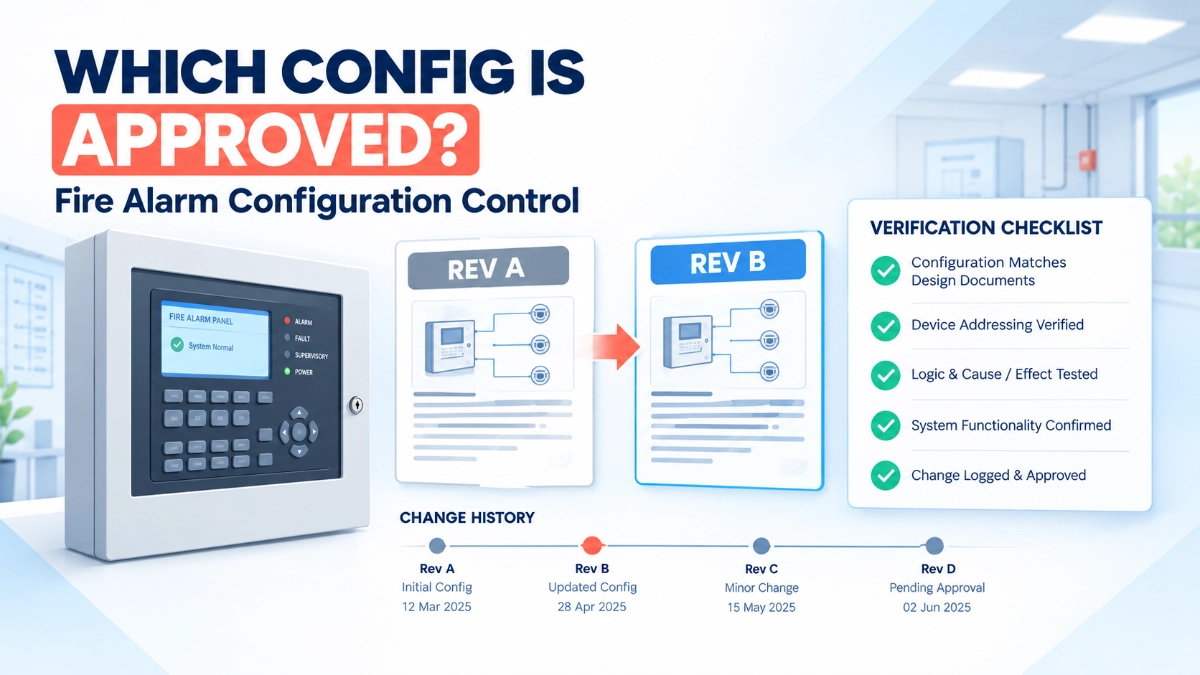
Which configuration was approved at commissioning? Were later changes authorised? Can the current state be compared with the original baseline? Were the affected functions tested? Could another engineer reconstruct the history if the person who did the work is no longer available?
Incomplete records don’t make a system unsafe on their own. They do make verification, troubleshooting, maintenance, and future modification harder. That is the problem fire alarm configuration management addresses.
Configuration version control helps engineers identify the approved system baseline, record authorised modifications, compare configuration states, and verify that changes were implemented and tested appropriately. It supports traceability across commissioning, maintenance, upgrades, and handover. A good record shows what changed, why, who approved it, which configuration was affected, and what verification followed. The exact method depends on the fire alarm platform, manufacturer tools, project requirements, and site procedures.
Why Configuration Control Matters After Commissioning
A system’s configuration keeps changing after handover. Typical triggers include:
- Device replacement during maintenance.
- Additions linked to building extensions or layout modifications.
- Changes to cause-and-effect logic or other approved functional settings.
- Updates to networked systems and connected interfaces, where applicable.
Each change can move the installed system away from its approved design intent. When records don’t capture that movement, troubleshooting becomes guesswork, and the next modification starts from an uncertain position.
Configuration control does not replace commissioning, testing, inspection, or maintenance. It supports them by establishing traceability between the approved design, the changes made, and the evidence that they were checked.
What Counts as a Fire Alarm Configuration Baseline?
A fire alarm configuration baseline is a documented reference state against which later changes can be assessed. Depending on the system and project, it may include:
- Panel and network architecture.
- Device inventory, addresses, and assigned locations.
- Relevant approved programming and configuration records.
- Cause-and-effect relationships and approved response logic.
- Input/output relationships and interface mappings, where applicable.
- Software, firmware, or tool versions, where these are recorded and important.
- Approved drawings, device schedules, commissioning records, and functional test results.
- Known limitations, outstanding actions, and approved deviations.
The baseline is not necessarily one file. It may be a controlled set of files, records, drawings, and verified system information. For an EST Fire Alarm System, as for any platform, that set should be identified before the first post-handover change is planned.
Associate the baseline with a date, system identification, approval status, and responsible parties. Device records matter here: addresses, types, and locations for EST Detectors and Devices are among the first items to diverge from drawings after replacements and additions.
Version Control Is More Than Saving Multiple Files
Backups preserve data. Configuration control preserves meaning: which version is approved, why it changed, and how the change was verified.
| Basic file storage | Controlled configuration management |
|---|---|
| Multiple files saved without clear status | Clearly identified approved baseline and subsequent versions |
| Filenames such as “final” or “final-new” | Consistent naming and version identification |
| Changes recorded informally or not at all | Documented change request, reason, and approval |
| Limited information about who changed what | Traceable author, reviewer, approver, and implementation details |
| No clear connection to testing records | Change linked to verification and test evidence |
| Uncertain current version | Defined process for identifying the current approved state |
The rigour of the process should match system complexity, risk, project requirements, and manufacturer capabilities. No single tool suits every project.
How to Establish a Reliable Configuration Baseline
- Identify the system: Record the project, site, panels, networks, relevant equipment, and applicable configuration elements.
- Collect existing records: Gather approved drawings, device schedules, configuration exports where supported, commissioning documents, and modification history.
- Verify the available state: Determine whether the records correspond to the installed, operational system. Do not assume an old file matches the live configuration.
- Resolve discrepancies: Document differences between records and verified system conditions, and investigate them before declaring the baseline complete.
- Define the baseline: Identify the approved reference set, its revision, date, scope, and approval status.
- Control access and storage: Keep records in a protected location with suitable access control and backup arrangements.
- Communicate ownership: Define who maintains the records, who approves changes, and how authorised personnel retrieve the current version.
Establishing a baseline does not make undocumented configurations approved. Any discrepancy must go through the relevant project and site review processes.
How to Control Changes Throughout the System Lifecycle
A controlled modification follows this path: Request → Impact Review → Approval → Implementation → Verification → Record Update → Closure.
- Request: Describe the proposed change, its reason, location, and affected equipment or functions.
- Impact Review: Assess effects on device addressing, cause-and-effect logic, interfaces, system capacity, documentation, and other relevant functions.
- Approval: Confirm that the appropriate responsible parties have reviewed and authorised the change before implementation.
- Implementation: Record what changed, by whom, when, and using which approved method or configuration revision.
- Verification: Identify the inspections and tests needed to show the change works as intended and has not adversely affected related functions.
- Record update: Update controlled configuration records, drawings, device schedules, and other affected documents.
- Closure: Record test results, outstanding actions, approvals, and final configuration status.
The amount of testing depends on the modification’s impact, system design, manufacturer instructions, applicable requirements, and approved site procedures. Not every change demands a complete system retest, and no change can be assumed safe with a token check.
What Should a Configuration Change Record Include?
| Record field | Purpose |
|---|---|
| Change reference | Unique identification and traceability |
| Site and system identification | Establishes where the change applies |
| Previous approved version | Identifies the reference state |
| Proposed change | Describes the intended modification |
| Reason for change | Records the operational or technical need |
| Affected equipment and functions | Defines the scope and impact |
| Requested by and implemented by | Identifies relevant personnel |
| Reviewer and approver | Records authorisation and review |
| Implementation date | Establishes chronology |
| Verification and test evidence | Shows how the change was checked |
| Updated documents and configuration | Identifies revised records |
| Final status and outstanding actions | Makes closure status clear |
Keep the record concise enough to use in practice, yet complete enough for another competent engineer to reconstruct the change history.
Configuration Drift, Unapproved Changes, and Documentation Gaps
These three problems are related but not interchangeable.
- Configuration drift is a difference between the controlled reference state and the current configuration, arising from accumulated modifications, inconsistent records, or other changes.
- Unapproved changes are modifications that have not passed the applicable authorisation process.
- Documentation gaps are missing or outdated records that prevent reliable confirmation of the system’s state.
Warning signs include unexplained differences between drawings and installed devices, inconsistent configuration files, undocumented device replacements, unclear programming revisions, and test records that do not match the latest modification history.
A discrepancy is a reason to investigate. It is not automatic proof of an unauthorised or unsafe modification.
Common Configuration-Control Mistakes Engineers Should Avoid
| Mistake | Practical consequence | Better practice |
|---|---|---|
| Treating a file labelled “final” as the baseline | Nobody can confirm it was approved or is current | Define the baseline by approval status, revision, and date |
| Overwriting the previous configuration without history | Changes cannot be compared or rolled back to a known state | Preserve prior approved versions under controlled identifiers |
| Assuming an archived file matches the live system | Work starts from a false reference | Verify records against the operational system first |
| Recording a change without verification | No evidence the change works or left other functions intact | Link every change to test evidence |
| Updating programming but not drawings or schedules | Documents contradict the system | Treat document updates as part of closure |
| Not recording maintenance or emergency changes | Silent drift builds up | Require retrospective records and review |
| Leaving approval responsibility unclear | Changes proceed without accountable review | Name reviewers and approvers up front |
| Storing records where maintenance staff cannot reach them | Engineers work from outdated copies | Use a controlled, accessible, protected location |
| Treating a backup as change control | Data exists, but status and verification do not | Use backups alongside change records and approvals |
Configuration Version Control in EST Fire Alarm Systems
At a general engineering level, the same discipline applies to Edwards/EST systems. Before planning any change, identify the installed platform, the approved configuration records, the available manufacturer tools, the system architecture, and the project documentation.
Platform identification matters for maintenance planning and lifecycle documentation. EST3 and EST4 installations should each be assessed against their own records and manufacturer documentation. Do not assume their tools, file formats, configuration workflows, capabilities, or compatibility are identical. Verify any platform-specific procedure, software requirement, or firmware consideration against current official manufacturer documentation before acting.
Making Configuration Control Part of Everyday Engineering
Configuration control fails when treated as a one-time documentation exercise. To sustain it:
- Assign a clear configuration owner.
- Establish a controlled location for approved records.
- Use consistent version identifiers and change references.
- Link modifications to approval and test evidence.
- Review records at commissioning, handover, maintenance, and expansion milestones.
- Ensure the next responsible engineer can identify the current approved state.
- Include configuration status in handover and maintenance reviews.
Keep it proportionate. The process should be disciplined and auditable without generating paperwork the team cannot maintain. For project support, product selection, and documentation coordination across the lifecycle, an EST Fire Alarm System Distributor in India can be one point of reference alongside your consultant and commissioning team.
Key Takeaways
- A verified baseline gives every later change a reliable reference point.
- Backups preserve data; version control establishes status, history, and approval.
- Every change needs impact review and authorisation before implementation.
- Verification and document updates are part of closing a change, not optional extras.
- Traceability across the system lifecycle lets the next engineer understand the system without relying on memory.
Read Also: Fire Alarm Event Correlation: How Engineers Distinguish One Fault From a Wider System Problem
Read Also: Fire Alarm and BMS Data Integration: Which Information Should Cross the Interface?