Introduction
Modern CCTV systems can record thousands of hours of video every day. However, when an incident occurs, security teams often face a different challenge: finding the exact footage that explains what happened.
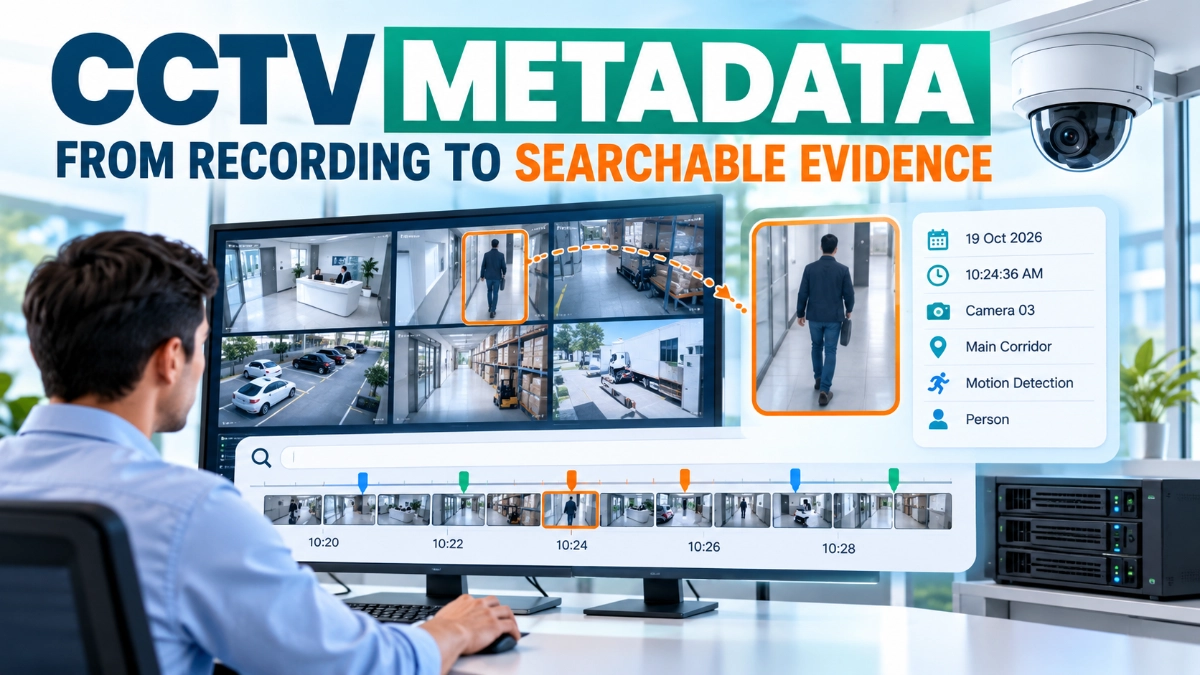
An investigator may need to identify when a vehicle entered a warehouse, when a person accessed a restricted area, or when a package disappeared from a distribution centre. Manually searching through hours of recordings can consume valuable time and delay investigations.
This is where CCTV metadata becomes important.
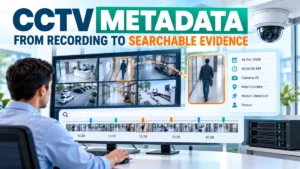
Metadata adds searchable information to video recordings, such as timestamps, object classifications, camera identifiers, motion events, and analytics results. When a compatible camera and video management system support these capabilities, operators can search recordings using specific events or attributes instead of relying only on manual playback.
For enterprise environments, this changes CCTV from a passive recording system into a more useful operational investigation tool.
What Is CCTV Metadata?
CCTV metadata is structured information tied to video footage that describes, organises, or interprets what a camera captures.
A video recording shows what happened. Metadata helps systems identify relevant information about the recording and makes that information easier to search.
Depending on the camera, analytics software, and recording platform, metadata may include:
- Date and time of an event
- Camera identification
- Motion detection events
- Object classification, such as person or vehicle
- Object location within a frame
- Direction of movement
- Line-crossing events
- Intrusion detection events
- License plate recognition results, where supported
- Camera status and system events
Not every CCTV system generates all these data types. Some metadata comes directly from the camera, while other information comes from video analytics software or an integrated third-party platform.
For example, a basic motion detection system may record when movement occurs. An advanced analytics system may classify the moving object as a person or vehicle and associate that classification with a timestamp.
The main purpose of CCTV metadata is to make relevant video easier to locate, interpret, and investigate.
Why Traditional Video Recording Is Not Enough
Traditional CCTV systems primarily focus on capturing and storing video. This remains essential, but recording alone does not guarantee efficient investigations.
Consider a distribution centre with 80 cameras recording continuously. If an inventory discrepancy occurs during an eight-hour shift, an investigator may need to review several cameras covering loading bays, storage aisles, entrances, and dispatch areas.
The challenge increases when the exact incident time is unknown.
Without effective search tools, the investigator must narrow the time window, open individual recordings, review footage, and repeat the process across multiple cameras.
This approach creates three operational problems.
1. Longer Investigation Times
Security teams may spend hours reviewing footage to locate a short incident. This delays reporting and diverts staff from other responsibilities.
2. Greater Risk of Missing Relevant Events
An incident may occur outside the expected time window or in a camera view that the investigator initially overlooks.
3. Limited Operational Insight
Video can reveal an incident, but structured event information can help organisations identify recurring patterns, such as repeated access attempts, vehicle movement through restricted areas, or unusual activity around loading bays.
Metadata does not eliminate the need to review footage. Instead, it helps investigators narrow the search and focus on relevant recordings.
How CCTV Metadata Makes Video Searchable
A metadata-enabled surveillance workflow typically involves four stages.
Stage 1: Video capture
The camera captures video and sends the stream to an NVR or video management system.
Stage 2: Event detection
The camera or analytics platform detects an event, such as movement across a virtual line or entry into a defined area.
Stage 3: Metadata generation
The system associates the event with information such as the timestamp, camera ID, object type, or event category, depending on its capabilities.
Stage 4: Search and verification
An authorised operator searches for relevant events, opens the associated video, and verifies what actually happened.
For example, a warehouse manager investigating unauthorised access could search for intrusion events associated with a particular camera and time period. The system could return relevant event markers, allowing the manager to review the corresponding footage.
The exact search options depend on the supported analytics, metadata format, VMS or NVR capabilities, and device interoperability.
Important Types of CCTV Metadata
1. Timestamp and Camera Metadata
Timestamps and camera identifiers form the foundation of video investigation.
They help operators locate recordings from a specific camera during a defined period. Accurate time synchronisation across cameras and recording systems is particularly important when investigators need to reconstruct a sequence of events.
If camera clocks differ, investigators may struggle to correlate footage from multiple locations.
2. Motion and Event Metadata
Motion metadata identifies periods when the system detects movement. Event metadata can also describe conditions such as line crossing, intrusion detection, or camera tampering.
These event markers help operators narrow their search to specific moments instead of reviewing an entire recording.
However, motion detection alone does not establish that suspicious activity occurred. Environmental movement, lighting changes, and incorrect detection settings can produce irrelevant alerts.
3. Object Classification Metadata
Video analytics can classify objects into supported categories, such as people and vehicles.
Depending on the system, operators may be able to search for recordings containing a particular object type or retrieve clips associated with a detected event.
This can be useful in factories, parking facilities, retail environments, and logistics centres.
Engineers should verify the actual analytics capabilities before specifying a system. Object classification does not automatically mean that a camera can identify a person’s identity or reliably recognise every object in difficult conditions.
4. Location and Movement Metadata
Some analytics systems track an object’s position within the camera’s field of view or identify movement across predefined zones.
These capabilities can help investigate movement through entrances, loading areas, restricted zones, or production floors.
Their accuracy depends on camera placement, image quality, scene conditions, analytics performance, and correct configuration.
The Role of Metadata in Enterprise CCTV Applications
Metadata becomes particularly valuable when an organisation needs to investigate incidents across many cameras.
Warehouses and Distribution Centres
Warehouse operators can use supported event searches to investigate activity around loading bays, inventory storage areas, vehicle entrances, and dispatch points.
For example, if a shipment discrepancy occurs, investigators can use timestamps and available event metadata to narrow the footage they need to review.
Manufacturing Facilities
Factories may use video analytics to identify activity around restricted machinery, production zones, or designated safety areas.
Metadata can help operators locate relevant events and review whether established procedures were followed. CCTV should complement, rather than replace, appropriate safety controls and supervision.
Commercial Buildings
Office complexes, campuses, and commercial facilities can use event metadata to investigate access incidents, vehicle movements, and activity in controlled areas.
The value depends on the site’s access policies, camera coverage, analytics requirements, and applicable privacy rules.
Metadata and the Importance of Interoperability
A common enterprise challenge is ensuring that cameras, NVRs, analytics applications, and video management systems can exchange useful information.
A camera may generate metadata, but that does not guarantee that the recording platform can interpret it or expose it through searchable filters.
Interoperability standards can help address this challenge.
ONVIF Profile M, for example, addresses metadata and events for analytics applications. It supports standardised approaches for exchanging information associated with video analytics, subject to the relevant profile requirements and device capabilities.
Before selecting equipment, engineers should verify:
- Whether the camera generates the required metadata.
- Whether the NVR or VMS supports the relevant metadata format.
- Whether analytics events remain available in recorded footage.
- Whether the platform supports the required search filters.
- Whether timestamps remain consistent across devices.
- Whether the required features work across the specific firmware and software versions.
Metadata generation and metadata search are separate capabilities. Both must work correctly to deliver practical benefits.
How CCTV Metadata Improves Investigation Efficiency
The business value of metadata becomes clearer when organisations measure investigation performance.
Consider a hypothetical warehouse investigation. An operator previously spent 90 minutes manually reviewing recordings. With an appropriately configured metadata-enabled workflow, the operator narrows the search and locates the relevant footage in 20 minutes.
That would represent a reduction of approximately 78% in investigation time.
These figures are illustrative, not industry benchmarks. Actual results depend on camera coverage, event accuracy, recording quality, system performance, and operator experience.
Organisations can measure improvements through several indicators:
- Average time required to locate relevant footage.
- Time between incident reporting and evidence retrieval.
- Percentage of investigations completed within a target period.
- Number of irrelevant event alerts.
- Frequency of missing or inaccessible recordings.
- Time required to export footage for authorised review.
Tracking these indicators helps organisations evaluate whether metadata delivers measurable operational value.
Engineering Considerations Before Deployment
A searchable CCTV system requires more than enabling analytics.
Camera Placement and Image Quality
Analytics performance depends on usable images. Poor lighting, glare, obstructions, unsuitable viewing angles, and excessive motion blur can reduce detection accuracy.
Engineers should select camera positions based on the operational task, not simply the area they need to cover.
Processing and Network Capacity
Metadata and analytics can introduce additional processing and network requirements. The impact depends on whether analytics run on the camera, a dedicated server, or a centralised platform.
Network design should account for video streams, analytics traffic, recording requirements, and future expansion.
Storage and Retention
Organisations should confirm how the platform stores metadata, event indexes, and associated video.
Some systems retain event information separately from the underlying recording. If video expires under the retention policy while an event record remains available, the event may no longer provide usable evidence.
Search Performance
Engineers should test real investigation scenarios before deployment. A system that displays event markers but cannot filter or retrieve them efficiently may not meet operational requirements.
Security and Access Control
Metadata can contain sensitive information about people’s movements and activities. Organisations should apply appropriate access permissions, retention policies, audit logging, and data protection controls.
Metadata Is Not the Same as Digital Evidence Integrity
One important distinction deserves attention: searchable footage is not automatically verified evidence.
Metadata helps locate and interpret recordings, but it does not independently prove that a video is authentic or unaltered.
For investigations, organisations should preserve the original recording where possible, document the export process, restrict access, and maintain a clear record of how the footage was handled.
Where evidentiary integrity is important, teams should follow applicable organisational procedures and legal requirements. Appropriate integrity-verification methods, including cryptographic hashes or supported video-authenticity features, may strengthen the process.
Metadata should support evidence retrieval, not replace evidence-preservation procedures.
Choosing CCTV Equipment for Metadata-Enabled Systems
When planning an enterprise surveillance deployment, engineers should evaluate the complete system rather than focusing only on camera resolution or recording capacity.
For example, an organisation considering Impact by Honeywell CCTV should assess the intended surveillance tasks, camera compatibility, analytics requirements, network architecture, NVR capabilities, and evidence retrieval workflow.
Impact by Honeywell bullet cameras may suit applications that require directional coverage, while Impact by Honeywell dome cameras may fit other indoor or commercial environments depending on the selected model and installation requirements.
When evaluating Impact by Honeywell NVRs, confirm the supported camera channels, recording parameters, integration capabilities, storage requirements, and available search functions. Do not assume that a particular NVR supports advanced metadata indexing without checking its specifications.
Organisations sourcing equipment through an Impact by Honeywell distributor in India should verify current product documentation and compatibility requirements before finalising the design.
The objective is to select equipment that supports the required operational workflow, from capturing usable video to retrieving and preserving relevant footage.
Conclusion
Enterprise CCTV is becoming more than a tool for recording and replaying video. When cameras, analytics platforms, and recording systems work together, metadata can make surveillance footage easier to search and more useful during investigations.
For warehouses, factories, campuses, and commercial facilities, the practical benefit is straightforward: operators can spend less time searching through recordings and more time investigating relevant events.
However, these benefits depend on suitable camera placement, accurate timestamps, compatible systems, reliable metadata indexing, appropriate retention, and disciplined evidence handling.
The real value of CCTV metadata is not simply collecting more information. It is helping organisations find the right footage faster, investigate incidents more efficiently, and make better use of the video they already record.
Read Also: CCTV Cybersecurity Beyond Passwords: Cameras as Connected Network Endpoints
Read Also: A Camera Can Be Working Perfectly and Still Fail Its Security Objective