Introduction: When the Environment Complicates Fire Detection
Consider a hypothetical food plant. Every morning, a wash-down starts while the ovens are still venting. Within minutes, a cloud of steam drifts under a ceiling detector. The detector sees airborne particles, the room is warm, and the airflow changes as the HVAC ramps up. An hour later, the same detector sits in a quiet corner of the line, slowly collecting a film of flour dust.
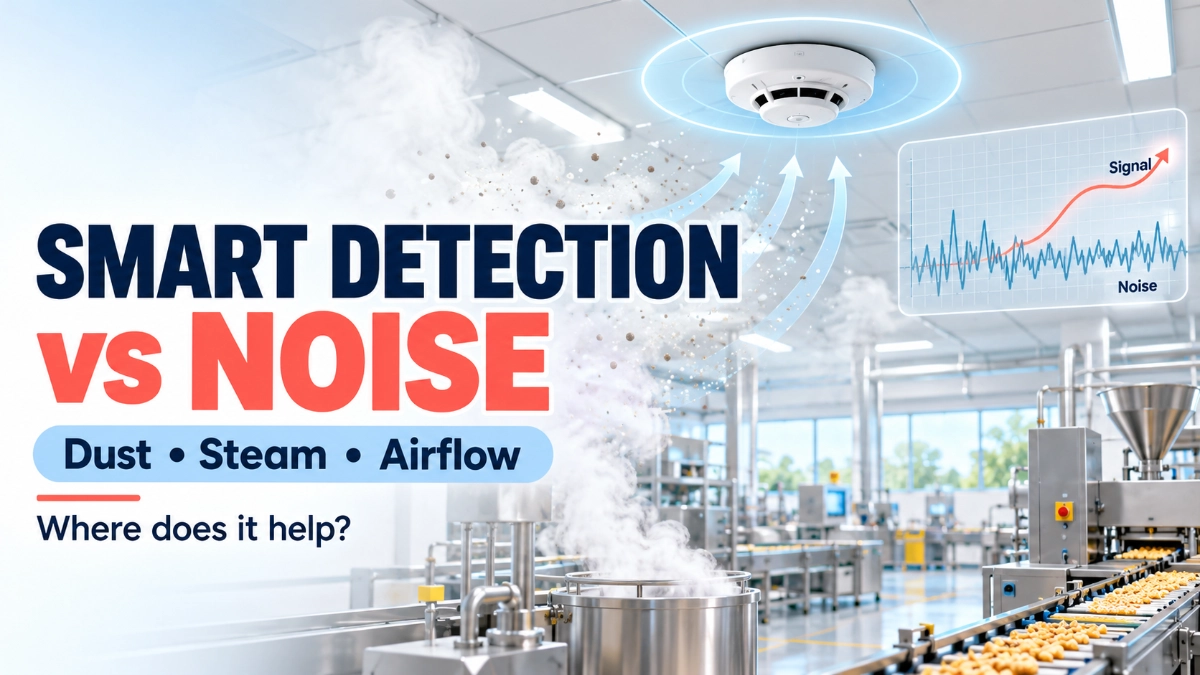
The detector has to decide something hard in both cases. Is this a developing fire, or just the normal life of the building?
That is the core engineering problem behind intelligent fire detection. Industrial spaces are full of signals that can resemble, mask or interfere with a real fire signature. The goal is to separate meaningful evidence from environmental noise without weakening early warning.
Intelligent detection can help interpret some of those signals. How well it works depends on the technology, the application, the configuration and the surrounding conditions. It is not a substitute for good design.
What Is Environmental Noise in Fire Detection?
Environmental noise in fire detection is any physical or environmental influence that can be mistaken for fire, or that interferes with a detector’s ability to interpret a real fire. It includes dust, steam, aerosols, temperature swings, airflow changes and contamination of the detector itself.
Common sources include:
- Dust and airborne particles from grinding, packaging or material handling.
- Steam and moisture from cooking, cleaning or process equipment.
- Temperature fluctuations near ovens, dryers, loading doors or sunlit roofs.
- Industrial fumes and aerosols.
- Welding and hot-work activity.
- Cooking-related aerosols in industrial kitchens
- Airflow and ventilation changes that dilute or redirect smoke.
- Contaminated or ageing detectors.
- Process changes that alter the environment over time.
Four terms are easy to confuse:
| Term | Meaning |
|---|---|
| Environmental interference | A condition that affects sensing or interpretation |
| Nuisance alarm | An alarm caused by a non-fire source, such as steam, dust or cooking aerosol |
| Detector contamination | Build-up inside or on the detector that changes its response |
| Fire indicator | A real product of combustion, such as smoke, heat or flame radiation |
These conditions do not affect every technology equally. Optical smoke detectors, heat detectors, ionisation detectors, aspirating systems and flame detectors each respond to different phenomena. Steam may trouble one and barely register on another.
What Makes Fire Detection Intelligent?
Intelligent fire detection means a detector, panel or software layer interprets signals instead of simply comparing one measurement to a fixed threshold. The exact features vary by product.
Common capabilities include:
- Multi-sensor detection: Combining smoke, heat, or other inputs so the system has more than one piece of evidence.
- Signal interpretation: Assessing how a signal rises over time, not just its level.
- Sensitivity adjustment: Setting response to suit the environment, within approved limits.
- Environmental compensation: Adjusting for slow drift such as dust build-up, where the product supports it.
- Alarm verification and decision logic: Confirming a condition before escalating, only where approved.
- Device diagnostics: Reporting contamination, drift or abnormal conditions.
- Aspirating smoke detection: Drawing air through sampling pipes to a sensitive detection chamber, often with filtering and signal processing.
What is the difference between an addressable detector and an intelligent detector?
An addressable detector has a unique identity on the system loop. An intelligent detector interprets signals using processing or algorithms. The first describes communication. The second describes functionality.
Addressability lets the panel know which device is in alarm, fault or pre-alarm. It does not guarantee multi-sensor inputs, advanced analytics or immunity to interference. An addressable detector can be simple, and a conventional detector can include sophisticated sensing. The only reliable test is the product documentation.
How Does Intelligent Fire Detection Reduce Unwanted Alarms?
Intelligent detection can reduce unwanted alarms by using more information about an event before deciding how to respond. It cannot remove the need to detect real fires early.
The main mechanisms are:
- Combining inputs: If smoke is high but temperature is unchanged, that evidence differs from smoke and rising heat together.
- Evaluating patterns: Steam bursts and developing fires often differ in how quickly signals rise, how long they persist and how they fade.
- Interpreting changing conditions: Some devices track baseline drift so slow build-up is not read as an event.
- Flagging contamination: Where supported, a detector can report that it is dirty or operating abnormally before it causes repeated alarms.
- Providing diagnostics: Event history shows when, where and how often an alarm pattern appears.
- Supporting investigation: Records help engineers link alarms to production schedules or HVAC changes.
Can smart fire detectors distinguish smoke from steam?
Sometimes, to a degree, but no detector separates smoke from steam perfectly in all conditions. Both can scatter light as particles or droplets. Some designs use optical analysis, a thermal channel or time-based signal behaviour to assess which is more likely. Dense, hot steam near a detector can still be ambiguous. Manufacturer limits and field testing matter.
A realistic example
In a food-processing area, steam levels rise and fall with each production cycle. A basic optical detector with a fixed threshold may alarm when steam density briefly crosses its limit. A multi-sensor detector, where the product supports it, may weigh the optical signal against thermal behaviour and signal pattern. A short steam surge may then be treated differently from a sustained rise with heat.
This helps only if the detector is placed where steam does not constantly saturate it, and if the algorithm is approved for the application. A properly designed system must also avoid delaying a genuine alarm.
Reducing unwanted alarms is not the same as delaying a real one. Any verification or delay must be approved, documented and compatible with the required response.
Can intelligent fire detection eliminate false alarms?
No. It can reduce the likelihood of some nuisance alarms. It cannot remove every environmental cause, correct a poor design or make an unsuitable detector suitable.
Where Intelligent Detection Has Limitations
Intelligent detection cannot reliably interpret smoke that never reaches the detector. No algorithm can analyse an event the sensor does not see.
Common limitations include:
- Incorrect detector selection: A detector chosen for an office may be wrong for a dusty process hall.
- Poor placement: Detectors near supply diffusers, in dead air or far from likely fire locations may respond late.
- Excessive dust or contamination: Heavy build-up can shift response beyond what compensation can handle.
- Airflow effects: Strong ventilation can dilute or divert smoke, and high ceilings can allow stratification.
- Obstruction: Racking, ducts, signage or stored goods can block smoke paths.
- Incorrect configuration: Wrong settings or modes can make a capable detector behave poorly.
- Inadequate maintenance: Compensation works within limits, and cleaning and testing still matter.
- Conditions outside specified limits: Humidity, temperature, condensation or air speed beyond the rating can affect reliability.
- Inappropriate sensitivity settings: Lowering sensitivity to stop alarms can slow response to a real fire.
- Poorly managed delays or verification: Unapproved delays can compromise life safety.
Reducing nuisance alarms must never justify suppressing legitimate fire indications. Any change to sensitivity, delay or verification should follow the applicable standard, the authority having jurisdiction and the manufacturer’s instructions.
Smart Detection vs Conventional Detection: What Is the Difference?
Conventional and addressable describe system architecture. Basic and intelligent describe detector functionality. They are separate questions.
In a conventional fire alarm system, detectors are wired in zones, and the panel shows which zone is in alarm. In an addressable fire alarm system, each device has a unique address, so the panel identifies the specific detector or call point.
| Factor | Conventional system | Addressable system |
|---|---|---|
| Device identification | Zone level | Individual device |
| Diagnostics | Typically limited | Often richer, depending on product |
| Configuration | Generally fixed by detector type | More options may be available |
| Maintenance information | Zone-based troubleshooting | Device-level history may be available |
| Environmental adaptation | Depends on the detector | Depends on the detector and panel |
| Integration | Simpler | Often broader, depending on the panel |
Conventional detectors can still be an appropriate and reliable choice when the design suits the application. Smaller buildings or simpler zones may fit a conventional fire alarm panel well. Larger or more complex facilities often benefit from device-level information.
Which Industrial Environments May Benefit From Intelligent Detection?
Multi-sensor smoke detectors and intelligent algorithms may add value where environmental conditions vary, but suitability depends on the application.
| Environment | Challenge | Possible benefit | Engineering considerations |
|---|---|---|---|
| Manufacturing plants | Dust, fumes, process heat | Pattern-based interpretation, contamination reporting | Detector type, cleaning access, fire hazard analysis |
| Warehouses and distribution centres | Height, airflow, racking | Diagnostics and zone-level analysis across large areas | Stratification, smoke transport, racking obstruction |
| Food-processing facilities | Steam, wash-down, humidity | Combined sensing may help separate steam events | Ingress protection, condensation, placement |
| Industrial kitchens | Cooking aerosols and heat | Heat-aware detection may reduce reliance on smoke alone | Appropriate detector type, local codes |
| Changing-steam areas | Variable moisture loads | Event history for recurring alarms | Placement away from steam sources |
| Dust-generating areas | Contamination, drift | Drift tracking and maintenance alerts | Enclosures, aspirating options, cleaning schedules |
| Large complex facilities | Many zones, many devices | Device-level addressing speeds investigation | Loop design, documentation, panel capability |
| Buildings with changing HVAC | Shifting airflow | Review of alarm history against HVAC operation | Re-assess detector locations after changes |
No single technology fits every facility. The right choice follows from the fire hazard and the environment, not from the feature list.
How Should Engineers Evaluate Intelligent Fire Detection?
Detector selection should be based on a documented fire-risk assessment, relevant standards, project requirements and manufacturer guidance. A practical sequence:
- Identify the interference: Name the source, frequency and location.
- Understand likely fire characteristics: Smouldering, flaming, fast or slow growth all differ.
- Review the sensing technology: Check what each detector actually measures.
- Check manufacturer environmental limits: Temperature, humidity, air speed and contamination.
- Evaluate airflow and placement: Where will smoke travel, and where will it pool?
- Test whether the features address the real problem: Do the multi-sensor or intelligent functions target your interference?
- Review alarm configuration and requirements: Include approved delays and verification, if any.
- Set inspection and maintenance procedures: Cleaning and test intervals follow the environment.
- Investigate recurring alarms: Use history to find causes instead of adjusting settings blindly.
- Verify genuine fire detectability: Confirm real fire indications still reach a suitable detector in time.
Practical Comparison Table
| Environmental challenge | Potential effect | Where intelligent detection may help | What it cannot replace |
|---|---|---|---|
| Dust | Can contaminate chambers and raise signal levels | Drift compensation and contamination reporting, where supported | Cleaning, enclosures and correct detector choice |
| Steam | Can resemble smoke to some optical sensors | Combined smoke and heat evaluation may help assess events | Placement away from steam sources and rated detectors |
| Temperature fluctuations | May affect heat detector response or sensor drift | Threshold or compensation logic within rated limits | Selecting detectors rated for the range |
| Airflow | Can dilute or divert smoke | Diagnostics may reveal repeated late or odd responses | Layout design and smoke-transport analysis |
| Detector contamination | May shift sensitivity or cause nuisance alarms | Fault or maintenance indications, where supported | Inspection, cleaning and testing |
| Changing industrial processes | New sources can create new alarm patterns | Alarm history supports review | Reassessment of the design after change |
The Role of Addressable Fire Alarm Systems
An addressable fire alarm panel communicates with each addressable detector over a loop, so the system can report the exact device and, depending on the product, its status or condition. That makes troubleshooting faster. If the same device alarms every morning at the same time, engineers can compare the pattern with wash-down or ventilation schedules.
Addressability supports investigation. It does not guarantee intelligent detection, advanced analytics or immunity from interference. Confirm both the panel and detector documentation for the functions you need.
In a GST fire alarm system, as with any manufacturer’s range, specific capabilities vary by model. Only documented features should be assumed, and specifiers should check the current datasheet for the exact detector and panel.
Maintenance and Configuration Still Matter
Reliability depends on more than the technology installed. A good programme includes:
- Detector cleaning and inspection
- Functional testing
- Reviewing alarm history
- Checking device configuration
- Investigating recurring alarms
- Reviewing production and HVAC changes
- Confirming detector locations remain suitable
- Updating records after approved system changes
Fire alarm detector maintenance is not optional for intelligent systems. Compensation features have limits, and a detector reporting contamination still needs cleaning or replacement.
Staff should never disable detectors or change alarm settings outside an authorised impairment procedure and the applicable requirements.
Conclusion: Intelligence Must Work With Good Engineering
Environmental noise, sensing technology, configuration, detector placement and maintenance all work together. Intelligent fire detection can improve how a system interprets available information. It cannot create information that never reached the sensor.
Reliable fire protection still depends on ensuring that the right fire indicators can reach a suitable detector and trigger the required response.
Read Also: Fire Alarm Configuration Drift: How Small Changes Can Break Design Intent
Read Also: How Process Exhaust Systems Can Influence Fire Detection Strategy