A maintenance engineer at an industrial facility pulls a fault report for one warehouse bay. It looks minor. Then the panel history shows similar faults from nearby devices over the past fortnight, plus an intermittent communication event late one night.
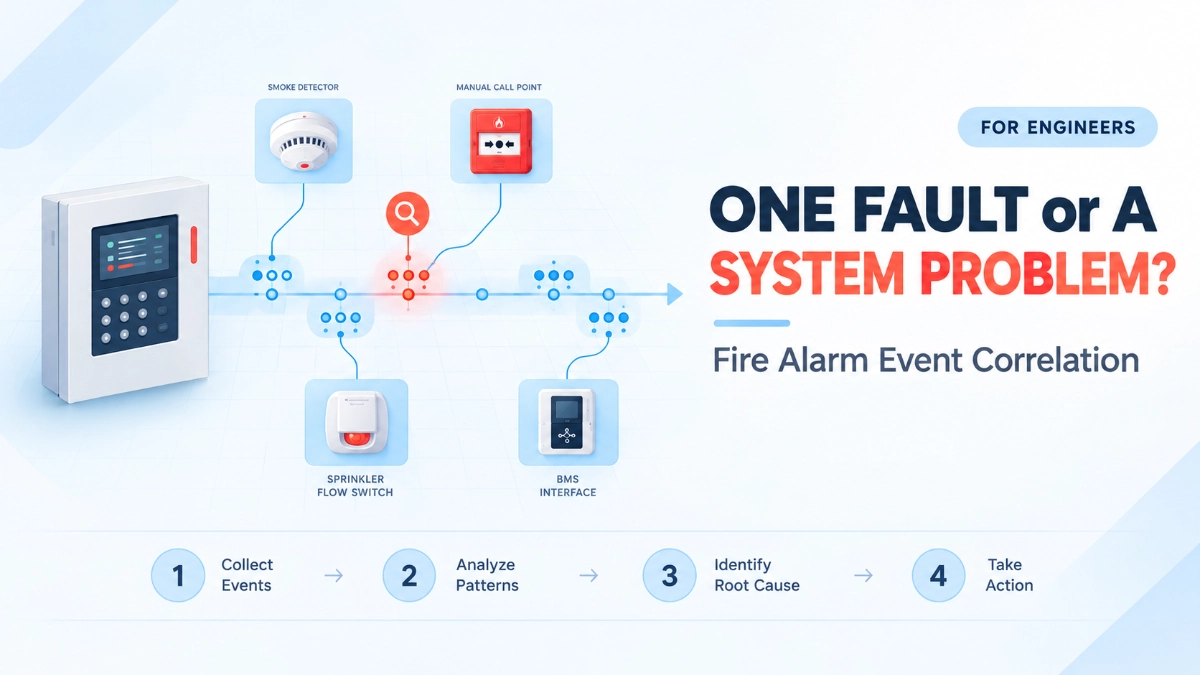
Questions follow. Are these events independent? Did one precede the others? Are the devices related physically or logically? Did anything change before the pattern began? What evidence would justify widening the investigation beyond the first fault?
Fire alarm event correlation is the structured method for answering those questions without jumping to conclusions.
Fire alarm event correlation compares event timestamps, locations, sequences, recurrence, and recent system changes to find relationships worth investigating. These patterns help engineers prioritise checks across devices, loops, panels, networks, power supplies, configurations, and connected interfaces where applicable. Correlated events indicate a possible relationship, not a proven shared cause. Engineers must verify each hypothesis through system records, physical inspection, approved diagnostic procedures, and appropriate testing.
Why a Single Fault Message May Not Tell the Whole Story
A fault message reports a symptom. “Device fault” or “communication trouble” does not say whether the cause lies in the device, its wiring, its environment, its configuration, or something upstream. Reading each message alone can lead to a component replacement while the underlying condition remains.
Recurring or simultaneous events can justify a broader look. But a high event count does not automatically mean a major failure, since one unstable device can generate many entries. Chronology and system context matter more than message volume. Event descriptions, timestamps, and diagnostic detail also vary by system, so interpretation must rest on the installed system’s documentation.
The Four Signals Engineers Use to Correlate Events
1. Time — When Did the Pattern Begin?
Timestamps show when a pattern began, how often it repeats, and whether events overlap. A fault recurring at regular intervals prompts different questions than one appearing only overnight. A change in frequency is often more informative than the total count.
Before trusting a timeline, check panel clock accuracy, time synchronisation, and event-record limitations such as buffer size and overwritten entries. Timestamps from a fire alarm panel and a BMS may not be comparable unless their clocks are known to be aligned and their event definitions are equivalent.
2. Location — Where Are the Events Concentrated?
Location data shows whether events cluster around:
- a single detector or device
- a group of devices
- a loop or circuit, where relevant
- a panel or network segment
- a building or environmental zone
- shared infrastructure or a connected interface
Device identifiers and addressing records for EST Detectors and Devices help map events to installed points. But physical proximity does not establish a shared electrical, logical, or causal relationship. Adjacent devices may sit on different circuits, and distant ones may share a path. Location analysis needs the system architecture.
3. Sequence — What Happened Before and After the Event?
Event order can suggest how symptoms relate: a device fault followed by communication events, a supervisory condition preceding panel indications, or an interface message following a panel event. What is observable depends on the specific system.
Chronological order is not causation. The first logged event may be the earliest recorded symptom of a condition that began elsewhere, and two events may share an unrecorded trigger. Use sequence to generate hypotheses, and keep observed events separate from inferred ones.
4. Recent Changes — What Was Different Before the Pattern Appeared?
Review what changed:
- Maintenance or device replacement
- Configuration or programming changes
- Building alterations or newly installed equipment
- Environmental changes
- Power or network work
- Changes to connected BMS or other ELV interfaces
A recent change is an investigation lead, not evidence of fault or responsibility. Patterns often coincide with maintenance simply because that is when devices are handled, and records are written. Compare work records against the timeline, then verify before attributing anything.
Is It an Isolated Fault or a Wider System Problem?
The table below lists investigation clues, not universal diagnostic rules. No event pattern can independently confirm a specific failure mode.
| Investigation clue | Possible interpretation | What engineers should verify |
|---|---|---|
| Repeated events from one device | Local device, environmental, wiring, or configuration issue | Device history, installation conditions, approved diagnostic checks |
| Similar events across related devices | Shared circuit, environmental, or configuration issue may be worth investigating | Device grouping, circuit topology, common conditions, system records |
| Communication events across multiple points | Possible communication-path, network, power, or configuration concern | Event sequence, architecture, available diagnostics, approved tests |
| Events beginning after maintenance | A change-related issue is possible | Work records, configuration changes, replacement details, verification results |
| Events across separate systems or interfaces | A shared condition or interface issue may be possible | Independent logs, timestamp alignment, interface mapping, responsibilities |
| Several unrelated events without a consistent pattern | Multiple independent issues may exist | Individual event evidence and alternative explanations |
A Practical Fire Alarm Event-Correlation Workflow
- Preserve the evidence: Retrieve available event history and relevant maintenance, configuration, and commissioning records before clearing or changing anything.
- Establish the timeline: Arrange events chronologically and confirm timestamp reliability.
- Group related events: Compare device identifiers, locations, event types, panels, loops, and interfaces where applicable.
- Identify the first observable change: Note what appears first in the available records, without assuming it is the root cause.
- Review recent work: Check maintenance, configuration, building, environmental, power, and network changes.
- Develop competing hypotheses: Record more than one plausible explanation, with evidence for and against each.
- Verify systematically: Follow manufacturer-approved procedures and site requirements to inspect and test the relevant components or paths.
- Document the conclusion: Record the confirmed finding, remaining uncertainty, corrective action, verification outcome, and follow-up needs.
Testing scope should follow the evidence, the system design, applicable requirements, and the impact of any corrective action. Never disable protection, bypass safety functions, or change live configurations without proper authorisation and safeguards.
A Worked Example — When Several Faults Appear Together
This is an illustrative scenario, not a real or verified incident.
A group of devices in one process area begins reporting recurring faults. Around the same period, a communication-related event appears on the panel. The team’s first assumption is an isolated device problem.
The timeline and location grouping change that view. The faults began within days of ceiling-void work, and the architecture drawings suggest the devices may share a circuit path. The team now holds competing hypotheses: independent device faults from contamination, disturbed wiring or connections from the building work, a configuration change, or coincidence. Each is listed with supporting and contradicting evidence.
Engineers then review work records, inspect the area, and run manufacturer-approved checks within their authorisation. They record a diagnosis only when testing confirms one explanation and rejects the others. If the evidence stays inconclusive, the report says so.
Common Mistakes in Event Correlation
- Assuming the first event is the root cause. It may be an early symptom. Treat it as one hypothesis among several.
- Treating simultaneous events as proof of a common cause. Independent faults can coincide. Look for a mechanism linking them.
- Ignoring clock differences between systems. Misaligned timestamps create false sequences. Verify synchronisation first.
- Grouping by physical location without understanding the architecture. Proximity can mislead. Map events to circuits, panels, and network paths.
- Watching message counts while missing a change in sequence. A shift in event order can matter more than repetition.
- Assuming recent maintenance must be responsible. Timing is not blame. Check work records and verification results.
- Clearing or altering records before preserving evidence. Useful history is lost. Export and secure records first.
- Closing the investigation when the symptom disappears. Intermittent faults return. Verify the affected function before closure.
How Event Correlation Supports Commissioning and Maintenance
A well-kept event history improves recurring-fault investigations, post-maintenance verification, and commissioning and handover records. It also supports trend review for preventive maintenance and gives maintenance teams, integrators, consultants, and facility managers a shared factual basis. Patterns that warrant further investigation surface earlier when records are consistent.
Event correlation does not replace physical inspection, approved testing, system knowledge, or manufacturer documentation. It tells engineers where to look first.
Event Correlation in EST Fire Alarm Systems
Before interpreting a pattern on any EST Fire Alarm System, engineers should understand the installed architecture, panel configuration, available event records, network design, and approved diagnostic tools. Identifying whether a site runs EST3 or EST4 is part of architecture review, documentation, and project planning. Specific event definitions, diagnostic functions, and platform differences must be confirmed against current manufacturer documentation, not assumed.
For product or project support, an EST Fire Alarm System Distributor in India can be a starting point for documentation and coordination.
Key Takeaways for Engineers
- Build the timeline before forming assumptions. Confirm clock reliability first.
- Read location together with architecture. Proximity alone proves nothing.
- Treat sequence as evidence, not proof. Order suggests relationships without establishing cause.
- Treat recent changes as investigation leads. Verify before attributing responsibility.
- Verify and document before closure. Record findings, uncertainty, corrective action, and verification outcome.
Read Also: Fire Alarm and BMS Data Integration: Which Information Should Cross the Interface?
Read Also: A Fire Alarm Modification Was Small. Why Did It Create a Bigger Engineering Problem?