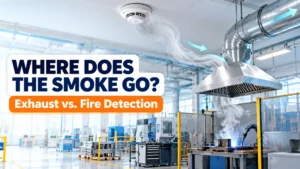
Consider a detector installed exactly where the layout drawing says it should be. It sits inside the spacing grid, on a flat ceiling, with no obvious obstruction. Directly beneath it, a local exhaust hood draws air from a heated process at a steady rate. During a smoke test, the test smoke bends toward the hood and passes below the detector. The detector works. The layout is compliant on paper. The problem is the assumption behind the grid: still air.
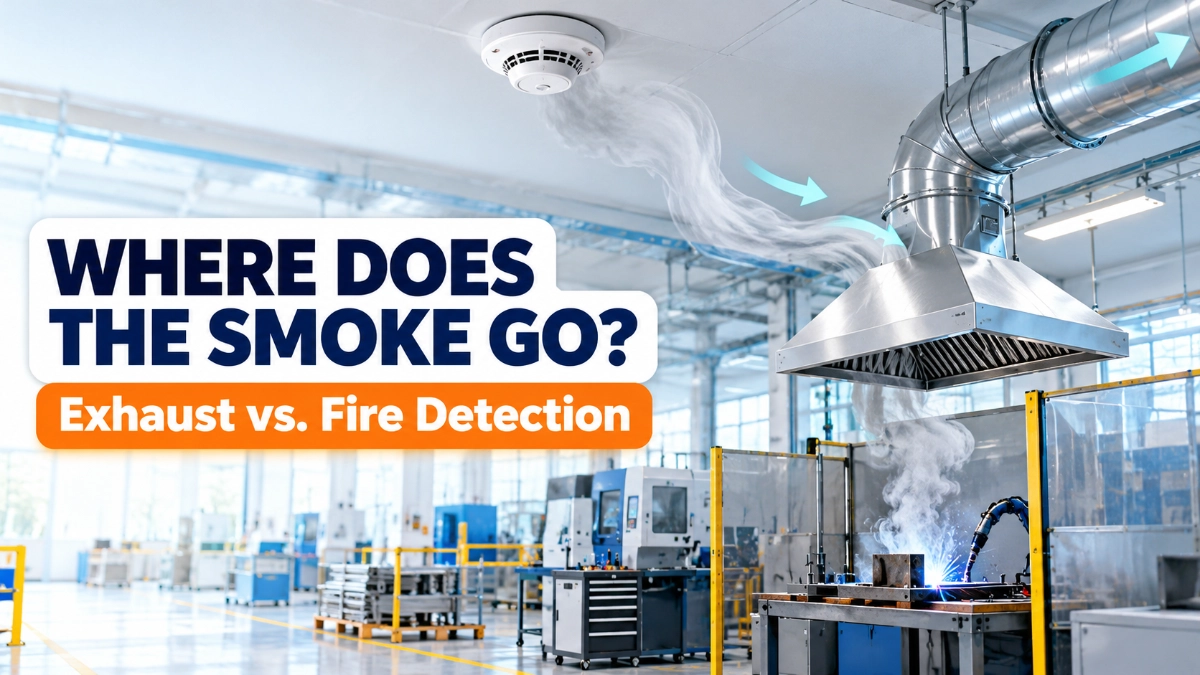
That gap separates installing detectors from designing a fire detection strategy around real operating conditions. A fire detector’s performance depends not only on the detector itself, but also on how smoke and combustion products move through the surrounding environment.
Process exhaust systems deserve attention during industrial fire alarm design because they change that movement. The term covers many systems: local exhaust ventilation, extraction hoods, industrial dust extraction, fume and welding extraction, process ventilation ducts, kitchen and food-processing exhaust, chemical process exhaust, and general industrial ventilation. Each serves a different purpose and creates different airflow conditions.
The central question is this: how can engineers keep industrial fire detection appropriate when exhaust systems influence smoke movement?
The chain of reasoning is straightforward. Process exhaust system → changes local airflow → influences smoke transport → affects detector exposure → informs detector placement and detection strategy.
What Is a Process Exhaust System?
A process exhaust system removes heat, fumes, dust, vapours, or other airborne contaminants at or near the point where an industrial activity generates them. Engineers also call this local exhaust ventilation when it captures contaminants at the source.
It differs from general HVAC ventilation, which conditions and circulates air for occupant comfort and dilution. The two systems may interact. A large exhaust flow, for example, needs make-up air from somewhere. But they do not necessarily share a purpose, a control scheme or an operating schedule.
Exhaust airflow depends on several factors:
- Hood location and capture design
- Extraction rate and fan operation
- Duct configuration
- Make-up air arrangements
- Whether the process equipment is running
- The characteristics of the process itself
A third category also matters: smoke-control systems. They exist to manage smoke during a fire. Process extraction and general ventilation usually exist for other reasons, so a detection strategy should not assume they behave like smoke control.
How Exhaust Airflow Can Influence Smoke Movement
Exhaust airflow can change where smoke travels, how fast it arrives and how concentrated it is when it gets there. The effect depends on the fire location, smoke buoyancy, exhaust flow, room geometry, make-up air and system configuration. It does not always delay detection, and it does not always improve it.
Exhaust airflow may:
- Draw smoke toward an extraction point. Smoke near a hood can follow the capture flow rather than rise to the ceiling.
- Alter the route of smoke. Local airflow patterns can steer a plume sideways or around equipment.
- Dilute smoke. Mixing between air streams can lower the local concentration reaching a detector.
- Disturb ceiling accumulation. Smoke normally collects as a layer under the ceiling, and strong air movement can change how that layer forms.
- Affect stratification. Smoke stratification is the tendency of smoke to stall at a lower height when it cools or meets warmer air above it. Airflow and thermal conditions together can strengthen or weaken it.
Keep two ideas separate. Smoke moving within a room is governed by buoyancy, ceiling geometry and room airflow. Smoke moving inside an exhaust duct is governed by duct flow. A duct-mounted detector and a ceiling-mounted detector face different conditions and serve different roles.
Manufacturer installation guidance reflects this. One detector installation manual notes that nominal spacing assumes ideal conditions such as a smooth ceiling and no air movement, and that air currents can change smoke travel. The same manual advises against installing a detector in the airstream of a supply diffuser.
Why Detector Placement Must Account for Extraction Points
Detector placement should be evaluated against actual airflow, not only against a floor plan. Proximity to an extraction point does not alone decide whether a location is suitable.
Engineers should assess each detector location against:
- Exhaust hoods and extraction grilles
- Supply-air outlets and return-air openings
- Ductwork
- High ceilings
- Structural beams
- Enclosed process areas
- Equipment that obstructs airflow
A detector near a return opening may see smoke drawn toward it. A detector in a supply jet may see smoke pushed away. A detector in a stagnant pocket behind equipment may see neither. The result depends on velocity, direction and geometry, so no single rule fits every layout.
This article gives no universal minimum distance from hoods or outlets, because none exists. Separation distances and airflow criteria come from the applicable standard, the detector manufacturer’s instructions and the project requirements. NFPA 72, for example, addresses high-air-movement areas and the effect of air currents on detector location. Check the edition your jurisdiction has adopted. In India, IS 2189 is the national code of practice for selection, installation and maintenance of fire detection and alarm systems, including those in industries.
Smoke testing and airflow observation under normal operating conditions, with exhaust running, give more reliable evidence than drawings alone.
Different Exhaust Applications Create Different Detection Challenges
No single detection approach suits every exhaust system. The table summarises typical considerations. The listed effects depend on the actual process and operating conditions.
| Exhaust Application | Potential Detection Consideration | Engineering Review |
|---|---|---|
| Dust extraction | Airborne particles and contamination | Environmental suitability and maintenance |
| Welding extraction | Fumes and particulates | Detection technology and local airflow |
| Chemical process exhaust | Process-specific airborne substances | Hazard assessment and equipment suitability |
| Food processing exhaust | Steam, heat, moisture, or grease where relevant | Environmental conditions and maintenance |
| Large manufacturing extraction | Multiple airflow paths and changing production layouts | Smoke movement and detector placement |
- Dust extraction: Airborne particles can reach detectors and accumulate in sensing chambers. That affects both detector suitability and cleaning frequency. Combustible dust also brings explosion and fire-prevention requirements that sit outside fire alarm design. NFPA 91, for instance, covers exhaust systems for vapours, gases, mists and noncombustible particulate solids and states that combustible particulate solids fall under other standards.
- Welding and metalworking exhaust: Welding produces fumes and particulates that local extraction captures only in part. Residual fume can drift into the ceiling zone. Detector technology must suit that environment, and extraction near the work point can change airflow around nearby detectors.
- Chemical and process exhaust: Do not assume every chemical process behaves alike. Evaluate the process hazards, airborne substances, temperature and equipment suitability for each area, including any hazardous-area requirements.
- Food processing and industrial kitchens: Steam, heat, moisture, and grease-laden air are common, and frequent washdown increases exposure. These conditions can influence both detector selection and cleaning routines.
- Large manufacturing facilities: Several extraction points, high ceilings, machinery and shifting production layouts create overlapping airflow paths. A layout that suited the plant five years ago may not suit it today.
Can Process Exhaust Systems Contribute to Nuisance Fire Alarms?
Yes, they can contribute, but rarely the only cause. Exhaust systems often sit within a wider environmental condition in which dust, fumes, steam or other airborne contaminants interact with the selected detector technology and trigger an alarm without a fire.
NFPA 72 has long expected detector locations to account for potential ambient sources of smoke, moisture, dust or fumes, and for electrical or mechanical influences, in order to limit nuisance alarms.
Treat these problems as separate issues:
- Nuisance alarm: an alarm from a non-fire source such as steam or process fume.
- Detector contamination: build-up inside the detector that changes its response.
- Reduced sensitivity: a detector that responds less readily than intended.
- Smoke dilution: smoke mixes with exhaust or make-up air before reaching the detector.
- Delayed exposure: smoke takes longer, or a different route, to arrive.
- Genuine fire condition: a real event that must not be dismissed as a nuisance.
Each has a different cause and a different fix. Investigate recurring alarms and find the actual cause. Do not disable detectors or change settings without an appropriate assessment, because that can remove protection from the area that most needs it.
How Engineers Should Select an Appropriate Detection Strategy
Selection depends on the expected fire, the environment and the airflow, not on one technology being better than the rest. Engineers should weigh fire characteristics, expected combustion products, environmental conditions, ceiling geometry, airflow, applicable standards, manufacturer limitations and maintenance access.
Options include:
- Point-type smoke detectors, which sample air at a single location.
- Heat detectors, which respond to temperature and tolerate some conditions that disturb smoke detectors, though they typically respond later to smouldering fires.
- Multi-sensor detectors, which combine sensing principles.
- Specialised detection technologies, such as beam or aspirating systems, where the application justifies them.
IS 2189 itself lists detector choices by risk and environment, including cases where heat detection suits dirty or kitchen areas and beam or aspirating detection suits others. Confirm this against the edition you apply.
Separate two decisions: selecting a detector technology and designing the fire alarm architecture.
On architecture, an addressable fire alarm panel identifies each addressable detector individually, which improves event visibility and fault location. A conventional fire alarm panel monitors conventional detectors in zones, so an alarm points to a zone rather than a single device. Manufacturers such as GST offer both approaches, and the GST fire alarm system range is one example of how architecture options are packaged.
Addressable architecture improves visibility. It does not remove airflow-related detection challenges. A well-identified detector in the wrong airflow location is still in the wrong location.
What Happens When Exhaust Systems Are Modified?
Fire detection should be reassessed when a change could alter the assumptions behind the original design. Typical triggers include:
- New extraction hoods
- Relocated production machinery
- Changed exhaust fan capacity
- Modified ductwork or make-up air arrangements
- New process equipment or higher throughput
- New airborne contaminants
- Changed partitions or ceiling layouts
The fire alarm panel and detectors may stay the same while the environment around them changes. The extent of review should match the significance of the change. A like-for-like fan replacement may need little more than a record, while a new hood line across a production bay deserves a proper look at smoke movement and detector locations.
Good change management helps: review drawings, assess environmental conditions, involve fire protection and HVAC engineers, and update documentation when required.
Inspection, Testing and Maintenance Considerations
Testing and maintenance must follow the applicable fire alarm standard, the manufacturer’s instructions and site procedures. In exhaust-influenced areas, add these checks:
- Review detector contamination and clean only as the manufacturer instructs.
- Investigate recurring unwanted alarms.
- Perform required functional tests.
- Review changes to exhaust operation.
- Check that detectors have not become obstructed.
- Keep records of system changes.
- Coordinate fire alarm and ventilation maintenance schedules.
- Follow impairment and restoration procedures whenever a device goes out of service.
Do not make disabling detectors a routine response to process emissions.
Practical Engineering Checklist for Fire Detection Near Exhaust Systems
- Identify all process exhaust and local extraction points. Include small hoods that drawings often omit.
- Document normal and variable exhaust operating conditions. Note shifts, batch cycles and fan speeds.
- Identify potential fire locations and expected smoke characteristics. Smouldering, flaming and oil fires behave differently.
- Evaluate the relationship between exhaust airflow and detector locations. Use observation or smoke testing, not drawings alone.
- Identify dust, fumes, steam, moisture or other contaminants.
- Check ceiling height, obstructions, partitions and equipment layout.
- Select detection technology appropriate to the application.
- Verify compliance with applicable standards and manufacturer requirements.
- Establish inspection and testing procedures. Include cleaning intervals.
- Reassess the design after significant process or ventilation changes.
Conclusion: Design Around Real Operating Conditions
Industrial fire detection should reflect how the facility actually operates. The factors work together: fire characteristics + exhaust airflow + environmental conditions + detector technology + detector placement + maintenance. Weakness in any one can undermine the rest.
Coordination between fire protection engineers, HVAC engineers, process engineers and facility teams helps surface detection challenges before they become operational problems. Process exhaust systems and fire detection strategy belong in the same design conversation, early and again after every significant change.
Read Also: The Production Line Moved. What Happened to Fire Detection Coverage?
Read Also: How Fire Alarm Design Should Adapt to Seasonal Industrial Operations