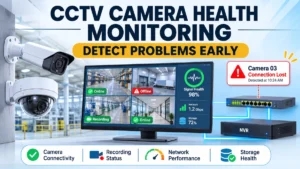
A CCTV camera does not always fail suddenly. In many cases, its performance starts degrading long before an operator notices a problem.
A camera may experience intermittent disconnections, increasing network latency, recording interruptions, reduced image quality or storage-related issues. However, the monitoring screen may still show the camera as online.
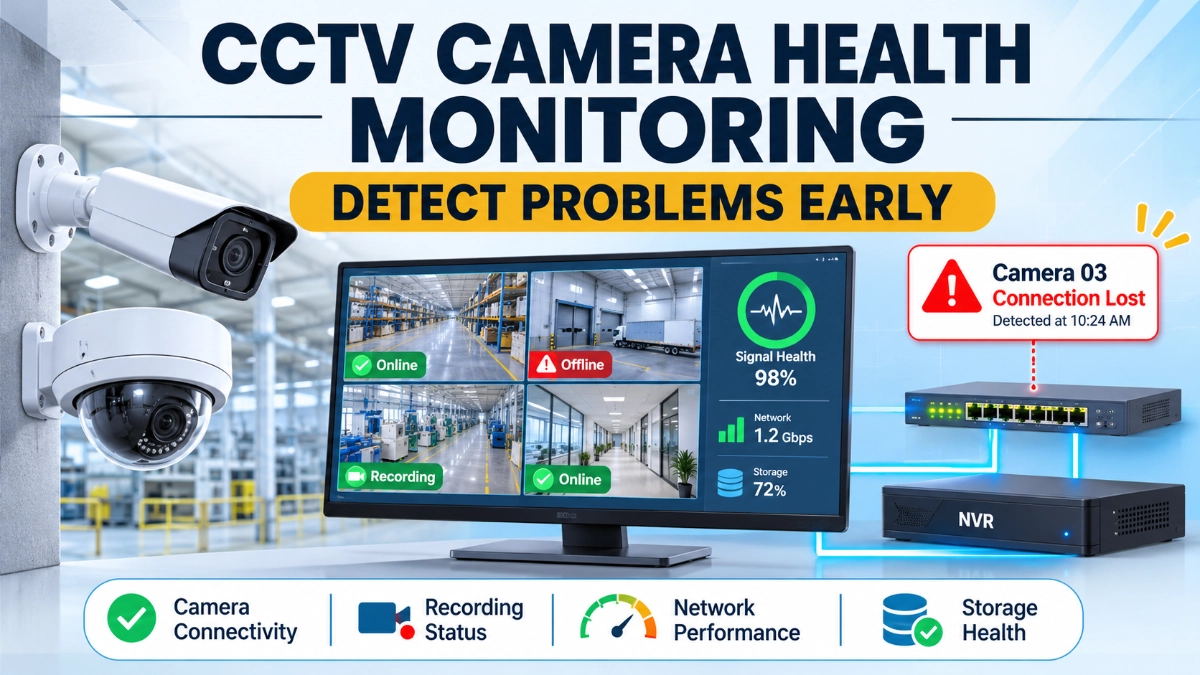
This creates a major challenge for security teams. By the time an operator reports missing footage or an unavailable camera, the problem may have already affected several hours or even days of surveillance.
This is where CCTV camera health monitoring becomes important.
Instead of waiting for operators to identify faults, engineers can monitor camera connectivity, video streams, network performance, recording status, storage health and device conditions to identify early warning signs.
For modern IP surveillance systems, proactive monitoring is not simply a maintenance activity. It is an important part of building a reliable security infrastructure.
In this article, we explore how CCTV health monitoring works, which parameters engineers should track, common warning signs and practical methods for detecting problems before they affect surveillance operations.
What Is CCTV Camera Health Monitoring?
CCTV camera health monitoring is the continuous process of checking camera connectivity, video streaming, recording performance, network conditions, storage availability and device status to identify potential faults before they become operational problems.
It helps engineers detect:
- Camera disconnections and communication failures.
- Video loss and intermittent streaming.
- Network latency and packet loss.
- Recording interruptions.
- Storage capacity and disk failures.
- Power supply and PoE-related issues.
- Abnormal device temperatures.
- Time synchronisation problems.
The objective is simple: identify problems early, reduce surveillance downtime and maintain continuous video availability.
1. Why Proactive CCTV Health Monitoring Matters
Traditional CCTV maintenance often follows a reactive approach. Engineers investigate a problem after an operator reports a camera failure, missing footage or poor video quality.
However, reactive maintenance has several limitations:
- Problems may remain unnoticed for hours.
- Recording gaps can affect incident investigations.
- Intermittent faults may disappear before inspection.
- Engineers may spend more time identifying the root cause.
- Multiple cameras may experience the same network-related issue.
Proactive monitoring changes this approach.
Instead of checking cameras only when something goes wrong, engineers continuously evaluate system health and establish alerts for abnormal behaviour.
Example: An Early Warning Scenario
Consider a warehouse with 80 IP cameras connected to multiple PoE switches and an NVR system.
One camera starts disconnecting for a few seconds several times a day.
The operator may not notice these interruptions because the camera reconnects automatically.
However, a monitoring system can identify repeated connection losses and alert the engineering team.
The engineer can then investigate the switch port, cable connection, PoE power delivery or camera network interface before the issue becomes a complete failure.
The biggest advantage of proactive monitoring is that it identifies abnormal behaviour before it becomes an operational complaint.
2. Camera Connectivity and Online Status
The first parameter engineers should monitor is camera connectivity.
An IP camera must maintain a stable connection with the network and its recording platform.
However, checking whether a camera is online is not enough.
A camera can respond to a ping while its video stream remains unavailable.
Engineers should monitor:
- Camera online/offline status.
- Repeated disconnection events.
- Network response time.
- Connection recovery time.
- Communication errors.
- Camera-to-NVR connectivity.
What Should Trigger an Alert?
Repeated disconnections within a short period should trigger investigation, even if the camera reconnects automatically.
For example, a camera that disconnects five times within an hour deserves attention.
Possible causes include unstable power, loose cabling, switch port problems, IP conflicts or firmware-related issues.
A useful monitoring system should distinguish between a temporary interruption and repeated instability.
3. Video Stream Health: Detect Problems Beyond Camera Connectivity
One of the most important aspects of CCTV health monitoring is video stream analysis.
A camera may appear online but fail to deliver usable video.
This can happen because of:
- Video stream interruption.
- Excessive packet loss.
- Incorrect stream configuration.
- Encoding problems.
- Network congestion.
- NVR decoding limitations.
- Camera firmware issues.
Engineers should monitor both the main stream and sub-stream wherever the platform exposes their status.
Important Video Health Parameters
| Parameter | What engineers should check |
|---|---|
| Frame rate | Unexpected reduction in FPS |
| Bitrate | Sudden changes or unstable bitrate |
| Resolution | Incorrect stream resolution |
| Video availability | Missing or frozen streams |
| Stream latency | Delays in video delivery |
| Codec | Unexpected encoding changes |
| Image quality | Blur, distortion or abnormal exposure |
For example, if a camera normally delivers 25 FPS but suddenly drops to 8 FPS, the monitoring platform should flag the change.
The engineer can then investigate bandwidth availability, encoding settings, camera processing or NVR performance.
It is important to establish thresholds based on the actual camera configuration and application rather than applying one universal limit to every camera.
4. Network Health Monitoring for IP CCTV Systems
Network performance directly affects CCTV reliability.
Large surveillance installations often include multiple switches, uplinks, VLANs, routers and recording servers.
A network problem can therefore affect several cameras simultaneously.
Engineers should monitor the following parameters:
- Bandwidth utilisation: Identifies network links approaching their available capacity.
- Packet loss: Helps detect missing network packets that can affect video delivery.
- Latency: Identifies delays between cameras, network infrastructure and recording systems.
- Port errors: Highlights interface errors, drops and abnormal switch-port behaviour.
- PoE status: Helps identify power-related issues affecting connected cameras.
- Link status: Detects unexpected Ethernet link changes.
Why Switch-Level Monitoring Is Important
Suppose 16 cameras connected to one PoE switch begin experiencing intermittent video loss.
Checking each camera individually may waste valuable troubleshooting time.
However, if all affected cameras share the same switch, engineers should investigate the common infrastructure first.
Possible causes include:
- Switch overload.
- Insufficient PoE power budget.
- Uplink congestion.
- Faulty network cabling.
- Incorrect VLAN settings.
- Switch hardware or firmware problems.
This is why network monitoring should form part of every large-scale CCTV health monitoring strategy.
5. PoE and Power Supply Monitoring
Power-related issues are another common reason for CCTV instability.
Power over Ethernet (PoE) allows compatible IP cameras to receive electrical power through Ethernet cabling.
However, engineers must consider the total power requirement of connected devices.
A switch may support 24 PoE ports but still have a limited total PoE power budget.
If connected cameras exceed the available budget, the system may experience power-related interruptions, depending on the switch and its power-management behaviour.
What Should Engineers Monitor?
- Total PoE power consumption.
- Available power budget.
- Individual port power usage.
- Port power interruptions.
- Unexpected device reboots.
- Switch power supply status.
For example, adding several PTZ cameras with higher power requirements to an existing switch can change its total power demand.
Monitoring PoE consumption helps engineers identify capacity problems before they affect camera availability.
6. NVR Recording and Storage Health
A CCTV system can display live video while failing to record footage correctly.
This is one of the most important issues that proactive monitoring should detect.
Engineers should monitor:
- Recording status.
- Storage utilisation.
- HDD health.
- Disk errors.
- RAID status, where applicable.
- Recording schedules.
- Camera recording gaps.
- NVR temperature and system alarms, where supported.
Storage Capacity Is Not the Same as Storage Health
An NVR may have sufficient free storage but still experience recording problems because of a failing hard drive or storage communication issue.
Similarly, an incorrect recording schedule can create gaps even when the hardware works normally.
For this reason, monitoring should include both storage capacity and actual recording availability.
A healthy live stream does not guarantee a healthy recording system.
For larger installations, engineers should periodically test playback from randomly selected cameras to confirm that recorded footage is available and usable.
7. Temperature and Environmental Monitoring
Environmental conditions can influence camera performance, especially in industrial facilities, outdoor installations and warehouses.
High temperatures, moisture, dust and poor ventilation can affect electronic equipment.
Depending on the hardware, engineers may be able to monitor:
- Internal device temperature.
- NVR operating temperature.
- Switch temperature.
- Fan status.
- Environmental sensor readings.
- Humidity and enclosure conditions.
Not every CCTV camera provides internal temperature telemetry. In those cases, engineers can use external environmental sensors or periodic inspections.
Example
Consider an outdoor camera installed near a manufacturing process.
During normal operation, the camera performs correctly. However, temperature increases during afternoon production hours.
The device starts restarting intermittently.
By correlating camera disconnection alerts with environmental temperature readings, engineers can investigate overheating rather than immediately replacing the camera.
This type of correlation makes troubleshooting more effective.
8. Firmware, Configuration and Time Synchronisation Monitoring
CCTV health monitoring should also track changes in device configuration.
Unexpected configuration changes can affect system performance even when every device remains online.
Important parameters include:
- Firmware version.
- Camera resolution.
- Frame rate.
- Bitrate.
- Video compression.
- IP address.
- User authentication.
- Recording configuration.
- NTP settings.
- Motion detection settings.
Engineers should maintain a baseline configuration and compare it against the current device settings.
This helps identify unauthorised changes, configuration drift and compatibility issues.
Time synchronisation also deserves attention.
If cameras and NVRs use different timestamps, incident investigations become more difficult.
Monitor NTP synchronisation, time zones and timestamp consistency across the surveillance system.
9. How to Build an Effective CCTV Health Monitoring Strategy
An effective monitoring strategy combines device-level, network-level and recording-level information.
Here is a practical approach for engineers.
Recommended monitoring workflow
- Establish a system baseline: Record camera models, IP addresses, firmware versions, switch connections, stream settings and recording requirements.
- Connect monitoring sources: Use supported NVR/VMS health dashboards, SNMP monitoring, device APIs, syslog and network-management tools.
- Define health thresholds: Set application-specific limits for disconnections, packet loss, latency, FPS, storage and PoE consumption.
- Configure intelligent alerts: Generate alerts for repeated failures, abnormal behaviour and sustained performance degradation.
- Correlate multiple events: Compare camera, switch, NVR and environmental alerts to identify common root causes.
- Review and improve: Analyse recurring faults, update thresholds and maintain preventive maintenance records.
Choosing the Right Monitoring Tools
The monitoring platform should match the size and complexity of the installation.
| Monitoring method | Primary purpose |
|---|---|
| NVR/VMS dashboard | Camera status and recording |
| SNMP monitoring | Network switch and device health |
| Syslog | Device events and error records |
| Network monitoring software | Bandwidth, latency and packet loss |
| Device APIs | Supported camera health information |
| Storage monitoring | HDD and recording health |
| Environmental sensors | Temperature and humidity |
Engineers should verify which parameters each device actually exposes. A monitoring platform cannot reliably report information that the camera, NVR or network equipment does not provide.
10. How Different CCTV Applications Benefit from Health Monitoring
Health monitoring requirements vary according to the application.
Industrial facilities
Monitor camera uptime, network stability, recording continuity and environmental conditions around production areas.
Warehouses and distribution centres
Monitor blind spots, camera disconnections, recording gaps and network performance across large storage areas.
Commercial buildings
Monitor access-area coverage, NVR availability, time synchronisation, and camera recording schedules.
Outdoor surveillance
Monitor weather-related deterioration, power interruptions, connectivity and enclosure conditions.
11. Selecting CCTV Equipment With Monitoring in Mind
Proactive monitoring starts during system design, not after installation.
Engineers should evaluate whether the selected cameras and recording equipment provide the necessary status information, network compatibility and recording capabilities.
For example, when considering Impact by Honeywell CCTV, engineers should evaluate camera specifications, supported network features, recording compatibility and the requirements of the intended application.
The choice between Impact by Honeywell bullet cameras and Impact by Honeywell dome cameras should depend on the surveillance environment, mounting requirements and coverage objectives.
Similarly, when evaluating Impact by Honeywell NVR’s, engineers should consider supported camera channels, recording capabilities, storage requirements and available system-health information.
For equipment sourcing, an authorised or verified Impact by Honeywell distributor in India can be a relevant starting point for checking product specifications and availability.
The important consideration is to select equipment that fits the complete surveillance architecture and its long-term monitoring requirements.
12. CCTV Camera Health Monitoring Checklist
Engineers can use the following checklist during routine system inspections.
| Monitoring parameter | What to verify |
|---|---|
| Camera connectivity | Online status and repeated disconnections |
| Video streaming | FPS, bitrate and stream availability |
| Network | Latency, packet loss and bandwidth |
| PoE | Power consumption and port stability |
| NVR | Recording status and system alarms |
| Storage | Disk health and available capacity |
| Firmware | Current version and update history |
| Configuration | Changes to IP and video settings |
| Time | NTP and timestamp consistency |
| Environment | Temperature and enclosure condition |
Recommended practice: Combine continuous automated monitoring with periodic physical inspections. Neither approach should replace the other.
Conclusion: Detect Problems Before They Become Surveillance Failures
CCTV reliability depends on more than installing good cameras and connecting them to an NVR.
A reliable surveillance system requires continuous monitoring of camera connectivity, video streams, network performance, power delivery, storage health and device configuration.
The biggest advantage of proactive CCTV health monitoring is that it allows engineers to identify early warning signs before they develop into serious operational problems.
Instead of waiting for operators to report missing footage or disconnected cameras, engineering teams can use automated alerts, performance monitoring and event correlation to identify faults earlier.
As CCTV installations become larger and more network-dependent, proactive monitoring will become an increasingly important part of surveillance system design and maintenance.
The objective is not just to know whether a camera is online. It is to know whether the camera is delivering usable video, communicating reliably and recording the footage when it matters most.
Read Also: Camera Coverage After Factory Layout Changes: How to Identify New Surveillance Blind Spots
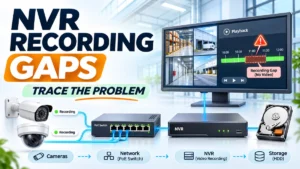
Read Also: NVR Recording Gaps: How to Trace Problems Across Cameras, Networks and Storage