When engineers specify CCTV, one of the most common mistakes is starting with camera resolution.
“Should we use a 4MP or 8MP camera?”
That sounds like a straightforward question, but resolution alone does not determine whether a surveillance system will actually deliver useful evidence.
A better starting point is the operational requirement.
Does the camera only need to detect that someone entered an area? Does the operator need to recognise a familiar person? Or must the recorded image provide enough detail to identify an unknown individual?
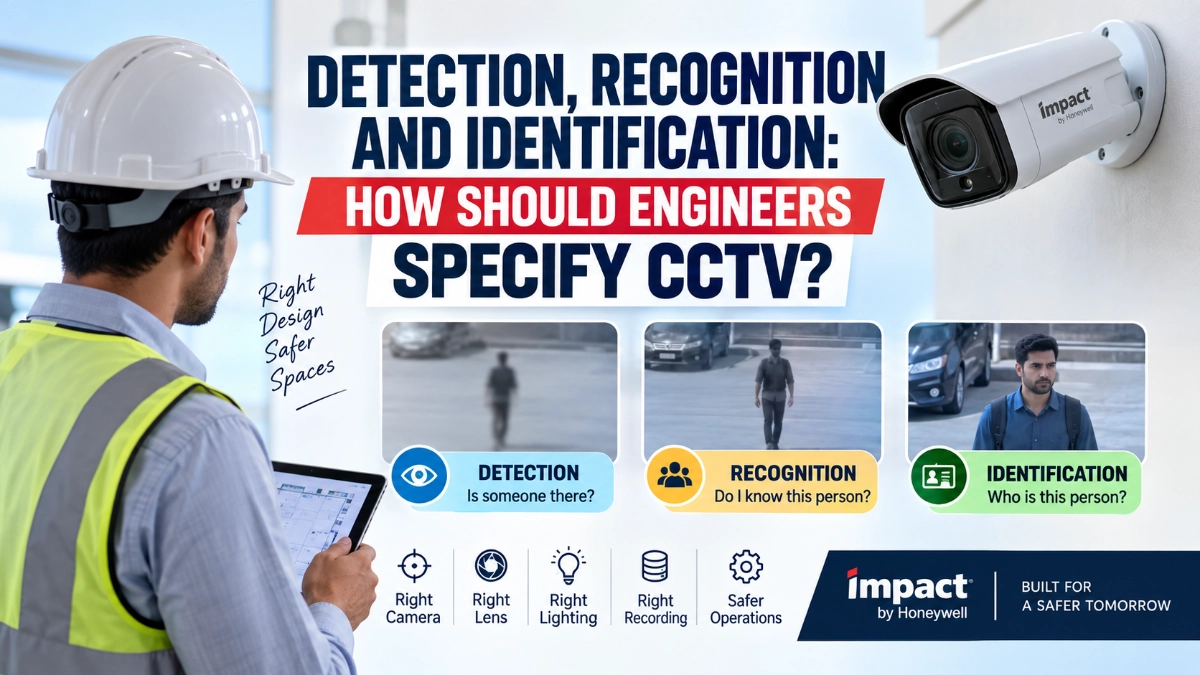
These requirements lead to three important surveillance objectives:
- Detection: Determining whether a person or object is present.
- Recognition: Determining whether the person or object is familiar or matches a known reference.
- Identification: Obtaining enough visual detail to establish the identity of an individual or distinguish a specific object.
This distinction matters because a camera can produce a sharp-looking image while still failing its actual surveillance objective.
For CCTV engineers, the specification should therefore move from “What megapixel camera should I use?” to “What level of visual detail must the system reliably deliver at the target location?”
What Should Engineers Specify?
Engineers should specify CCTV based on the required surveillance outcome, target area, viewing distance, pixel density, lens selection, lighting conditions, mounting position, scene activity and recording requirements, not camera megapixels alone.
A practical design approach is:
Operational objective → target area → required pixel density → camera/lens → lighting → analytics → recording → verification
For many conventional surveillance designs, pixel density is a useful engineering parameter because it connects camera resolution and lens selection with the amount of detail available on the target.
Common guidance associated with IEC 62676-based pixel-density models uses approximately:
| Objective | Approx. pixel density |
|---|---|
| Detection | 25 px/m |
| Observation | 63 px/m |
| Recognition | 125 px/m |
| Identification | 250 px/m |
These figures should be treated as design guidance rather than a guarantee. Real-world performance also depends on lighting, motion, compression, camera angle, image quality and the characteristics of the scene.
Why Megapixels Are Not Enough
A 4MP camera does not automatically provide better identification than a 2MP camera.
Similarly, an 8MP camera does not guarantee that a face 30 metres away will be identifiable.
Why?
Because the total number of pixels on the sensor is only one part of the equation.
Consider two cameras:
- Camera A: 8MP, wide-angle lens
- Camera B: 4MP, narrower lens
If Camera A spreads its pixels across a very large area while Camera B concentrates its pixels on a smaller target area, Camera B may provide more useful detail on the person you actually care about.
This is why engineers should consider pixels per metre (px/m) or another appropriate performance metric rather than relying solely on megapixel ratings.
The key question is:
How many useful pixels will cover the target at the required distance?
That question is much more meaningful than simply asking how many megapixels the camera has.
Understanding Detection, Recognition and Identification
1. Detection: “Is Someone There?”
Detection is the most basic surveillance objective.
The purpose is to establish that a person, vehicle or object is present within a defined area.
For example:
- Someone entered a restricted corridor.
- A vehicle entered a loading zone.
- A person crossed a perimeter.
- An object appeared in a monitored area.
At the detection level, the system may not need to provide enough detail to identify the individual.
Engineering implication
A detection camera can generally cover a larger area because the required level of detail is lower.
However, engineers should avoid specifying a wide-angle camera simply because it covers more area. If the camera is too wide, the target may occupy too few pixels for the intended analytics or investigation.
2. Recognition: “Do I Know This Person?”
Recognition requires more detail.
Here, the objective is not merely to determine that somebody is present. The system should provide enough visual information for an operator to recognise a person, vehicle or object when compared with something previously known.
Examples include:
- Recognising an employee entering a controlled area.
- Recognising a familiar vehicle.
- Recognising a person previously seen on site.
- Distinguishing between different types of objects.
Recognition usually requires substantially greater pixel density than basic detection.
Engineering implication
Camera position becomes increasingly important.
A camera mounted too high may capture the top of a person’s head rather than useful facial detail.
Likewise, a camera facing a bright entrance may produce a silhouette if the exposure and dynamic range are inadequate.
For recognition-focused applications, engineers should evaluate:
- Camera height
- Horizontal viewing angle
- Distance to the target
- Lens focal length
- Lighting direction
- WDR performance
- Expected subject movement
3. Identification: “Who Is This Person?”
Identification represents a higher evidentiary requirement.
The objective is to obtain sufficient detail to determine the identity of an unknown person or distinguish a specific individual from others.
Typical applications include:
- Security entrances
- High-value asset areas
- Restricted access points
- Cash-handling locations
- Critical infrastructure
- Perimeter gates
- Investigation-critical viewpoints
A common pixel-density model uses approximately 250 px/m for identification.
But achieving that number on paper does not automatically guarantee usable evidence.
The image still needs adequate:
- Focus
- Exposure
- Contrast
- Illumination
- Shutter speed
- Compression quality
- Facial orientation
- Scene stability
This is why CCTV design should include performance verification, not simply equipment selection.
The Most Important Concept: Pixel Density
Pixel density describes how much image information is available across the target.
Imagine a person standing in front of a camera.
If the person occupies only a small portion of the image, increasing the camera’s overall resolution may not solve the problem.
The engineer needs to make the person occupy enough pixels.
This depends on several variables:
Pixel density = camera resolution + lens selection + target distance + field of view
The relationship is not simply “higher megapixels = better surveillance.”
A narrower field of view can place more pixels on a specific target, while a wider field of view distributes those pixels across a larger scene.
Lens Selection Can Matter More Than Resolution
One of the most overlooked parts of CCTV specification is lens selection.
Suppose a camera must monitor a gate located 25 metres away.
If the engineer selects an excessively wide lens, the entire gate may fit comfortably into the image—but the face of a person entering through it may occupy too few pixels.
A more appropriate focal length may reduce the field of view while concentrating available pixels on the critical area.
This leads to an important engineering principle:
Do not design the camera around the area alone. Design it around the critical target within that area.
For example, a warehouse may require general monitoring across the floor but identification at specific entry and exit points.
Those two objectives may require different cameras.
One Camera Does Not Have to Do Everything
Trying to make one camera perform detection, recognition and identification across a large site often creates compromises.
A better approach is to divide the surveillance design into operational zones.
Example: Industrial Facility
| Area | Primary objective | Typical design approach |
|---|---|---|
| Perimeter | Detection | Wide-area coverage |
| Parking area | Observation/Recognition | Moderate detail |
| Main entrance | Identification | High pixel density |
| Loading gate | Identification | Focused view |
| Warehouse floor | Detection/Observation | Wider coverage |
| High-value storage | Recognition/Identification | Focused camera |
| Control room access | Identification | Dedicated viewpoint |
This approach can produce a more practical system than installing the same camera model everywhere.
Camera Placement Is Part of the Specification
A technically capable camera can fail because of poor placement.
Engineers should evaluate:
Camera height
Too high can reduce useful facial detail.
Camera angle
Extreme viewing angles can make faces difficult to interpret.
Distance
Increasing distance generally reduces pixel density on the target.
Lighting
Backlighting, low light, and rapidly changing illumination can affect image usability.
Target direction
If people routinely walk sideways across the scene rather than toward the camera, the required image characteristics may change.
Environmental conditions
Outdoor cameras may need to deal with:
- Rain
- Dust
- Fog
- Direct sunlight
- Night conditions
- Reflections
- Temperature changes
Therefore, camera specification and camera placement should be treated as one engineering problem.
Don’t Ignore Motion Blur
A high-resolution image is not useful if the subject is moving and the shutter speed is too slow.
This is particularly important at:
- Entrance gates
- Vehicle checkpoints
- Roadways
- Warehouses
- Manufacturing facilities
- Parking areas
For identification applications, engineers should consider expected target speed and lighting before finalising camera settings.
A camera that produces excellent static images may produce poor evidence when a person or vehicle moves quickly through the scene.
WDR and Lighting Can Change the Result
Consider an entrance with strong sunlight outside and a darker interior.
A conventional camera may struggle to expose both areas correctly.
The result could be:
Bright background + dark face = poor identification
Wide Dynamic Range (WDR) can help manage scenes with significant differences between bright and dark areas.
However, WDR should not be treated as a replacement for proper camera positioning and lighting design.
Engineers should inspect the actual scene whenever possible.
What Should Be Included in a CCTV Specification?
Instead of writing:
“Install 8MP IP cameras.”
a stronger engineering specification should describe the intended performance.
For example:
“The CCTV system shall provide identification-level image detail at designated access-control points under defined day and night operating conditions. Camera selection shall be based on target distance, field of view, lens characteristics and required pixel density.”
A detailed specification can include:
- Surveillance objective
- Target area
- Critical target dimensions
- Camera mounting height
- Target distance
- Horizontal field of view
- Required pixel density
- Minimum resolution
- Lens/focal-length requirements
- Low-light performance
- WDR requirements
- Frame rate
- Compression
- Storage duration
- Recording mode
- Analytics requirements
- Network requirements
- Environmental rating
- Verification/testing method
This gives contractors and system integrators a performance target rather than simply prescribing hardware.
How Bullet and Dome Cameras Fit Into the Design
Camera form factor should follow the application.
Bullet cameras can be useful where the design calls for a directional view, longer-range coverage, or clearly defined viewing direction.
For example, an outdoor perimeter or vehicle approach may benefit from a directional camera configuration.
Dome cameras can be useful where a more discreet or ceiling-mounted form factor is appropriate, particularly in offices, retail environments, corridors and indoor facilities.
The important point is that engineers should not specify a camera purely because it is a bullet or dome.
The correct question is:
Which camera configuration can reliably achieve the required surveillance objective at the target location?
This is where a portfolio such as Impact by Honeywell CCTV can be evaluated based on application requirements rather than simply comparing megapixel numbers.
For projects requiring directional outdoor coverage, engineers can assess suitable Impact by Honeywell bullet cameras against factors such as lens options, environmental conditions and required target distance.
For indoor areas or locations where the installation calls for a ceiling-mounted form factor, Impact by Honeywell dome cameras can be considered as part of the overall surveillance design.
The NVR Is Also Part of the Engineering Design
The camera is only one component of the surveillance system.
The Network Video Recorder (NVR) must support the camera streams, recording requirements and required features.
Engineers should verify:
- Number of supported channels
- Incoming bandwidth
- Recording resolution
- Storage capacity
- Compression support
- Playback capability
- Network interfaces
- Camera compatibility
- Alarm/event handling
- Analytics support
- Redundancy requirements where applicable
For example, selecting high-resolution cameras without appropriately sizing the recording infrastructure can create a system-level bottleneck.
When evaluating Impact by Honeywell NVRs, engineers should therefore match NVR capability with the actual camera count, stream configuration, retention requirement and project architecture.
A Practical CCTV Design Workflow
A reliable CCTV specification can follow this sequence.
Step 1: Define the security objective
Ask:
What must the operator be able to determine from the video?
Detection? Recognition? Identification?
Step 2: Mark the critical target
Identify exactly where the required evidence must exist.
Do not design only around the total coverage area.
Step 3: Measure the distance
Record the distance between the camera and the critical target.
Step 4: Define the field of view
Determine how much of the scene must be captured.
Step 5: Calculate or verify pixel density
Check whether the selected camera and lens can provide the required detail at the target.
Step 6: Evaluate lighting
Check daytime, nighttime, backlight and artificial lighting conditions.
Step 7: Select camera type
Choose the appropriate camera, lens and form factor.
Step 8: Design recording infrastructure
Match the NVR, network and storage capacity to the camera system.
Step 9: Validate the design
Use a site survey, camera design software, pixel-density calculations or physical testing where appropriate.
Step 10: Document acceptance criteria
The final specification should clearly state what constitutes acceptable performance.
A Simple Example
Imagine an office entrance.
The security team only needs to know when somebody enters the lobby.
A detection-level camera may be sufficient for general coverage.
Now consider the security door leading into a restricted server room.
The requirement changes.
The system may need to provide enough detail for the security team to determine who entered.
That camera should therefore have a more focused field of view and a higher target pixel density.
The same building can consequently require different CCTV specifications in different areas.
This is the core principle:
CCTV should be specified according to what the video must prove not simply what camera is available.
Common CCTV Specification Mistakes
Mistake 1: Choosing cameras only by megapixels
Resolution is important, but it does not define the complete surveillance outcome.
Mistake 2: Using the same camera everywhere
Different areas have different operational requirements.
Mistake 3: Ignoring the lens
A high-resolution sensor paired with an unsuitable lens can still produce insufficient target detail.
Mistake 4: Designing for daytime only
A camera that performs well at 2 PM may perform very differently at 10 PM.
Mistake 5: Mounting cameras too high
The camera may cover the area but fail to capture useful facial information.
Mistake 6: Ignoring network and storage
High-resolution cameras generate significant data. Recording infrastructure must be designed accordingly.
Mistake 7: Not validating the final installation
A design calculation is valuable, but actual site conditions can expose problems that are not obvious on a drawing.
Detection vs Recognition vs Identification: The Engineer’s Checklist
Before approving a CCTV camera, ask:
Detection
- Can I reliably determine that a target is present?
Recognition
- Can an operator distinguish or recognise the target?
Identification
- Can the image provide sufficient detail for the intended identity-related task?
Then ask:
- What is the target distance?
- What is the required field of view?
- What pixel density is required?
- What lens achieves that result?
- What happens at night?
- What happens under backlighting?
- How fast will the target move?
- Where will the camera be mounted?
- What recording resolution will be retained?
- Can the NVR and network support the required streams?
- How will the installation be tested?
If these questions have clear answers, the CCTV specification becomes much more defensible.
Conclusion
CCTV engineering should begin with performance requirements, not product resolution.
Detection, recognition and identification represent different surveillance objectives, and each requires a different level of visual detail.
The most effective specification connects the objective to measurable design factors such as pixel density, target distance, field of view, lens selection, camera position, lighting, motion, recording and verification.
For engineers, this approach creates a clearer path from security requirement to system design:
Define the objective → identify the critical target → calculate the required detail → select the camera and lens → design the recording system → verify performance.
Whether the project uses Impact by Honeywell CCTV, bullet cameras, dome cameras or network video recorders, the engineering principle remains the same: specify the system according to the evidence the video must deliver.
A camera should not simply “cover” an area.
It should deliver the right level of information at the right location.
And that is the difference between installing CCTV and properly engineering a video surveillance system.
Read Also: IP Cameras, PoE, Network, NVR and VMS: Where Does CCTV Performance Actually Break?
Read Also: 1G vs 2.5G vs 10G Networking for Enterprise CCTV Systems