A project team shortlists five companies for a fire alarm requirement. All five quotations arrive labelled “fire alarm solution.” One is a straightforward product quote with model numbers and prices. Another includes design support and commissioning. A third mentions integration with the building management system, while a fourth is silent on installation altogether. On paper, every vendor looks similar. In practice, they are offering very different things.
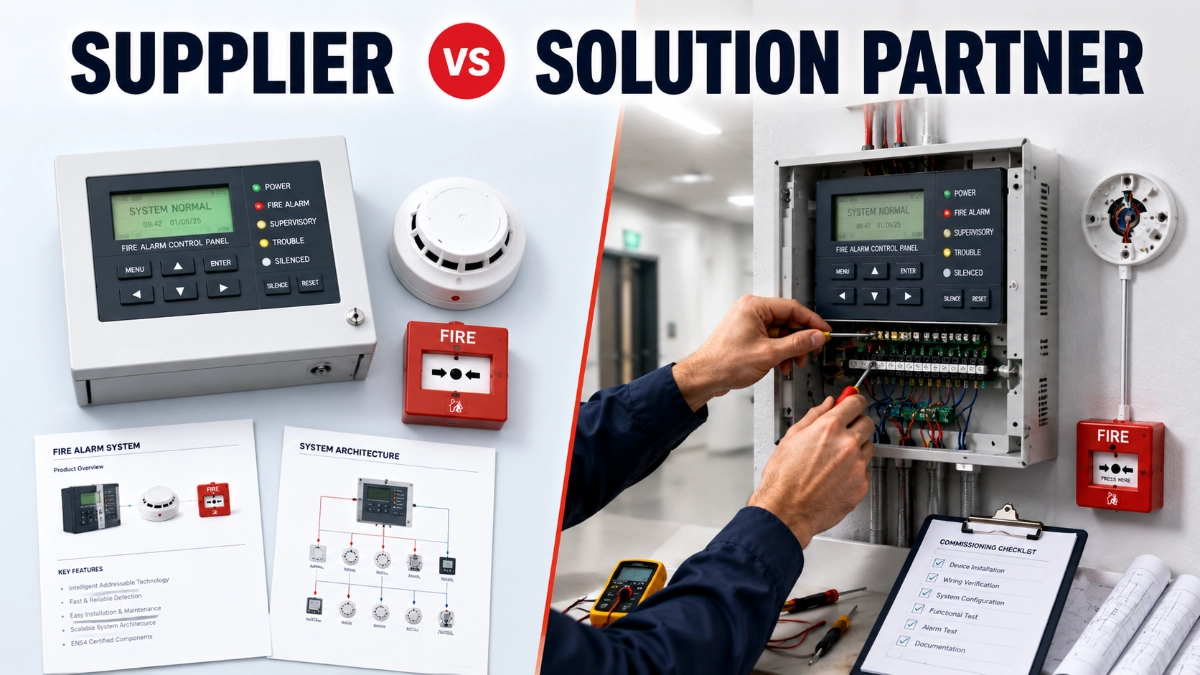
This is one of the most common points of confusion in fire alarm procurement. Buying fire alarm products and receiving a complete technical solution are not necessarily the same thing, and the difference matters long before the first device is mounted on a wall.
This article explains how a fire alarm product supplier differs from a technical solution partner, where a system integrator and distributor fit in, and how to evaluate which type of vendor a specific project actually needs.
What Is a Fire Alarm Product Supplier?
A fire alarm product supplier primarily provides equipment and product-related information, while a technical solution partner may take responsibility for broader engineering, integration and project requirements depending on the agreed scope.
A product supplier, sometimes operating as a distributor or reseller, focuses on making fire alarm equipment available to the market. This typically includes:
- Sourcing panels, detectors, modules, and accessories from manufacturers.
- Maintaining product availability and stock.
- Providing product datasheets, catalogues, and technical specifications.
- Preparing commercial quotations against a defined bill of materials.
- Handling logistics and delivery.
- Representing one or more brands through a distribution or channel arrangement.
A supplier’s value lies in product knowledge, availability, and commercial terms, not necessarily in project execution. Many suppliers do not perform design, installation, or commissioning as part of their standard scope. Some may offer these services separately, but this should never be assumed. The exact scope varies from company to company, and it should always be confirmed rather than presumed from the word “solution” appearing in a quotation.
What Is a Fire Alarm Technical Solution Partner?
A technical solution partner operates with a wider, project-oriented responsibility. Instead of starting from a product list, this type of company typically starts from the project requirement itself.
Depending on the agreed scope, a technical solution partner’s work may include:
- Understanding the building’s fire safety requirements and constraints.
- Recommending a system architecture suited to the site.
- Selecting products based on requirements rather than catalogue preference.
- Coordinating with consultants and architects on design.
- Assessing compatibility between devices, panels, and third-party systems.
- Planning integration with access control, HVAC shutdown, or building management systems.
- Coordinating or managing installation.
- Carrying out testing and commissioning.
- Producing as-built documentation and system records.
- Advising on lifecycle needs such as future expansion or servicing.
None of this is automatic. A company describing itself as a solution partner does not necessarily perform every item on this list; the actual responsibilities depend entirely on the contract and the scope that has been agreed for that specific project.
Fire Alarm Supplier vs Technical Solution Partner — Key Differences
| Factor | Product Supplier / Distributor | Technical Solution Partner |
|---|---|---|
| Primary role | Product supply | Technical/project solution |
| Product selection | Product-focused | Requirement-focused |
| System design | Usually outside basic supply scope | May be included, depending on scope |
| Installation | Not necessarily included | May be included or managed |
| Commissioning | Not necessarily included | May be included or managed |
| Integration | Limited to product information unless separately agreed | Often part of the technical scope |
| Documentation | Datasheets and product documents | Project or system documentation may be included |
| Procurement | Strong focus | May support procurement as part of the solution |
| Technical responsibility | Product-level | Potentially system-level |
| Best suited for | Product procurement | Complex project requirements |
These are typical patterns rather than fixed rules. A supplier can, in some cases, extend into technical services, and a solution partner may still rely on a distributor for certain product lines. The table is a starting point for asking the right questions, not a substitute for reading the actual scope of work.
Supplier, Distributor, Integrator and Solution Partner Are Not the Same
These terms are often used loosely in the fire alarm industry, but they describe different functions.
- Product Manufacturer: The company that designs and manufactures the fire alarm equipment panels, detectors, modules, and related hardware.
- Distributor: A business that sources products through an authorised channel and distributes them to suppliers, contractors, or end users, typically across a defined region.
- Supplier: A company that provides products to customers. A supplier may operate as a distributor, reseller, or vendor, and the term does not by itself indicate whether technical services are included.
- System Integrator: A company that combines multiple components into a functioning system. This may include configuration, programming, installation, testing, and commissioning, depending on the project contract.
- Technical Solution Partner: A broader, project-oriented role that may combine consultation, engineering, product selection, integration, and implementation, depending on the agreed scope.
The important point is that none of these labels guarantees a fixed set of activities. Two companies calling themselves “solution partners” may offer very different scopes. The label is a starting point for a conversation, not a specification.
Why the Difference Matters in Fire Alarm Projects
Choosing the wrong type of partner for a given requirement creates practical problems later in the project, not at the point of quotation.
- Scope gaps appear when a buyer assumes design or commissioning is included, but the vendor’s scope only covers product supply.
- Incorrect product selection can occur when equipment is chosen from a catalogue without a full requirement analysis.
- Compatibility issues surface during installation if device and panel combinations were not evaluated against the specific system architecture.
- Unclear installation responsibility often becomes visible only when work is already underway, and no party has formally accepted it.
- Commissioning responsibility disputes are common when multiple vendors are involved, and none has explicitly taken ownership of final testing.
- Documentation gaps affect handover, maintenance planning, and future expansion if as-built records were never part of anyone’s scope.
- Project delays and procurement confusion result from unclear boundaries between the supplier, contractor, and consultant.
- Cost comparison problems arise when quotations from different companies are compared without recognising they cover different scopes.
These are not hypothetical risks; they are the direct result of assuming that “fire alarm solution” means the same thing across every vendor.
When Should You Choose a Fire Alarm Product Supplier?
A product supplier is typically the right choice when:
- A design has already been finalised by a consultant or engineer.
- Product specifications and brand requirements are already established.
- A separate contractor or integrator will handle installation and commissioning.
- The project needs confirmed product availability and competitive commercial terms.
- Datasheets, compliance documents, and technical literature are required for submission.
- The requirement is to expand or replace equipment within an existing, already-designed system.
In these scenarios, the buyer already has technical clarity and mainly needs reliable access to the correct products.
When Should You Work With a Technical Solution Partner?
A technical solution partner becomes more relevant when:
- Requirements are not yet fully defined and need to be developed.
- The project requires a system design from the ground up.
- Multiple fire and life-safety systems need to be integrated.
- Existing infrastructure needs to be assessed before new equipment is added.
- The project involves networked panels across multiple buildings or floors.
- Several stakeholders consultant, contractor, facility team need technical coordination.
- Installation and commissioning require specialist, hands-on involvement.
- The project needs a single point of accountability across design, supply, and execution.
These situations call for someone who can own the technical outcome, not only the product list.
Questions to Ask Before Selecting a Fire Alarm Vendor
A short, direct set of questions can prevent most scope-related problems later.
- Are you a manufacturer, distributor, supplier, reseller, integrator, or service provider?
- Which brands and product ranges do you supply?
- Is product availability confirmed for this project’s timeline?
- Are datasheets and technical documentation available for submission?
- Who is responsible for system design?
- Who handles installation?
- Who handles programming and configuration?
- Who performs testing and commissioning?
- Who is responsible for system integration with other building systems?
- What exactly is included in the quotation?
- What activities are explicitly excluded?
- Who provides project and as-built documentation?
- Is the proposed equipment compatible with the specified system architecture?
- Who remains responsible after delivery for faults, replacements, or technical queries?
- Will separate contractors or integrators be required to complete the project?
Asking these questions directly, and getting them answered in writing, avoids far more disputes than reviewing a company’s marketing description ever will.
Example — How Responsibilities Can Be Divided
A typical commercial building project might involve a chain of responsibility such as:
Building owner → Consultant → Product distributor → System integrator/contractor
In this structure, the consultant defines the system design and specification. The product distributor supplies the specified equipment, along with datasheets and commercial terms. The system integrator or contractor handles installation, wiring, configuration, and commissioning. The building owner ultimately holds the completed, tested system and its documentation.
Not every project follows this exact structure; some technical solution partners combine several of these roles under one contract, while others keep them separate. What matters is that each responsibility is assigned to someone, in writing, before work begins.
Where a Fire Alarm Product Distributor Fits Into the Project
A product distributor plays a focused but genuinely useful role in this chain. Its core value is making the right products available at the right time, with accurate technical information to support design and procurement decisions. This typically includes product range depth, brand access, datasheets, and commercial supply support and, for distributors with wider logistics networks, PAN-India product distribution.
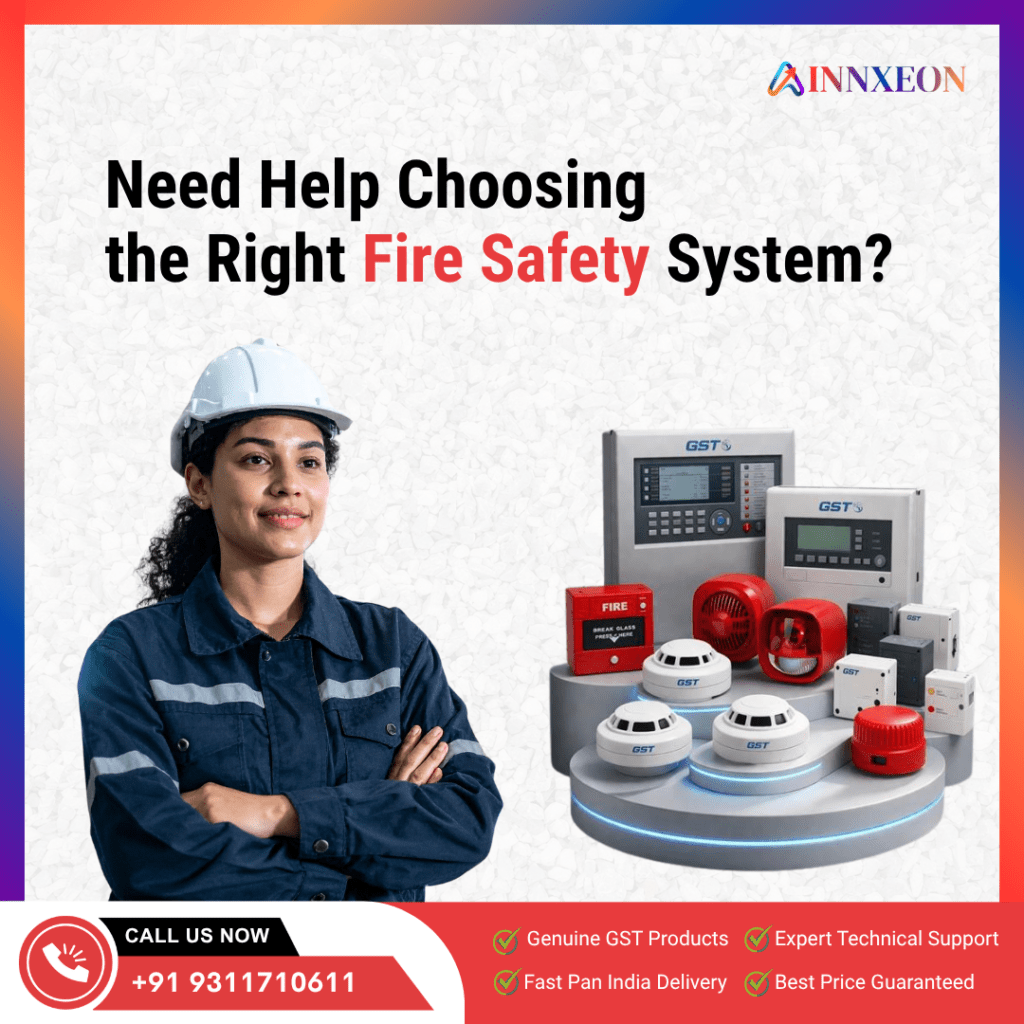
Innxeon Technologies Pvt. Ltd. operates in this space as a PAN-India distributor and supplier of GST (Gulf Security Technology) fire alarm systems and related products. Its role centres on product distribution, supplying items such as an addressable fire alarm panel, a conventional fire alarm panel, addressable detectors, and conventional detectors from the GST product range, along with the technical documentation needed to evaluate and specify them. As a GST fire alarm system distributor in India, Innxeon supports procurement and product-selection stages of a project. It is a distributor role, and buyers requiring installation, commissioning, after-sales technical support, maintenance, or AMC services should confirm those requirements separately with a qualified contractor or integrator, since product distribution and project execution are distinct functions.
How to Evaluate a Fire Alarm Supplier or Solution Partner
A structured evaluation is more reliable than judging a vendor by its title. Consider:
- Is the product authenticity is the equipment genuine and traceable to the manufacturer?
- Brand authorisation or channel relationship, where applicable.
- Product availability against the project timeline.
- Technical documentation: datasheets, wiring references, compliance literature.
- Product knowledge demonstrated during technical discussions.
- Relevant project experience for the type of building involved.
- Scope clarity: Is the proposal specific about what is and isn’t included?
- Integration capability, if the project needs multi-system coordination.
- Engineering resources available to support design questions.
- Installation and commissioning capability, where applicable to the scope.
- Documentation practices for handover and future maintenance.
- Commercial transparency in the quotation.
- A clear responsibility matrix across design, supply, installation, and commissioning.
- Warranty and support scope, clearly defined rather than implied.
The consistent theme across all of these is that buyers should evaluate the actual scope offered by a company, not the label it uses to describe itself.
Final Takeaway
A product supplier and a technical solution partner can both be valuable; they simply solve different parts of the fire alarm procurement and project lifecycle. A supplier is well suited to projects with a finalised design and a clear product requirement. A technical solution partner is better suited to projects that still need design, integration, installation, or commissioning support.
The right choice depends on what the project actually needs at this stage: products, technical design, integration, installation, commissioning, or some combination of these. Getting clear, written answers on scope rather than assuming based on a company’s title is what prevents confusion later in the project.
For projects that already have a defined specification and simply need reliable product access, Innxeon Technologies Pvt. Ltd. supplies GST fire alarm system products, including addressable and conventional panels and detectors, as part of its PAN-India distribution network.
Read Also: Fire Alarm System Selection: 12 Questions Consultants Should Ask Before Procurement
Read Also: What Makes a Fire Alarm Panel Suitable for Large Industrial Facilities?