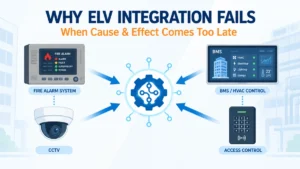
A facility integrates its fire alarm system with access control. During commissioning, the panel activates, and the room goes quiet for a different reason: nobody agrees on what should happen next.
Which doors should release? Should every controlled door unlock, or only some? What happens to restricted technical areas? What is the expected behaviour if communication between the fire alarm panel and access-control server drops mid-event? What happens during a fault instead of a confirmed alarm? Who owns the final cause-and-effect logic once both systems are wired together?
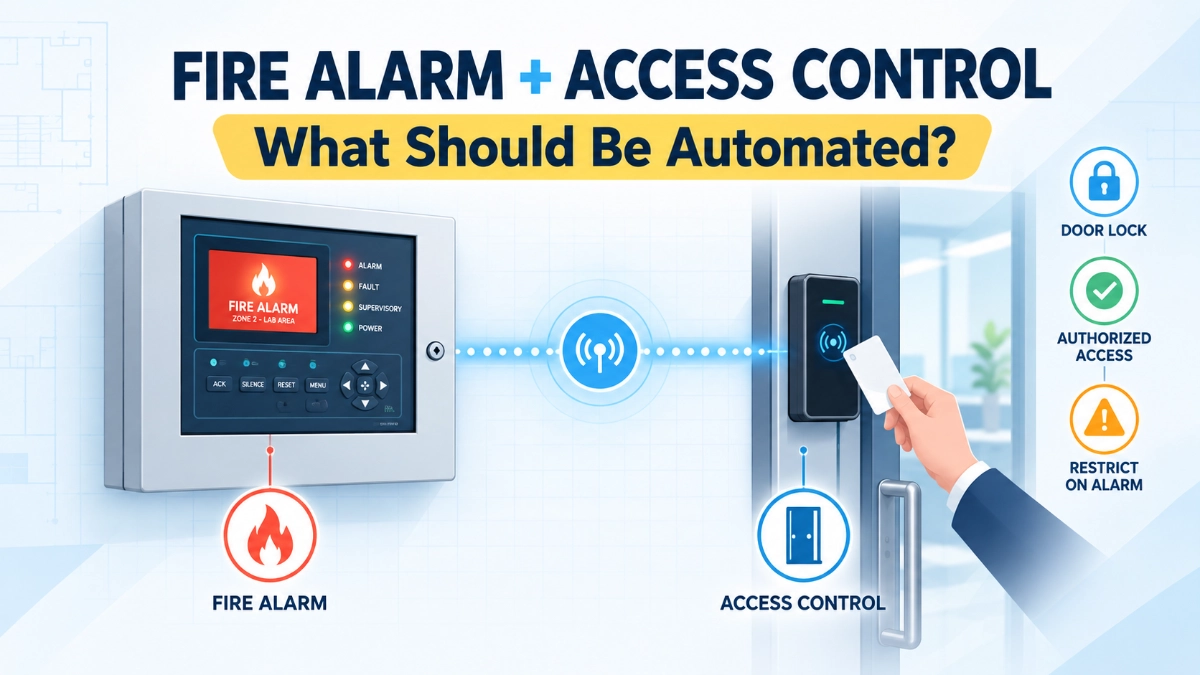
Connecting two systems electrically is not the same as engineering an integration. A relay closure or network link can move a signal from panel to controller in minutes; deciding what that signal should legitimately cause is the real engineering work.
The objective is controlled, predictable life-safety behaviour, not maximum automation. Every automated action needs a defined reason, trigger, outcome, and failure behaviour.
What Should and Should Not Be Automated?
Automation should be limited to actions explicitly defined in the project’s approved cause-and-effect matrix, based on risk assessment, door classification, and applicable requirements. Egress-related responses tied to confirmed alarms are commonly automated; security-sensitive functions, fault-state responses, and communication-loss behaviour typically require conditional logic. No single rule applies to every door or building; the correct response is project-specific, documented, and tested before commissioning.
Potentially automated: Defined egress responses tied to confirmed alarms in specific zones.
Conditional: Responses depending on area classification, occupancy, or documented operational need.
Not to be automated blindly: Blanket door unlocking, disabling unrelated security functions, or treating faults and communication failures as equivalent to a confirmed alarm.
What Does Fire Alarm-to-Access Control Integration Actually Mean?
The interface passes a defined event alarm, supervisory signal, fault, or status change from the fire alarm system to access control, which executes a pre-engineered response via dry contacts, monitored interface modules, dedicated gateways, or network-level integration.
Relevant concepts include the alarm event, the controller’s ability to act on it, door hardware behaviour (fail-safe or fail-secure), egress requirements, and status monitoring confirming the action occurred. Not every fire alarm system controls every access-control function; scope varies with architecture and project intent.
Why “Unlock Everything” Is Not an Engineering Strategy
A common but flawed assumption is that a fire alarm should unlock every controlled door. Engineers must weigh occupant movement and egress routes, security-sensitive versus general circulation areas, hazardous or restricted technical rooms, compartmentation, operational continuity needs, and each door’s functional role.
A server room, pharmacy, or chemical storage area may sit behind access control not treated identically to a general corridor door during a fire event. The correct response comes from the approved design and cause-and-effect requirements, not a default assumption in the wiring.
What Can Potentially Be Automated?
| Function | Potential Automation | Engineering Question |
|---|---|---|
| Door release | Conditional | Which doors, under what confirmed trigger? |
| Emergency egress behaviour | Conditional | What life-safety response is required for that area? |
| Access-control monitoring | Yes, where designed | What status needs tracking? |
| Alarm event notification | Conditional | Who needs the information, and when? |
| System status indication | Conditional | What information is operationally useful? |
| Security functions | Usually conditional | Could automation create a new risk? |
This table is illustrative, not a universal requirement.
What Should NOT Be Blindly Automated
Poorly engineered integrations share a common cause: automating a response before defining the condition that should produce it, unlocking every door regardless of location, disabling security controls without justification, triggering unrelated building actions, letting an access-control fault compromise the fire alarm system, assuming communication failure behaves like a confirmed alarm, or changing permissions automatically without a defined operational need. Integration should never introduce a new, unmanaged failure mode.
Alarm Is Not the Same as Fault
This distinction is frequently mishandled. A confirmed fire alarm, a supervisory condition, a trouble/fault condition, a communication failure, and a power or access-control system failure are distinct states, each potentially warranting a different response or none at all.
Releasing doors on a trouble signal rather than a confirmed alarm can create unnecessary exposure without a life-safety benefit; ignoring a fault because “it isn’t an alarm” can leave an integration silently degraded. Alarm and fault logic should never be treated as interchangeable.
Cause-and-Effect Matrix: The Real Core of Integration
The documented matrix is where engineering decisions actually live: the design document the interface should be built from, not paperwork added afterwards.
| Trigger | Area/Condition | Automated Response | Monitoring/Indication | Verification |
|---|---|---|---|---|
| Fire alarm | Defined area | Defined access response | Required status | Functional test |
| Supervisory event | Defined condition | Project-specific | Indication | Verification |
| Fault | Defined fault | Project-specific | Fault indication | Fault test |
| Communication failure | Interface failure | Defined failure behaviour | Trouble indication | Failure test |
This is an illustrative framework, not a universal requirement; every row should come from risk assessment, design review, and coordination with the authority having jurisdiction.
Local Logic vs Centralised Integration
Architectures generally fall into a few patterns: a supervised interface output from the fire alarm system, a controlled input on the access-control side, dedicated relay modules, or logic distributed across controllers. Understanding where decision logic resides matters: a door that appears to respond “automatically” may be governed by a separate controller, not the fire alarm panel directly.
What Happens When Something Fails?
Engineers must evaluate failure scenarios before commissioning: power failure on either system, interface failure, communication failure, controller failure, wiring faults, network failure, configuration errors, and loss of supervision. For each, intended behaviour should be defined, tested, and understood by operators; an untested failure mode is effectively unknown.
EST3 and EST4 in Integrated Fire Alarm Architectures
Platforms such as EST3 and EST4 are commonly deployed in facilities where access-control integration is a design consideration. Engineers should evaluate available interfaces, how the architecture supports the required cause-and-effect logic, and failure behaviour for the specific project. Interface capabilities and third-party compatibility vary by configuration and should be verified against current manufacturer documentation rather than assumed.
Where Devices and Interfaces Matter
Integration reliability doesn’t rest solely on the control panel or access-control server. It depends on EST Detectors and Devices, the interface points connecting field devices to the panel, wiring and supervision, and how events are represented as they move through the system. A well-designed matrix can still fail in practice if device wiring or supervision doesn’t match what the logic assumes.
How Engineers Should Test Fire Alarm and Access Control Integration
- Review approved cause-and-effect documentation.
- Verify interface architecture matches the design.
- Confirm input/output relationships.
- Test each defined alarm condition individually, then the intended door/access response.
- Test supervisory and fault conditions separately from alarms.
- Test communication/interface failures where required.
- Verify restoration/reset behaviour.
- Record all results against expected outcomes and update documentation.
Testing should verify both what the system does and what it does when something goes wrong without defeating or bypassing life-safety equipment outside a controlled, documented procedure.
10 Common Fire Alarm–Access Control Integration Mistakes
- Assuming every door should unlock
- Designing without a cause-and-effect matrix
- Treating alarms and faults as the same condition
- Ignoring failure behaviour
- Ignoring door function and location
- Failing to test communication failures
- Not documenting interface logic
- Assuming third-party compatibility
- Testing only the normal alarm scenario
- Failing to train facility operators
Practical Example — A Multi-Zone Industrial Facility
Consider a facility with multiple fire alarm zones, several access-controlled entry points, open production areas, restricted technical rooms, and defined egress routes.
When an alarm activates in a production zone, the cause-and-effect design may call for the release of doors along that zone’s egress path. A restricted electrical or server room in the same building may retain its access-control behaviour during that alarm, since it isn’t on the egress path and unrestricted access carries more risk than benefit there. If the alarm originates in a different zone, the response for that room may be evaluated differently depending on smoke spread and compartmentation.
This is the actual decision process: alarm location, door function, occupant movement, security, and failure behaviour weighed together per area, not one blanket response for the whole facility.
Engineer’s Integration Checklist
- Risk assessment completed; door classification defined per opening.
- Cause-and-effect matrix approved before programming begins.
- Interface architecture confirmed against design intent.
- Alarm, fault, and supervisory conditions defined separately, per zone.
- Power failure and communication failure behaviour defined and tested.
- Wiring/interface supervision verified.
- Door and reset/restoration behaviour verified against approved logic.
- Full testing completed, recorded, and documentation updated to as-built condition.
- Operators trained on integrated behaviour; process defined for future modifications.
Where the EST Fire Alarm System Fits
Within a documented strategy, the EST Fire Alarm System typically remains the life-safety reference point and the source of confirmed alarm, supervisory, and fault conditions while access control retains responsibility for its own security functions. This is common but not universal; the allocation of decision-making authority should be defined during design, not assumed after installation.
Selecting the Right Technical Support
Project teams expanding an integrated environment often need capable support for selecting compatible equipment, obtaining documentation, and coordinating implementation. A knowledgeable EST Fire Alarm System Distributor in India can help integrators access accurate technical information and plan expansion without relying on assumptions about compatibility.
Expert Insights
Integration should be designed around cause-and-effect logic, not wiring convenience. More automation does not mean better life safety. Alarm, supervisory, fault, and communication-loss conditions need distinct treatment. Every automated action should trace to a defined trigger and documented outcome. Documentation is part of the system, not an afterthought.
Key Takeaways
- Integration is an engineering exercise, not a wiring exercise.
- Automation should be limited to actions defined in an approved cause-and-effect matrix.
- Door-release logic depends on area classification and risk assessment, not a blanket rule.
- Alarm, supervisory, fault, and communication-failure conditions must be treated as distinct states.
- Failure behaviour needs to be defined and tested before commissioning, not assumed.
- Documentation and operator training are integral, not optional, parts of the system.
- Automate only what has a clearly defined purpose, documented trigger, expected response, and verified failure behaviour.
Read Also: How Event Logs Can Reveal Hidden Fire Alarm System Problems
Read Also: EST Fire Alarm System for Industrial Facilities: What Engineers Should Evaluate