Picture a university campus at 2 a.m. A kitchen exhaust duct in the dining hall overheats at the same moment a smoke detector activates in a dormitory three buildings away. Two separate emergencies, two separate locations, one fire alarm network.
This is the exact scenario fire alarm networks are built for. A single event is straightforward. Two or more events happening within seconds of each other is when system design is actually tested.
Building owners and facility managers rarely think about this until they need it. But for fire consultants, MEP engineers, and system integrators, simultaneous event handling is one of the most important and most misunderstood parts of fire alarm network design.
This article breaks down how modern networked fire alarm systems detect, prioritise, and manage multiple emergencies simultaneously, and why this capability distinguishes a truly resilient life safety system from a basic one.
Why Multiple Emergency Events Are a Challenge
A fire alarm system isn’t just reacting to one trigger. It’s constantly listening across hundreds or thousands of points.
In a large facility, several things can happen close together:
- A real fire in one wing
- A false alarm from steam or dust in another
- A sprinkler flow switch activating
- A device going into trouble mode
If the system can only “think about” one event at a time, responders lose precious seconds. Worse, one alarm could mask another. This is precisely why older, non-networked systems struggle in large or multi-building environments.
Understanding Networked Fire Alarm Systems
A networked fire alarm system connects multiple fire alarm control panels so they share information in real time, rather than operating as isolated units.
Instead of one panel monitoring one building, a network of panels monitors an entire campus, high-rise, or industrial complex as a single, coordinated system.
Each panel retains its own local intelligence; it can still detect, process, and respond to alarms even if communication with other panels is temporarily interrupted. This is called distributed intelligence, and it’s a core design principle behind reliable networks.
How Modern Fire Alarm Networks Communicate
Panels typically communicate using peer-to-peer communication over a dedicated data network, often arranged in a redundant loop or ring topology.
Here’s why the ring matters: if a cable is cut or damaged at one point, data can still travel the opposite direction around the loop and reach every panel. This is called network redundancy, and it’s a baseline expectation in any serious fire alarm network design.
Communication typically includes:
- Alarm, supervisory, and trouble signals
- Device status and addressing information
- Cause-and-effect programming instructions
- Time-stamped event data for logging
This constant exchange is what allows a fire in Building A to trigger a coordinated response like unlocking doors or shutting down air handling in Building B- without a person manually relaying the information.
Event Prioritisation Explained
What is alarm prioritisation? Alarm prioritisation is the logic that determines which signal a fire alarm system displays, announces, and acts on first when multiple events occur close together.
Not every signal carries equal weight. A properly designed network follows a strict hierarchy:
- Fire alarm signals: Highest priority, always displayed and acted on first
- Supervisory signals: Such as a closed sprinkler valve
- Trouble signals: Such as a wiring fault or low battery
If a fire alarm and a trouble signal arrive within the same second, the fire alarm always takes precedence on the panel display and in any voice evacuation messaging. Trouble conditions are logged and queued, not ignored; they’re simply never allowed to delay a life-safety response.
Simultaneous Alarm Processing
Can fire alarm systems process multiple alarms at once? Yes. Addressable networks process multiple alarms simultaneously because every detector, pull station, and module has its own unique address on the network.
Because each device reports independently, the panel doesn’t need to “finish” handling one alarm before recognising another. Both are received, logged, and displayed, usually within a second or two of activation, per typical addressable system response specifications.
What happens if two fires occur simultaneously? Consider a manufacturing plant where a machine overheats in the assembly area while, separately, a storage room detector picks up smoke from an electrical fault.
The network:
- Logs both events with individual timestamps
- Displays both on the panel and any remote annunciator, ranked by priority and sequence
- Executes cause-and-effect programming for each zone independently (e.g., releasing doors near the assembly area while shutting down ventilation near storage)
- Sends both events to the monitoring station without one overwriting the other
Neither event is dropped, delayed indefinitely, or merged into a single confusing signal.
Multi-Building Emergency Coordination
Can multiple buildings report emergencies together? Yes, this is one of the main reasons large campuses use networked systems instead of standalone panels.
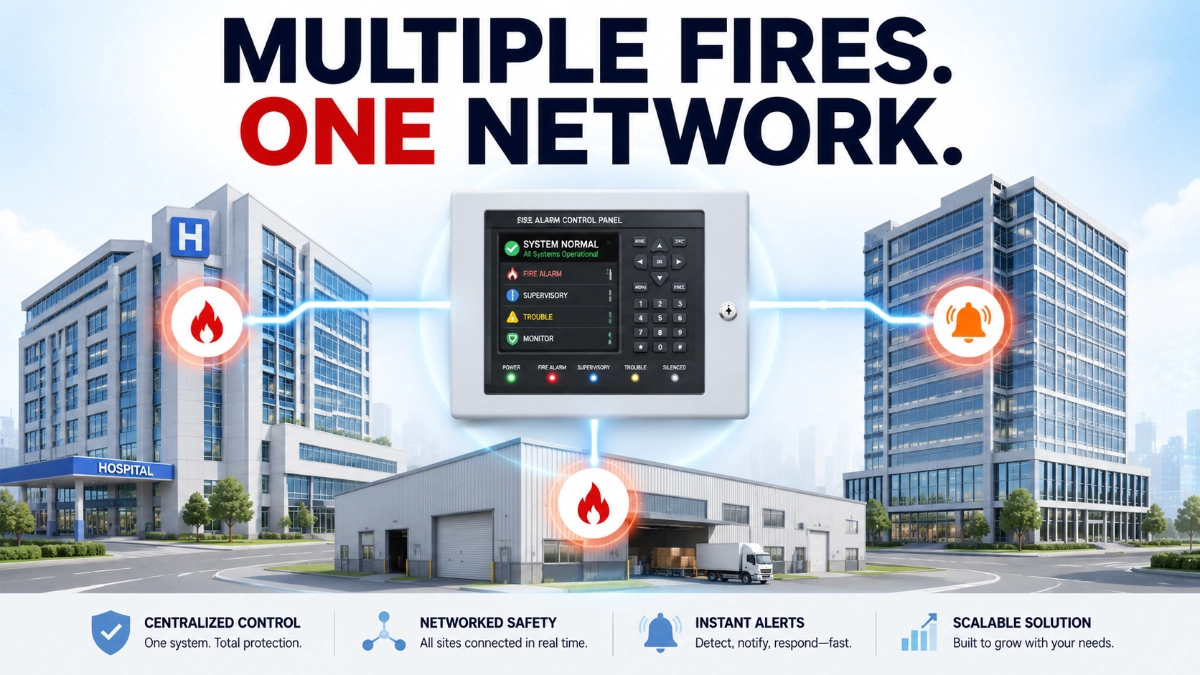
Take a hospital campus with a main tower, an outpatient wing, and a separate parking structure. If a fire occurs in the parking structure while a supervisory event triggers in the outpatient wing, the network shares both events across every connected panel and any central command station.
Facility staff at the main tower see a real-time, campus-wide picture rather than needing separate reports from each building. This is especially valuable in airport terminals, shopping malls, and university campuses, where multiple structures share pedestrian traffic and evacuation planning.
Role of Intelligent Addressable Devices
Addressable Detectors are the foundation of simultaneous event handling. Unlike Conventional Detectors, which report only as part of a shared zone circuit, each addressable device has its own identity on the network.
This means a facility manager doesn’t just learn “there’s an alarm on the third floor”; they learn “smoke detector 3-14, near the east stairwell, activated at 2:14 a.m.” That level of detail matters enormously when two events happen close together, because staff can immediately tell them apart.
How Control Panels Share Critical Information
An Addressable Fire Alarm Panel doesn’t just collect data locally; it shares device status, alarm history, and programming logic with every other panel on the network.
This shared awareness enables:
- Synchronised evacuation messaging across zones
- Coordinated elevator recall in high-rise buildings
- Unified event logs viewable from any networked panel
- Remote annunciation at security desks or fire command centres
In a high-rise office building, this means a fire on the 20th floor can trigger elevator recall and stairwell pressurisation while the ground-floor panel simultaneously displays the exact event and location to arriving fire crews.
What Happens During Panel Failure
What happens if one control panel fails? This is where fault tolerance and distributed intelligence prove their value.
If one panel loses power or suffers a fault, the network is designed so that:
- Neighbouring panels continue operating independently
- The network isolates the faulted panel’s segment (network isolation during faults) so the fault doesn’t cascade
- Local devices connected to unaffected panels keep functioning normally
- The fault itself is logged and reported as a trouble condition
No single point of failure should be able to take down life safety coverage for an entire facility. This is a fundamental requirement under most modern fire alarm network design standards, including guidance referenced in NFPA 72.
Event Logging and Incident Tracking
Every event alarm, supervisory, or trouble is logged with a timestamp, device address, and event type. This creates a complete, chronological record across the entire network, not just one panel.
For a data centre or industrial facility undergoing insurance review or post-incident investigation, this log is often the first document requested. Event acknowledgement (recording who reviewed and responded to each signal) is also tracked, creating accountability for facility staff and monitoring personnel.
Reducing False Alarm Conflicts
How do fire alarm networks avoid false alarm conflicts? Through a combination of event buffering, addressable device intelligence, and prioritisation logic.
Event buffering temporarily holds and sequences incoming signals so a burst of nuisance alarms like dust triggering multiple detectors during construction doesn’t overwhelm the display or bury a genuine fire signal.
Addressable devices also support drift compensation and sensitivity adjustment, which reduces false activations at the source rather than relying on network logic to sort them out after the fact.
Integration with Other Building Safety Systems
Networked fire alarm systems rarely operate in isolation. They typically integrate with:
- HVAC systems, for smoke control and damper operation
- Access control, for door unlocking and lockdown coordination
- Elevator controllers, for recall sequencing
- Mass notification and voice evacuation systems
- Building management systems (BMS), for centralised monitoring
This integration is what allows a single verified event, say, in a warehouse loading dock, to trigger a coordinated set of building-wide responses automatically, rather than relying on manual intervention during a stressful moment.
Benefits for Large Commercial Facilities
Why are networked fire alarm systems better for large facilities? Because scale multiplies the chance of simultaneous events, and standalone panels simply aren’t built to coordinate a facility-wide response.
Large facilities benefit from:
- Centralised monitoring across multiple buildings or floors
- Faster, coordinated emergency response
- Reduced risk of missed or overwritten alarms
- Simplified compliance reporting and inspection records
- Scalable design that grows with future building expansion
Comparison Table: Standalone vs. Networked Fire Alarm Systems
| Feature | Traditional Standalone System | Networked Fire Alarm System |
|---|---|---|
| Multiple event handling | Limited; risk of missed or overwritten signals | Processes and displays multiple events independently |
| Communication | Isolated per panel | Peer-to-peer across all connected panels |
| Response time | Slower coordination between buildings | Near real-time, campus-wide awareness |
| Scalability | Difficult to expand | Designed for growth and multi-building integration |
| Fault tolerance | Single point of failure | Distributed intelligence with network isolation |
| Monitoring | Manual, panel-by-panel | Centralised remote annunciation |
| Reporting | Fragmented logs | Unified, timestamped event history |
| Building integration | Minimal | Deep integration with HVAC, access control, elevators |
Best Practices for Reliable Fire Alarm Network Design
- Use redundant loop or ring topology wiring wherever the building layout allows it.
- Assign clear, documented addressing conventions for every device during installation.
- Program cause-and-effect logic per zone, not as a single building-wide response.
- Test network isolation and panel failover during commissioning, not just after installation.
- Keep event logs backed up off-panel for compliance and incident review.
- Coordinate fire alarm integration with HVAC and access control early in the design phase.
- Choose an Addressable Fire Alarm Panel over a Conventional Fire Alarm Panel for any facility with more than one building or zone type.
- Schedule regular sensitivity checks on addressable detectors to reduce false alarm conflicts.
- Document remote annunciator locations so responders always know where to check first.
- Review network capacity before adding new buildings or expansion phases.
Future Trends in Intelligent Fire Alarm Networking
Fire alarm networking continues to move toward greater intelligence at the device level. Expect to see:
- Wider adoption of IP-based panel networking alongside traditional wired loops
- Predictive maintenance using device-level diagnostics
- Deeper integration with building management and IoT platforms
- Cloud-based remote monitoring for multi-site portfolios
Manufacturers such as GST Fire Alarm System have positioned their addressable platforms around this direction, combining peer-to-peer panel networking with device-level intelligence so multi-building facilities can manage several events without losing situational awareness. Facilities evaluating a platform upgrade often work with a GST Fire Alarm System Distributor in India to assess network topology against building layout before specifying hardware.
Conclusion
Handling one emergency well is the baseline expectation for any fire alarm system. Handling several at once, without confusion or delay, is what defines a genuinely resilient network.
Addressable device intelligence, peer-to-peer panel communication, strict alarm prioritisation, and built-in fault tolerance work together to give facility teams and first responders an accurate, real-time picture even on the system’s worst night.
As buildings grow more connected and campuses continue expanding, the ability to manage multiple simultaneous events isn’t a luxury feature. It’s the standard that separates a compliant system from a truly dependable one.
Read Also: Why Fire Alarm Architecture Matters More Than Panel Specifications
Read Also: Why Networked Fire Alarm Systems Are the Future of Large Facilities