Fire safety in large facilities has never been more critical. Whether it is a sprawling warehouse, a multi-floor hospital, or a data centre running mission-critical infrastructure, a delayed fire alarm can mean the difference between a manageable incident and a catastrophic loss.
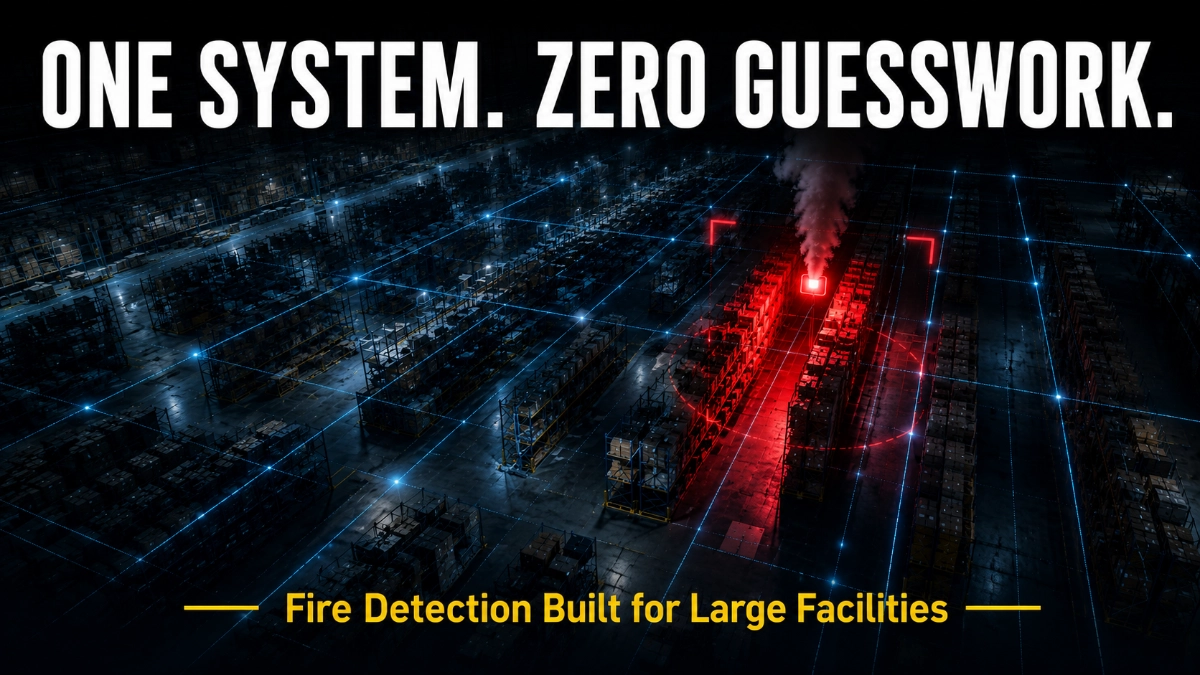
Large buildings present unique detection challenges. Long cable runs, high ceilings, multiple occupancy zones, and complex architectural layouts all make early and accurate fire detection considerably harder. In these environments, a slow or imprecise alarm response does not just threaten assets. It threatens lives.
This is why the fire safety industry has increasingly moved toward intelligent, addressable systems capable of pinpointing alarm locations instantly and communicating in real time. Among the systems widely deployed in these demanding environments, GST fire alarm systems have established a strong reputation for reliability, scalability, and detection accuracy.
This guide explains exactly how GST fire alarm systems improve fire detection efficiency in large facilities, why detection speed matters, and what facility managers and fire safety professionals need to know when specifying or maintaining fire alarm systems.
Why Fire Detection Efficiency Matters in Large Facilities
Delayed Detection Risks
Fire doubles in size roughly every minute under typical conditions. In a large open warehouse or a multi-story building, a two-minute detection delay can allow a localised fire to spread to adjacent storage bays, mechanical rooms, or escape routes. Detection speed is the single most important variable in limiting fire damage and preserving life safety.
Real-World Example: In a 50,000 sq ft distribution warehouse, a fire starting in a high-rack storage aisle can reach flashover within 3 to 4 minutes if palletised goods are involved. Every second of detection delay directly expands the fire zone.
Complex Building Layout Challenges
Multi-wing hospitals, multi-floor office towers, and campuses with interconnected buildings create significant challenges for conventional fire detection approaches. Without individual device identification, a fire alarm in a 200-device zone still leaves responders searching through a large area before locating the actual source.
Occupant Safety Concerns
Large facilities routinely house hundreds or thousands of occupants. Hospitals may have non-ambulatory patients. Factories have shift workers in remote areas. Airports have transient crowds unfamiliar with evacuation routes. In every case, early and precise detection enables faster, better-organised evacuation.
Asset Protection Requirements
Data centres, pharmaceutical cold stores, and manufacturing facilities house assets worth millions of dollars. Fire in these environments does not just destroy physical assets. It disrupts supply chains, compromises sensitive data, and can render critical infrastructure offline for weeks. Efficient detection limits fire spread before suppression systems or fire brigade response contains it.
Compliance and Regulatory Importance
International standards, including NFPA 72 (National Fire Alarm and Signalling Code), BS 5839, and local authority requirements, increasingly mandate addressable systems for certain building types and occupancies. Facilities that fail to demonstrate adequate detection performance risk enforcement action, insurance penalties, and legal liability.
Key Ways GST Fire Alarm Systems Improve Detection Efficiency
1. Addressable Device Identification
The most significant efficiency advantage of a GST fire alarm system over conventional alternatives is addressable device identification. Every detector, call point, and module on the system carries a unique address programmed into the panel. When a detector activates, the panel immediately displays its specific address, location label, and device type on the control panel display and any remote annunciators.
This eliminates the fundamental weakness of conventional systems, where an alarm in a large zone only tells responders that a fire may exist somewhere within a large area. With addressable detection, responders know the exact room, corridor, or floor affected before they leave the control room.
Facility Example: In a 10-story commercial building with 400 addressable detectors, an alarm on the 7th floor server room detector triggers an immediate panel display identifying that specific device. Security can dispatch to the correct location in under 30 seconds.
2. Faster Fire Location Detection
Precise fire location identification directly reduces response time. Fire service crews entering a large hospital or industrial complex need to navigate efficiently to the fire source. A conventional fire alarm panel showing a zone alarm covering an entire building wing could send responders to the wrong end of a large floor. An addressable fire alarm panel shows the exact device address, floor, and location label, directing responders immediately to the seat of the fire.
3. Reduced Investigation Time
When a fire alarm activates in a large facility, the priority is determining whether the alarm represents an actual fire, a pre-fire condition, or a fault. In conventional systems, this investigation requires physically checking the entire zone. With a GST addressable system, the panel identifies the specific device and its status, allowing security or fire wardens to go directly to the device location for investigation. This reduces alarm investigation time significantly and allows faster decisions about evacuation and fire service notification.
4. Improved Monitoring Across Multiple Zones
Large facilities are divided into fire detection zones to enable controlled evacuation and fire compartmentalisation. GST systems allow monitoring of hundreds or thousands of devices across multiple zones simultaneously from a single control panel. Network configurations allow multiple panels to share information, giving a single operator station visibility over an entire campus or complex.
5. Better Event Tracking and Diagnostics
GST fire alarm panels maintain detailed event logs recording every alarm, pre-alarm, fault, and service action with timestamps. This event history is invaluable for post-incident analysis, maintenance scheduling, regulatory inspections, and legal documentation. Facility managers can review device history to identify detectors with frequent pre-alarms, a common early indicator of an impending false alarm or device fault.
6. Scalable Architecture for Large Buildings
A major practical advantage of GST systems is their loop-based, scalable architecture. A single addressable loop can support hundreds of devices, and panels can be networked to cover facilities with thousands of detection points. As facilities expand, new devices are simply added to existing loops or new loops are added to the network, without replacing the core infrastructure.
7. Real-Time Alarm Communication
GST systems support integration with building management systems, emergency voice communication systems, elevator recall systems, and automatic suppression systems. When a fire alarm activates, the system can simultaneously trigger the correct suppression zone, initiate evacuation announcements in the affected areas, recall elevators to the ground floor, and notify a remote monitoring centre, all within seconds of detection.
8. Intelligent Detection Technologies
Modern GST addressable detectors incorporate multi-criteria detection algorithms that analyse multiple fire parameters simultaneously, including smoke particle density, heat rise rate, and carbon monoxide levels. This intelligent approach allows detectors to distinguish between genuine fire signatures and environmental conditions that may cause false alarms, such as cooking fumes, dust, or steam.
9. Reduced False Alarms
False alarms are a serious operational problem in large facilities. Each false alarm disrupts operations, costs staff time, risks evacuation injuries, and can erode occupant trust in the alarm system over time. GST addressable detectors with sensitivity adjustment and drift compensation significantly reduce false alarm rates compared to conventional fixed-threshold detectors. Individual device sensitivity can be adjusted through the panel without physically accessing the detector.
Industry Insight: Research from fire safety bodies consistently shows that addressable systems with intelligent detection generate significantly fewer unwanted alarms than conventional systems in commercial and industrial environments.
10. Centralised Fire Monitoring
For facilities with multiple buildings or campuses, GST systems support centralised monitoring from a single control room. Network communication allows a single operator to monitor the fire alarm status of every building in real time, receive device-specific alarm notifications, and manage system configuration from one location. This centralised visibility is particularly valuable for large industrial complexes, hospital campuses, and airport facilities.
GST Fire Alarm Systems in Different Large Facilities
Warehouses
Warehouses present some of the most demanding fire detection challenges. High-rack storage, varied commodity storage, and large open floor areas mean smoke and heat travel differently than in standard commercial buildings. Beam smoke detectors, aspirating smoke detection systems, and high-sensitivity addressable detectors are commonly deployed in conjunction with GST panels.
The addressable architecture enables zone-specific suppression activation, ensuring only the affected storage bay is targeted while the rest of the facility continues operating. This precision is critical for facilities with high-value inventory.
Manufacturing Plants
Manufacturing environments combine fire risk sources, including welding operations, flammable chemical storage, electrical equipment, and dust accumulation, with challenging detection conditions, including high ambient temperatures, airborne particulates, and vibration. GST systems with addressable detectors allow individual sensitivity settings per device location, meaning detectors near welding bays can be set with appropriate thresholds while storage area detectors maintain standard sensitivity.
Hospitals
Hospitals require fire alarm systems that enable progressive horizontal evacuation without full building evacuation of non-ambulatory patients. GST addressable systems support sophisticated cause-and-effect programming that triggers zone-specific actions such as door releases, smoke damper activation, and targeted PA announcements based on which specific device activates. This precision is only achievable with addressable detection.
Commercial Buildings
Multi-tenant commercial buildings have varied occupancy types on different floors, each with different detection requirements. GST addressable systems allow floor-by-floor customisation of detection sensitivity, alarm routing, and evacuation messaging while maintaining centralised monitoring and management.
Shopping Malls
Shopping malls combine public areas, food courts, storage rooms, and mechanical areas within a single detection system. The mix of environments, from smoke-generating food courts to retail areas sensitive to false alarms, requires intelligent detection that can be configured per zone. Addressable detectors with individual sensitivity profiles address this requirement directly.
Data Centres
Data centres demand the earliest possible fire detection with near-zero false alarm tolerance. Aspirating smoke detection systems connected to GST addressable panels provide pre-fire detection capability, identifying smoke particles at concentrations well below those that trigger conventional detectors. This early warning allows suppression activation before actual flame development, protecting irreplaceable equipment and data.
Addressable vs Conventional Fire Detection Efficiency
Understanding the technical differences between addressable and conventional systems helps facility managers make informed decisions:
| Feature | Addressable Fire Alarm Systems | Conventional Fire Alarm Systems |
| Device Identification | Individual device ID with location label | Zone-only identification |
| Alarm Location Accuracy | Exact device location displayed | Entire zone indicated only |
| Response Speed | Immediate precise location | Search required within zone |
| Maintenance Efficiency | Remote fault diagnostics per device | Physical inspection required |
| Scalability | Easily expanded by adding loop devices | New zones require new cables |
| Troubleshooting | Panel identifies fault device instantly | Manual zone isolation required |
| Expansion Capability | High – loop-based architecture | Limited by zone wiring |
| Large Facility Suitability | Highly suitable | Suitable only for smaller facilities |
| False Alarm Management | Individual device sensitivity control | Zone-level only |
| Event Logging | Comprehensive with timestamps | Basic or none |
Common Challenges in Large Facility Fire Detection
Long Cable Runs
Large facilities require fire alarm cabling to cover significant distances, creating potential signal degradation and voltage drop on conventional systems. GST addressable systems use loop topologies with supervised wiring, maintaining signal integrity and enabling the panel to detect and locate cable faults automatically.
Multiple Building Blocks
Campus-style facilities with separate buildings require either multiple standalone systems or a networked approach. GST panel networks communicate over fibre or copper data links, presenting the entire campus as a single integrated system to operators while maintaining independent local control at each panel.
High Ceilings
Warehouses, factories, and atria with ceilings exceeding 10 meters require specialist detection approaches. Beam smoke detectors covering wide spans and aspirating smoke detection sampling air from high levels are integrated with GST addressable panels to provide effective coverage in high-bay environments.
Dusty Environments
Industrial environments with airborne dust, woodworking operations, or grain storage can trigger false alarms on standard optical smoke detectors. Addressable heat detectors, rate-of-rise detectors, and dust-compensated optical detectors specifically designed for industrial environments address this challenge when connected to a GST addressable system.
Occupancy Variations
Facilities with varying occupancy patterns, such as factories with day and night shifts, shopping centres with different trading hours, and hospitals with 24-hour operation, benefit from time-of-day sensitivity profiles available on GST addressable systems.
Best Practices for Maximising Fire Detection Efficiency
- Design detector placement based on NFPA 72 or BS 5839 spacing requirements, adjusted for ceiling height, air movement, and obstructions specific to each area.
- Conduct commissioning tests on every installed device at system handover, verifying loop integrity, device communication, and cause-and-effect programming.
- Schedule periodic maintenance, including detector sensitivity testing, sounder output verification, battery load testing, and panel diagnostic review at a minimum annually.
- Train facility staff and fire wardens on panel operation, alarm investigation procedures, and escalation protocols specific to your system configuration.
- Integrate the fire alarm system with building management, HVAC control, access control, and emergency voice communication systems for coordinated emergency response.
- Monitor event logs regularly to identify detectors with repeated pre-alarm activations, which may indicate developing faults or detector contamination requiring attention.
- Review and update cause-and-effect programming whenever building layouts, occupancy types, or operational processes change significantly.
Future Trends in Large Facility Fire Detection
Intelligent Fire Detection
Next-generation fire detectors increasingly incorporate onboard analytics capable of distinguishing fire signatures from interference sources with greater precision. Multi-criteria detectors analysing smoke, heat, and CO simultaneously are becoming standard in demanding environments.
Smart Building Integration
Fire alarm systems are becoming deeply integrated with building automation platforms. GST systems with open-protocol communication support BACnet and other building automation protocols, allowing fire alarm data to feed into centralised building management dashboards alongside HVAC, access control, and energy management systems.
Remote Monitoring
Cloud-connected fire alarm monitoring allows facilities managers and service providers to view system status, receive alarm notifications, and review event logs remotely via web interfaces or mobile applications. This capability is particularly valuable for multi-site operations and facilities with limited on-site engineering resources.
Predictive Maintenance
Advanced GST systems track individual detector performance metrics over time, flagging devices whose sensitivity readings are drifting outside acceptable parameters before they fail compliance tests or generate nuisance alarms. This predictive approach replaces time-based maintenance schedules with condition-based interventions, reducing costs and improving system reliability.
Enhanced System Diagnostics
Modern addressable panels provide real-time loop diagnostics, including device-level signal quality measurement and earth fault location. These capabilities significantly reduce fault diagnosis time and allow targeted maintenance interventions rather than systematic loop checks.
Conclusion
Fire detection efficiency in large facilities is not a technical luxury. It is a fundamental life safety requirement. The speed and precision with which a fire alarm system identifies and communicates a fire determine how quickly occupants can evacuate, how effectively fire services can respond, and how successfully asset damage can be limited.
GST fire alarm systems deliver these critical capabilities through intelligent addressable architecture, individual device identification, scalable loop-based design, and sophisticated integration with building systems. For facility managers, fire safety consultants, and MEP professionals specifying fire detection for complex environments, understanding the performance advantages of addressable systems over conventional alternatives is essential to designing and maintaining effective fire safety infrastructure.
The investment in a properly designed, installed, and maintained GST addressable fire alarm system pays returns not only in regulatory compliance but in the genuine protection of people and assets every day the facility operates.
Read Also: Why GST Fire Alarm Systems Are Expanding Fast in Industrial India
Read Also: Why Industries Are Switching to GST Fire Alarm Systems