Fire incidents in industrial environments carry consequences that go far beyond equipment damage. A single fire event in a manufacturing plant, warehouse, data centre, or hospital can disrupt operations for months, endanger hundreds of lives, trigger regulatory penalties, and inflict irreversible reputational damage on an organisation.
The statistics reinforce the urgency. According to global fire safety research, industrial fires account for a disproportionate share of total fire-related losses driven by high fuel loads, complex machinery, hazardous materials, and large occupied spaces. As industrial facilities grow larger and more interconnected, the challenge of detecting and managing fire events early has never been greater.
At the same time, regulatory frameworks are tightening. Fire codes across the Middle East, South Asia, Europe, and North America now mandate intelligent fire detection systems in facilities beyond a certain scale. Civil defence authorities are requiring not just detection, but documentation, real-time monitoring, and third-party system integration.
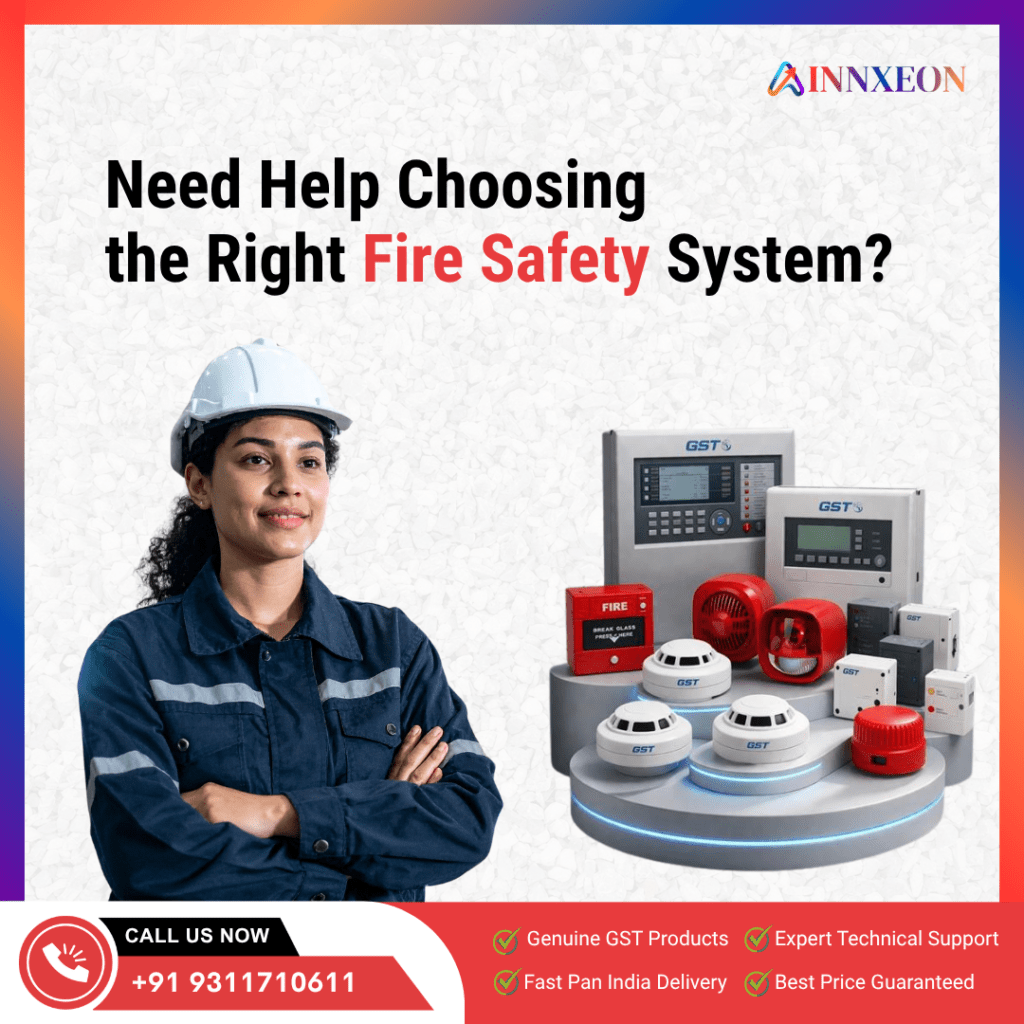
This is precisely why facility managers, MEP consultants, and fire safety engineers are increasingly specifying GST fire alarm systems for industrial projects. GST (Gulf Security Technology) has built a reputation for delivering reliable, addressable, and scalable fire detection solutions that meet the demands of modern industrial environments without unnecessary complexity or cost inflation.
This guide examines what makes GST systems different, why industries are switching, and what decision-makers need to understand before selecting a fire alarm platform for their next project.
What Is a GST Fire Alarm System?
GST fire alarm systems are intelligent, addressable fire detection and alarm solutions designed for commercial, industrial, and critical infrastructure environments. Manufactured and engineered with a focus on reliability and technical depth, GST panels are widely deployed in factories, hospitals, hotels, data centres, airports, and large commercial towers.
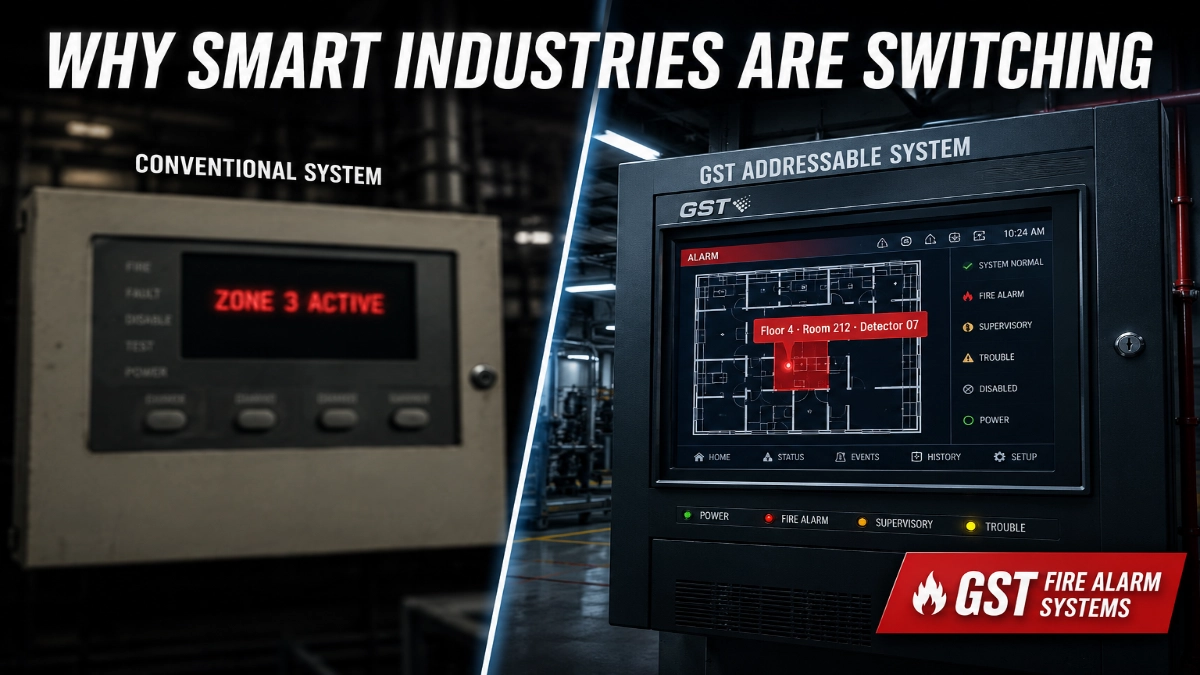
At their core, GST systems operate on an addressable loop architecture. Unlike conventional fire alarm systems, where detectors are grouped into zones without individual identification, every device on a GST addressable loop has a unique address. This means the fire alarm control panel knows exactly which detector, call point, or module has triggered, not just which zone.
Core Components of a GST Fire Alarm System
- Fire Alarm Control Panel (FACP): The central brain managing all connected devices and loops.
- Addressable smoke detectors: Optical, ionisation, or multi-sensor types with individual addresses.
- Heat detectors: Fixed temperature and rate-of-rise types for industrial environments.
- Manual call points: Break-glass units triggering immediate alerts.
- Sounders and visual alarm devices: For occupant notification and evacuation.
- Input/output modules: For integration with suppression systems, ventilation control, and BMS.
- Repeater panels and network nodes: For multi-building and networked campus deployments.
How GST Fire Alarm Systems Work
Understanding how GST systems operate helps explain why they outperform conventional alternatives in industrial settings.
Each detector and device on the addressable loop communicates with the panel using a polling protocol. The panel continuously interrogates each device, checking its status, measuring environmental parameters, and verifying functional integrity. This polling happens multiple times per minute across all connected devices.
When a detector senses smoke, heat, or flame beyond its configured threshold, it sends a digital signal to the panel. The panel immediately identifies the exact device address, cross-references it with its programmed site map, and generates an alarm with floor, zone, room, and device-level information displayed on the panel LCD and transmitted to any connected monitoring systems.
Advanced GST panels also apply drift compensation algorithms, adjusting detector sensitivity over time to account for environmental dust and ageing, maintaining detection accuracy without generating false alarms. This is a critical capability for industrial environments where ambient conditions fluctuate significantly.
Addressable vs. Conventional Fire Alarm Systems
One of the most common questions fire safety consultants face is whether to specify an addressable fire alarm panel or a conventional fire alarm panel. The answer depends on project scale, safety requirements, and long-term operational plans, but for industrial facilities, addressable systems consistently deliver superior value.
| Feature | Addressable (GST) | Conventional |
| Device Identification | Exact device-level location displayed | Zone only — no individual device ID |
| False Alarm Management | Drift compensation + multi-criteria logic | Higher false alarm rate |
| Fault Monitoring | Real-time, device-specific faults reported | Zone-level fault only |
| Scalability | Hundreds to thousands of devices per panel | Limited zone capacity |
| BMS Integration | Native integration via protocols | Limited or not supported |
| Maintenance Efficiency | Precise fault pinpointing reduces visit time | Manual zone-by-zone testing required |
| Regulatory Compliance | Meets EN 54 Category L1/L2 requirements | Limited to basic compliance |
| Installation Flexibility | Loop wiring — flexible topology options | Star or radial only |
| Remote Monitoring | Supported natively | Requires add-on hardware |
| Cost Over Time | Lower lifecycle cost | Higher maintenance and operational cost |
Common Challenges Industries Face with Outdated Fire Alarm Systems
Before switching to GST or any intelligent fire detection platform, many facilities are operating legacy conventional systems that create recurring operational problems. Understanding these challenges helps justify the upgrade decision.
1. Inability to Pinpoint Fire Location Quickly
Conventional fire alarm panels display a zone alarm, for example, ‘Zone 3 Active.’ In a large warehouse or multi-floor factory, Zone 3 might cover hundreds of square meters. Emergency responders waste critical minutes searching for the actual source. In fire scenarios, every second matters.
2. High False Alarm Rates
Industrial environments generate dust, steam, exhaust fumes, and temperature fluctuations that trigger conventional detectors unnecessarily. Repeated false alarms lead to alarm fatigue, where personnel begin to ignore or delay response to fire signals. This is one of the most dangerous behavioural outcomes in industrial fire safety.
3. Limited System Visibility
Facility managers operating conventional systems often have no real-time visibility into system health. A detector with a failing sensor or a corroded connection may go undetected until a fire event reveals its failure. This creates hidden operational risk.
4. Poor Integration with Other Building Systems
Older fire alarm panels were not designed to communicate with modern BMS platforms, access control systems, or SCADA infrastructure. As industrial buildings become smarter, isolated fire alarm systems become operational liabilities.
5. Difficult and Expensive Maintenance
Maintaining conventional systems across large facilities requires routine manual testing of every zone, a time-consuming and labour-intensive process. Without precise fault reporting, maintenance teams cannot prioritise or efficiently resolve issues.
6. Compliance Gaps
As fire safety codes are revised, older conventional systems may no longer satisfy current civil defence or regulatory requirements. Upgrading piecemeal is often more expensive than replacing the system with a compliant intelligent platform.
Why Industries Are Switching to GST Fire Alarm Systems
The shift from conventional to GST addressable fire alarm systems is driven by a convergence of operational, regulatory, and economic factors. Here is a detailed look at the primary reasons behind this industrial transition.
1. Faster and More Precise Fire Detection
GST addressable detectors respond to fire signatures with greater precision than conventional devices. Because each detector is individually polled and its environmental readings continuously monitored, the system can identify an escalating fire condition before it reaches alarm threshold, enabling pre-alarm notifications that give facility teams an additional response window.
In a fire event, the GST panel displays the exact device name, floor, room and zone, eliminating search time and enabling emergency responders to reach the right location within seconds.
2. Intelligent Addressable Technology Reduces False Alarms
GST systems apply multi-criteria detection logic. Advanced multi-sensor detectors measure both smoke density and heat rise simultaneously, requiring both parameters to exceed thresholds before triggering an alarm. Combined with drift compensation and configurable alarm verification intervals, this dramatically reduces nuisance alarms in dusty, steamy, or high-humidity industrial environments.
3. Centralised Monitoring for Large Facilities
GST network fire alarm panels allow multiple panels to be connected across a facility or across multiple buildings, all monitored from a single centralised repeater or master panel. For large manufacturing campuses, hospital complexes, or hotel chains, this means one control room operator can monitor the fire status of every building simultaneously.
Alarm, fault, and event logs are centralised, providing complete audit trails for compliance documentation and post-incident analysis.
4. Scalability to Match Facility Growth
Industrial facilities expand. New production lines are added, warehouses are extended, and campuses grow. GST systems are designed with this reality in mind. Adding new devices to an existing addressable loop is straightforward; no rewiring of the entire system is required. Additional panels can be networked to the existing installation, preserving the original investment.
5. Seamless Integration with BMS and Safety Infrastructure
GST fire alarm control panels support integration with Building Management Systems (BMS) via standard protocols, including BACnet, Modbus, and dry contact interfaces. This enables automatic cross-system responses when a fire alarm triggers, for example, HVAC shutdown, access door release, elevator recall, and PA announcement, all initiated automatically without manual intervention.
Integration with public address (PA) systems allows pre-recorded or live voice evacuation instructions to be broadcast to specific zones rather than the entire building, reducing panic and enabling organised evacuation.
6. Real-Time Fault Monitoring and Predictive Maintenance
Every device on a GST loop continuously reports its operational status to the panel. Faults such as open circuits, short circuits, dirty detectors, or low battery conditions are immediately flagged with the specific device address. Facility maintenance teams receive precise fault information, reducing troubleshooting time from hours to minutes.
This real-time visibility also supports predictive maintenance strategies, identifying devices that are trending toward failure before they actually fail, preventing undetected coverage gaps.
7. Compliance with Fire Safety Regulations
GST fire alarm systems are designed and certified to meet major international fire safety standards, including EN 54 (European), NFPA 72 (North American), UL (Underwriters Laboratories), and regional civil defence requirements across the Gulf, South Asia, and Southeast Asia. This broad certification portfolio simplifies the compliance process for project consultants and contractors.
For facilities operating under ISO 45001 (occupational health and safety) or pursuing LEED certification, GST systems provide the documentation and compliance records needed for third-party audits.
8. Superior Reliability in Demanding Industrial Environments
Industrial environments subject fire alarm systems to mechanical vibration, electromagnetic interference, temperature extremes, and chemical exposure. GST detectors and field devices are designed with robust enclosures and electronic protection to maintain reliable performance in these conditions.
Loop isolation modules, a standard feature in GST system design, ensure that a short circuit on one segment of the loop does not disable the entire system. The loop automatically isolates the fault segment, keeping all remaining devices fully operational.
9. Networking Capability for Multi-Site Deployments
For organisations managing fire safety across multiple facilities, whether a manufacturing group with three plants or a hotel chain with properties in multiple cities, GST network panels enable centralised monitoring and reporting from a single remote command centre. This reduces the need for dedicated on-site fire safety personnel at each location and enables faster coordination with emergency services.
10. Long-Term Cost Efficiency
While GST addressable systems carry a higher initial investment than basic conventional systems, the total cost of ownership over a five to ten-year period is consistently lower. Faster fault resolution, reduced false alarm costs (including emergency service call-outs and operational disruption), lower maintenance labour requirements, and longer system lifespan all contribute to favourable lifecycle economics.
GST Fire Alarm Systems in Action: Industrial Use Cases
Manufacturing Plants
In manufacturing environments, fire risks come from electrical equipment, flammable raw materials, and high-temperature processes. GST multi-sensor detectors distinguish genuine fire signatures from welding sparks and dust, while integration with suppression systems enables automatic response in high-risk production areas.
Warehouses and Logistics Centres
High-rack storage facilities present severe fire spread risks. GST beam detectors and aspirating smoke detection (ASD) systems monitor large open spaces effectively, while centralised panel networking provides full coverage visibility across multiple warehouse units from a single control point.
Commercial High-Rise Towers
Multi-story commercial buildings require detector coverage across hundreds of offices, common areas, and technical rooms. GST addressable systems provide floor-by-floor alarm identification and integrate with the building’s life safety systems, elevators, pressurisation fans, and PA for coordinated evacuation.
Hospitals and Healthcare Facilities
Hospitals require both reliable detection and minimised false alarms to avoid disrupting patient care. GST systems with pre-alarm notifications allow clinical staff to investigate alerts before full evacuation is initiated, while zone-specific alarm management protects vulnerable patients in critical care areas.
Hotels and Hospitality Venues
Guest safety and brand reputation are inseparable in the hospitality sector. GST systems provide room-level alarm identification, integration with property management systems, and automatic notification to front-desk and security personnel, enabling rapid and organised guest evacuation.
Data Centres
Data centres demand the highest sensitivity detection with the lowest false alarm rates. GST aspirating smoke detection systems sample air continuously from within server racks, detecting combustion particles at concentrations far below visible smoke levels, enabling intervention before any hardware damage occurs.
Educational Campuses
University campuses and school complexes spanning multiple buildings benefit from GST network panel architecture, allowing security staff to monitor all buildings from a central security desk. Individual building panels maintain local autonomy while feeding status to the campus-level monitoring system.
Infrastructure Projects
Tunnels, substations, and transportation hubs represent specialised fire safety challenges. GST systems offer specialised detection options, linear heat detection cables for tunnels and cable trays, flame detectors for open electrical switchgear rooms, combined with centralised monitoring for infrastructure operations centres.
How GST Fire Alarm Systems Improve Emergency Response
Emergency response effectiveness is directly tied to the quality of information available to responders in the first minutes of a fire event. GST systems enhance emergency response across several dimensions.
Immediate Location Intelligence
The GST panel provides first responders with the exact location of the triggered device within seconds of alarm activation. This eliminates guesswork and allows security personnel, fire wardens, and arriving fire brigades to deploy directly to the right location.
Automated Cross-System Actions
Pre-programmed cause-and-effect logic in GST panels triggers automatic protective actions at alarm time, shutting down HVAC to prevent smoke spread, releasing fire doors, activating suppression systems in designated zones, and recalling elevators to the ground floor. These actions happen in milliseconds, well before human operators can manually initiate them.
Evacuation Support
Integration with PA systems enables automated zone-specific voice evacuation instructions. Occupants in the fire-affected zone receive immediate evacuation announcements while occupants in unaffected areas receive shelter-in-place or standby instructions, reducing congestion at evacuation routes and improving overall evacuation safety.
First Responder Coordination
GST systems can be configured to automatically transmit alarm signals and location data to monitoring stations or directly to fire brigade dispatch systems via IP network or dedicated communication lines. This reduces the time between alarm activation and emergency service dispatch.
Post-Incident Documentation
GST panels maintain detailed event logs with timestamps for every alarm, fault, and system action. This documentation is essential for post-incident investigation, insurance claims, regulatory reporting, and implementing corrective measures to prevent recurrence.
The Future of Industrial Fire Safety: Smart Detection and AI Integration
The evolution of fire safety technology is accelerating. GST and the broader fire alarm industry are incorporating advanced capabilities that will define the next generation of industrial fire protection.
AI-Assisted Fire Monitoring
Artificial intelligence algorithms are being integrated into fire detection platforms to analyse environmental data patterns and distinguish genuine fire signatures from false alarm sources with greater accuracy than rule-based systems. AI-assisted monitoring can also identify abnormal equipment behaviour patterns that precede fire events, enabling intervention before any fire initiates.
IoT Integration and Connected Sensors
Industrial IoT (IIoT) connectivity is enabling fire alarm systems to share data with broader operational platforms. Temperature trends from process sensors, power consumption anomalies from electrical monitoring systems, and environmental data from HVAC networks can all contribute to a holistic fire risk picture that goes beyond traditional smoke and heat detection.
Remote Diagnostics and Cloud Monitoring
Cloud-connected fire alarm management platforms allow fire safety engineers to remotely access panel status, review event logs, push firmware updates, and perform diagnostic checks without physically visiting a site. For organisations managing multiple facilities, this capability significantly reduces maintenance costs and improves system uptime.
Intelligent Building Safety Ecosystems
The convergence of fire safety, security, building management, and energy systems into unified intelligent building platforms is accelerating. GST systems with their open integration protocols and robust networking capabilities are well-positioned to serve as the fire safety layer within these broader intelligent building ecosystems.
Facilities that invest in GST addressable systems today are building on a foundation that can accommodate these emerging capabilities as they mature, protecting their technology investment well into the next decade.
Practical Recommendations for GST System Selection
For consultants and facility managers evaluating GST fire alarm systems, the following framework helps ensure the right system configuration is specified for each project.
- Define the facility risk profile: Identify high-hazard zones, occupancy loads, and operational processes that influence detection technology selection.
- Determine scalability requirements: Plan for current needs plus projected expansion over five to ten years to select the right panel capacity.
- Map integration requirements: Identify which BMS, PA, suppression, access control, and SCADA systems the fire alarm must communicate with.
- Select the appropriate detector types: Match optical, heat, multi-sensor, beam, or aspirating detection technologies to the environmental conditions in each space.
- Plan the network architecture: For multi-building sites, design the panel network topology before specifying individual panel models.
- Verify compliance requirements: Confirm which fire codes and civil defence standards apply to the project and verify that the selected GST model carries the relevant certifications.
- Evaluate service and support: Ensure certified installation and maintenance expertise is available in the project region.
Building Industrial Safety on a Foundation That Performs
Industrial fire safety is not a compliance checkbox. It is an operational commitment that protects people, assets, production continuity, and organisational reputation. The decision to switch from a conventional fire alarm system to a GST addressable fire alarm system reflects a practical recognition that modern industrial environments require more than basic detection.
GST fire alarm systems deliver faster detection, precise location identification, reduced false alarms, real-time fault monitoring, and seamless integration with the operational infrastructure that drives modern industrial facilities. They are designed to grow with a facility, to meet evolving compliance requirements, and to serve as the foundational safety layer in increasingly intelligent building ecosystems.
For fire safety consultants, MEP engineers, facility managers, and industrial project managers evaluating their next system specification, GST represents a well-proven, technically substantive choice, one that delivers operational value that extends well beyond the commissioning date.
The shift to intelligent fire detection is not a trend. It is the new standard for industrial safety infrastructure. Organisations that make this transition thoughtfully, with the right system partner, position themselves for safer operations, stronger compliance records, and lower long-term costs.
Read Also: How Large Facilities Approach Fire Alarm System Standardisation?
Read Also: The Biggest Weakness in Many Industrial Fire Safety Strategies