Over a long weekend, a plant relocates a production line to shorten material travel. A taller machine goes in. The conveyor is extended. Pallets are staged along a new aisle, and an extraction hood is added above the process. On Monday, the fire alarm control panel shows the system as normal.
Does that confirm the original detection coverage still fits the building?
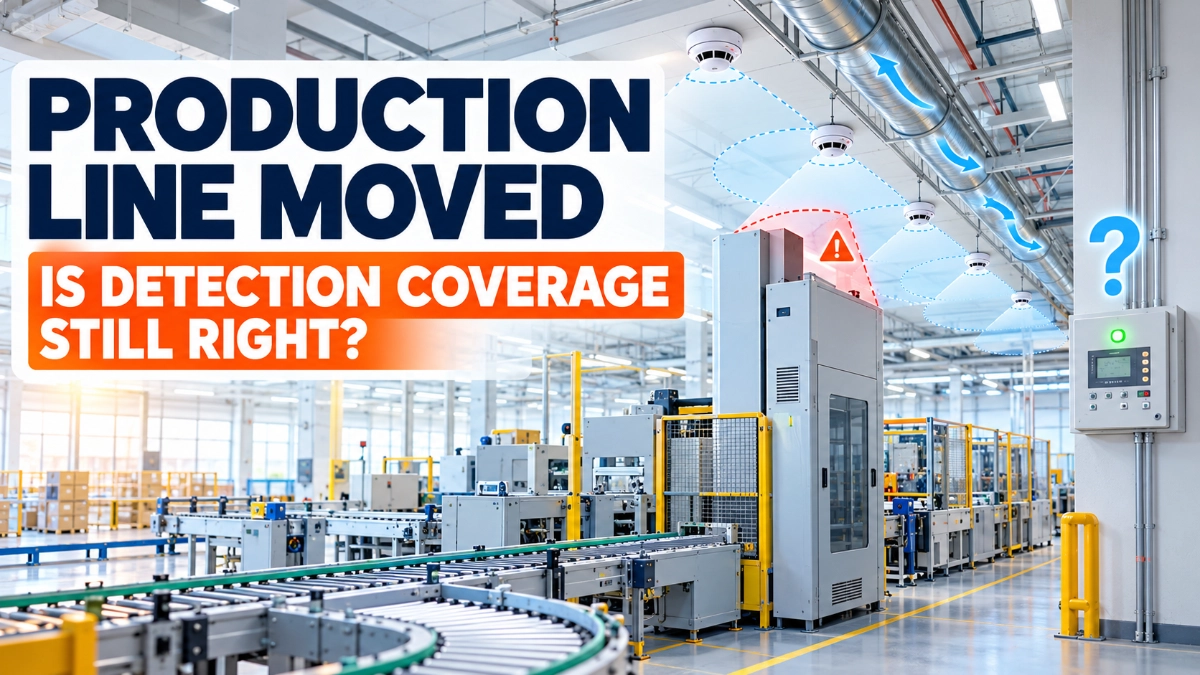
Not by itself. Fire detection arrangements rest on assumptions about ceiling geometry, equipment positions, airflow, expected fire hazards and access. When those conditions change, the design assumptions may no longer describe the facility. The concern is not whether detectors remain physically installed. It is whether their location, exposure, accessibility and relationship to potential fire sources remain appropriate.
This article looks at fire detection coverage after production-line relocation: what can change, how to investigate, and how to respond in proportion to the change. A layout change does not automatically make a system non-compliant. The outcome depends on the extent of the change, the original design basis, detector technology, hazards, applicable standards and actual site conditions.
Why Moving a Production Line Can Change Fire Detection Coverage
Relocating a production line can change obstructions, airflow, fire hazards and device access, all of which influence how well existing detectors respond. The building structure may be unchanged, but the environment the fire alarm system operates in is not.
A relocation can alter:
- Equipment positions, machine enclosures and conveyor routes.
- Ceiling-level obstructions such as ducts, cable trays and suspended services.
- Storage arrangements and material-handling routes.
- Local airflow, heat release and smoke movement patterns.
- Combustible material quantities.
- Maintenance access.
- The location and nature of potential ignition sources.
It helps to separate two kinds of change. One is a physical change affecting detector coverage, such as a new partition between a detector and the area it was meant to serve. The other is a change in the hazard or conditions that influence detection, such as a new process with different fuels, or a new exhaust stream. Both can warrant review, and they call for different questions.
Five Ways a New Production Layout Can Affect Detection
1. New Equipment Can Obstruct Smoke Movement
Can machinery relocation affect smoke detector coverage? It can. Tall machinery, partitions, enclosures, overhead conveyors and cable trays may influence how smoke travels to a detector or how well a detector is exposed to it.
Not every obstruction creates a blind spot. The effect depends on geometry, smoke movement, detector position and the design requirements that apply to the original layout. A machine that is low relative to the ceiling may matter little. A tall enclosure beneath a detector row may matter a great deal. The point is to assess it rather than assume either outcome.
2. Detectors May No Longer Match the New Hazard Location
A relocated machine can bring a different process or ignition source into an area. A zone designed around light assembly may now contain a process using oils, heated surfaces, powders or electrical load.
If the fire hazards, materials or expected fire characteristics have changed, the original detector type and arrangement may need reassessment. Smoke detectors, heat detectors and other technologies respond to different fire signatures and different environments. Suitability depends on the new conditions, not the old ones.
3. New Conveyors and Racking Can Change the Environment
Storage height, conveyor position, suspended equipment and ceiling-level structures all shape how smoke reaches detectors. Higher storage can reduce the clear space below the ceiling. Overhead conveyors can introduce new horizontal barriers. Either may affect smoke transport, detector access and the assumptions behind the original layout. Increased storage height also changes combustible loading, which belongs in the same review.
4. Airflow Can Change Around the Relocated Line
New machinery, exhaust and extraction equipment, ventilation ducts and production enclosures can change local airflow. Airflow influences how smoke is transported and diluted before it reaches a detector.
Airflow does not always delay detection. Depending on the airflow pattern and the fire scenario, it may carry smoke toward a detector, away from one, or dilute it. That is why the evaluation should consider the actual HVAC and extraction arrangement and plausible fire scenarios, rather than a general rule.
5. Maintenance Access Can Become More Difficult
Relocated equipment can block access to detectors, cables, junction points and manual call points. Accessibility matters for inspection, testing, cleaning, troubleshooting and safe maintenance. A detector that technicians cannot reach safely is harder to test and keep serviced, which affects the long-term reliability of the installation.
Summary Table
| Production Layout Change | Potential Detection Concern | Engineering Review |
|---|---|---|
| Taller machinery | Altered smoke movement or obstruction | Review geometry and detector exposure |
| New conveyor | Changed ceiling-level configuration | Reassess relevant coverage assumptions |
| Relocated production process | Different fire hazards or environmental conditions | Review detector suitability |
| New exhaust equipment | Changed local airflow | Evaluate smoke transport |
| Increased storage height | Changed smoke movement and combustible loading | Review storage arrangement and detection design |
| Restricted equipment access | Difficult inspection or maintenance | Review safe access and maintainability |
Each concern is a possibility to assess, not an inevitable outcome.
A Normal Fire Alarm Panel Does Not Prove Coverage Is Adequate
Can a fire alarm panel show normal status while a layout review is still needed? Yes. A normal status reports the condition of the monitored system. It does not evaluate whether detectors are positioned appropriately for the current layout.
Several distinct questions are easy to merge:
- Normal panel status: The control panel is not reporting an alarm, fault or other abnormal conditions.
- Device communication and circuit integrity: Devices respond, and wiring is monitored.
- Detector functional condition: A detector can sense and signal as designed.
- Physical detection coverage: Detectors are located so they can respond to fires in the protected area.
- Suitability for the current environment: The detector type fits the present hazards and conditions.
- Compliance with applicable design requirements: The arrangement meets the codes and design basis that apply.
A normal panel can indicate that monitored circuits and devices are healthy. That is valuable. But it cannot establish that a new partition has not changed smoke access, or that a new process suits the installed detector type. Those are engineering judgments about the physical building, which the panel does not make.
Addressable and Conventional Systems After a Layout Change
Do addressable fire alarm systems automatically solve coverage problems? No. Addressable architecture can improve device identification, but it does not by itself make detector placement correct for a new layout.
| Consideration | Addressable | Conventional |
|---|---|---|
| Device identification | Individual device identification, depending on configuration | Alarm typically identified at circuit or zone level |
| Troubleshooting | Device-level status where supported can narrow fault location | Fault finding may require checking devices along a zone |
| Moving devices | Programming, labelling and records need updating | Zone allocation and circuit loading need review |
| Expansion | Subject to loop and panel capacity | Subject to zone and panel capacity |
| Documentation | Device schedules and address maps need updating | Zone charts and drawings need updating |
| Verification | Required after modification | Required after modification |
An addressable fire alarm panel works with addressable detectors, which report individual identity. This can help technicians see which device is affected after a change and, where supported, view device-level status. A conventional fire alarm panel works with conventional detectors on zone circuits, where an alarm indicates the zone rather than the specific device. Zone boundaries then matter, especially if a relocation splits a former single area into separate production zones.
Either architecture can need reassessment. Better identification does not change smoke paths, hazards or obstructions. Manufacturers such as GST (Gulf Security Technology) supply both approaches; design and device limits should be confirmed in the manufacturer’s documentation for the specific system.
What Engineers Should Review Before Approving the New Layout
What should engineers check before moving production equipment? Compare the revised layout against the original detection design, then assess obstructions, hazards, airflow, detector suitability, access and system capacity. The review should be proportionate to the change and follow applicable codes, manufacturer requirements and site procedures.
- Compare the original detector layout with the revised production layout.
- Identify new obstructions and changes in ceiling-level geometry.
- Reassess the hazards associated with relocated equipment and processes.
- Review ventilation, exhaust and local airflow changes.
- Check whether detectors remain appropriate for the environment.
- Evaluate whether the layout affects coverage or spacing assumptions.
- Review manual call points, notification appliances and access routes where relevant.
- Check circuit loading, wiring, addressing, zoning and system capacity if devices or circuits change.
- Update drawings, device schedules and related documentation.
- Complete the required inspection, testing, verification and approval before returning modified areas to normal operation.
This list is a framework. It does not give universal spacing values, and it does not replace a formal engineering assessment.
Practical Example: A Conveyor Line Moves Under Existing Detectors
This is an illustrative scenario, not a real case study. A plant relocates a conveyor and installs taller machinery beneath an existing row of smoke detectors. No measurements or outcomes are implied.
An engineer would ask:
- Has the new machinery introduced obstructions between detectors and the protected area?
- Could the configuration alter smoke movement?
- Has the process or fire hazard changed?
- Are the detectors still appropriate for the environment?
- Can technicians safely access the devices?
- Does the revised layout affect the original coverage assessment?
- Do system modifications and documentation updates become necessary?
The answers could range from “no change needed, record the review” to “relocate or add devices, change detector type, or revise zoning.” The correct response depends on the actual site assessment.
Engineering Checklist for Production-Line Relocation
- Obtain the revised production layout.
- Compare the revised layout with existing fire alarm drawings.
- Identify new machinery, enclosures, partitions and overhead obstructions.
- Review changes in materials, processes and ignition hazards.
- Assess changes to ventilation and smoke movement.
- Confirm detector suitability and coverage.
- Review device access and maintenance requirements.
- Evaluate any wiring, circuit, zoning or panel-capacity changes.
- Update drawings and equipment records.
- Complete required testing and verification.
- Document outstanding issues and required approvals.
Completing the checklist does not by itself demonstrate compliance.
When Should a Fire Detection Design Review Be Required?
When should a fire alarm design be reassessed after a factory layout change? Whenever a change could affect the original detection design assumptions. Typical triggers include:
- Relocating major production machinery.
- Installing tall equipment or new enclosures.
- Changing storage heights or rack configurations.
- Introducing new combustible materials or changing processes.
- Modifying extraction or HVAC systems.
- Creating new partitions or production zones.
- Extending conveyors.
- Moving fire alarm devices or modifying detection circuits.
Three activities are distinct: reviewing a proposed layout, assessing the installed arrangement, and formally approving changes. Approval typically involves the responsible fire protection engineer, a competent person, the authority having jurisdiction where applicable, and the site change-management procedure. Teams sourcing GST equipment in India can work through a GST fire alarm system distributor in India such as Innxeon Technologies Pvt Ltd, a PAN-India distributor; design review remains with the project’s qualified engineers.
Conclusion: Every Layout Change Deserves the Right Questions
Moving a production line does not automatically make an existing fire alarm system ineffective. It can, however, change the assumptions on which fire detection coverage was based. Physical coverage, environmental suitability, hazards, device access and system configuration should be reassessed whenever the change is significant enough to warrant it.
The practical takeaway: add fire detection review to the layout change-management process before equipment moves, and close it out with testing and updated records after.
Read Also: How Fire Alarm Design Should Adapt to Seasonal Industrial Operations
Read Also: How Dust, Steam and Airflow Can Complicate Fire Detection in Industrial Facilities